
Foundations of a Kingdom:
The House of Wessex
West Saxons and the Forging of England
Additional Information: Anglo-Saxon England
The House of Wessex transformed the fragmented territories of early medieval Britain, elevating a localized southwestern chiefdom into a unified English nation. Spanning centuries of intense warfare, the West Saxon dynasty navigated the complete collapse of the Anglo-Saxon heptarchy under the pressure of Scandinavian invasions, establishing the military, fiscal, and administrative networks required to absorb rival kingdoms into a centralized realm.
From this multi-generational struggle emerged the first true sovereigns of a unified people, creating a continuous dynastic line that laid down the permanent foundations for the development of the English language, common law, and regional shire boundaries before a seismic shock from across the Channel forever altered the lineage of the throne.
Page Contents:
Origins of the House of Wessex: Cerdic and the West Saxons
Additional Information: Anglo-Saxon England / The Rise of the West Saxons
The ancestral foundations of the Wessex dynasty were forged amidst the violent chaos of the sub-Roman migration era, traditionally initiated in 495 AD when the warlord Cerdic and his son Cynric made landfall on the Hampshire coast with five ships. Rather than arriving as the rulers of a unified territory, these early pioneers operated as localized tribal chieftains leading an elite, opportunistic war band of Germanic and Jutish mercenaries.
Intriguingly, the name Cerdic itself is not Germanic, but an Old English rendering of a native Brittonic name such as Ceretic or Caradoc, indicating that the lineage emerged from a fluid process of ethnic assimilation and political intermarriage between incoming Saxon warriors and the native post-Roman British aristocracy. This frontier kinship group—historically recorded as the Cerdicings—gradually expanded their territorial footprint across the southern chalklands, utilizing armed force and strategic alliances to absorb neighboring pockets of resistance before establishing a formal kingship in 519.
The driving force for the expansion of this early state was the Gewisse, a powerful tribal federation and ruling clan whose identity preceded the very concept of the West Saxons. Originating as a post-Roman polity in the upper Thames Valley, the Gewisse formed an elite cultural core around Dorchester-on-Thames, initially acting as federate troops positioned to protect the old Roman agricultural lands from external raids.
Throughout the sixth and seventh centuries, this fluid confederation absorbed the surrounding West Saxon tribal populations, shifting its political and military weight southward from the midlands to project raw power deep into Wiltshire and Hampshire. To cement their fragile authority across this expanding multi-tribal network, the Cerdicing elites actively utilized religious conversion, marked by the pivotal 635 baptism of King Cynegils by Saint Birinus at Dorchester-on-Thames.
By systematically manufacturing elaborate regnal lists that tied their lineage to the mythological ancestor Gewis and the pagan god Woden, these early chieftains successfully transformed a volatile frontier war band into a sacred, legitimate ruling house, establishing the unbroken institutional lineage that held the throne until the accession of King Egbert in 802.
Ecgberht
King of Wessex 802–839
King of Kent, Essex, Sussex 825–839
King of Mercia 829–830,
Bretwalda 829–839
Bio:
The long reign of King Egbert serves as the critical turning point that established West Saxon political dominance, breaking decades of Mercian supremacy across the midlands. Having spent his youth in a thirteen-year forced exile at the Frankish court of Charlemagne due to deep dynastic rivalries with King Offa, he closely scrutinized continental templates of centralized military command, administrative minting, and state organization.
Upon returning to claim the West Saxon throne in 802, he systematically consolidated his local borders before launching an aggressive campaign of expansion that culminated at the landmark Battle of Ellendun in 825.
His decisive tactical victory over Beornwulf of Mercia completely shattered the old midland hegemony, allowing him to immediately dispatch his son Æthelwulf to annex Kent, Surrey, Sussex, and Essex into a single southern bloc. He capitalized on this collapse in 829 by marching his forces north to secure the total submission of the Northumbrian nobility at Dore, briefly occupying the Mercian throne itself before the native king Wiglaf rallied local noble families to reclaim it in 830.
By spending his final years successfully coordinating with the local populations to repel destructive Scandinavian coastal raids at the Battle of Hingston Down, his assertive governance repaired the borders of the kingdom and laid down the secure territorial foundations inherited by his descendants.

Further Information: King Ecgberht
Æthelwulf
King of Wessex 839–858
King of Kent 825–858
Sub-King of Sussex, Surrey, and Essex 839–855
Bio:
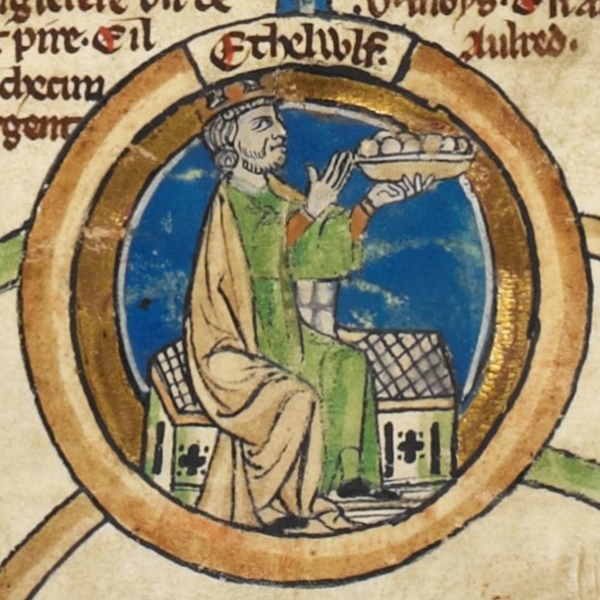
King Æthelwulf navigated the opening, volatile decades of large-scale Viking attacks by executing a deeply religious and sophisticated strategy of defensive consolidation. Inheriting a vast but loosely bound southern hegemony from his father, he successfully maintained dynastic control over Kent, Surrey, Sussex, and Essex by integrating local noble families and coordinating defensive fleets along the coastlines.
His primary military triumph occurred at the Battle of Aclea in 851, where his disciplined West Saxon infantry lines met and slaughtered a massive Viking force that had previously stormed London and Canterbury, achieving the greatest slaughter of a heathen army recorded by contemporary chroniclers.
Deeply pious and focused on securing divine intervention for his realm, he implemented the Decimation, a legal decree that permanently surrendered a tenth of his royal lands to the Christian church to fund the clergy and alleviate the tax burdens of impoverished free
farmers.
His subsequent year-long pilgrimage to Rome in 855 and his strategic dynastic marriage to the young Carolingian princess Judith of Flanders consolidated his international prestige among continental rulers, though this extended absence triggered a domestic coup led by his eldest surviving son, forcing a peaceful partition of the kingdom that preserved the lineage of the crown during a period of immense geopolitical strain.
Further Information: King Æthelwulf
Æthelbald
King of Wessex 855–860
Bio:
King Æthelbald secured his position at the apex of society through an aggressive domestic rebellion, capitalizing on his father’s extended absence in Rome to seize control of the West Saxon heartland. Backed by a powerful faction of western nobles who feared losing political influence to the eastern shires, he forcefully blocked the old king from reclaiming his full patrimony upon his return.
To prevent a catastrophic civil war in the face of imminent Viking invasions, the realm was formally divided, leaving him to rule the wealthy western shires of Wessex proper while his father held the newly absorbed eastern dependencies. Upon his accession to the unified throne, he provoked an immediate political and ecclesiastical crisis by marrying his teenage stepmother, the Carolingian princess Judith, an uncanonical union that deeply alienated the Archbishop of Canterbury but successfully preserved his fragile political alliances with continental Europe.
His brief, turbulent reign left little institutional footprint on the wider landscape, as he focused primarily on stabilizing his internal borders and maintaining control over local noble families until his sudden death cut short his controversial grip on power.

Further Information: King Æthelbald
Æthelberht
King of Wessex 860–865
King of Kent 855–865,
Sub-King of Sussex, Surrey, and Essex 855–865
Bio:
The accession of King Æthelberht marked a critical transition for the southern kingdoms, as he successfully abolished the traditional practice of appointing a separate sub-king to rule over the eastern dependencies of Kent, Surrey, and Sussex.
Recognizing that dynastic fracturing invited more Scandinavian exploitation, he fully merged these separate territories into a single, centralized administration under a unified West Saxon assembly, creating a far more resilient fiscal and military apparatus to confront renewed maritime pressure.
His reign was characterized by a continuous state of alertness, punctuated by a sudden Danish raid that bypassed coastal defenses to sack the royal capital of Winchester before local forces rallied to drive the invaders back into the sea. Further maritime incursions hit the Isle of Thanet, where local nobles were forced to pay silver ransoms before launching an armed counter-attack against the treacherous raiding fleets.
Despite the constant threat of destruction, his administrative consolidation permanently bound the south-eastern shires to the West Saxon crown, establishing the territorial stability required to survive the imminent arrival of the Great Heathen Army.

Further Information: King Æthelberht
Æthelred I
King of Wessex 865–871
Bio:
King Æthelred I governed during the opening, cataclysmic phase of the great Scandinavian invasion, spending his entire reign locked in a desperate, high-attrition war of survival against the Great Heathen Army.
Working in close military cooperation with his younger brother Alfred, he frantically marched his royal forces across the southern shires to confront the rapid movements of the Danish warlords, who had already systematically dismantled the rival kingdoms of Northumbria and East Anglia.
His military campaigns formed a brutal sequence of engagements across the winter of 871, highlighted by a stunning tactical victory at the Battle of Ashdown, where his disciplined shield wall broke the massed charges of the heathen kings. However, this success was rapidly neutralized by heavy losses at Basing and Meretun, which depleted the core manpower of the West Saxon army.
Worn down by continuous combat and suffering from severe wounds or illness contracted in the field, he died at the height of the crisis, passing a heavily fractured and bleeding kingdom to his final surviving brother.

Further Information: King Æthelred I
Alfred
King of Wessex 871–899
King of the Anglo-Saxons 886–899
Bio:
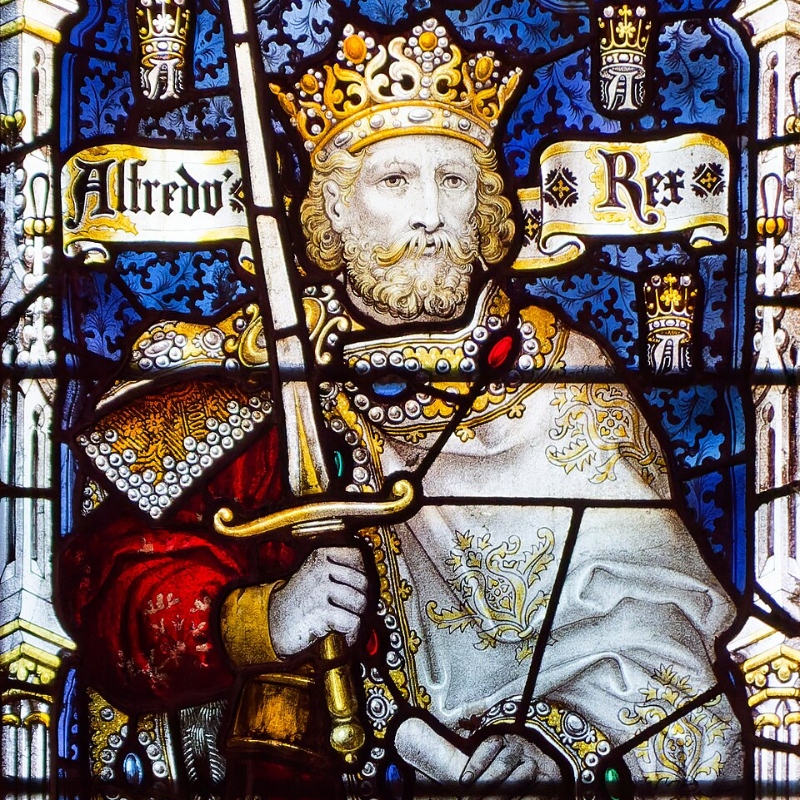
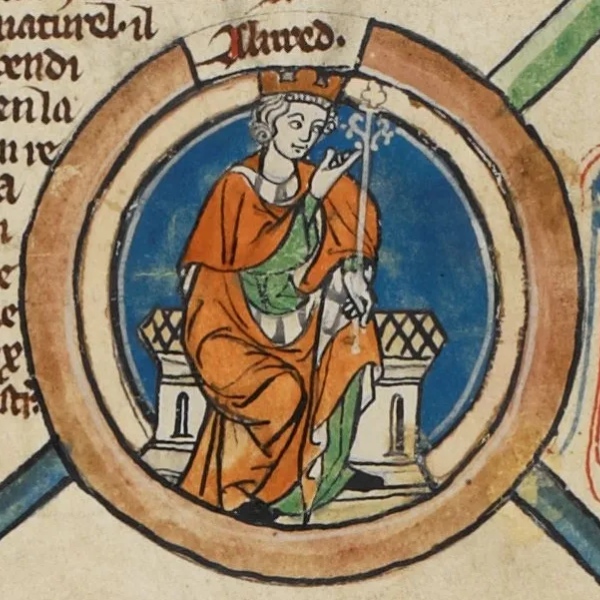
The reign of King Alfred the Great represents the definitive turning point in the forging of the English nation, transforming a broken, occupied kingdom into the defensive superpower of the island. Forced into exile inside the Somerset marshes by a sudden Danish winter coup, he organized a resilient guerrilla campaign before emerging to completely break the power of the Viking king Guthrum at the Battle of Edington.
To permanently secure his borders, he implemented a sweeping administrative and military revolution, constructing a network of thirty-three fortified garrison towns known as burhs and commissioning a fleet of longships to counter maritime raids. He paired this defensive consolidation with a massive, state-directed revival of vernacular education, personally translating Latin texts into Old English and codifying the Doom Book to unify the laws of Wessex, Mercia, and Kent under a single constitutional framework.
By establishing a shared Anglo-Saxon identity bound to the defense of Christian civilization, his comprehensive structural reforms laid down the exact institutional blueprint inherited by all subsequent English monarchs.
Further Information: King Alfred the Great
Edward
King of the Anglo-Saxons 899–924
Bio:
King Edward the Elder transformed his father’s defensive architecture into an aggressive weapon of territorial conquest, systematically dismantling Scandinavian rule across the southern and midland shires.
His reign opened with a severe internal succession crisis, which he firmly suppressed by defeating his rebellious cousin Æthelwold at the Battle of the Holme. Working in synchronization with his sister, Æthelflæd, Lady of the Mercians, he launched a continuous, multi-front offensive that pushed the borders of the kingdom steadily northward into the Danelaw. His armies achieved a devastating tactical triumph over the Northumbrian Danes at the Battle of Tettenhall, permanently crippling the military leadership of the northern invaders.
Through the methodical construction of twin fortifications along strategic riverways, he forced the submission of East Anglia and the Five Boroughs of Mercia, annexing these vast territories directly into the West Saxon crown and forcing the princes of Wales and Scotland to recognize his ultimate political supremacy.

Further Information: King Edward the Elder
Æthelstan
King of the Anglo-Saxons 924–927
King of the English 927–939
Bio:
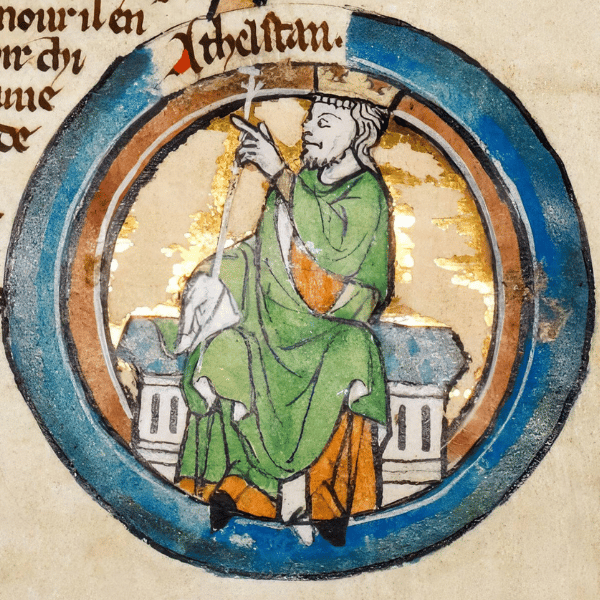
King Æthelstan was the first true sovereign of all England, successfully bridging the regional divides of the island to create a unified kingdom stretching from the English Channel to the Scottish borders.
In 927 AD, he launched a swift military offensive to capture the Viking kingdom of York, subsequently hosting the historic assembly at Eamont where the kings of Scotland, Strathclyde, and Wales formally surrendered their independent sovereignty to his crown.
When a formidable northern coalition of Scots, Strathclyde Britons, and Dublin Vikings launched a massive counter-offensive to break his hegemony, he led a unified English army northward to achieve an overwhelming tactical triumph at the Battle of Brunanburh. This savage engagement permanently secured the borders of the newly integrated state.
He used this total military dominance to centralize the governance of the realm, utilizing a single, highly sophisticated royal chancery to standardize legal charters and enforcing a uniform silver currency across all regional marketplaces to lock the entire economy into a single network.
Further Information: King Æthelstan
Edmund I
King of the English 939–946
Bio:
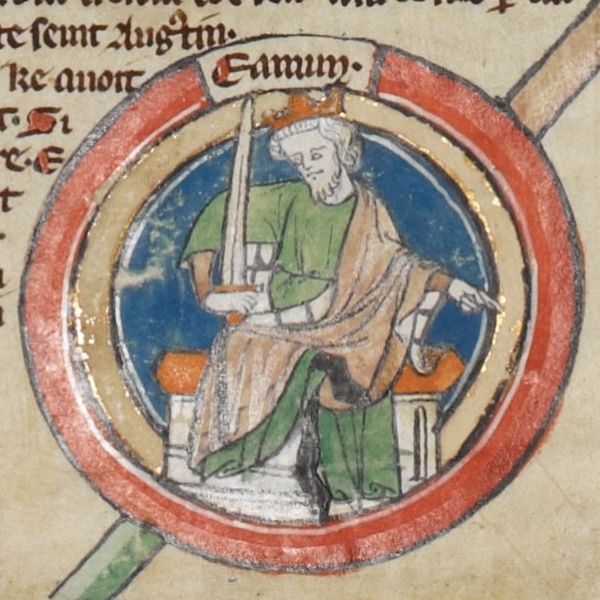
The brief, high-velocity reign of King Edmund I was defined by a constant struggle to defend the fragile unification of England from immediate fragmentation. Upon his accession, a sudden Viking rebellion led by Olaf Guthfrithson forcefully stripped the crown of the Five Boroughs of Mercia and the kingdom of York, threatening to reset the political landscape back to the old divisions of the Danelaw.
Showing immense determination, he launched a successful counter-offensive to completely recapture the East Midlands and permanently expel the Scandinavian rulers from Northumbria by 944. He expanded his strategic footprint into the far north by subduing the Kingdom of Strathclyde, ceding the territory to King Malcolm I of Scotland in exchange for a binding military alliance to block future Viking landing networks.
His successful stabilization of the northern frontiers was cut short when he was stabbed to death during a brawl at a royal estate by a banished outlaw, triggering an immediate succession disruption during a period of ongoing instability.
Further Information: King Edmund I
Eadred
King of the English 946–955
Bio:
King Eadred completed the multi-generational conquest of the north, permanently extinguishing independent Scandinavian rule in England through a combination of scorched-earth military operations and financial coercion.
His reign was dominated by the volatile political landscape of Northumbria, which repeatedly revolted to accept the notorious Norwegian warlord Eric Bloodaxe as its independent king. He responded with an aggressive campaign of suppression, marching his armies deep into the northern territory to burn crops, destroy livestock, and flatten settlements until the regional nobility abandoned the Viking line.
By arresting the treacherous Archbishop Wulfstan of York and locking him in prison, he decapitated the religious and political leadership of the northern separatist movement. His decisive actions permanently absorbed the Kingdom of York into the unified English state, ensuring that the northern shires were governed directly by West Saxon earls, though his final years were clouded by a crippling digestive illness that left him physically incapacitated before his death.

Further Information: King Eadred
Eadwig
King of the English 955–959
Bio:
King Eadwig’s reign was characterized by a catastrophic collapse of internal dynastic cohesion, resulting in a violent political civil war that temporarily split the newly unified kingdom in half.
Ascending the throne as an inexperienced teenager, he immediately alienated the established political and religious elite of the country, famously causing a massive scandal on his coronation night by abandoning his witan to engage in an illicit encounter with a high-ranking noblewoman and her daughter. This erratic behavior provoked an immediate counter-offensive led by Saint Dunstan and the Archbishop of Canterbury, who forcefully intervened to annul his subsequent marriage on the grounds of consanguinity.
Furious at this challenge to his sovereign authority, he banished Dunstan from the realm and confiscated monastic lands, a move that triggered a widespread coup across the midlands and the north. The rebellious Mercian and Northumbrian nobles permanently rejected his rule, declaring his younger brother Edgar as their independent sovereign and forcing a humiliating partition of the country that restricted his authority to the southern shires until his sudden death.

Further Information: King Eadwig
Edgar The Peaceful
King of the English 959–975
Bio:
The reign of King Edgar the Peaceful represents the absolute golden age of Anglo-Saxon monachal authority, characterized by uncompromised internal stability, sweeping institutional reforms, and unmatched imperial prestige.
Reunifying the divided kingdom upon his brother's death, he abandoned aggressive expansion in favor of an intense consolidation of the state, working in close cooperation with Saint Dunstan to implement the Benedictine Reform, which completely revitalized the intellectual and economic power of the English monasteries. His unrivaled hegemony was spectacularly demonstrated during the imperial assembly at Chester, where he was symbolically rowed down the River Dee by eight client kings from Scotland, Wales, and Strathclyde to cement his status as the undisputed Emperor of Britain.
He used this total political dominance to standardize the currency of the country, ordering a complete national recoinage every six years to protect marketplace integrity, while establishing a highly structured coronation ritual at Bath Abbey that provided the precise liturgical template used by all subsequent English sovereigns down to the modern era.

Further Information: King Edgar The Peaceful
Edward
King of the English 975–978
Bio:
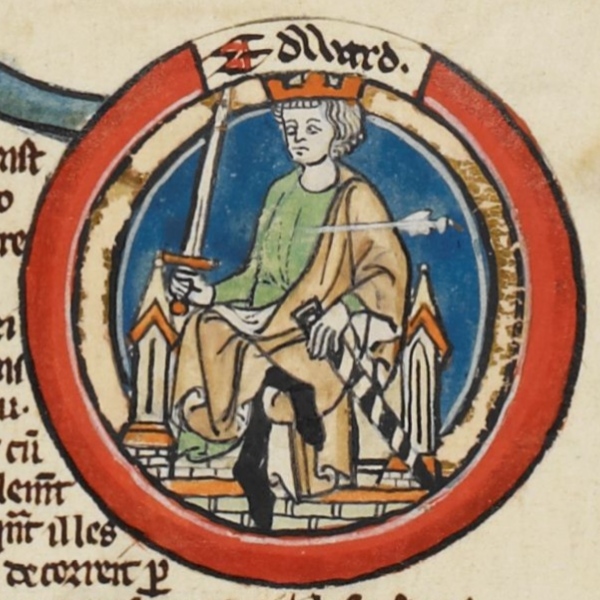
King Edward the Martyr inherited a fractured state, his three-year reign paralyzed by a vicious succession feud and an armed noble revolt against the church. Because his crown was fiercely contested by a court faction backing his infant half-brother, Æthelred, the teenage king never established absolute control over the provinces.
Seizing on the old king's death, provincial ealdormen launched an immediate assault to dismantle the late king's monastic reforms. They forcefully evicted monks from major abbeys and seized the extensive farming estates back for their own families, a domestic upheaval worsened by a severe, widespread crop failure across the shires.
Edward's inability to control the competing magnates left him completely vulnerable to treason. While arriving on horseback to visit his brother at Corfe Castle, he was ambushed by members of Æthelred's household, who stabbed him to death in his saddle, a political assassination that permanently ruined the legitimacy of the next administration.
Further Information: King Edward the Martyr
Æthelred II
King of the English 978–1013 (1st Reign)
King of the English 1014–1016 (2nd Reign)
Bio:
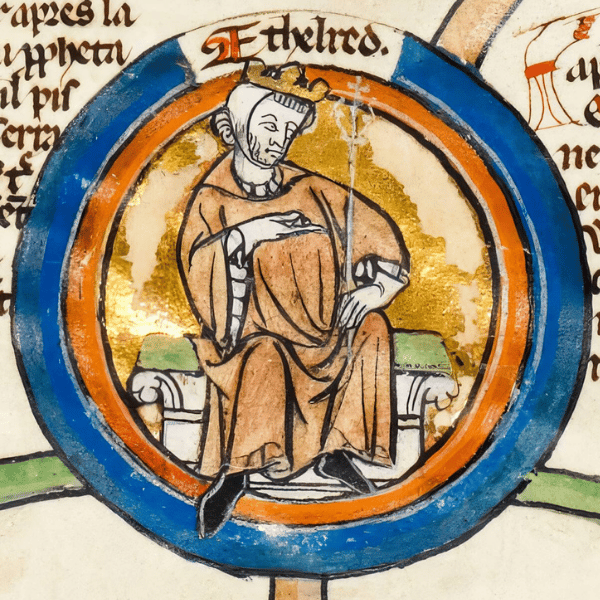
The long, disastrous reign of King Æthelred the Unready witnessed the collapse of the Anglo-Saxon state under the pressure of renewed, industrial-scale Scandinavian invasions.
Lacking the military capability or the cohesive support of his nobility to confront the mobile Danish fleets, his administration abandoned active defense in favor of financial capitulation, passing the first Danegeld by levying massive taxes on the population to purchase temporary truces.
In a desperate attempt to neutralize internal security threats, he authorized the St. Brice's Day Massacre, ordering the systematic execution of all Danish settlers living in England, a brutal blunder that provoked an immediate war of vengeance from King Sweyn Forkbeard.
This relentless conflict completely paralyzed the fiscal and administrative networks of the kingdom, forcing Æthelred into a humiliating exile in Normandy while Danish armies overran the country, permanently shattering the prestige of the ancient Cerdicing line and leaving the state in a condition of absolute exhaustion.
Further Information: King Æthelred II
The Scandinavian Interlude
The continuous line of native West Saxon governance broke decisively during the early eleventh century under a Scandinavian military and political conquest that placed the House of Denmark at the head of English society. Triggered by decades of internal political instability and the ruinous financial drain of the Danegeld payments under Æthelred the Unready, the armies of the North Sea launched a war of expansion that shattered the rule of the Cerdicing lineage.
This period served as a direct connection between the old Anglo-Saxon kingdoms and the incoming Norman era, introducing elite Scandinavian military households like the housecarls and partitioning the country into massive, heavily armed regional earldoms. Rather than dismantling the existing English administration, the Danish conquerors chose to adopt and maintain the efficient taxation systems, silver mints, and written legal codes of the realm, using English wealth to anchor a vast North Sea Empire that temporarily bound the fates of England, Denmark, and Norway under a single crown.
The roots of this conquering lineage—the Knýtlinga dynasty—were forged amidst the violent unification of Denmark during the tenth century. Founded by the chieftain Gorm the Old and expanded by his son Harald Bluetooth, the House of Denmark transformed a fragmented collection of Viking raiding networks into a centralized, Christianized maritime power based at the royal strongholds of Jelling and Roskilde. Seeking to redirect the aggressive energies of their local warrior elites away from internal civil warfare, the Danish monarchs turned their focus outward toward the immense wealth of the English marketplace.
This campaign reached its peak under Sweyn Forkbeard and his younger son, Cnut the Great, who used the elite professional crews of the Thingamen and the wealth of the Baltic trade routes to launch a successful invasion, permanently transforming a regional Scandinavian ruling line into a legitimate European imperial house.
Sweyn
King of Denmark 986–1014
King of Norway 1000–1014
King of the English 1013–1014
Bio:
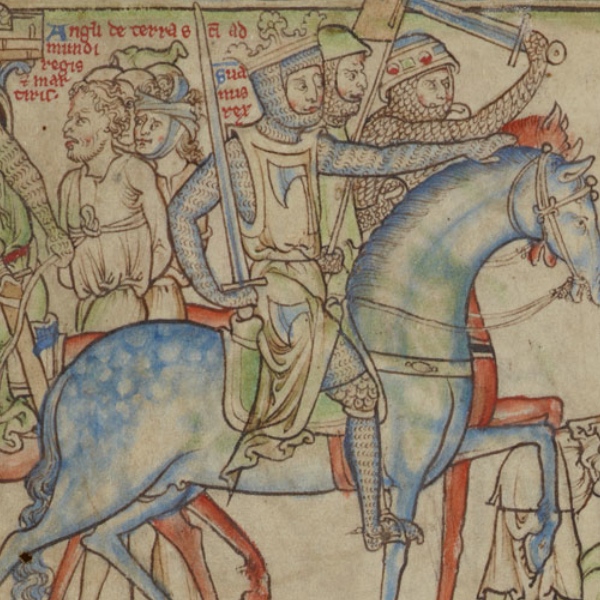
The brief and violent rule of King Sweyn Forkbeard over England was the direct product of a decade-long war of vengeance against the West Saxon crown.
Following the brutal St. Brice's Day Massacre authorized by Æthelred the Unready—which claimed the lives of Sweyn's own sister and numerous Danish settlers—the Danish warrior king launched a sequence of devastating, scorched-earth invasions designed to systematically paralyze the English economy. Utilizing a highly trained fleet of longships, he bypassed coastal defenses to flatten major towns, extract massive silver tributes, and smash local militias until the political cohesion of the country collapsed entirely.
In 1013, he launched his final, overwhelming offensive, marching his professional army through the Danelaw to receive the immediate submission of the northern earls before turning south to lay siege to London.
Faced with total destruction, the citizens of London surrendered, forcing Æthelred to flee into exile in Normandy and leaving the English witan with no choice but to declare Sweyn the undisputed King of England, though his sudden death at his military headquarters in Gainsborough just weeks later cut short his initial attempt to establish a permanent dynasty.
Further Information: King Sweyn Forkbeard
Edmund II
King of the English 1016
Bio:
King Edmund Ironside compressed a lifetime of spectacular, high-velocity military resistance into a frantic seven-month reign, earning his legendary moniker through his unyielding determination to defend the country from total Danish conquest.
Originally launching a domestic rebellion against his father’s incompetent administration, he rapidly seized command of the national forces upon the old king's death, successfully breaking through the enemy lines to twice lift the brutal Siege of London. He marched his shield wall across the southern shires to win tactical engagements at Penselwood and Otford, continually out-maneuvering the formidable armies of Cnut the Great.
However, his heroic defensive campaign was permanently broken at the catastrophic Battle of Assandun, where the treasonous desertion of Ealdorman Eadric Streona completely shattered the English lines.
Exhausted by heavy casualties, he was forced to sign the Treaty of Olney, partitioning the country to leave Cnut in control of all lands north of the Thames before his sudden death, from battle wounds or suspected murder, finalized the Danish conquest of the realm.
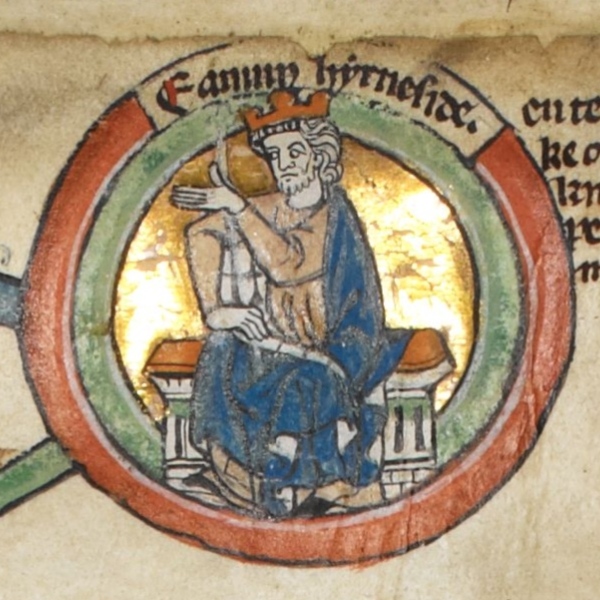
Further Information: King Edmund II Ironside
Cnut
King of England 1016–1035
King of Denmark 1018–1035
King of Norway 1028–1035
Bio:
King Cnut the Great was one of the most successful and powerful statesmen in early medieval European history, successfully fashioning a vast transatlantic maritime dominion known as the North Sea Empire.
Seizing the unified English crown through sheer military dominance following his crushing tactical triumph over Edmund Ironside at the Battle of Assandun in 1016 AD, he executed a ruthless political purge to rapidly secure his position, executing treacherous native nobles like Eadric Streona to prevent future internal coups.
To reconcile his new English subjects, he made the brilliant diplomatic move of marrying King Æthelred’s widow, Emma of Normandy, a calculated alliance that neutralized Norman hostility while validating his legitimacy among the old West Saxon elite.
He ruled England with immense institutional sophistication, completely abandoning raw military plunder to govern strictly through the traditional laws of King Edgar, while relying on the native civil service to enforce a uniform silver coinage and audit the royal taxation networks.
By dividing the country into four massive, stable earldoms—Wessex, Mercia, East Anglia, and Northumbria—and performing a highly publicized pilgrimage to Rome to secure international prestige from the Pope, his extensive reign brought two decades of unprecedented peace and commercial prosperity to the island, firmly locking English trade lines into the wider economic markets of Scandinavia and continental Europe.

Further Information: King Cnut
Harold I
King of England 1035–1040
Bio:
The turbulent and highly controversial reign of King Harold Harefoot was born directly out of a vicious dynastic succession crisis that erupted immediately upon the death of Cnut the Great. Because his legitimate half-brother and rightful heir, Harthacnut, was completely pinned down in Scandinavia defending the Danish borders from a hostile Norwegian invasion, Harold aggressively stepped into the political vacuum to seize the regency of England.
Backed by a powerful northern noble faction led by Earl Leofric of Mercia and his mother’s extensive Mercian family networks, he rapidly expanded his grip on power, bypassing the protests of Archbishop Æthelnoth to seize the royal treasury at Winchester and claim the direct title of king.
His administration was permanently stained by a brutal act of political violence in 1036, when his agents ambushed and captured the returning West Saxon prince Alfred Ætheling, blinding the young prince with such savagery that he died from his wounds, an atrocity that deeply alienated the southern nobility and forced Queen Emma into exile.
Harold spent his final years working frantically to fortify the southern coastlines against an imminent invasion from his brother's fleet, until a sudden illness killed him just weeks before the Danish warships arrived.

Further Information: King Harold I Harefoot
Harthacnut
King of Denmark 1035–1042
King of England 1040–1042
Bio:
King Harthacnut governed England through a short, exceptionally vindictive military dictatorship, his brief rule characterized by extreme fiscal coercion and a total collapse of domestic popularity.
Arriving from Denmark with an elite invasion fleet of sixty warships to claim the throne following his brother’s sudden death, his first official act was a display of unrestrained dynastic vengeance; he ordered the corpse of Harold Harefoot to be exhumed from Westminster Abbey, decapitated, and thrown directly into the River Thames.
To fund the immense operational costs of maintaining his foreign fleet, he immediately levied the Heregeld, a crushing national naval tax that extracted over thirty thousand pounds of silver from the population, a financial extraction so brutal that it triggered a violent anti-tax rebellion in Worcester, which Harthacnut suppressed by ordering his housecarls to burn the entire city to the ground.
Recognizing that his erratic behavior and failing physical health threatened to trigger a total collapse of the Danish regime, he attempted to secure the succession by recalling his exiled West Saxon half-brother, Edward the Confessor, back to the royal court in 1041, a calculated dynastic bridge that enabled a peaceful restoration of the ancient Cerdicing line when Harthacnut suddenly collapsed and died from a stroke while drinking heavily at a wedding feast in Lambeth.

Further Information: King Harthacnut
Saint Edward
King of the English 1042–1066
Bio:
The peaceful reign of King Edward the Confessor marked the final, twilight restoration of the ancient West Saxon dynasty following twenty-six years of Danish rule.
Having spent his youth in exile across the Channel, his governance was heavily influenced by Norman customs, a political preference that deep-seated Anglo-Saxon noble houses, most notably the ultra-wealthy family of Earl Godwin of Wessex, fiercely resisted.
This underlying tension exploded into an open constitutional standoff, resulting in the temporary exile of the Godwin clan before their massive naval strength forced the king into a humiliating political compromise. Despite these internal struggles, he successfully insulated the domestic economy from international shocks, permanently abolishing the hated Danegeld tax to alleviate financial pressure on his subjects, while dedicating his personal energy to the construction of the monumental Romanesque Westminster Abbey.
His lifelong failure to produce a direct male heir created a catastrophic biological vacuum at his death, triggering the immediate usurpation of Harold Godwinson and the subsequent Norman Conquest that permanently ended the native lineage of the throne.

Further Information: King Edward the Confessor
The House of Godwin
The final years of native Anglo-Saxon rule were dominated by the rapid rise of the House of Godwin, an ambitious aristocratic family that broke through traditional royal lineages to seize the crown itself.
The family rose from modest beginnings in Sussex under the outlaw Wulfnoth Cild, but their fortunes were completely transformed by his son, Godwin. By proving his military loyalty to Cnut the Great during the Danish conquest, Godwin secured the massive Earldom of Wessex, using strategic land acquisitions, marriages into Danish royalty, and ruthless political maneuvering to turn his household into the most powerful faction in England.
By the time Edward the Confessor took the throne, the Godwin family controlled far more land, wealth, and armed warriors than the king himself, rendering the royal court virtually helpless against their ambitions and allowing Godwin's eldest son, Harold, to claim the throne the moment the Confessor died.
Harold II
King of the English 1066
Earl of Wessex 1053–1066
Earl of East Anglia 1045–1053
Bio:
King Harold II governed England through a short, exceptionally violent nine-month reign that was completely consumed by an apocalyptic, multi-front war of national survival. Ascending the throne in January 1066 through a rapid coronation orchestrated by the witan immediately following the death of Edward the Confessor, Harold faced immediate challenges to his legitimacy from both domestic rebels and foreign empires.
His military capabilities were pushed to their absolute limits in September, when his treacherous brother Tostig partnered with the legendary Norwegian warrior king Harald Hardrada to launch a massive invasion fleet into Yorkshire.
Executing a stunning forced march of nearly two hundred miles in just five days, Harold caught the Scandinavian army completely by surprise and achieved a total tactical annihilation of the Norwegian forces at the Battle of Stamford Bridge, permanently ending the Viking threat to England. However, this brilliant northern victory was instantly neutralized when news arrived that William of Normandy had landed an elite cavalry army on the Sussex coast.
Forcing his exhausted infantry back south, Harold met the Norman invaders at the Battle of Hastings on 14 October 1066, where his legendary shield wall held for hours before breaking under continuous cavalry charges. Harold's death on the battlefield finalized the total destruction of the native Anglo-Saxon ruling class, leaving the undefended country open to complete Norman conquest.

Further Information: King Harold II

House Of Wessex FAQs