
Evolution of English
Law and Governance
The Foundation of Royal Justice and Constitutional Liberty
The legal structure of the modern British state does not rely on a single, written constitution. Instead, it was built over hundreds of years out of a long collection of court decisions, historic laws, and unwritten government customs. This flexible system grew out of a fierce, continuous struggle over who should run the country, eventually transforming the absolute power of the King into a modern parliamentary democracy run by the rule of law.
From the early local courts of the Anglo-Saxon era, the country systematically built a centralized system that replaced scattered local customs with a uniform, nationwide system of royal justice and trial by jury. By locking landmark historic agreements like Magna Carta, the Bill of Rights 1689, and the Great Reform Acts into the permanent law of the land, this unique setup successfully separated the day-to-day running of the country from the personal whims of the monarch.
Throughout this narrative, we will follow the long journey of this legal heritage, exploring how the early customs of local gatherings grew into a supreme system of laws that permanently placed the power of the throne under the control of Parliament.
Page Contents:

The Doom Book of King Alfred
893 AD
Additional Information: Anglo-Saxon England / The Reforms of Alfred
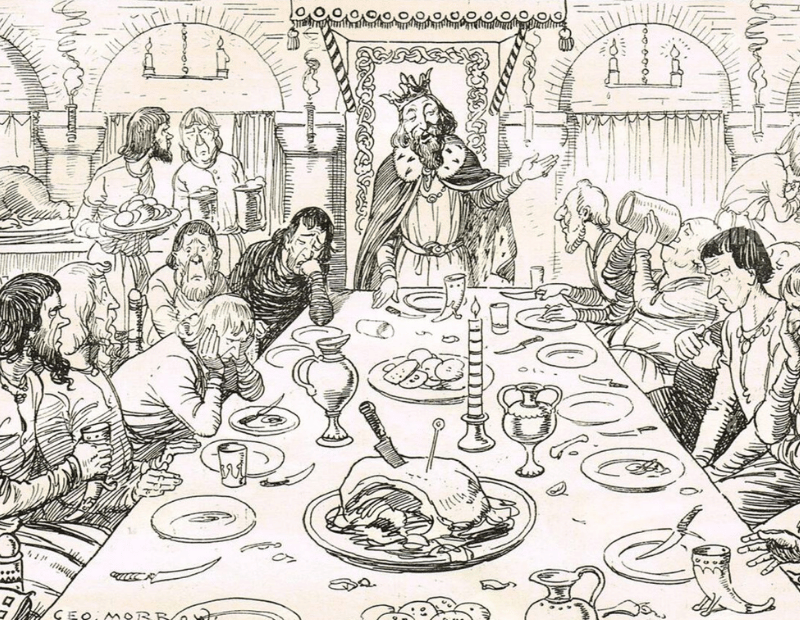
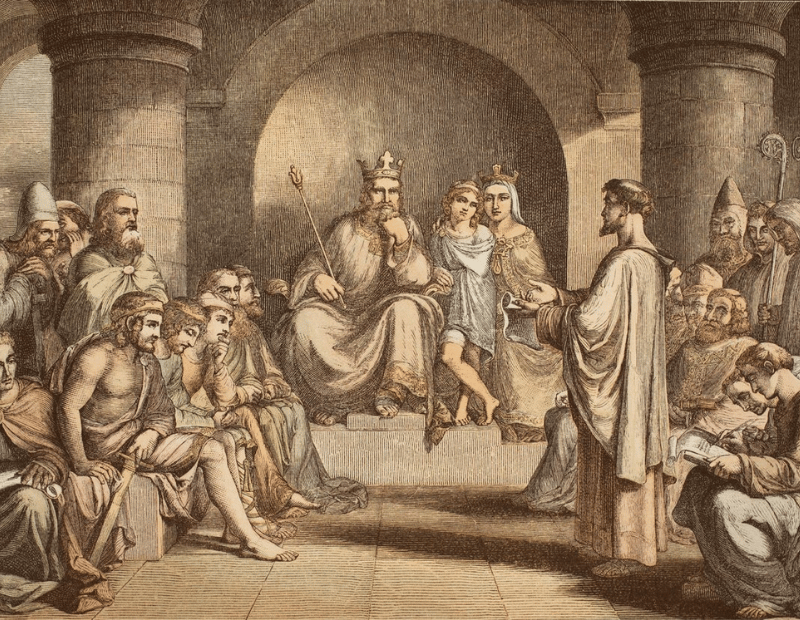
In the late ninth century, around 893, King Alfred the Great issued the Dōmbōc (Doom Book), a monumental legal code that systematically bound the separate Anglo-Saxon kingdoms under a unified common law. Facing total military conquest by Scandinavian Viking armies, Alfred recognized that survival required administrative and spiritual unity. He deployed the code to bind the distinct populations of Wessex, Kent, and Mercia to the direct legislative authority of the West Saxon crown, transforming a loose military alliance into a single legal community.
Instead of dictating new laws by arbitrary royal decree, the king gathered and reviewed the ancient customary codes of his predecessors, selecting specific statutes from the sixth-century laws of King Æthelberht of Kent, the seventh-century laws of King Ine of Wessex, and the eighth-century legislation of King Offa of Mercia. By merging these separate regional customs into a single text, Alfred replaced conflicting tribal rules with a standardized code, creating a shared legal framework decades before the physical political unification of England under his grandson Athelstan.
The Doom Book bound secular royal justice directly to biblical law, establishing the theological baseline for the state. The code opened not with an assertion of royal authority, but with a full Old English translation of the Ten Commandments, the Mosaic civil code from the Book of Exodus, and the Apostolic Decree from the Acts of the Apostles. This positioning framed the West Saxon monarch as a divinely appointed lawgiver who was personally responsible to God for the souls and peace of his subjects.
Alfred reinforced this code by organizing his territories into precise administrative districts, expanding the network of shires and establishing thirty-three fortified communal burhs that acted as regional administrative, legal, and economic hubs. Each shire was overseen by a royal ealdorman and a shire-reeve (sheriff)—crown officials tasked with traveling through the countryside to enforce the decrees of the Dōmbōc, collect crown taxes, and suppress private blood feuds.
By implementing the wergild system, the code replaced multi-generational revenge killings with fixed financial penalties based on a victim's rank, payable directly to the family and the state treasury, which successfully institutionalized the crown's role as the supreme arbiter of justice.
Further Information: The Doom Book of King Alfred
Anglo-Saxon Law: Wergild, Hundreds, and Customary Assembly
924 – 1066 AD
The daily administration of justice across tenth-century England functioned through a network of community courts that prioritized local stability over direct crown intervention. Long before the centralization of royal justice under the Norman kings, the legal landscape was anchored by the hundred and the shire moot. These ancient customary assemblies met at regular intervals under open skies, at prominent hills, or at historic boundary stones to resolve local property disputes, handle thefts, and enforce royal decrees.
The hundred moot, which gathered every four weeks, served as the primary court for the local neighborhood, bringing together prosperous peasant landowners and parish priests to hear testimony under the supervision of an elected hundred-man. Above this sat the shire moot, a grander regional assembly that met twice a year under the direction of the ealdorman and the shire-reeve (sheriff). This served as a vital forum where the regional gentry settled land battles and validated the statutory edicts dispatched from the King's council.
Rather than relying on corporal punishment or state imprisonment, this native Anglo-Saxon legal system suppressed lawlessness through a grid of mandatory financial restitutions known as wergild. Every individual within the kingdom possessed a legally defined monetary value based strictly on their hereditary rank, which dictated the exact cost of their life in the eyes of the law. At the apex of this legal grid stood the Archbishop or Etheling, whose lives were valued at the supreme rate of fifteen thousand thrymsas. Beneath the royal household, a wealthy thegn held an aristocratic valuation of twelve hundred shillings, while a common free peasant, or ceorl, was assigned a standard baseline of two hundred shillings. At the bottom of the free hierarchy, the indigenous Welshman occupied a marginalized tier, valued at one hundred shillings if he owned land and plummeting down to just sixty shillings if he was landless.
When a homicide occurred, the perpetrator was required to pay the victim’s family the exact wergild valuation to prevent the outbreak of a destructive private blood feud. This financial constraint effectively made crime a ruinous luxury for the local nobility. If a man could not pay his fine, he was reduced to a penal slave, losing his freedom to work off the debt. To guarantee that criminals could not simply flee their crimes, the crown enforced the tithing system, a compulsory legal network that required every free man over the age of twelve to belong to a small group of ten neighbors.
This collective unit was held jointly responsible for the behavior of its members. If any single individual committed an offense, the remaining nine were legally compelled to arrest the fugitive or pay the financial fines from their own assets, weaving mutual surveillance and shared responsibility into the fabric of the early state. If an accused criminal fled, the hundred-man blew a horn to raise the "hue and cry." This action forced every able-bodied man in the neighborhood to drop his tools, join the physical pursuit, and track the suspect across county borders under pain of heavy fines, turning the entire local population into an active arm of law enforcement.
Further Information: Anglo-Saxon Law: Wergild, Hundreds, and Customary Assembly


The Norman Conquest and Legal Dualism
1066 – 1154 AD
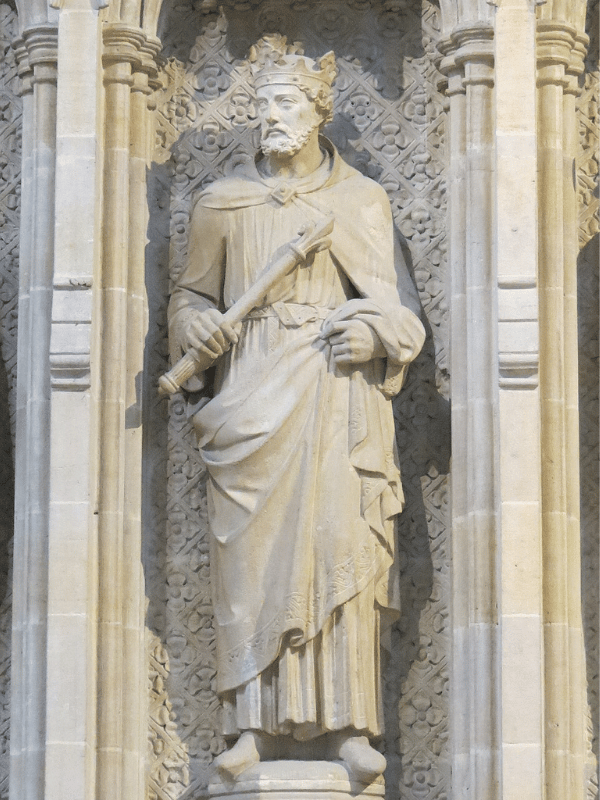
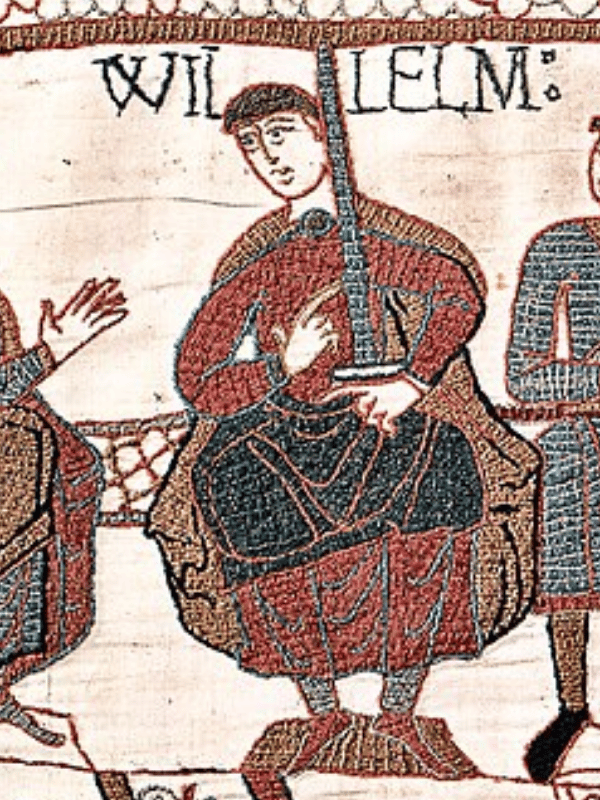
The Norman Conquest of 1066 systematically reshaped the legal landscape of England, creating a parallel system of legal dualism that bound two distinct cultures under a single crown. King William I the Conqueror faced an immediate problem: he needed to reward his continental followers with land while convincing the native population that his rule was legitimate. To achieve this, he chose not to erase the existing legal framework. Instead, he claimed to be the rightful successor to King Edward the Confessor, confirming the validity of traditional Anglo-Saxon customary laws and maintaining the local shire and hundred courts. This deliberate policy meant that for nearly a century, the native English and the incoming Normans operated under entirely separate codes of proof, property laws, and penalties.
The incoming Norman barons were not free to do whatever they wanted; they were strictly bound by a centralized legal framework managed directly by the king’s court (Curia Regis). While a Norman lord exercised total dominance over his local English peasantry, he was legally prohibited from defying royal commands, expanding his fortifications without a license, or waging private wars against other barons. The crown recognized that unchecked baronial lawlessness would break the unity of the kingdom. To secure the minority Norman population from targeted assassinations, the state introduced the Murdrum Fine. Under this law, if a corpse was discovered in a district and could not be proven to be English—a test known as the presentment of Englishry—the entire local hundred was hit with a massive financial fine paid to the royal treasury, forcing the native population to protect their conquerors.
This era completely reordered traditional procedures of judicial proof by introducing a highly dramatic, martial method of trial. While the native English population maintained their ancient reliance on oath-helpers and physical ordeals by hot iron or water, the Normans introduced Trial by Combat into the common law system. This innovation turned legal and land disputes into duels of physical strength, running on the theological premise that God would grant victory to the party telling the truth. To manage the deep cultural differences of the realm, the crown issued guidelines allowing an English defendant to choose between an ordeal or the duel, whereas a Norman defendant could demand trial by combat as a birthright.
Concurrently, the crown enforced highly oppressive, separate legal codes that completely overrode traditional customary rights. The most hated innovation was the establishment of Forest Law, a separate legal system operating outside the standard law to protect royal game across nearly one-third of England's territory. Under Forest Law, standard judicial protections and jury systems vanished; royal foresters held absolute power to punish violations. Commoners were legally prohibited from gathering timber or carrying hunting bows inside designated royal zones, and the penalties for killing a deer or wild boar were brutal, resulting in immediate blinding or hanging.
This total extraction of traditional land rights was backed by the supreme administrative power of the Domesday Inquest of 1086, a monumental nationwide census that logged the exact assets, land assessments, and liabilities of every village down to the last penny, establishing an unappealable record that permanently locked the wealth of the country into the legal records of the state.
Further Information: The Norman Conquest and Legal Dualism


Curia Regis, Royal Writs, and the Creation of Common Law
1154–1189 AD
Additional Information: The Plantagenet Era / The Constitutions of Clarendon
King Henry II transformed English justice in the late twelfth century by establishing permanent royal courts and a uniform system of royal writs, creating a single common law that overrode local baronial customs. Inheriting a realm fractured by decades of lawless aristocratic feuds following the nineteen-year civil war known as the Anarchy, the monarch built upon the foundations of the Curia Regis—the traditional Norman advisory council of barons, counts, and bishops—by creating permanent subcommittees dedicated entirely to the administration of royal justice.
In 1178, Henry II appointed a specialized panel of five royal justices, consisting of two clerics and three laymen, to sit permanently at Westminster to hear civil property disputes, a core judicial group that evolved directly into the Court of Common Pleas. Concurrently, the monarch formalized the Court of King's Bench, a superior tribunal that traveled with the King to handle criminal offenses and direct breaches of the King's peace, ensuring the crown held ultimate appellate authority over all domestic legal matters through an elite group of judicial administrators like Ranulf de Glanvill, the Chief Justiciar, who codified these centralizing routines.
To ensure this royal justice reached every corner of the kingdom, the crown issued the Assize of Clarendon in 1166, ordering these centralized judges to travel across six fixed regional circuits on regular tours known as eyres. By forcing these traveling justices to apply uniform legal principles that systematically overrode differing local customs, the court bound the entire land under a single system of justice common to the country as a whole. This statutory framework was reinforced by the Assize of Northampton in 1176, which expanded the powers of the traveling justices to handle severe criminal offenses like murder, arson, counterfeiting, and theft, while mandating that all local sheriffs swear oaths of loyalty directly to the King's treasury at the Exchequer.
The primary mechanism that drove this legal expansion was the deployment of royal writs, standardized parchment commands issued by the royal chancery that ordered local sheriffs to intervene in property battles. Prior to these reforms, an ordinary landholder facing wrongful eviction by a powerful local baron had no recourse outside the baron's own biased manorial court.
Henry II broke this aristocratic monopoly by introducing possessory assizes, which were standard legal actions initiated by specific royal commands that provided rapid remedy to landowners. The Writ of Novel Disseisin granted immediate relief to any freeholder who had been recently and wrongfully evicted from their land, bypassing complex questions of ancient hereditary title. The Writ of Mort d’Ancestor protected direct lines of inheritance by ensuring that if a tenant died, their lord could not seize the property before the rightful heir took possession. Finally, the Writ of Darrein Presentment resolved violent disputes between local landlords over who held the legal right to appoint a parish priest to a vacant church. For a modest fee paid directly to the royal chancery, any free subject could purchase a writ that bypassed the local baronial courts, instructing the shire sheriff to summon a panel of twelve local knights to testify under oath regarding who held the rightful possession of the land.
Further Information: Curia Regis, Royal Writs, and the Creation of Common Law

Magna Carta and the Subjection of the Crown
1215 AD
Additional Information: The Plantagenet Era / King John and the Magna Carta
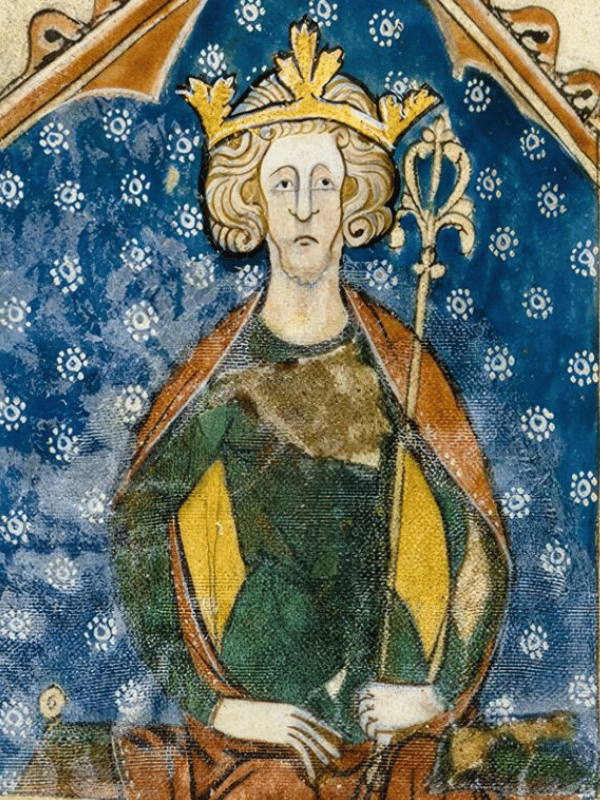
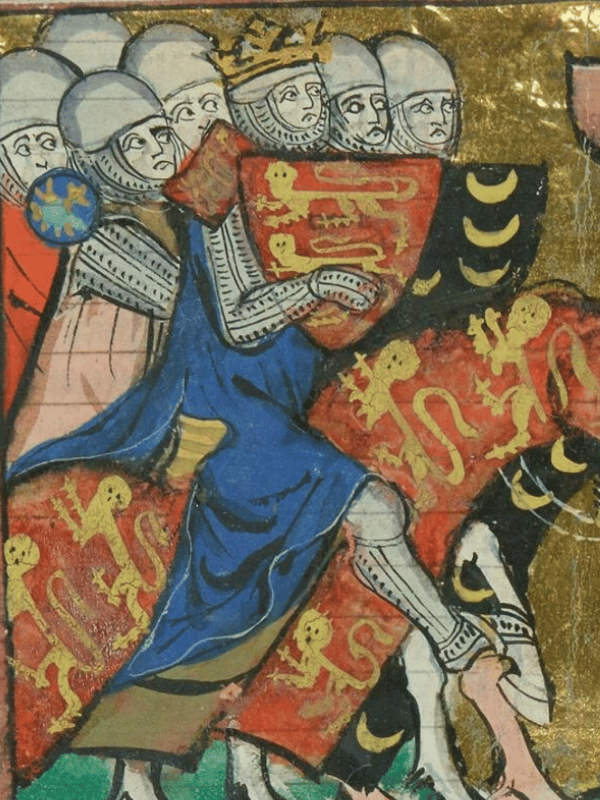
King John accepted Magna Carta on 15 June 1215 at Runnymede, establishing the foundational constitutional principle that the monarch's personal will is subordinate to the law and introducing the right to due process. John had pushed his feudal privileges to a breaking point, using arbitrary fines, forced wardships, and extrajudicial seizures of property to finance a disastrous continental war to reclaim Normandy from the French crown.
When his expensive military campaign collapsed at the Battle of Bouvines in 1214, a rebellious baronial coalition renounced their fealty, marched on London, and forced the cornered sovereign to accept a schedule of sixty-three distinct demands. Known as the Magna Carta, this document was not intended as a universal statement of human rights; it was a practical contract designed to defend the aristocratic landowning elite and high clergy from the arbitrary financial extortions of the crown. Despite these narrow origins, it altered the governance of the realm by locking the monarchy into a framework of written law through an elite group of rebel barons like Robert Fitzwalter, who organized the military occupation of the capital to enforce compliance.
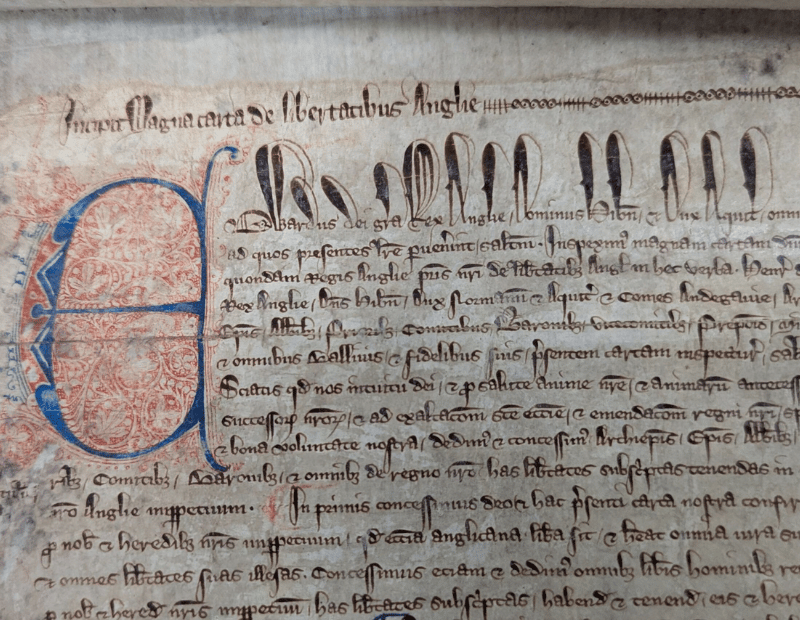
While much of the text focused on medieval property concerns like fish weirs on the River Thames and knightly service quotas, its clauses steadily expanded protection downward to impact ordinary unfree peasants. Clause 20 established a permanent legal boundary for commoners by declaring that a rustic or merchant could not be fined so heavily as to destroy their livelihood or strip them of their essential farming tools. More famously, Clause 39 established that no free man could be imprisoned, dispossessed, outlawed, or destroyed except by the lawful judgment of his equals or by the law of the land. This clause laid the direct groundwork for habeas corpus and due process, ensuring that the king's officers could not lock up or penalize citizens without formal judicial proceedings.
To ensure compliance, Clause 61 established an executive panel of twenty-five barons who held the explicit statutory authority to declare war on the crown, seize the king's castles, and confiscate royal lands if he violated the terms of the charter. Although Pope Innocent III promptly annulled the agreement months later, plunging the country into the First Barons’ War, successive royal administrations under the young Henry III were repeatedly forced to re-issue modified versions of the charter, notably in 1225, to secure national taxation, permanently embedding its clauses into the common law.
Further Information: Magna Carta and the Subjection of the Crown
The Great Consolidation and Statutory Renaissance
1272 – 1307 AD
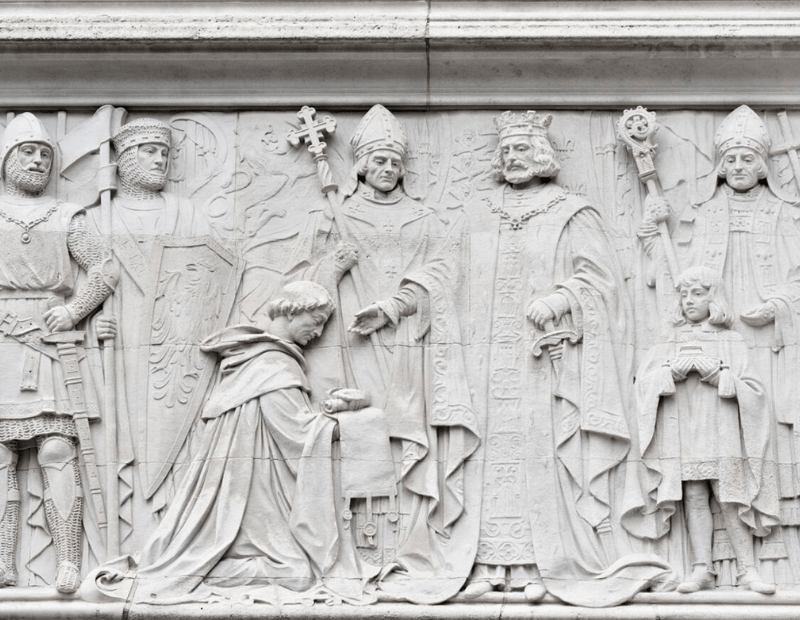
The late thirteenth century served as the primary crucible for written statutory law in England, driven by the aggressive legislative campaigns of King Edward I. Historically branded as the "English Justinian" for his systematic codification of the realm's legal infrastructure, Edward I recognized that the long-term stability of the crown and the resolution of persistent baronial land disputes required a transition away from unwritten customary memory toward permanent parliamentary statutes. Working in close alignment with his royal judges and advisors, the monarch utilized the growing institution of Parliament to pass a sequence of monumental statutory milestones that completely re-engineered English real estate law, property transfers, and commercial liability, laying down the blueprints for modern land tenure.
The supreme legislative achievement of this era occurred in 1290 with the passage of the statute Quia Emptores (Because the Buyers), which fundamentally reordered the mechanisms of property transfer across the shires. Prior to this act, a tenant who wished to dispose of a portion of his land would engage in subinfeudation, creating a new, lower tier in the feudal pyramid by becoming the lord of his buyer.
This practice caused severe financial disruption, as it systematically starved the high nobility and the crown of their traditional feudal revenues, such as wardships, marriages, and escheats. Quia Emptores crushed this loophole by completely banning subinfeudation; henceforth, any freeholder who sold his estate did so by substitution, meaning the new buyer stepped directly into the seller's shoes and held the land from the original lord under the exact same feudal obligations.
This statute effectively capped the complexity of the feudal pyramid and established the modern concept of free alienation, turning real estate into a fluid commodity that could be freely bought and sold without the lord's permission. Concurrently, the crown passed the statute De Donis Conditionalibus (Concerning Conditional Gifts) in 1285, which created the rigid system of entailed estates. This law legally bound an inherited estate to the direct bloodline of the recipient, making it impossible for a reckless heir to sell or forfeit the ancestral family lands, a statutory shield that preserved the wealth and stability of the English aristocracy across generations.
This statutory renaissance was accompanied by a major transition in how the courts recorded and utilized judicial evidence, marked by the emergence of the earliest Year Books. Moving away from brief, unrecorded oral arguments, shorthand legal scribes began entering the courts to systematically record the actual live debates, tactical choices, and judicial rulings that took place before the Westminster judges. Written in Law French, these compiled Year Books transformed the common law from a loose collection of regional customs into an analytical, precedent-driven science. Lawyers no longer had to guess at past decisions; they could cite recorded cases to bind the court's current ruling, creating a single, predictable standard of justice across all counties.
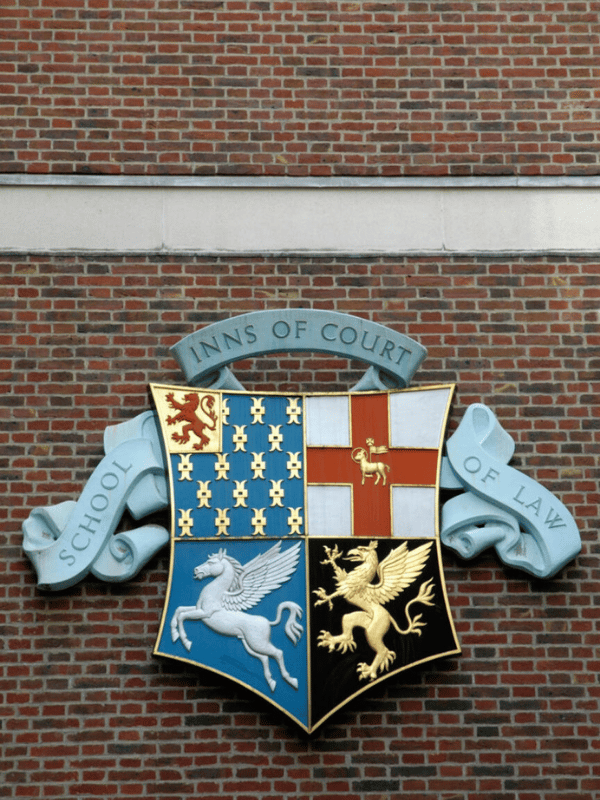
This technical transformation of the law catalyzed the formal creation of the legal profession, anchoring its development around the Inns of Court in London—specifically Lincoln's Inn, Gray's Inn, the Inner Temple, and the Middle Temple. These secular collegiate institutions completely broke the old monopoly of clerical canon lawyers. They functioned as rigorous residential academies where young laymen mastered the intricate art of common law pleading, writ selection, and statutory interpretation through intensive mock trials and lectures. By standardizing this training, the Inns of Court produced an elite, self-regulating guild of professional advocates (serjeants-at-law) and judges, converting the administration of English justice into a highly sophisticated, secular discipline that successfully isolated itself from arbitrary royal interference.
Further Information: The Great Consolidation and Statutory Renaissance


The Equity Revolution and the Court of Chancery
1350 – 1616 AD
The development of English jurisprudence was fundamentally split during the late medieval and early modern eras by the rise of Equity, a parallel system of justice that emerged to correct the harsh injustices caused by the rigid technicalities of the Common Law courts. By the early fourteenth century, the common law courts—the King’s Bench and the Court of Common Pleas—had become trapped within a hyper-technical writ system.
If an ordinary litigant could not find a standardized parchment writ from the royal chancery that precisely matched the specific facts of their injury, or if they made a minor clerical error on their pleadings, their case was instantly dismissed. Furthermore, common law remedies were limited strictly to financial damages; the courts had no legal mechanism to stop an ongoing injury or compel a defendant to perform a specific contractual task. Faced with this procedural deadlock, desperate subjects bypassed the common law entirely, sending direct petitions to the king's inner council, appealing to the royal conscience to deliver justice based on fairness rather than technical rules.
The king systematically delegated these petitions to the Lord Chancellor, the highest-ranking minister of the crown, who historically served as the king's chaplain and the "keeper of the royal conscience." Operating from the Court of Chancery, consecutive chancellors—originally senior ecclesiastics trained in Roman canon law—developed a completely unique, flexible method of court procedure that abandoned the common law writ system entirely. Instead of using juries, the Chancellor conducted inquisitorial proceedings, issuing a Writ of Subpoena to force a defendant to personally appear before him to be cross-examined under oath.
Because the Chancellor evaluated cases based on the principles of conscience, fairness, and "clean hands," the Court of Chancery invented vital legal remedies that common law could not offer, such as the injunction to freeze illegal acts and orders for specific performance to force the completion of contracts. The supreme achievement of this equitable jurisdiction was the development of the Trust (originally known as the Use). When a landowner went abroad to fight in the crusades or French wars, he would transfer the formal legal title of his estate to a trusted friend to hold for the benefit of his wife and children. Common law judges only recognized the legal title holder, allowing dishonest trustees to seize properties with impunity. The Court of Chancery crushed this exploitation by enforcing the moral obligation of the arrangement, declaring that while the trustee held the legal title, he was compelled by equity to manage the estate strictly for the beneficial owners, a split in property rights that remains a cornerstone of modern wealth management.
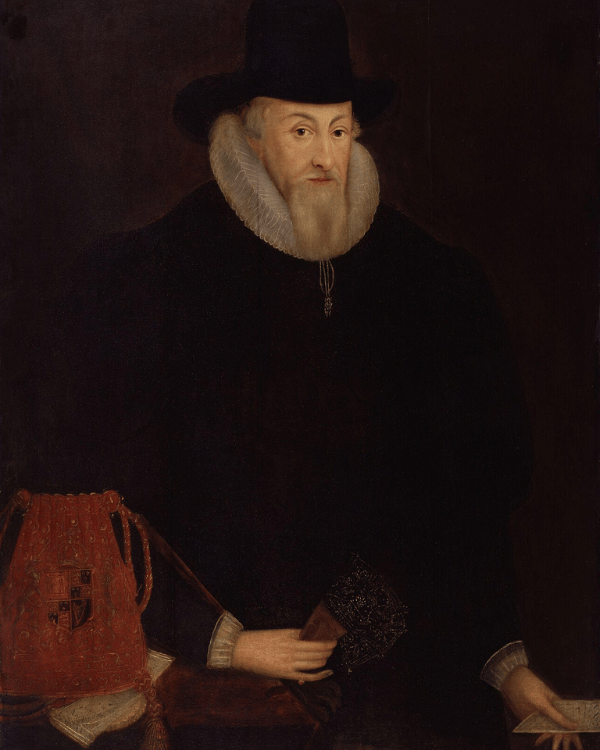
This parallel justice system triggered a monumental constitutional showdown in the early seventeenth century, culminating in the historic Earl of Oxford’s Case in 1615. The conflict pitted the Chief Justice of the King’s Bench, Sir Edward Coke—the fiery champion of Common Law supremacy—against the Lord Chancellor, Lord Ellesmere, who aggressively defended the jurisdiction of Equity. Coke ruled that the Court of Chancery had no legal right to overturn or freeze final judgments handed down by common law juries, threatening to imprison any lawyer or litigant who sought an equitable injunction after a common law trial.
Ellesmere counter-attacked, arguing that Chancery did not challenge the common law judgment itself, but merely acted in personam against the unconscionable behavior of the individual individual who had won through legal trickery. To resolve this gridlock, King James I issued a definitive royal decree in 1616, ruling that whenever the rules of Common Law and the rules of Equity came into direct conflict, Equity would always prevail. This historic executive decision permanently secured the dual architecture of English justice, ensuring that fairness and conscience retained the supreme statutory authority to override the technical letter of common law across the realm.
Further Information: The Equity Revolution and the Court of Chancery
The Tudor Legal Revolution
1485 – 1603 AD
The accession of the House of Tudor initiated an aggressive consolidation of executive, judicial, and ecclesiastical authority, establishing unique prerogative courts and a sovereign statutory framework that operated entirely outside traditional common law boundaries. Emerging from the domestic chaos of the Wars of the Roses, where over-mighty barons had routinely bribed local juries and intimidated county sheriffs, the early Tudor monarchs recognized that the re-establishment of public order required a direct exercise of royal prerogative.
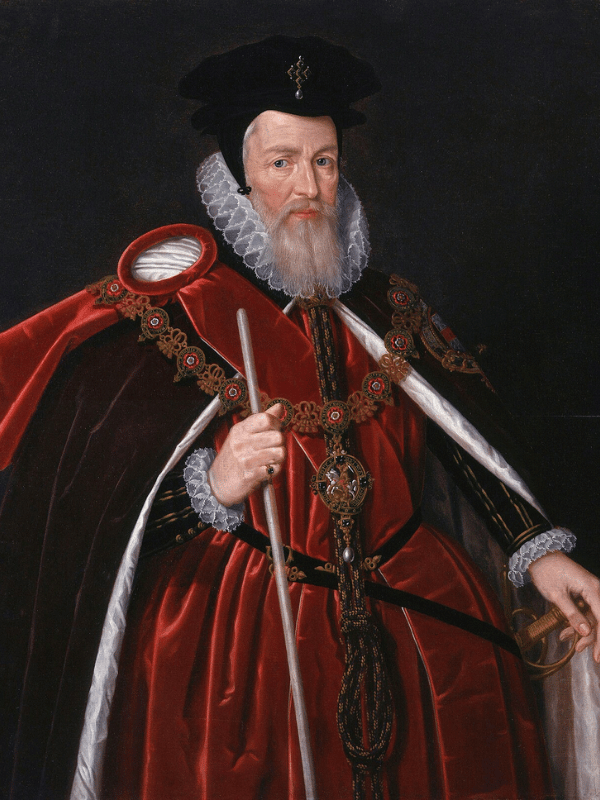
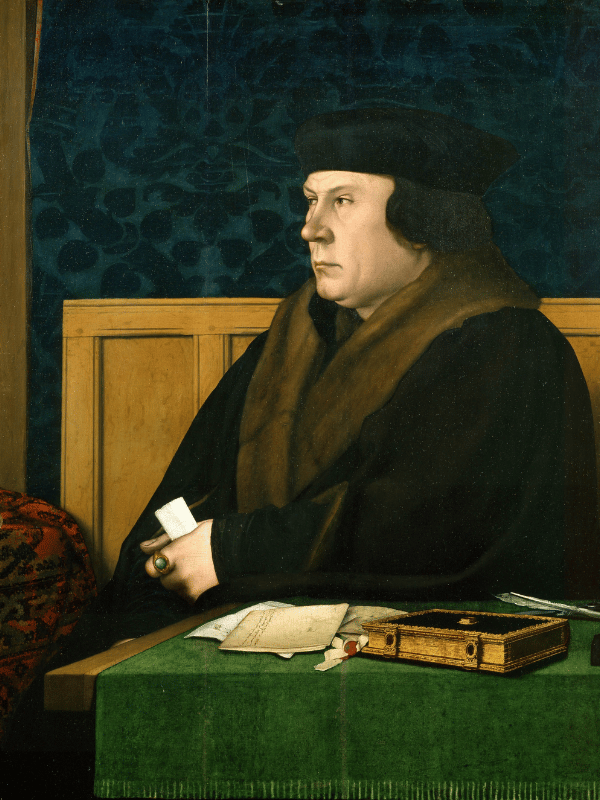
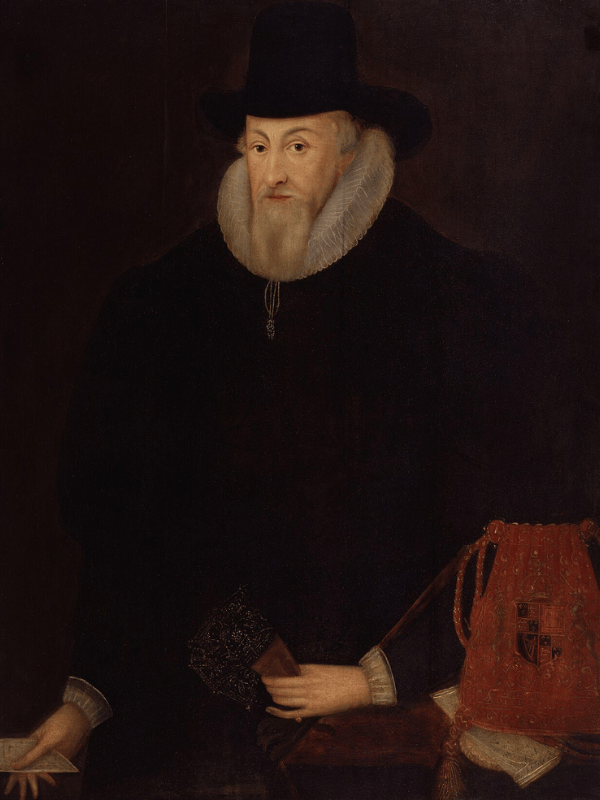
To break this aristocratic deadlock, the crown weaponized the inherent judicial powers of the king's privy council, establishing specialized tribunals that sat permanently at Westminster. These courts were engineered to bypass the technical delays, local biases, and vulnerabilities of standard county assemblies, shifting the balance of power decisively back to the central state through an elite group of professional ministers like Thomas Cromwell, 1st Earl of Essex, and William Cecil, 1st Baron Burghley, who transformed the medieval household into an administrative weapon of the crown.
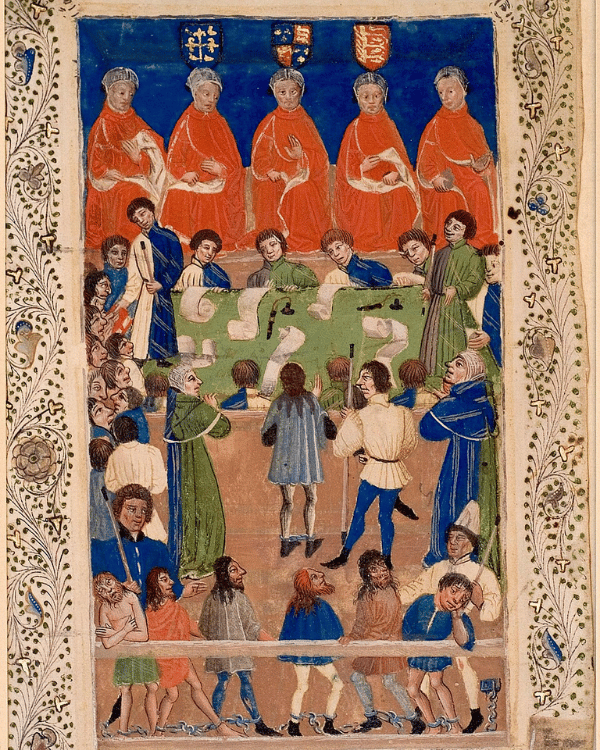
The premier symbol of this centralized legal enforcement was the Court of Star Chamber, so named because it met in a Westminster chamber featuring a ceiling decorated with gilded stars. Formally organized under the Star Chamber Act during the reign of King Henry VII, this court was composed directly of privy counselors, government ministers, and senior royal judges. It operated entirely without a jury, running instead on Roman-style investigative procedures where the judges acted as both the investigators and the final arbiters of fact. Litigants were forced to answer written interrogatories under oath, and because the court was not bound by the strict evidentiary rules of common law, it deployed intense psychological pressure, heavy financial fines, public pillorying, and corporal mutilation—such as cropping ears and branding faces—to crush sedition and punish aristocratic lawlessness.
While initially highly popular among the common people for its ability to deliver swift justice against untouchable local landlords, the Star Chamber gradually transformed under the late Tudors and early Stuarts into a hated tool of royal arbitrariness, deployed to bypass traditional liberties and suppress political dissent. Subsequently, the Baron Burghley deployed this tribunal to ruthlessly dismantle Catholic conspiracies and enforce religious conformity across all English counties.
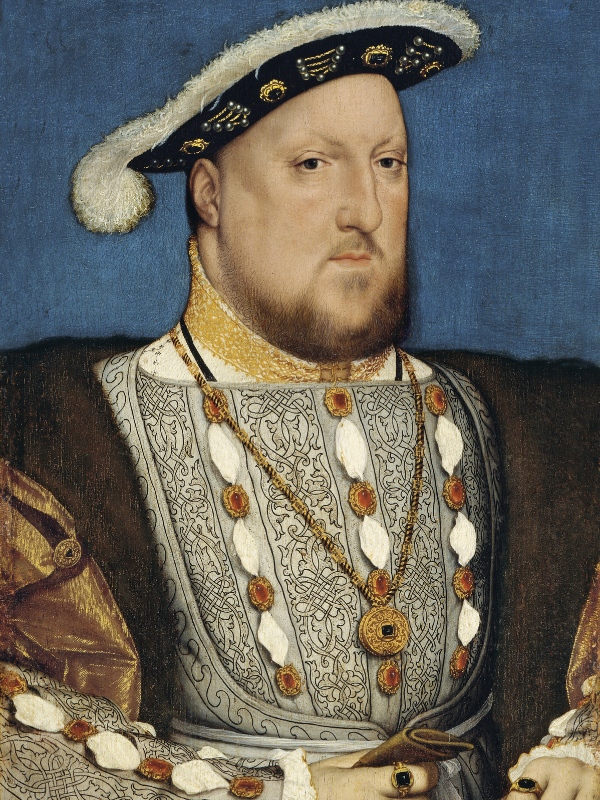
The absolute apex of this administrative transformation occurred between 1529 and 1536 when King Henry VIII summoned the historic Reformation Parliament to systematically dismantle the legal authority of the Catholic Church in England. Desperate to annul his marriage to Catherine of Aragon and facing an unyielding papal veto from Rome, the king and his chief architect, the Earl of Essex, unleashed a high-velocity legislative offensive that permanently altered the uncodified constitution.
The decisive blow landed with the passage of the Act in Restraint of Appeals in 1533, a monumental piece of statutory engineering that legally declared England to be an independent empire, governed by one supreme head and king having the dignity and royal estate of the imperial crown. This revolutionary statute completely outlawed the ancient practice of appealing domestic legal or religious disputes to the Pope, establishing the unchallengeable rule that English law was self-contained, total, and entirely free from the jurisdiction of any foreign potentate or court.
This statutory assertion of national independence was rapidly consolidated by the Act of Supremacy in 1534, which legally declared the king to be the supreme head on earth of the Church of England, fusing temporal and spiritual authority into a single domestic executive line. To finance this newly engineered state and crush potential centers of resistance, the crown pushed the Suppression of the Monasteries Acts through Parliament, executing a sweeping redistribution of real estate. Over eight hundred ancient religious houses were dissolved, and their vast holdings were seized by the crown.
To prevent the rising gentry from using equitable uses to evade the massive financial fees associated with these land transfers, the king forced the passage of the Statute of Uses in 1535. This radical piece of statutory engineering legally merged the beneficial ownership of an estate straight into the formal legal title, instantly exposing the land transfers of the high nobility to the direct fiscal extractions of the newly created Court of Wards and Liveries. This administrative tightening turned the entire real estate market of England into a highly visible, state-monitored landscape, ensuring that the crown held complete overview over the properties and marital alliances of its subjects while transforming the law into an active engine of state building.
Further Information: The Tudor Legal Revolution
The Case of Proclamations and Common Law Supremacy
1610 AD
The early seventeenth century witnessed an intense legal conflict over the boundaries of executive authority, culminating in the landmark Case of Proclamations in 1610. This pivotal courtroom confrontation permanently established that the royal prerogative was entirely subordinate to the common law, striking a decisive blow against absolute monarchy in England.
The crisis erupted during the reign of King James I, a sovereign fiercely committed to the divine right of kings, who argued that his personal royal estate placed his authority directly above all earthly judges, assemblies, and custom. Seeking to bypass the financial constraints and legislative debates of the Westminster Parliament, the King began utilizing royal proclamations as an active method of criminal lawmaking.
The political friction reached a breaking point when the King issued two highly sweeping executive edicts that directly disrupted the local trade and property rights of the English gentry. The first proclamation legally prohibited any citizen from constructing new buildings in London, an administrative measure designed to halt the physical expansion of the capital and enforce strict public tracking over urban populations. The second proclamation banned the manufacturing of starch from wheat, a decree executed to protect the national grain supply but one that instantly ruined the livelihoods of domestic starch-makers without any statutory trial or due process. When the House of Commons launched a formal petition of grievances, condemning these executive decrees as a dangerous breach of traditional liberties, the cornered King summoned the senior judiciary to Whitehall to validate his absolute authority.
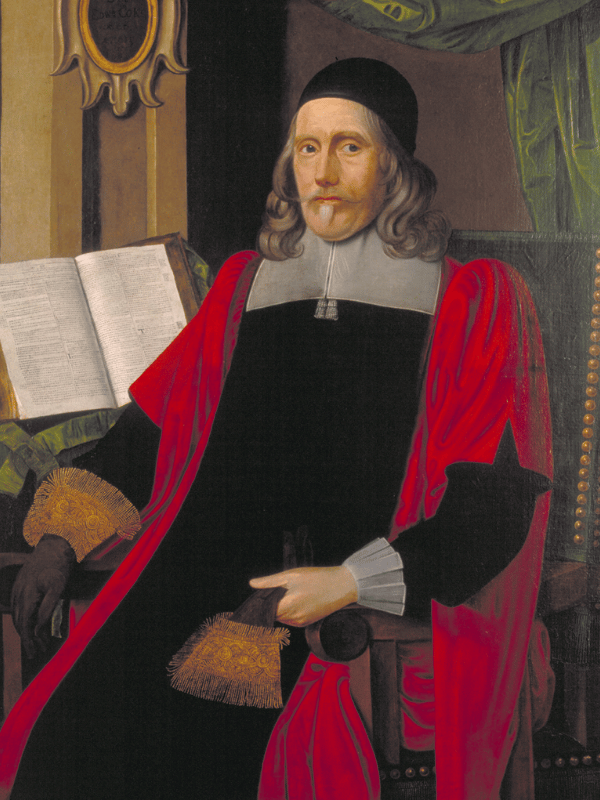
The resulting legal showdown pitted the King against Sir Edward Coke, Chief Justice of the Court of Common Pleas, who stood as the unyielding champion of common law supremacy. James I and his loyal Lord Chancellor, Thomas Egerton, 1st Viscount Brackley, argued that because the monarch was divinely appointed, he held an inherent prerogative power to issue whatever emergency decrees were necessary to preserve the safety and good rule of the realm. In an extraordinary display of judicial courage, Chief Justice Coke flatly rejected this absolute view of the crown. Deliberating alongside his fellow Westminster judges, the Chief Justice handed down a historic ruling, declaring that the King cannot by his proclamation create any offense which was not an offense before, for then he may alter the law of the land by his proclamation.
Chief Justice Coke established the permanent constitutional principle that the royal prerogative is not an unwritten, limitless well of personal power, but is strictly bounded by the law of the land, possessing only those specific legal rights that the common law allows. The court ruled that if an act was not already a crime by statute or custom, a royal proclamation could never make it a felony, nor could it authorize judges to inflict financial fines or corporal punishment on the king's subjects. Furthermore, the ruling confirmed that the senior judges, rather than the monarch, held the sole authority to interpret and define the legal boundaries of the royal prerogative.
This monumental decision permanently insulated the common law from executive dictation, erecting a judicial barrier against arbitrary rule and providing the legal weapons that the Long Parliament would subsequently deploy to dismantle the prerogative courts of the crown.
Further Information: The Case of Proclamations and Common Law Supremacy

The Long Parliament and Crisis of Sovereignty
1640 - 1642 AD
Additional Information: The Stuart Era / The Long Parliament and the Grand Remonstrance
The gathering of the Long Parliament in November 1640 launched a catastrophic constitutional battle that stripped King Charles I of his extra-parliamentary revenue systems and culminated in the Militia Ordinance of March 1642, an unprecedented legislative act that completely bypassed the King to seize control of the army.
Following an eleven-year period of personal rule during which Charles I dissolved the legislature and raised funds through widely despised, extrajudicial taxes like Ship Money, the King was forced to summon Parliament to finance his failed military campaigns in the Bishops' Wars against the Scottish Covenanters. Upon gathering, the House of Commons weaponized its exclusive control over national taxation to systematically dismantle the machinery of royal governance.
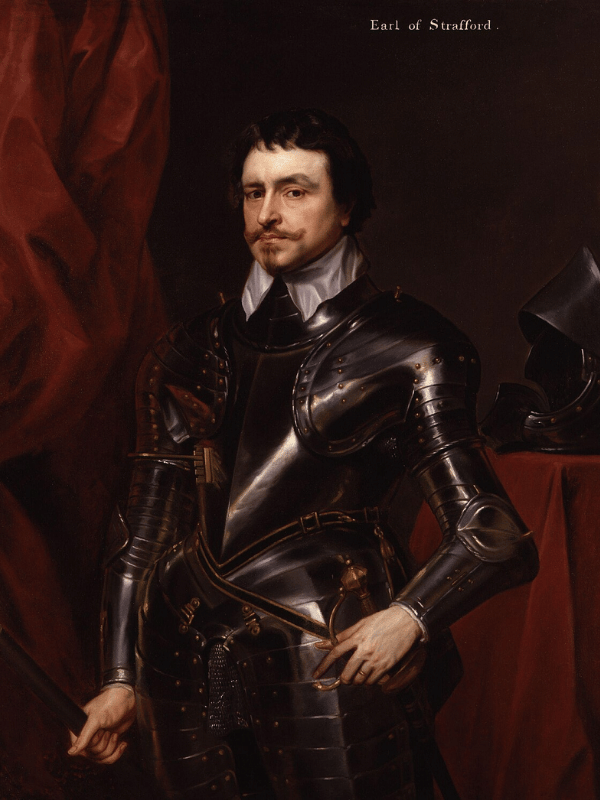
Led by brilliant political tacticians like John Pym, the Member of Parliament for Tavistock, the assembly launched a high-velocity legal offensive, passing the Triennial Act 1641 to legally compel the crown to summon Parliament at least once every three years. They also passed the Grand Remonstrance, a sweeping list of 204 grievances that publicly condemned the King’s advisers, and used a controversial Bill of Attainder to execute his chief minister, Thomas Wentworth, 1st Earl of Strafford, on Tower Hill for high treason.
To secure their position against royal retaliation, the Commons forced the cornered King to sign the Act of Continuance, a statute declaring that the current Parliament could not be dissolved without its own explicit consent. This legal dispute transformed into a complete breakdown of constitutional governance over the high-stakes question of military command. When a bloody rebellion erupted in Ireland in late 1641, both the King and Parliament recognized that whoever controlled the army tasked with suppressing the insurrection would hold absolute political mastery over the state. Refusing to trust Charles I with a military force, the House of Commons took the radical step of bypassing the traditional requirement for royal assent by passing the Militia Ordinance on 5 March 1642.
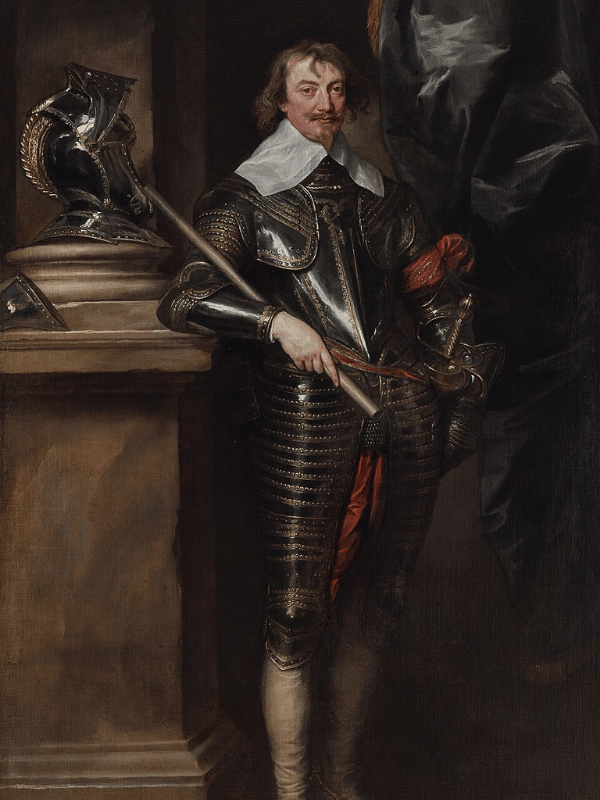
This statute declared that parliamentary ordinances held the full force of law without the signature of the King, uncoupling the defense of the kingdom from the person of the sovereign and placing the regional county militias under commanders appointed exclusively by Parliament. This move was enforced by powerful parliamentary magnates who seized the state's military infrastructure, including Robert Devereux, 3rd Earl of Essex, who was appointed Lord General of the parliamentary army, Robert Rich, 2nd Earl of Warwick, who successfully mutinied to seize control of the Royal Navy, and William Russell, 5th Earl of Bedford, who took command as General of the Horse.
Charles I responded by fleeing London for York, where he issued his own medieval Commissions of Array to rally his loyal gentry under the royal banner. This irreconcilable division of legal authority shattered the unity of the state and plunged the country directly into the English Civil War, transforming a legislative dispute into an armed battle for absolute sovereignty over England.
Further Information: The Long Parliament and Crisis of Sovereignty

Regicide and the Republican Interregnum
1649 - 1660 AD
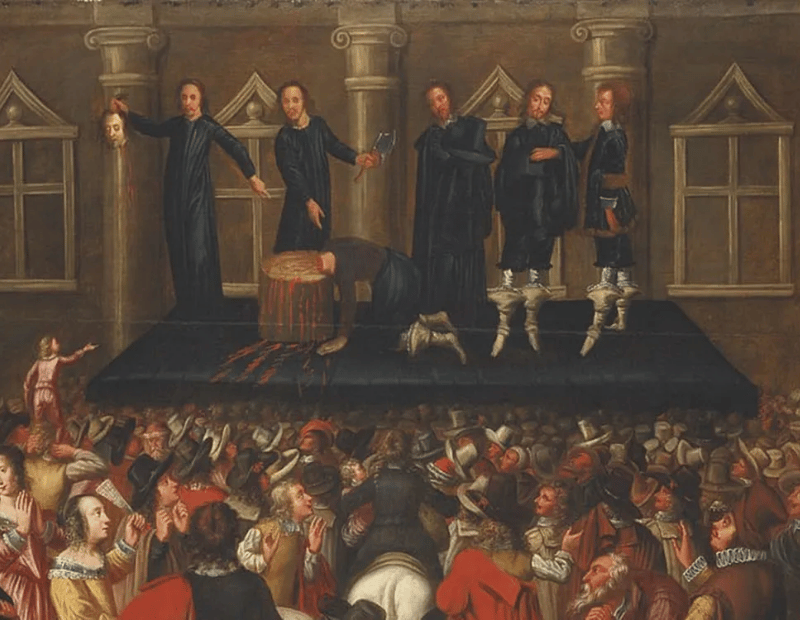
The creation of the High Court of Justice in January 1649 led to the public execution of King Charles I on 30 January 1649, terminating traditional monarchical rule and launching an eleven-year republican Interregnum. To establish this unprecedented tribunal, the radical Independent faction of the New Model Army and the House of Commons executed a ruthless political purge on 6 December 1648. They deployed troops under the direct command of Colonel Thomas Pride to physically block 186 moderate members from entering Parliament and arrested 45 others who favored continuing negotiations with the crown.
This remnant assembly, known as the Rump Parliament, passed a revolutionary ordinance creating a special commission of 135 judges to try the sovereign for high treason. Operating entirely without the consent of the House of Lords or the crown, this newly engineered tribunal shattered the ancient, fundamental legal doctrine of sovereign immunity, which had held for centuries that the monarch was the supreme font of all law, could commit no legal wrong, and was accountable only to God.
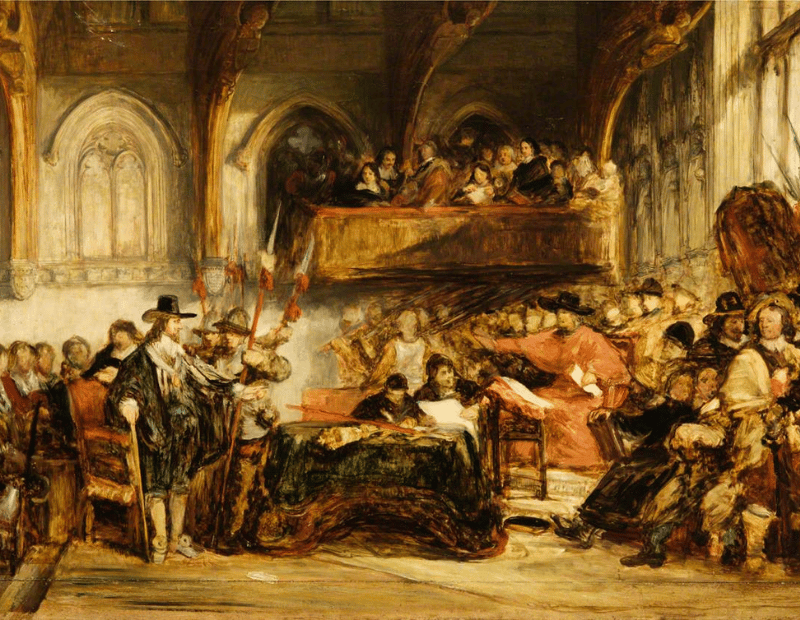
When Charles I was brought into Westminster Hall on 20 January 1649, he aggressively challenged the legal validity of the proceedings. Sitting before his captors, the King refused to remove his hat and flatly declined to enter a plea, repeatedly demanding to know by what lawful authority he had been brought to trial. He argued that since a king cannot be tried by any earthly court, the proceedings were an illegal usurpation of power.
Led by Solicitor General John Cook, who drafted the formal indictment, and Lord President John Bradshaw, who wore a specialized bulletproof hat reinforced with iron plates for personal protection, the court bypassed these constitutional objections. Cook and Bradshaw argued that the office of the king was not a personal hereditary right, but a conditional public trust granted by the people, and that by waging war against his own subjects during the civil wars, Charles Stuart had broken that contract. The court declared him a tyrant, a traitor, a murderer, and a public enemy, and fifty-nine commissioners, including Oliver Cromwell and Henry Ireton, signed his final death warrant.
On the afternoon of 30 January 1649, Charles I was led through a window of the Banqueting House at Whitehall onto an outdoor scaffold to be beheaded before a silent crowd. Following the regicide, the Rump Parliament moved swiftly to consolidate its victory by passing acts that officially abolished the office of the King and dissolved the House of Lords, declaring England to be a Commonwealth republic governed by a Council of State. However, this parliamentary experiment collapsed under the weight of financial stagnation and religious factionalism. Frustrated by the politicians' refusal to hold new elections, Oliver Cromwell marched into the House of Commons with an armed guard on 20 April 1653, famously ordering his soldiers to clear the room and remove the ceremonial mace, effectively ending the Commonwealth.
This military coup ushered in a period of direct rule under the Instrument of Government in December 1653, England's first and only written constitution, which appointed Cromwell as Lord Protector of the Commonwealth with sweeping executive powers. The protectorate soon degenerated into an unpopular military dictatorship when Cromwell divided the country into eleven administrative districts, placing each under the control of a major-general. These military commanders enforced strict Puritan codes, closing theaters and alehouses, banning traditional Christmas celebrations, and bypassing local common law courts to levy arbitrary taxes on Royalist families.
This continuous overreach alienated the provincial gentry and broke the traditional stability of English local governance. Following Cromwell's death in September 1658 and the rapid collapse of his son Richard Cromwell’s succession, the political elite and General George Monck orchestrated the return of King Charles II from exile in May 1660, restoring the traditional legal layout of the realm.
Further Information: Regicide and the Republican Interregnum
Primitives of Common Law
1670 – Present
The foundational protections of English common law were secured during the late seventeenth century, establishing the absolute right of habeas corpus against arbitrary arrest and guaranteeing the legal independence of the trial jury from state intimidation.
The oldest and most critical of these safeguards is habeas corpus (literally "you shall have the body"), which began as a customary medieval administrative writ but was formally locked down and given teeth by the Westminster Parliament through the passage of the Habeas Corpus Act 1679. Prior to this landmark statute, royal ministers routinely exploited procedural loopholes to imprison political opponents indefinitely without trial, frequently moving prisoners to isolated offshore islands or colonial garrisons outside the direct jurisdiction of the English courts.
The 1679 Act completely crushed this executive overreach by making it a severe offense for any jailer to ignore a royal writ. The statute gave any detained subject or their representative the absolute legal right to demand an immediate writ forcing the jailer to physically bring the prisoner before a common law judge within a fixed number of days. The state was then legally compelled to present valid, empirical proof of a specific crime; if the government could not produce a lawful, statutory charge, the judge was legally required to release the prisoner immediately, erecting an unyielding legal barrier against secret state detention and extrajudicial imprisonment.
This barrier against executive overreach was backed by the system of trial by jury, which placed the final verdict in serious criminal and civil trials directly into the hands of twelve ordinary citizens. While jurors originally functioned merely as local neighborhood witnesses under the early Norman kings, their absolute independence to find facts according to their own conscience was permanently secured in 1670 through the milestone decision in Bushel's Case.
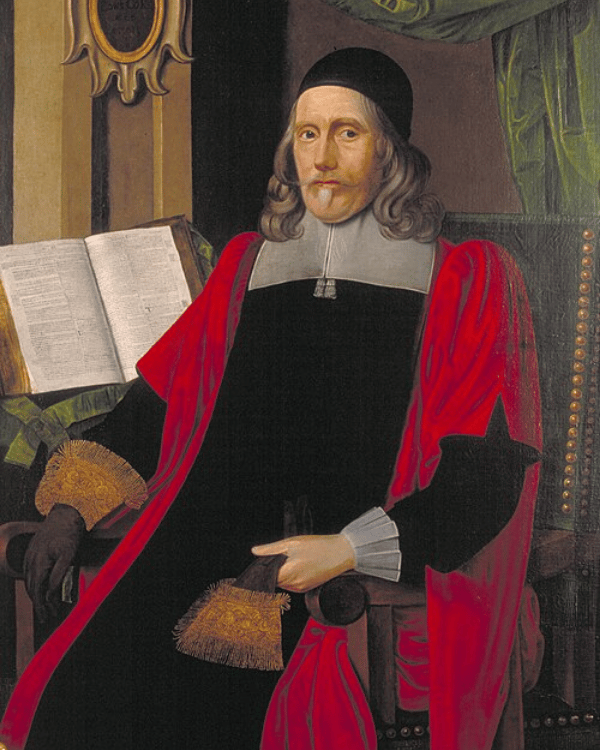
This constitutional flashpoint occurred during the trial of two prominent Quaker preachers, William Penn and William Mead, who were charged with unlawful assembly for preaching in a London street. Despite intense psychological pressure, starvation, and direct threats from the Recorder of London, the jury—led by Edward Bushel—refused to deliver a guilty verdict. The infuriated trial judge fined each juror forty marks and committed them to Newgate Prison for contempt of court. Bushel launched a challenge, prompting Chief Justice John Vaughan of the Court of Common Pleas to issue a historic ruling declaring that a jury can never be fined, imprisoned, or punished by the state for its final verdict. Vaughan established that because jurors are the sole arbiters of fact, they must be completely free from judicial coercion, confirming the trial jury as a primary civic protection against politically motivated government prosecutions.
To maintain order alongside these civic freedoms, English jurisprudence relies on the foundational doctrine of stare decisis (to stand by things decided), the rule of judicial precedent that requires lower courts to strictly follow the legal logic established in earlier, higher court rulings. Instead of using a rigid, top-down book of statutory codes like continental Europe's civil law traditions, the common law builds its architecture day by day through the accumulative decisions handed down by senior judges. When a high court resolves a complex legal dispute, that ruling becomes a binding precedent that all subsequent judges must follow in identical or similar cases.
This multi-century accumulation of case law provides the predictability and stability required to conduct commercial business, secure financial contracts, and protect property rights, ensuring that the law evolves organically through real-world experience rather than arbitrary executive decree.
Further Information: Primitives of Common Law
Stay Connected
The Glorious Revolution and English Bill of Rights
1688 – 1689 AD
Additional Information: The Stuart Era / The Glorious Revolution and Flight of the King
The deposition of King James II and the subsequent passage of the English Bill of Rights 1689 permanently subordinated the royal prerogative to statutory law, transforming the monarchy into a constitutional system. James II had alienated the Anglican political establishment by aggressively utilizing his personal suspending and dispensing powers to bypass parliamentary penal laws, appointing Catholic officers to the standing army, and jailing senior prelates who protested his decrees.
The conflict peaked when James II issued the Declaration of Indulgence, forcing the clergy to read it from their pulpits and prosecuting seven senior bishops for seditious libel inside the Court of King's Bench when they refused. The final crisis occurred in June 1688 when the birth of a royal son raised the prospect of an unbroken Catholic dynasty, prompting a coalition of Whig and Tory peers—known as the Immortal Seven—to invite the Dutch Stadtholder, William of Orange, to mount a military invasion. This political coalition was driven by powerful magnates, including Charles Talbot, 12th Earl of Shrewsbury, William Cavendish, 4th Earl of Devonshire, Thomas Osborne, 1st Earl of Danby, and Richard Lumley, 1st Feudal Baron Lumley. When William landed at Torbay with an army, James II fled to France, creating an executive vacuum that allowed the political elite to assemble a special Convention Parliament to redefine the terms of the throne.
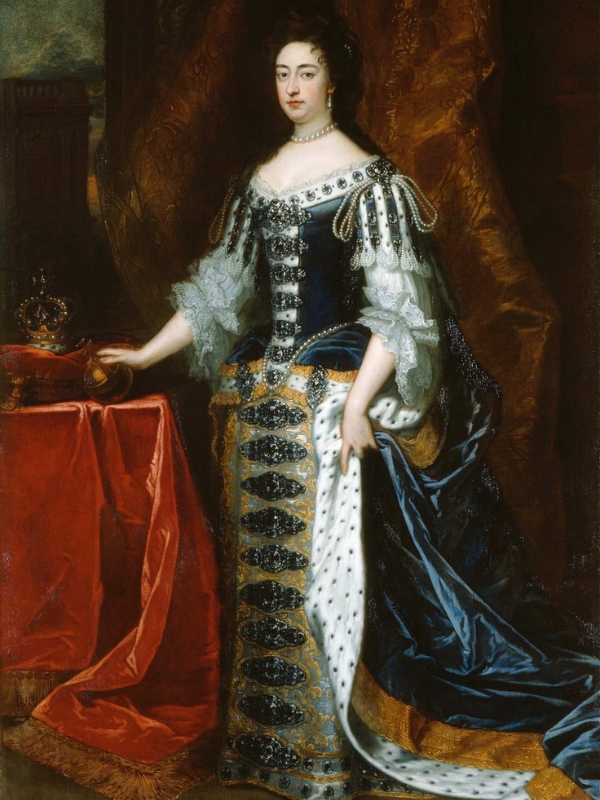
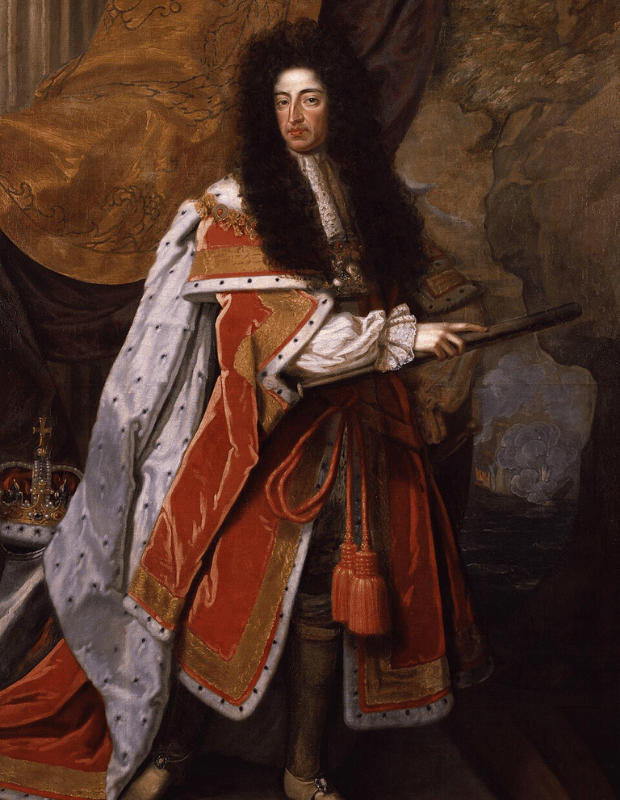
To resolve the critical succession crisis and permanently bound the royal prerogative, the special Convention Parliament enacted the English Bill of Rights 1689, a monumental piece of statutory architecture that altered the constitutional balance of power forever. This landmark legislation served as the strict, unyielding condition under which William III and Mary II were jointly offered the crown, establishing that royal legitimacy was no longer a matter of absolute divine right but a conditional public trust regulated by a sovereign legislature.
The statute systematically stripped the monarch of independent legislative and executive powers, explicitly declaring that the crown held no legal right to suspend parliamentary laws, dispense with penal statutes, or levy national taxes without an explicit grant from Westminster. It directly dismantled the military independence of the executive by declaring a standing army in peacetime without parliamentary consent to be entirely illegal, removing the crown's ability to enforce domestic obedience at the point of a sword.
Furthermore, the act secured the foundational protections of the modern state by insulating the freedom of parliamentary speech and debate from royal interference or judicial punishment outside the house itself. It guaranteed the right of subjects to freely petition the King without fear of prosecution, outlawed the practice of demanding excessive bail or imposing cruel and unusual punishments, and mandated the calling of frequent, free parliaments to manage the state's finances.
Finally, to safeguard the religious and political settlement of the nation, the statute codified the strict dynastic exclusion line, decreeing that anyone who held communion with the Church of Rome or married a Roman Catholic would instantly forfeit their hereditary right to rule, locking the Protestant national identity directly into the fundamental laws of the land.
Further Information: The Glorious Revolution and English Bill of Rights

Parliamentary Sovereignty and the Uncodified Constitution
1689–Present
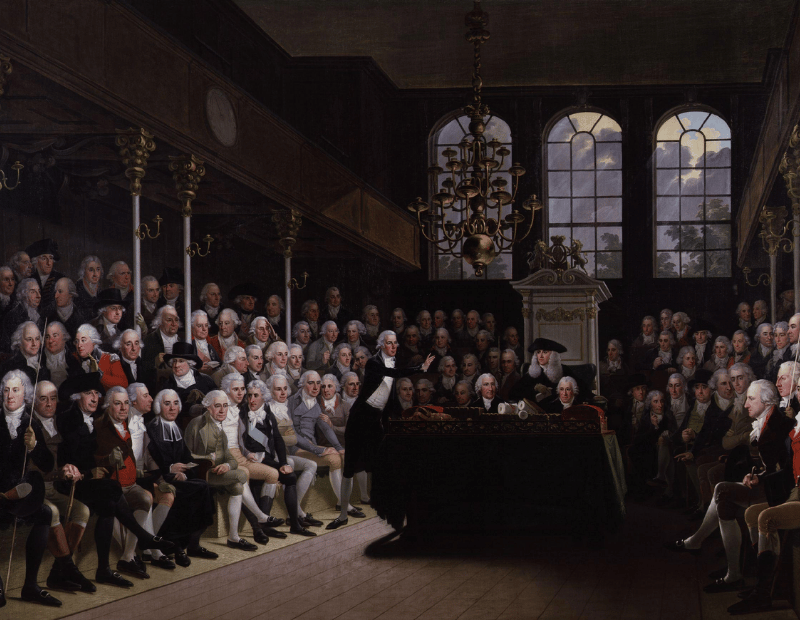
The core pillar of modern British governance is the doctrine of parliamentary sovereignty, a constitutional principle which dictates that the Westminster legislature holds the supreme legal authority to enact, amend, or repeal any law. Unlike nations that operate under a single written document that binds the state, Great Britain relies on an uncodified constitution built upon a rolling collection of landmark statutes, common law precedents, and unwritten political customs.
Under this framework, established by the constitutional settlements of the late seventeenth century, no individual or institution—including the reigning monarch, the prime minister, or the senior judiciary—possesses the legal right to overrule or set aside an Act of Parliament. This means that a statute passed by the legislature becomes the highest legal authority in the land, overriding all conflicting customary rights and older courtroom decisions, while ensuring that no historic parliament can ever pass a law that a subsequent parliament cannot dismantle or rewrite.
This supreme legislative supremacy is reinforced by the legal classicist A.V. Dicey, who defined the doctrine through a dual lens: first, that Parliament has the right to make or unmake any law whatever; and second, that no person or body is recognized by the law of England as having a right to override or set aside the legislation of Parliament. Because there is no higher constitutional court capable of striking down an Act of Parliament as "unconstitutional," the ultimate check on legislative power is political rather than judicial, resting entirely on the regular delivery of free general elections and the collective will of the electorate. This makes the British legal system highly responsive, enabling the government to pass sweeping emergency legislation or rewrite fundamental property laws in a single day through standard parliamentary majorities, bypassing the multi-year ratifications required by written constitutions.
Because this constitutional system lacks a rigid written text, the running of the government depends on constitutional conventions. These are unwritten rules of political behavior that are considered binding on the actors of the state even though they cannot be enforced in a court of law. For example, while the legal text of the country technically allows the King to refuse to sign an Act of Parliament, the unwritten convention of royal assent dictates that the sovereign must sign every bill passed by the legislature.
This custom is so firmly established that no monarch has vetoed a parliamentary bill since Queen Anne refused the Scottish Militia Bill in 1708. Similarly, the office of the Prime Minister and the rule of collective cabinet responsibility exist purely as conventions rather than written statutory laws. This reliance on conventions gives the British constitution its unique flexibility, allowing the system of governance to adapt to modern political realities without requiring complex constitutional amendments.
Further Information: Parliamentary Sovereignty and the Uncodified Constitution

The Act of Settlement and Isolation of Judicial Power
1701 AD
Additional Information: The Stuart Era / The Act of Settlement 1701, The History of the Church in England / The Act of Settlement 1701
The passage of the Act of Settlement 1701 permanently established the absolute independence of the English judiciary by changing the tenure of senior judges so they held office during good behaviour rather than at the personal pleasure of the monarch.
While the Bill of Rights 1689 had restricted the direct legislative overreach of the crown, royal judges still held their positions entirely at the discretion of the King, leaving the courtroom lines highly vulnerable to political intimidation, arbitrary dismissals, and crown manipulation.
Seeking to resolve an immediate succession vacuum following the tragic death of the last surviving child of Princess Anne, the Westminster Parliament passed the Act of Settlement 1701. While the primary purpose of the statute was to bypass over fifty senior Catholic claimants to steer the succession toward the Protestant House of Hanover, parliamentary leaders utilized this unique legislative leverage to permanently insulate the senior courts from executive interference.
The clause embedded within the 1701 statute changed the tenure of all senior judges from serving at the King's pleasure (durante beneplacito) to holding office during good behaviour (quamdiu se bene gesserint). Under this rule, a reigning monarch could no longer sack an independent judge who handed down a ruling that went against the financial or political interests of the crown.
Instead, a judge could only be removed from office following a formal address of misconduct passed by both the House of Commons and the House of Lords. Furthermore, their salaries were officially fixed and guaranteed by law to prevent the executive branch from utilizing financial pressure as a tool of coercion, establishing the definitive separation of judicial power that remains a foundational rule of modern constitutional governance.
Cabinet Governance and Ministerial Conventions
1721 – 1742 AD
The modern office of Prime Minister and the system of cabinet government emerged during the early Hanoverian era, shifting executive power from the crown to a single political leader who had to maintain a majority in the House of Commons. This constitutional change was accelerated by the accession of King George I in 1714, a German prince from Hanover who spoke no English and lacked a deep understanding of British domestic politics. Consequently, the new monarch abandoned the royal habit of attending and running meetings with his ministers. To fill this vacuum, a small committee of senior politicians, known as the Cabinet, began meeting independently at Whitehall to set state policy, manage the legislature, and draft government budgets, bypassing direct royal supervision.
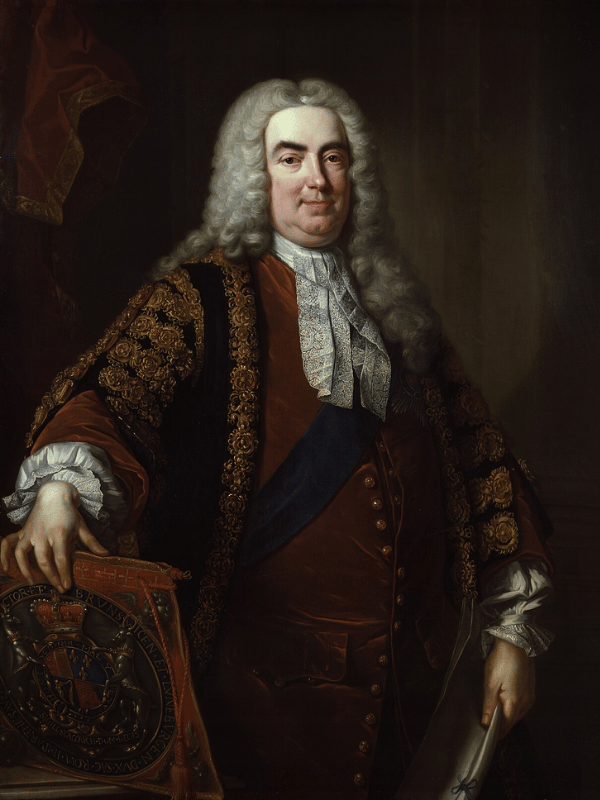
The politician who consolidated this new executive role was Sir Robert Walpole, a Whig financial manager who established the precedents that define the modern office of Prime Minister. Stepping into power following the financial collapse of the South Sea Bubble in 1720, Walpole used his fiscal skills to rescue public credit, protect the royal family from parliamentary investigations, and secure total control over the financial patronage of the state.
Appointed as First Lord of the Treasury and Chancellor of the Exchequer in April 1721, Walpole ran the government from his official residence at 10 Downing Street—a gift from George II—for over two decades. He maintained control by enforcing the unwritten convention of collective cabinet responsibility, a strict rule requiring all ministers to publicly support government policy or face immediate dismissal from the cabinet.
Walpole's twenty-one-year monopoly on power ended in February 1742 following a disastrous military campaign against Spain, known as the War of Jenkins' Ear. When a hostile coalition of Whigs and Tories defeated his government on a key vote regarding a disputed election petition for Westminster, Walpole established another constitutional precedent by immediately resigning his office. This action permanently cemented the modern convention that an executive government cannot rule by royal favor alone, but must always maintain the confidence of the elected House of Commons to retain the authority to govern the realm.
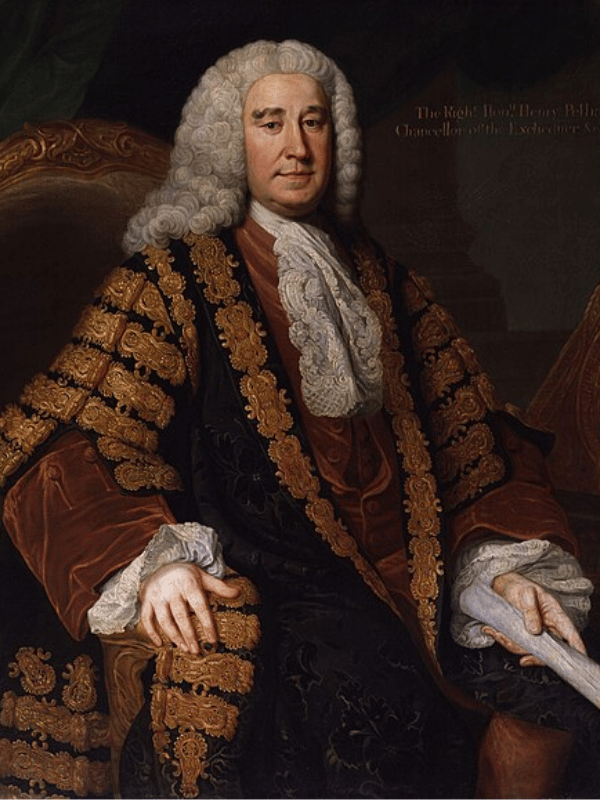
From this mid-century flashpoint, the institutional evolution of the executive line accelerated across successive administrations, systematically stripping the crown of its residual political interference. When Henry Pelham faced severe royal obstruction from King George II during the Jacobite Rebellion of 1746, he executed the first recorded collective cabinet strike. Pelham and his entire front bench resigned simultaneously, completely paralyzing the machinery of the state and forcing a humiliated monarch to reinstate them on their own terms. This high-stakes maneuver established the unbreakable convention of cabinet solidarity, proving that the executive functioned as a unified corporate board rather than a collection of separate royal servants.
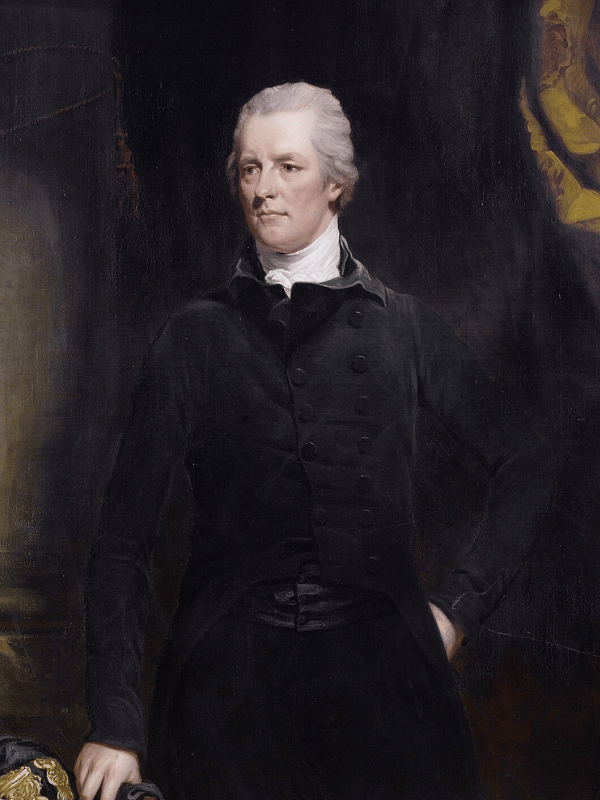
By the late eighteenth century, under the leadership of William Pitt the Younger, this operational framework hardened into its modern layout. Pitt permanently established the convention of individual ministerial responsibility, which legally and politically bound every secretary of state to answer directly to Parliament for the administrative failures or financial corruption of their specific departments. Concurrently, the crown's traditional patronage network was dismantled through the implementation of the Civil List acts, which stripped the monarch of the treasury assets used to bribe MPs. This fiscal isolation turned the King's veto into a dead letter, ensuring that by the dawn of the nineteenth century, the Prime Minister stood as the exclusive, accountable manager of the state, answering directly to a sovereign parliament.
"I must be King in my own House, and I will have no ministers who vote against my measures in Parliament. If any gentleman thinks fit to oppose the bills of the Treasury before the Commons, he cannot expect to sit at the Council board at Whitehall. I have told the King this day that the Earl of Chesterfield must surrender his staff as Lord Steward, for he has thought fit to make himself an active enemy to the Excise Bill, and no government can stand when its own servants pull down its walls."
— Sir Robert Walpole, Letter to the Duke of Newcastle regarding the Excise Crisis, April 1733
Further Information: Cabinet Governance and Ministerial Conventions
Reform Acts and the Transition to Mass Parliamentary Democracy
1832 – 1918 AD
Additional Information: The Victorian Era / Disraeli, Gladstone, and the Two-Party Political Arena
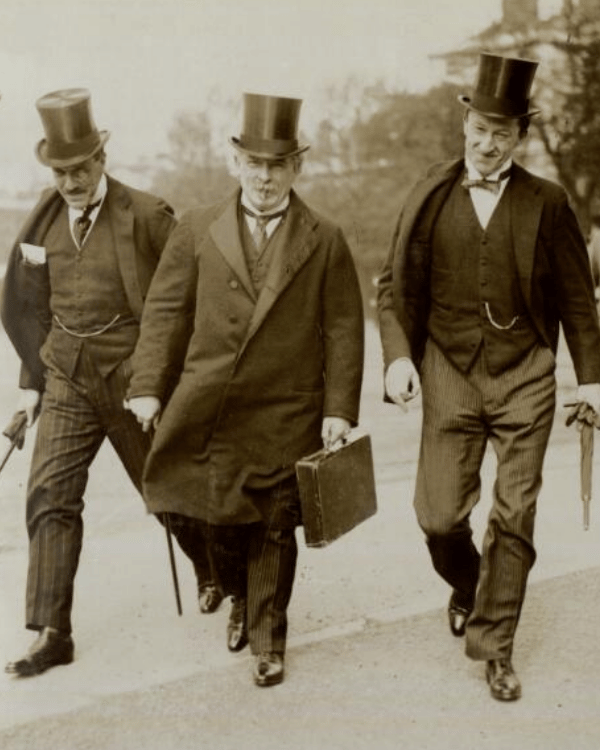
The passage of successive Reform Acts between 1832 and 1918 dismantled the corrupt system of aristocratic pocket boroughs and expanded the voting franchise, transforming the House of Commons into a mass parliamentary democracy.
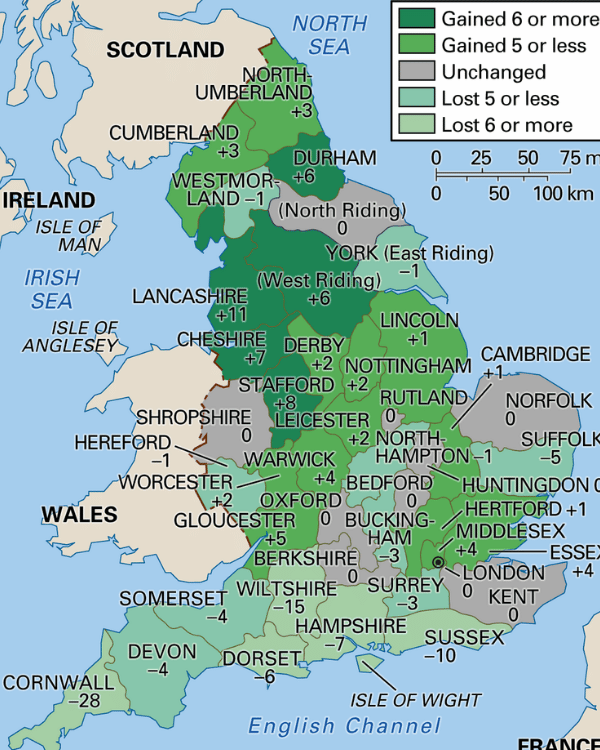
Prior to these statutory changes, the electoral map of England was warped by centuries of population shifts. Unpopulated rural hamlets, known as "rotten boroughs," returned two members to Parliament through aristocratic bribery, while massive industrial cities like Manchester and Birmingham held no independent representation. A famous example was Dunwich in Suffolk, which had almost completely eroded into the North Sea, yet continued to send two MPs to Westminster based on a handful of eligible voters. This exclusive monopoly over state power was broken by the Great Reform Act of 1832, which swept away 56 of these corrupt boroughs, redistributed the vacant seats to the expanding manufacturing hubs, and extended the voting franchise to the commercial middle classes.
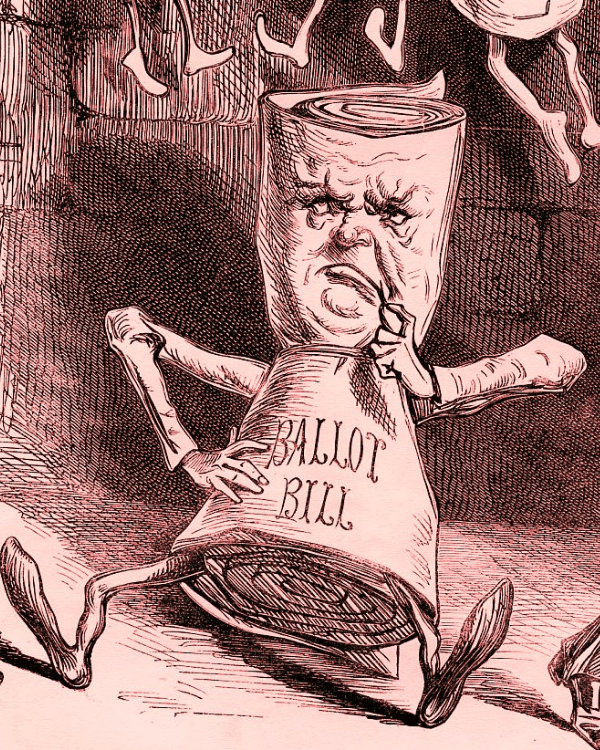
This initial breakthrough initiated a series of legislative expansions that gradually uncoupled voting rights from wealthy property ownership. The Representation of the People Act 1867 and the subsequent 1884 statute extended the franchise to urban working-class householders and agricultural laborers. These expansions forced political parties to build organized national networks to appeal to millions of newly registered voters. To protect these new voters from aristocratic coercion and workplace intimidation at the hustings, Parliament passed the Ballot Act 1872, which legally mandated the introduction of the secret ballot for all parliamentary and municipal elections. This procedural shield allowed working-class citizens to vote according to their own conscience, neutralizing the traditional influence of local landlords and factory owners.
The democratic consolidation of the legislature was achieved following the upheavals of the First World War with the passage of the Representation of the People Act 1918. Driven by the necessity to reward the wartime sacrifices of the civilian population, this statute abolished all remaining property restrictions for men over the age of twenty-one and granted the vote to women over thirty who met minimum property criteria. This transformation locked the traditional common law state into a modern system of universal mass democracy, expanding the total electorate from 7.7 million to over 21.4 million citizens.
The final element of this democratic transition occurred with the passage of the Parliament Act 1911, which permanently broke the legislative gridlock between the two chambers. Prior to 1911, the unelected House of Lords possessed an absolute veto over all legislation passed by the Commons. When the Lords broke convention by blocking the "People's Budget" of 1909, a severe constitutional crisis erupted. The resulting 1911 statute stripped the upper house of its absolute veto, removing their power to touch financial bills entirely and limiting their blocking authority to a maximum delay of two years, ensuring that the elected House of Commons stood as the supreme legislative force in the realm.
Further Information: Reform Acts and the Transition to Mass Parliamentary Democracy


British Immigration Law
1948 – 2026 AD
Additional Information: Post-War Britain / The British Nationality Act 1948, The Commonwealth Immigrants Act 1962, Redefining Citizenship: The British Nationality Act 1981
The transition of the United Kingdom from an imperial hegemon with borderless global citizenship into a highly restricted, statutory border state represents one of the most volatile chapters in modern British legal history. For centuries, the common law operating across the British Empire ran on the foundational principle of civitas, which dictated that any person born within the dominions of the crown owed allegiance to the sovereign and, in return, possessed an absolute, unhindered right of entry to the home territory of Great Britain.
This open legal framework was codified following the Second World War through the passage of the British Nationality Act 1948. Enacted by the post-war Labour administration to preserve the basics of an empire, this statute created the legal status of Citizen of the United Kingdom and Colonies (CUKC). It granted an estimated 800 million global subjects across the Caribbean, Sub-Saharan Africa, South Asia, and the Mediterranean the exact same statutory rights of entry, settlement, and employment as native-born Britons. This policy was launched as a top-down administrative decision by the political elite without a public referendum or electoral mandate, initiating an era of rapid demographic change that frequently clashed with the widespread opposition of the domestic electorate, who viewed the sudden dismantling of traditional entry controls as a threat to local social cohesion and public infrastructure.
The open-door policy of the 1948 Act quickly exposed a massive disconnect between the imperial ideals of the Westminster elite and the realities of domestic statecraft, forcing a dramatic legislative counter-offensive to restrict non-white Commonwealth migration. When a large influx of arrivals began utilizing their legal rights to settle in major industrial hubs, public friction and electoral pressure forced successive administrations to dismantle the 1948 framework.
This legal tightening began with the passage of the Commonwealth Immigrants Act 1962, a monumental piece of statutory engineering that broke the absolute right of free entry for global subjects. The 1962 Act mandated that all Commonwealth citizens seeking entry to the United Kingdom had to possess a government-issued employment voucher, which divided arrivals into strict quotas based on specialized skills or pre-arranged jobs, successfully subordinating the old common law right of allegiance to the economic requirements of the domestic labor market.
This restriction was radically expanded with the Commonwealth Immigrants Act 1968, an emergency statute passed in a single week to block East African Asians holding CUKC passports from fleeing persecution. The 1968 Act introduced the strict ancestral link requirement, decreeing that a Commonwealth passport holder only possessed an absolute right of entry if they, or at least one parent or grandparent, had been born, naturalized, or adopted within the United Kingdom itself, effectively partitioning global citizenship along lines of direct ancestral descent to isolate the home islands from external migration pressures.
The entire system of border control was permanently consolidated through the enactment of the Immigration Act 1971, which serves as the foundation of modern British immigration law. This statute completely abolished the separate rules for foreign nationals and Commonwealth citizens, replacing them with a single, highly centralized framework administered directly by the Home Office. The 1971 Act introduced the concept of the Right of Abode, an absolute statutory privilege granted exclusively to individuals who were entirely free from immigration controls. Anyone lacking this right of abode—including the vast majority of global Commonwealth citizens—was legally redefined as a non-citizen who required specific, conditional administrative permissions to enter, work, or settle in the country, turning the old imperial open-door policy into a highly policed, discretionary system managed by the state.
This separation was finalized by the British Nationality Act 1981, which went into effect on 1 January 1983. This statute completely dismantled the ancient common law doctrine of jus soli (birthright citizenship) that had governed England for over a millennium. Under the 1981 Act, being born on British soil no longer automatically granted nationality; a child born in the United Kingdom only acquired British citizenship if at least one parent was a British citizen or held legally recognized Indefinite Leave to Remain (ILR), permanently locking down the definition of national identity within precise, state-monitored legal boundaries.
As the twentieth century closed and the state transitioned into a globalized alignment, immigration law transformed into an active tool of economic management and geopolitical control through a series of rapid legislative adjustments. Following the expansion of the European Union and the massive surges in asylum applications during the 1990s and 2000s, New Labour passed a sequence of dense statutory acts—including the Asylum and Immigration Appeals Act 1993 and the Nationality, Immigration and Asylum Act 2002—which systematically restricted the legal rights of asylum seekers, introduced mandatory biometric residence permits, and expanded the state's powers of administrative detention and deportation.
This culminated in 2008 with the introduction of the Points-Based Immigration System, a technical framework that grouped non-European migration into five distinct tiers based on qualifications, salary thresholds, and language mastery. Following the 2016 Brexit referendum and the formal expiration of EU free movement rules, the state enacted the Immigration and Social Security Co-ordination (EU Withdrawal) Act 2020. This statute completed the historical shift away from regional or imperial allegiances by subjecting European citizens to the exact same points-based restrictions as the rest of the world, establishing a highly centralized, technocratic border infrastructure designed to maximize fiscal extraction and tightly regulate the demographic expansion of the nation.
Further Information: British Immigration Law


The Human Rights Act 1998 and European Law
1972 – 2020 AD
Additional Information: The Age of Migration / The Human Rights Act 1998 & loss of Sovereignty
The integration of Great Britain into European legal frameworks through the European Communities Act 1972 and the Human Rights Act 1998 introduced international legal standards directly into the domestic system, creating a long-term tension with the doctrine of parliamentary sovereignty. This transition began under Edward Heath's Conservative government with the European Communities Act 1972, which bound the country to the treaties of the European Common Market and required domestic courts to recognize the supremacy of European law.
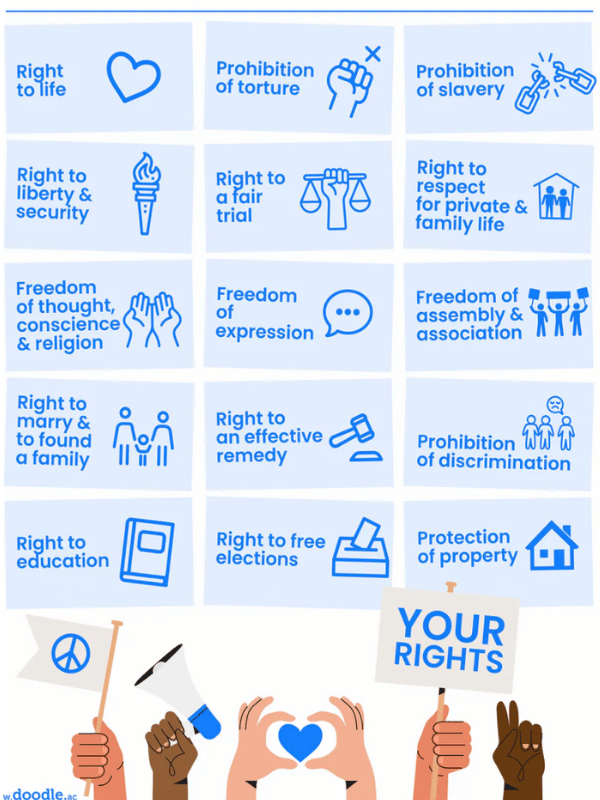
For nearly five decades, as confirmed by the landmark Factortame legal rulings between 1989 and 1991, if a British law regarding shipping or trade conflicted with European regulations, the senior courts were legally required to suspend the domestic statute. This shift broke the principle that a Westminster parliament could never have its laws overruled by an outside power. This international influence expanded with the passage of the Human Rights Act 1998 under Tony Blair's Labour government, which incorporated the European Convention on Human Rights (ECHR) directly into the domestic legal system. Prior to this legislation, a British citizen seeking to challenge a government action under the convention had to undertake a multi-year appeal to the international court in Strasbourg.
The 1998 statute resolved this by enabling domestic judges to evaluate whether government acts or parliamentary bills violated basic human rights. To avoid a direct constitutional clash over parliamentary supremacy, British legislators devised a compromise under Section 4 of the Act: senior judges cannot strike down a law, but they can issue a formal declaration of incompatibility. This declaration places severe political pressure on the government to amend its own rules, demonstrating how international legal standards were woven into the fabric of the uncodified constitution.
This arrangement altered the balance of power between the executive and the courts until the country's legal relationship with the European Union was formally severed following the passage of the European Union (Withdrawal) Act 2018 and the completion of Brexit on 31 January 2020.
Further Information: The Human Rights Act 1998 and European Law

Modern Constitutional Debates
2024 - Present
The uncodified legal system of Great Britain faces a series of sharp, ongoing challenges as the state navigates shifting domestic borders and growing tension with international human rights courts. This contemporary debate is driven by the rise of devolution—a process launched by the Scotland Act 1998, Government of Wales Act 1998, and Northern Ireland Act 1998—which transferred specific lawmaking powers to elected regional parliaments.
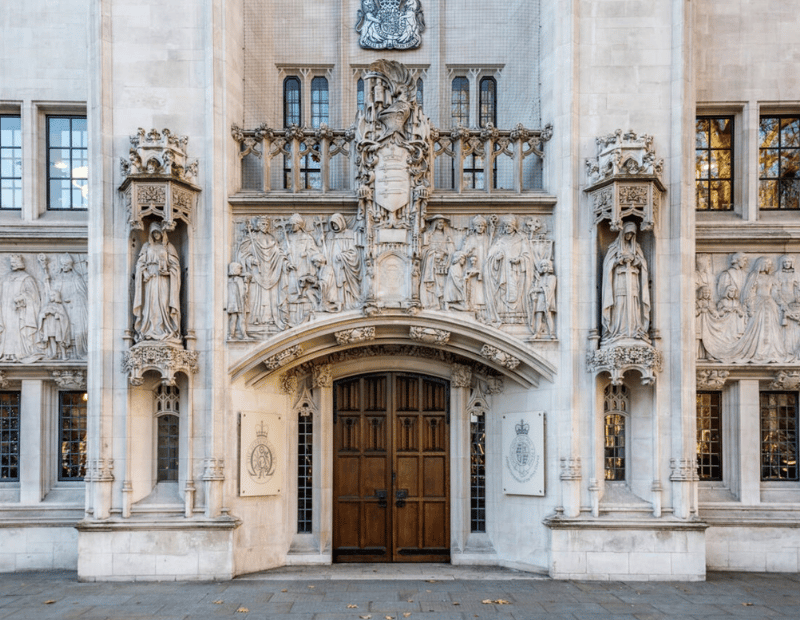
While the Westminster Parliament technically keeps the ultimate authority to overrule these regional assemblies, an unwritten political custom known as the Sewel Convention dictates that London should not step in to pass local laws without the explicit consent of the regional governments. This distribution of power has created significant friction, as regional lawmakers pass local statutes that clash with central policies, forcing the Supreme Court to intervene to draw clear boundaries between the rights of regional assemblies and the supremacy of the national parliament.
This domestic friction is compounded by a conflict over the influence of the European Court of Human Rights (ECtHR) in Strasbourg. Because the Human Rights Act 1998 requires British judges to take into account the rulings of the European court, critics argue that outside judges are altering the country's legal landscape, bypassing the elected legislature and undermining traditional English legal precedents. This standoff reached a major crisis over state immigration policies, national security measures, and border controls, particularly when Rule 39 interim injunctions issued by a single anonymous Strasbourg judge blocked the first scheduled deportation flight under the government's Rwanda asylum plan in June 2022. This international intervention blocked executive actions passed by the Westminster Parliament, creating a profound constitutional clash between the elected cabinet and foreign judicial directives.
This confrontation sparked debate over whether Great Britain should completely withdraw from the European convention or replace the 1998 statute with a native bill of rights. The dispute reached a critical milestone following the July 2024 general election; while the previous Conservative administration had attempted to bypass Strasbourg via the Safety of Rwanda Act 2024, Keir Starmer's newly elected Labour government instantly abandoned these maneuvers to re-align with international legal frameworks.
This policy shift forces the modern kingdom to decide whether to maintain its links to international legal systems or reassert the clear sovereignty of its own laws, leaving the ultimate destination of English constitutional supremacy undecided as the state enters the final half of the decade.
Further Information: Modern Constitutional Debates
English Law and Governance FAQs