
Peak of Empire:
The Victorian Era
The Victorian Era: An Imperial Zenith
Additional Information: The House of Hanover
The passing of King William IV in June 1837 launched an era of unprecedented industrial power and global dominance, permanently shifting the crown to his eighteen-year-old niece, Queen Victoria. Over the subsequent six decades, the nation systematically traded its traditional farming past for a roaring network of steam engines, coal mines, and textile mills, concentrating immense manufacturing power that turned the island into the workshop of the world. Underpinning this domestic transformation was the aggressive expansion of the British Empire, which utilized the unmatched naval supremacy of the Royal Navy and the commercial networks of merchant enterprise to build a global footprint that bound a quarter of the earth under a single crown.
Throughout this section, the we track the dramatic changes of the Victorian age, mapping how the country survived severe domestic factory unrest, built a modern parliamentary voting system, and handled the sweeping social upheavals that remade the framework of the nation.
Page Contents:
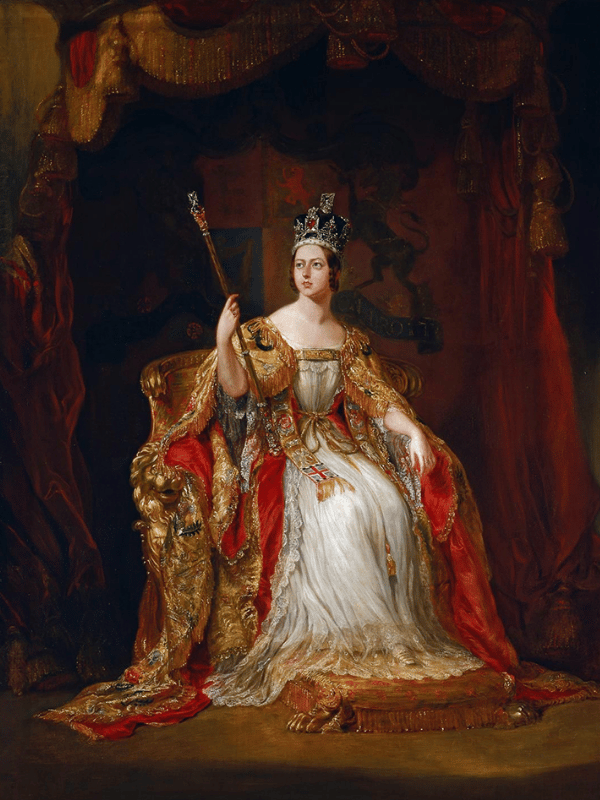
The Coronation of Victoria I
June 1837
Additional Information: The Georgian Era / The Death of William IV
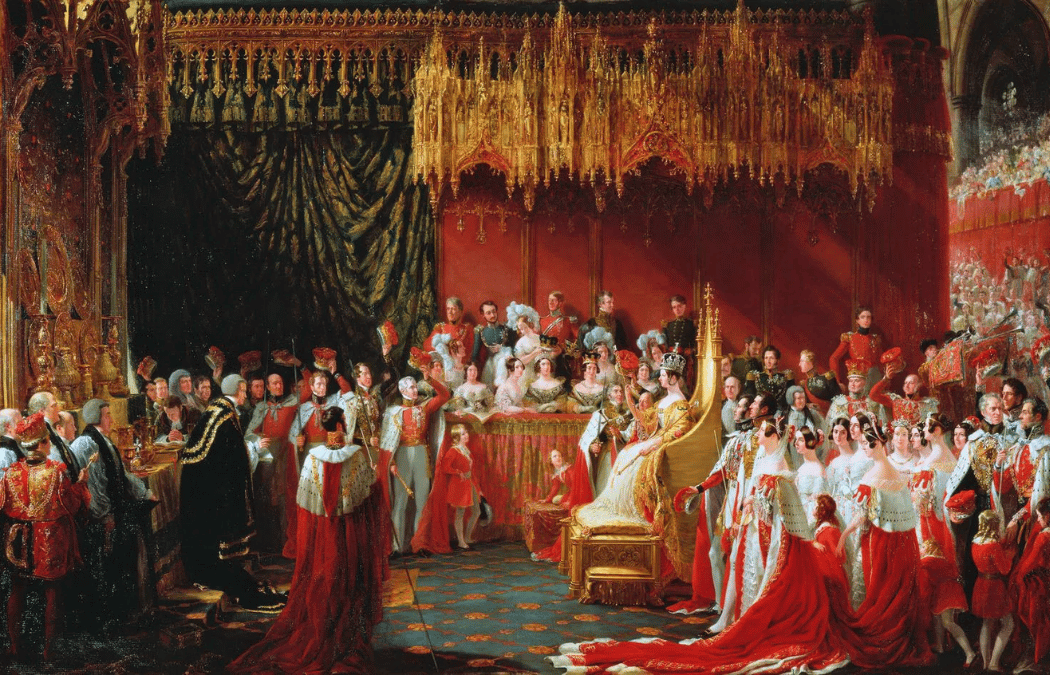
The death of King William IV on 20 June 1837 not only brought a new monarch to the crown, but also severed the 123-year personal union between Great Britain and the Kingdom of Hanover. Because Hanoverian succession laws barred women from inheriting the German crown under Salic Law, the two crowns split on a matter of biology. Princess Victoria of Kent ascended the British throne as the direct heir presumptive at eighteen years old, while the crown of Hanover passed from her lineage to her uncle, Ernest Augustus, Duke of Cumberland. Her formal coronation at Westminster Abbey on 28 June 1838 marked the dawn of the Victorian Era, bringing institutional stability to a monarchy that had been shaken by regency extravagance and popular unrest. Behind the coronation pageantry lay a country fracturing under industrial depression and urban poverty across the northern manufacturing cities.
To navigate these crises and learn the rules of a monarch within a constitutional country, Victoria relied on her first Prime Minister, the Whig statesman William Lamb, 2nd Viscount Melbourne. Operating from Downing Street, Lord Melbourne guided the young monarch through the legislative process, taught her the mechanics of governance, and insulated her from hostile Tory factions.
The inner workings of the monarchy changed in February 1485 through the Queen's marriage to her first cousin, Prince Albert of Saxe-Coburg and Gotha. Prince Albert was an administrative organizer who immediately took control of the royal household finances, cleared away court inefficiencies, and introduced disciplined continental management styles to the royal committees.
Mummy Mania and the Rise of Egyptology
1837 – 1922
The dawn of the Victorian era on 20 June 1837 accelerated a massive, obsessive cultural phenomenon across British society known as Egyptomania. While the academic study of antiquity slowly consolidated into the rigorous discipline of Egyptology, the public appetite for ancient Egyptian artifacts manifested as a highly macabre, commercialized craze.
The centerpiece of this obsession was the preservation of human remains. In ancient Egypt, mummification had been a sacred, religious ritual where embalmed bodies were bound in hundreds of yards of linen to preserve the deceased for the afterlife. To the Victorian public, however, these ancient dead were treated as consumer commodities, exotic curiosities, and theatrical entertainment. This obsession had been seeded decades earlier when Napoleon’s campaigns and pioneering surgeons like Thomas Pettigrew first popularized the public dissection of Egyptian mummies in the 1820s. By the late 1830s and 1840s, this practice had evolved from a niche scientific curiosity into a widespread, high-society entertainment staple across London.
The reality of this craze was highlighted by the sensational phenomenon of mummy unwrapping parties. Throughout the peak Victorian decades, these events transformed serious archaeological study into popular spectacles for high-society entertainment. Prominent antiquarians and private collectors regularly hosted ticketed, capacity events where they methodically removed the ancient linen bandages before an audience of aristocratic onlookers, examining the exposed amulets, jewellery, and skeletal remains. The trend spread rapidly across the private townhouses of the wealthy elite, where hosts would purchase mummies from international black-market traders to unwrap them as dinner-party entertainment, distributing the fragments of ancient wrappings to guests as exotic souvenirs.
This commercial exploitation reconfigured the domestic marketplace, integrating the physical remnants of ancient Egyptian history directly into everyday Victorian products. The most egregious manifestation of this trade was the mass production of a specialized oil-paint pigment known across artistic circles as "mummy brown" or Egyptian brown. This distinct, dark-brown color was manufactured by grinding down real human mummies mixed with pitch, myrrh, and bitumen—a dark, resin-like substance used in the ancient embalming process. The pigment was highly favored by prominent academic artists and the Pre-Raphaelite Brotherhood for its rich texture and transparency, remaining a standard, cataloged product across British art supply stores until the mid-twentieth century when the supply of ancient bodies was entirely exhausted. Concurrently, thousands of poorer, damaged mummies were purchased by industrial operations to be ground into agricultural fertilizer or processed into cheap paper pulp for local manufacturing.
The transition from this destructive, public exploitation toward a serious, preservationist science was driven by a new generation of British field researchers during the late nineteenth century. The structural foundation of modern Egyptology was established in 1882 when the writer Amelia Edwards co-founded the Egypt Exploration Fund to systematically finance archaeological excavations using rigorous structural mapping rather than destructive treasure-hunting. The absolute pioneer of this scientific shift was Sir William Matthew Flinders Petrie, who introduced meticulous stratigraphic recording and pottery analysis to the Nile Valley, fundamentally changing how artifacts were cleared and cataloged.
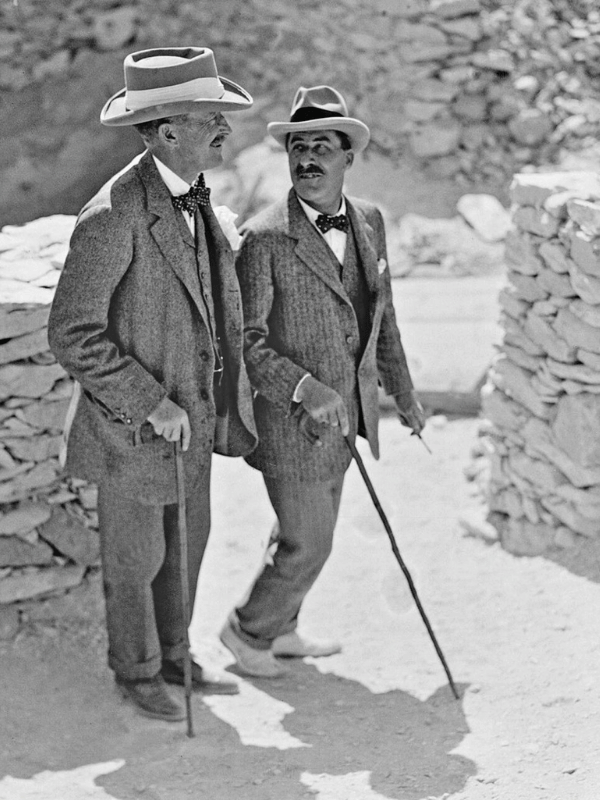
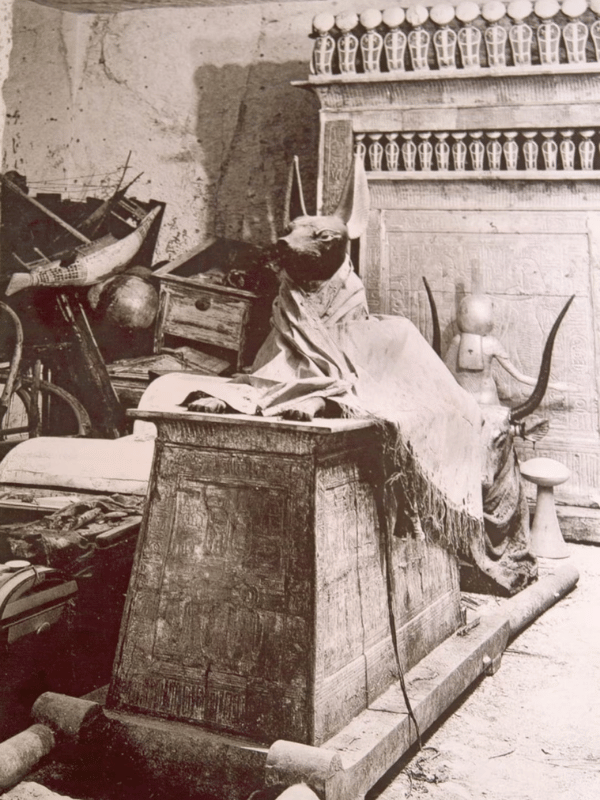
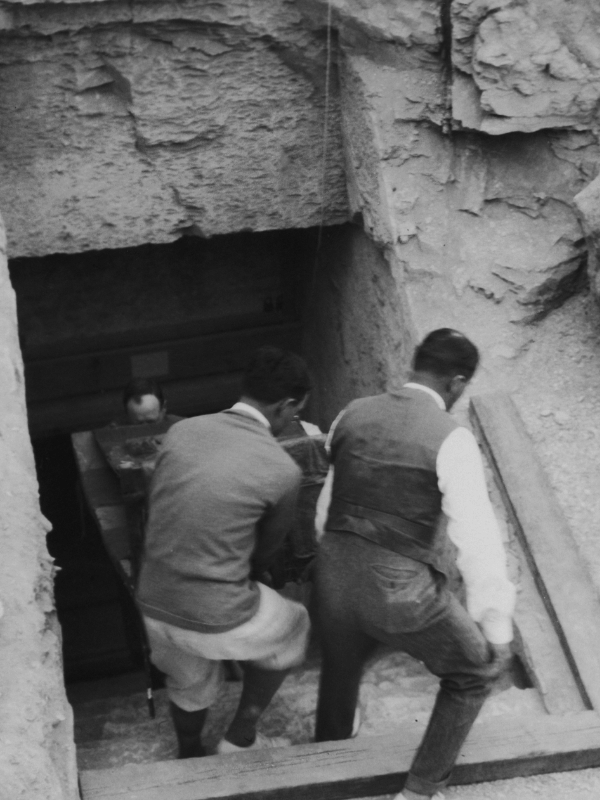
The ultimate, world-shaking culmination of this research occurred on 26 November 1922 in the Valley of the Kings, long after the close of the Victorian era. Following a relentless, five-year search financed by George Herbert, 5th Earl of Carnarvon, the British Egyptologist Howard Carter discovered the intact tomb of the boy pharaoh, King Tutankhamun. When Carter bored a tiny hole into the sealed plaster doorway and peered inside by the light of a single candle, the Earl of Carnarvon famously inquired if he could see anything, prompting Carter's iconic reply: "Yes, wonderful things."
The discovery of the unlooted tomb—containing thousands of priceless golden artifacts, royal sandals, and the pharaoh's spectacular solid gold sarcophagus—triggered a second, massive global wave of Egyptomania that reshaped international design, architecture, and popular fiction, permanently cementing the ancient pharaohs at the absolute center of Western popular culture.
Further Information: Mummy Mania and the Rise of Egyptology
The Chartist Movement
1838 - 1848
While the Great Reform Act of 1832 pacified the wealthy middle classes, it left the vast industrial working class entirely without a vote, sparking a decade of explosive radicalism known as the Chartist Movement. Mobilized by the publication of the People’s Charter of 1838, millions of wage-laborers across the northern manufacturing counties united under a single banner.
The movement demanded six radical constitutional changes: universal male suffrage, equal electoral districts, the abolition of property qualifications for members of parliament, annual parliaments, payment for representatives, and the secret ballot. This campaign bypassed traditional parliamentary channels, utilizing massive public rallies, fiery radical newspapers, and an expanding network of working-class clubs to challenge the exclusive rule of the landed establishment.
The government faced a profound crisis as the movement split between those advocating peaceful constitutional protest and the insurrectionists led by the charismatic Feargus O’Connor. When Parliament rejected their massive national petitions, simmering urban resentment exploded into open violence. In November 1839, the Newport Rising saw thousands of armed Chartist colliers march on South Wales to take control of the town, a direct insurrection that ended only when regular soldiers opened fire, killing over twenty rebels. This was paired with the Plug Plot Riots of 1842, a massive wave of general strikes where factory workers systematically pulled the plugs from steam engine boilers, paralyzing the industrial infrastructure of Lancashire and Yorkshire and forcing the government to deploy thousands of troops via the newly built railway networks to crush the unrest.
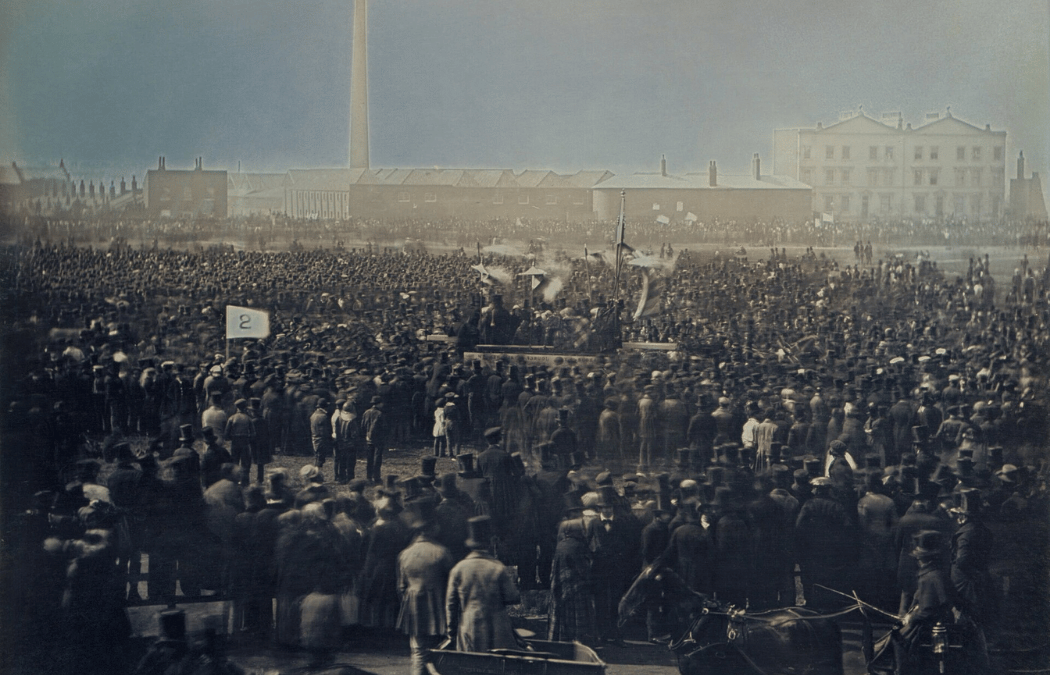
The movement reached its climax on 10 April 1848 against the backdrop of spreading revolutions across continental Europe. O’Connor mobilized over 150,000 Chartists to assemble at Kennington Common in London, intending to march across the Thames to deliver a final, six-million-signature petition directly to Parliament. Terrified of a revolution in the capital, the government executed a massive counter-mobilization. The Duke of Wellington took command of London's defenses, deploying eight thousand regular troops, fortifying the Bank of England, and swearing in 150,000 special constables to completely block the bridges. Outmaneuvered by this overwhelming display of military force, and with the petition subsequently exposed as containing thousands of forged signatures, the march dissolved without a shot fired.
Although the movement collapsed in the short term, Chartism permanently altered the political character of the country; within seven decades, five of their six radical demands were quietly passed into law, proving that the industrial masses had successfully laid the democratic foundations for modern Britain.
The First Opium War and the Treaty of Nanking
1839 – 1842 AD
Additional Information: The Second British Empire / Qing China and the Opium Wars
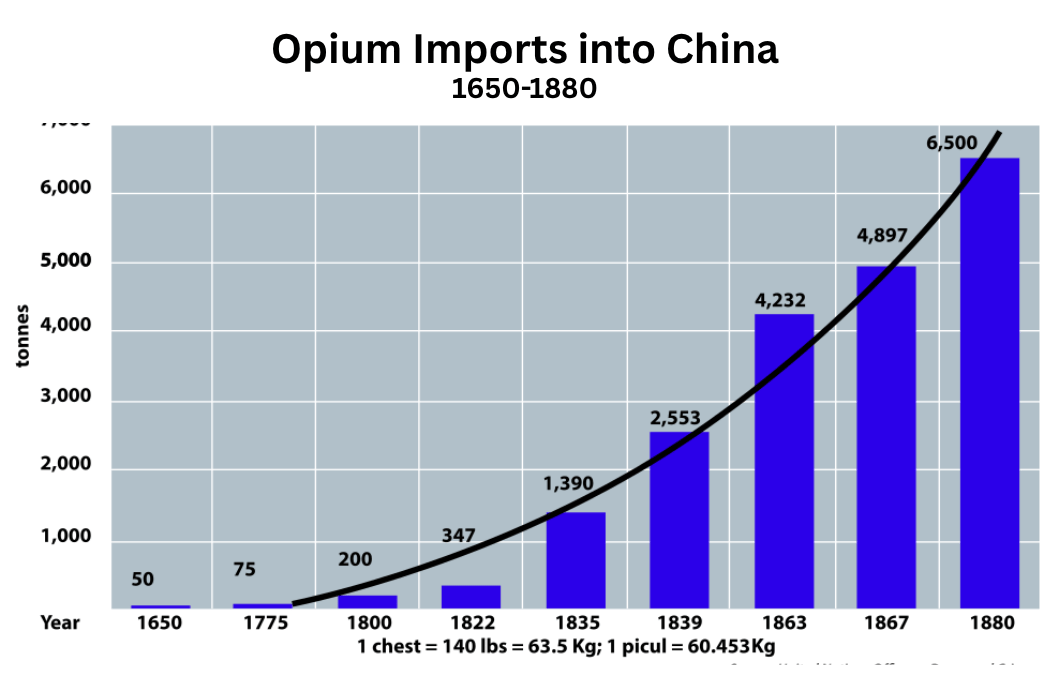
The opening of a direct conflict across the coastlines of imperial China was triggered by a severe trade imbalance between Great Britain and the Qing Dynasty. While the British public consumed massive amounts of Chinese tea, silk, and porcelain, the mercantilist policies of the Daoguang Emperor restricted all foreign merchant interaction to the solitary port of Canton and mandated that all transactions be paid exclusively in scarce silver bullion.
To halt this drain of precious metal from the national treasury, the Honourable East India Company began weaponizing the illegal trade of Indian-grown opium, smuggling thousands of chests into Chinese black markets to create a highly addictive consumer base and reverse the silver flow. The volatile diplomatic standoff exploded into crisis in March 1839 when the newly appointed Imperial Commissioner, Lin Zexu, arrived in Canton to launch a draconian eradication campaign. He blockaded the foreign merchant factories, forced the British Superintendent of Trade, Charles Elliot, to surrender twenty-two thousand chests of British opium, and dissolved the contraband stocks inside massive lime pits along the shore, inflicting an immense financial loss on London trading houses.
William Lamb, the 2nd Viscount Melbourne, who served as Prime Minister, reacted with immediate firmness, rejecting Chinese legal jurisdiction and dispatching a powerful naval expeditionary force to execute an aggressive policy of gunboat diplomacy. This punitive fleet arrived off the Chinese coast in June 1840, deploying advanced steam-powered iron warships like the Nemesis alongside standard ships-of-the-line to completely outmaneuver the shallow-draft wooden war-junks of the Qing navy.
The British forces launched a systematic campaign of coastal captures and fortifications. They bombarded and occupied the island of Chusan in July 1840, before advancing to the Pearl River delta. In January 1841, during the Second Battle of Chuenpi, the iron-hulled Nemesis utilized Congreve rockets to incinerate eleven imperial war-junks, forcing the temporary capitulation of Canton. When the imperial court rejected these early terms, the British expanded their operations northward under the command of Lieutenant-General Hugh Gough. British columns stormed the fortified heights of Amoy in August 1841, captured the strategic port of Ningpo in October 1841 after obliterating a counter-offensive of native recruits, and breached the walled defences of Chapu in May 1842.
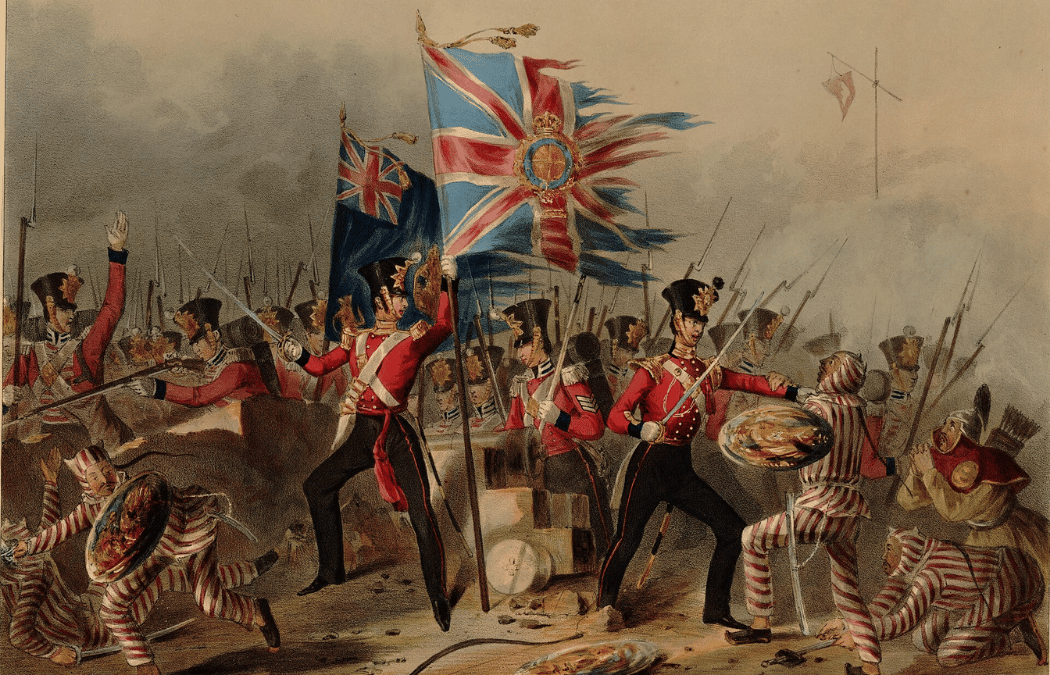
The campaign reached its military climax during the summer of 1842 as the fleet entered the Yangtze River to choke off the vital trade arteries of the empire. In June 1842, British gunboats silenced the massive coastal batteries at Woosung, clearing the path to capture Shanghai. The decisive operational breakthrough occurred on 21 July 1842 at the Battle of Chinkiang, where British troops under Lieutenant-General Hugh Gough stormed the strategic stronghold guarding the intersection of the Yangtze River and the Grand Canal.
Facing a desperate, fanatical resistance from the elite Manchu garrison, British infantry utilized scaling ladders and gunpowder charges to blow open the city gates, clearing the ramparts through intense hand-to-hand fighting that cost the British force over one hundred casualties and resulted in mass ritual suicides among the defeated defenders. This strategic triumph completely severed the grain supply lines to Beijing, allowing the fleet to advance directly to the walls of Nanking and forcing the imperial court to sue for peace to prevent the total dismantling of their remaining administrative infrastructure.
The conflict was officially brought to a victorious close on 29 August 1842 through the signing of the Treaty of Nanking, a landmark diplomatic settlement historically branded by China as the first of the Unequal Treaties. Under the strict terms of this agreement, negotiated aboard the flagship HMS Cornwallis by Sir Henry Pottinger and Qing commissioners Qiying and Yilibu, Great Britain engineered a sweeping expansion of imperial commerce.
The treaty forced the Qing Dynasty to completely dismantle the restrictive Canton system, opening five treaty ports—Canton, Amoy, Fuchow, Ningpo, and Shanghai—to unrestricted foreign merchant residence and consular authority. Furthermore, the Daoguang Emperor was forced to pay an enormous global indemnity of twenty-one million silver dollars to compensate for the destroyed opium and fund the British war exchequer, while ceding full, permanent sovereignty of Hong Kong Island straight to the British Crown to serve as a secure maritime trading base, initiating a century of European imperial dominance across the region.
Further Information: The First Opium War and the Treaty of Nanking
The First Anglo-Afghan War
1839 – 1842 AD
Additional Information: The Second British Empire / The First Anglo-Afghan War and Disaster at Kabul
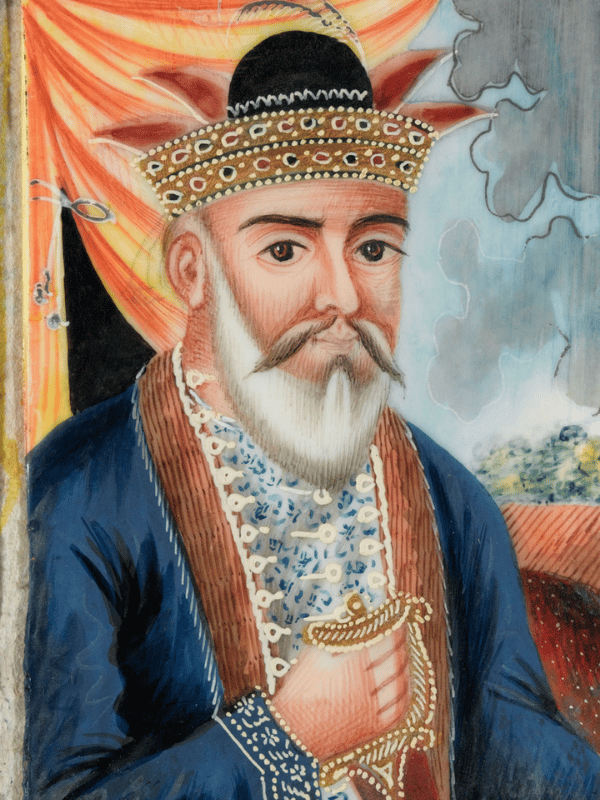
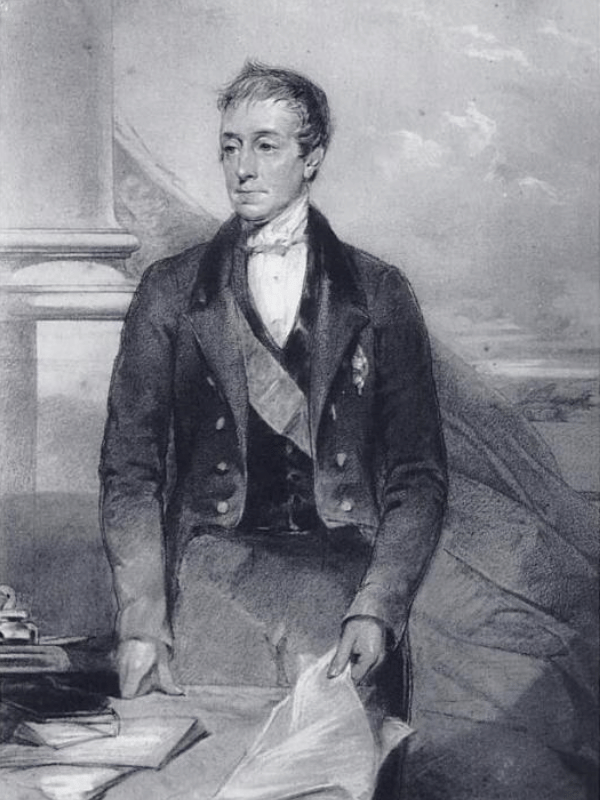
The opening of the first major Victorian campaign in Central Asia was driven by intense geopolitical anxiety regarding the vulnerability of British India to a potential Russian land invasion. Driven by the forward strategy of George Eden, the 1st Earl of Auckland, the corporate state launched a massive preemptive invasion in March 1839 to secure the mountain passes of Afghanistan.
The Army of the Indus, a force of twenty-one thousand British and Sepoy troops, marched through the grueling Bolan Pass and achieved its first major tactical victory on 23 July 1839 at the Battle of Ghazni. Finding the massive stone fortress heavily defended, British engineers launched a daring night raid to blow open the city's Kabul Gate with gunpowder charges, allowing infantry columns to storm the interior and crush the garrison. The army occupied Kabul in August 1839, successfully deposing the independent Amir, Dost Mohammad Khan, and installing a submissive puppet monarch, Shah Shuja Durrani.
Believing the conquest was finalized, the administration reduced the occupation garrison, leaving a compact force in Kabul under the command of Major-General William Elphinstone, an aging veteran crippled by severe gout. This initial corporate success proved to be a fragile illusion. The high cost of maintaining the puppet court forced Auckland to slash the traditional financial subsidies paid to local Ghilzai tribal chieftains, triggering a sudden, violent popular uprising across the country.
The situation turned critical in November 1841 when an angry mob in Kabul murdered the British political resident, Sir Alexander Burnes, outside his residence, exposing the fatal vulnerability of the British position. Rather than utilizing his regular infantry to crush the rising early, Elphinstone hesitated, trapping his troops inside unfortified cantonments situated outside the city walls. Following the execution of the chief diplomat, Sir William Macnaghten, during a botched negotiation with Akbar Khan—the rebellious son of Dost Mohammad—the starving garrison was forced to sign a humiliating capitulation. On 6 January 1842, Elphinstone ordered a full evacuation, marching a vulnerable column of 4,500 regular soldiers and twelve thousand civilian camp followers out of Kabul into the freezing mountain passes, relying on a false promise of safe passage to Jalalabad.
The brutal ninety-mile winter retreat quickly transformed into a total massacre as the column entered the narrow, snow-choked defiles of the Khord Kabul pass. Sheltered along the high stone ridges, thousands of Ghilzai snipers utilized their long-range jezail muskets to systematically slaughter the freezing, disorganized column from above, while mobile Afghan cavalry squadrons launched relentless charges into the rear guards. The discipline of the regular regiments completely collapsed under the sub-zero temperatures and a total lack of food.
The final defensive stand took place on 13 January 1842 at the rocky hill of Gandamak, where a tiny, exhausted remnant of twenty survivors from the 44th Regiment of Foot fought to the last man using their bayonets. Out of sixteen thousand individuals who had departed Kabul, nearly the entire column was wiped out by frostbite, starvation, and execution, leaving the military surgeon Dr. William Brydon to ride into the besieged border garrison at Jalalabad to report the destruction of the army.
Concurrently, independent British garrisons along the frontier fought desperate, separate actions to survive the national uprising. At the heavy Siege of Jalalabad, a brigade under Major-General Sir Robert Sale refused to capitulate, fortifying the broken mud walls and launching a decisive infantry sally on 7 April 1842 that shattered Akbar Khan's besieging army and captured their camp.
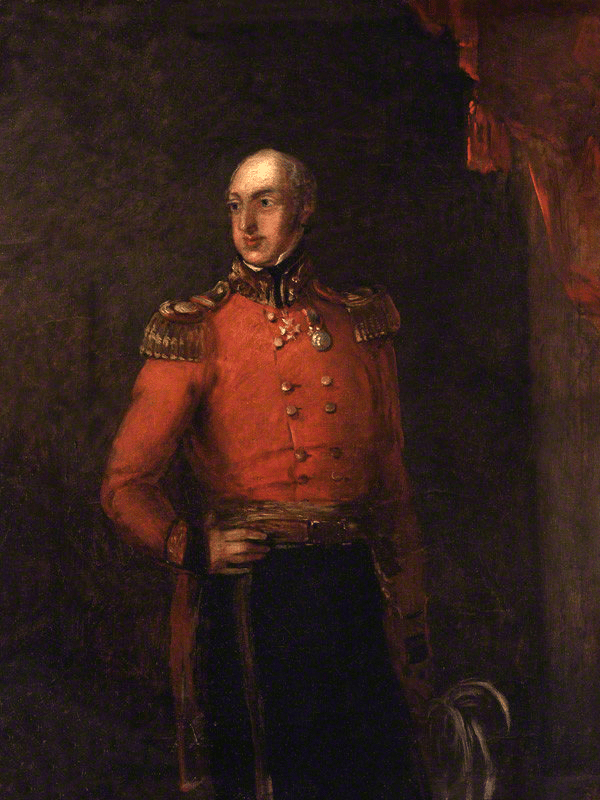
To avenge these humiliations and rescue the surviving hostages, Lord Auckland's replacement, the Governor-General Lord Ellenborough, dispatched the powerful Army of Retribution under Major-General George Pollock in the spring of 1842. Pollock's force became the first army in history to successfully storm the formidable Khyber Pass, utilizing specialized flankers to clear the heights before marching to reinforce Jalalabad, relieving the garrison at Kandahar, and systematically destroying the Grand Bazaar of Kabul in September 1842 to reassert imperial authority before executing a permanent strategic withdrawal from Afghanistan.
The British Conquest of Sindh
1843 AD
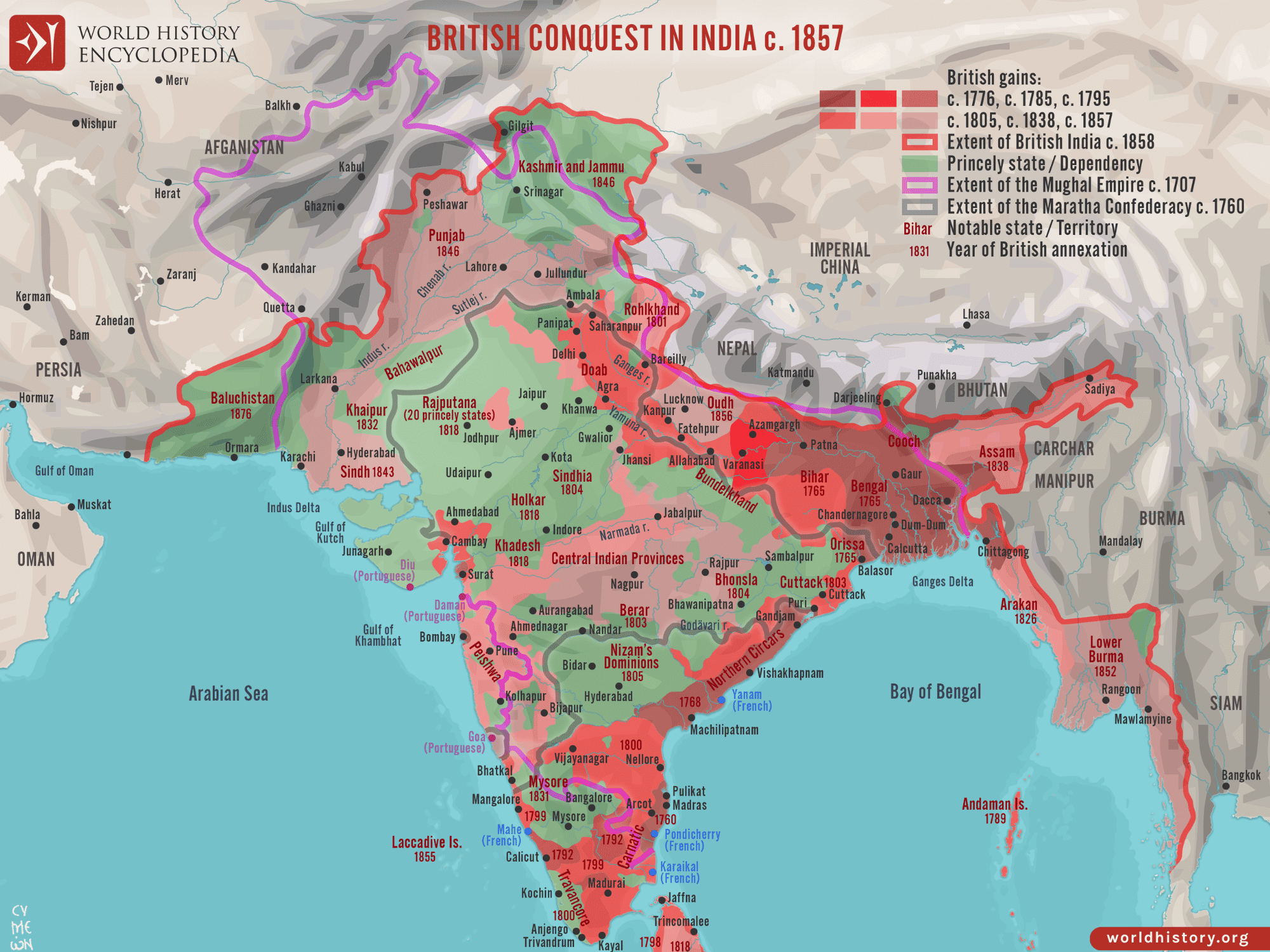
The military annexation of the independent Amirs of Sindh was driven by the desperate desire of the East India Company to restore its shattered military reputation following the catastrophic retreat from Kabul. Seeking to secure complete control over the navigation routes of the lower Indus River and expand the western frontier of the British Raj, the Governor-General, Edward Law, the 1st Earl of Ellenborough, unilaterally violated existing non-aggression treaties with the Talpur dynasty of Sindh.
Ellenborough dispatched a veteran, highly aggressive commander, Major-General Sir Charles Napier, to assume supreme military and political control over the region. Napier deliberately provoked a war by demanding draconian territorial concessions, seizing the wealthy trading center of Sukkur, and launching a high-velocity desert march to blow up the desert fortress of Imamgarh in January 1843, an unprovoked escalation that forced the desperate Baluchi tribal armies to rise in armed defense of their sovereign borders.
The brief but exceptionally bloody campaign achieved its definitive military milestone on 17 February 1843 at the Battle of Miani. Major-General Napier led a compact, heavily outnumbered force of 2,800 British and Sepoy infantry, comprising elite troops from the 22nd Regiment of Foot and disciplined Bombay native units, to confront a massive twenty thousand-strong Baluchi army.
The hostile host was entrenched along the high, steep dry bed of the Fuleli River, protected by dense hunting forests on their flanks. Napier relied on sheer tactical audacity, marching his infantry columns across an open plain under a blistering fire straight to the edge of the river bank. The engagement quickly transformed into a savage, close-quarters slugfest as the Baluchi warriors charged out of the river bed with swords and shields, only to be systematically cut down at point-blank range by the disciplined, rolling musket volleys and socket bayonets of the British lines.
The deadlock was broken when Napier ordered his cavalry brigade, the 9th Bengal Light Cavalry and the Scinde Horse, to launch a desperate charge through the river bed to storm the enemy’s exposed rear camp. This cavalry maneuver caused the Baluchi lines to fracture, turning the engagement into a total tactical rout that cost the Baluchi forces over five thousand casualties and the loss of their entire artillery train, while Napier suffered 256 casualties.
Napier followed up this victory on 24 March 1843 by winning the Battle of Hyderabad, deploying massed artillery to break a second army under Sher Muhammad Talpur and force the unconditional surrender of the historic capital. Bypassing his administrative boundaries, Napier immediately annexed the entire wealthy province straight into the corporate state machine, sending a legendary, one-word Latin pun back to the Governor-General—Peccavi, meaning "I have sinned"—to announce his unauthorized conquest, which permanently extended the British imperial frontier across the Indus.
Further Information: The British Conquest of Sindh
The Anglo-Burmese Wars
1824 – 1885 AD
Additional Information: Decline and Decolonisation / The Fall of Burma and Ceylon
The systematic expansion of the British Raj into Southeast Asia was driven by a century-long series of high-attrition campaigns that ultimately dismantled the independent Konbaung dynasty of Burma. The conflict developed across three separate operational phases, shifting from a defensive frontier action straight into a war of total imperial annexation.
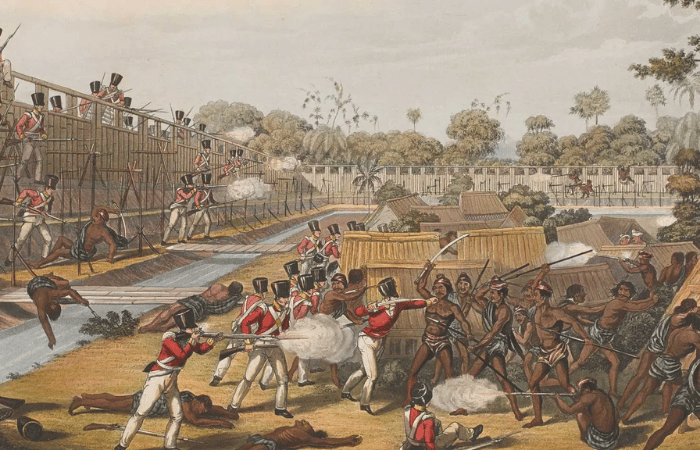
The First Anglo-Burmese War erupted in March 1824 when Burmese expansion into Assam and Cachar directly threatened the borders of British Bengal. A massive maritime expeditionary force of eleven thousand troops under Major-General Sir Archibald Campbell sailed up the Irrawaddy River to capture Yangon. The campaign quickly transformed into a grueling war of attrition against the brilliant Burmese General Maha Bandula, who constructed formidable bamboo stockades that blunt-forced early British infantry assaults.
Although Campbell eventually routed the Burmese forces at the Battle of Danubyu in April 1825, where Maha Bandula was killed by a mortar shell shell fragmentation, the victory was hollow; over fifteen thousand British and Sepoy soldiers died during the campaign, with over ninety-five percent of the casualties caused by yellow fever, malaria, and dysentery rather than combat. The conflict concluded in February
1826 with the Treaty of Yandabo, forcing Burma to pay a heavy indemnity and cede its vital coastal provinces.
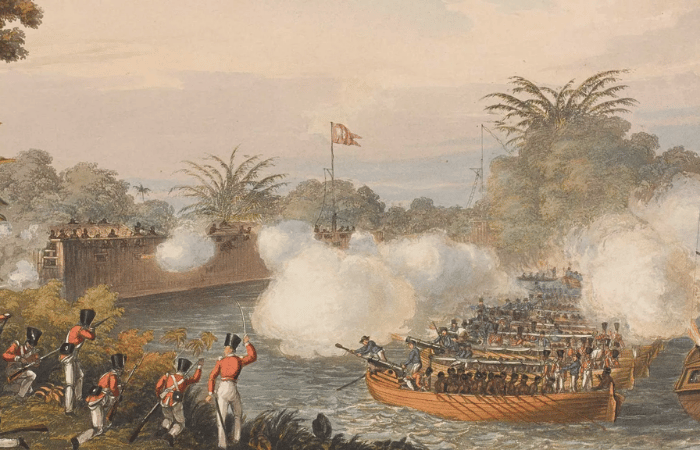
The peace dissolved into the Second Anglo-Burmese War in April 1852 following a series of aggressive commercial disputes engineered by British merchants in Yangon. The Governor-General, James Ramsay, the 1st Marquess of Dalhousie, used a minor fine levied against two British sea captains as a diplomatic trigger to dispatch a powerful naval squadron under Commodore George Lambert.
Utilizing advanced steam-powered gunboats, Lambert implemented an airtight maritime blockade, while an amphibious land force under Major-General Henry Godwin successfully stormed the heavily fortified Shwedagon Pagoda citadel in less than three days. Bypassing negotiations entirely, the Marquess of Dalhousie issued a unilateral proclamation of annexation in December 1852, swallowing the entire wealthy province of Lower Burma and stripping the Konbaung dynasty of its maritime outlets, leaving the remaining independent kingdom landlocked and economically dependent on British goodwill.
The final chapter of Burmese independence was closed in November 1885 during the Third Anglo-Burmese War, a high-velocity preemptive strike launched by the ministry of Robert Gascoyne-Cecil, the 3rd Marquess of Salisbury. Driven by intelligence that the Burmese King Thibaw Min was actively negotiating secret military and commercial monopolies with the French Empire, the Governor-General, Frederick Hamilton-Temple-Blackwood, the 1st Earl of Dufferin, launched a swift invasion.
A specialized flotilla of armored river steamers carrying ten thousand troops under Major-General Harry Prendergast surged up the Irrawaddy River, using superior artillery coordination to silence the frontier forts at Minhla and Myingyan in less than a week. The expeditionary force entered Mandalay on 28 November 1885, forced King Thibaw to sign an unconditional abdication, and systematically plundered the royal glass palace.
On 1 January 1886, the 1st Earl of Dufferin issued an imperial proclamation incorporating the entirety of Upper Burma directly into the British Raj, completely erasing the independent kingdom from the global map and establishing direct administrative dominance over the eastern frontier.
Further Information: The Anglo-Burmese Wars
Railway Mania
1840 - 1850
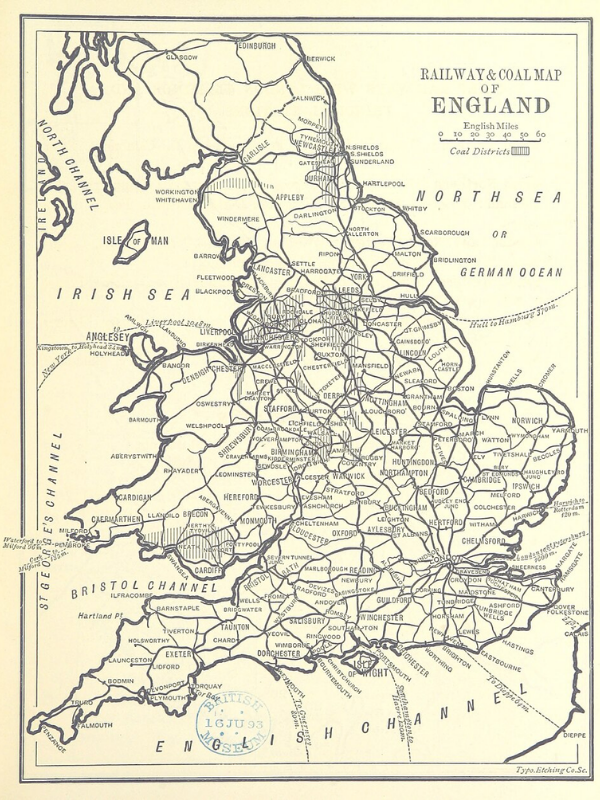
The stabilization of the country following the early Chartist unrest coincided with a monumental infrastructure boom that transformed the physical and economic geography of Great Britain. Known to history as Railway Mania, this phenomenon peaked between 1844 and 1846, when the British Parliament passed 272 individual statutory acts, legally authorizing private joint-stock companies to construct vast networks of iron track across the country.
Driven by a surplus of middle-class capital and speculative investors seeking high returns, the craze was fueled by promotional figures like George Hudson, the "Railway King," who paid out massive dividends using capital from new investors before his accounting frauds were exposed. Speculators rushed to buy shares in hundreds of competing lines, which caused railway stock prices to skyrocket before a sharp credit crash in late 1847 wiped out hundreds of fragile corporate ventures, shattering the fortunes of thousands of families and forcing the Bank of England to raise interest rates to eight percent.
Despite this financial collapse, the physical lines left behind turned Britain into an integrated industrial powerhouse. Led by pioneering civil engineers like George and Robert Stephenson, alongside their great rival Isambard Kingdom Brunel, armies of over 250,000 migratory Irish and British construction laborers—historically known as navvies—executed an immense feat of engineering.
Working with little more than pickaxes, shovels, and black gunpowder, these crews hand-dug deep cuttings, blasted the famous two-mile Box Tunnel through solid rock, and constructed massive brick structures like the Wharncliffe Viaduct. The labor was exceptionally hazardous; on the construction of the Woodhead Tunnel alone, the casualty rate exceeded that of the British army at the Battle of Waterloo, with over thirty men killed from accidental explosions and cave-ins.
By 1850, over 6,000 miles of working track spanned the country, permanently altering the physical layout of the island. This fast transport grid slashed industrial freight costs by 70%, allowed heavy coal and raw iron ore to move from northern pits to southern factories with unprecedented speed, and broke the isolation of rural shires. Furthermore, the necessity of managing complex train timetables across competing networks forced the railway companies to abandon localized sun-dials.
In November 1847, the Railway Clearing House officially mandated the synchronization of all clocks to Greenwich Mean Time, establishing a uniform national time across all towns and providing the physical foundation required to fuel the height of the Victorian workshop.
The Workshop of the World
1840 - 1855
By the mid-1840s, the violent social shocks of the early radical movements began to stall as Great Britain achieved an unmatched level of global industrial supremacy, officially earning its historical title as the Workshop of the World. This era saw the country mass-produce more coal, iron, textiles, and heavy machinery than the rest of the civilized world combined. Statistically, the home islands mined over two-thirds of the world's coal, manufactured half of its commercial iron, and processed more than seventy percent of all raw cotton textiles, a transformation that turned the nation into the single, undisputed engine of international commerce.
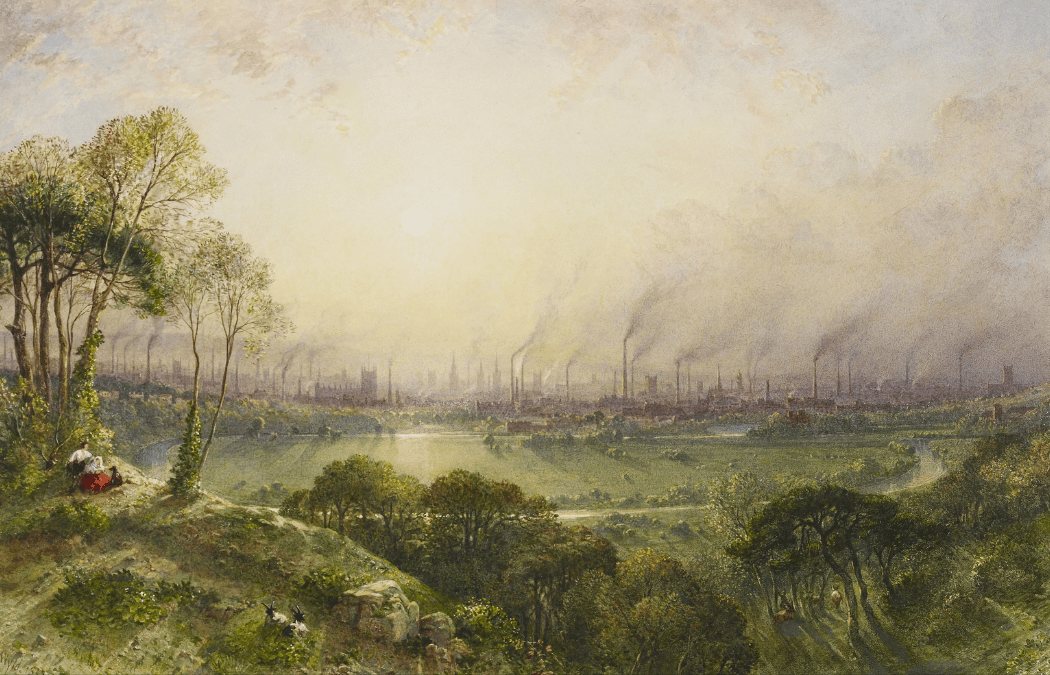
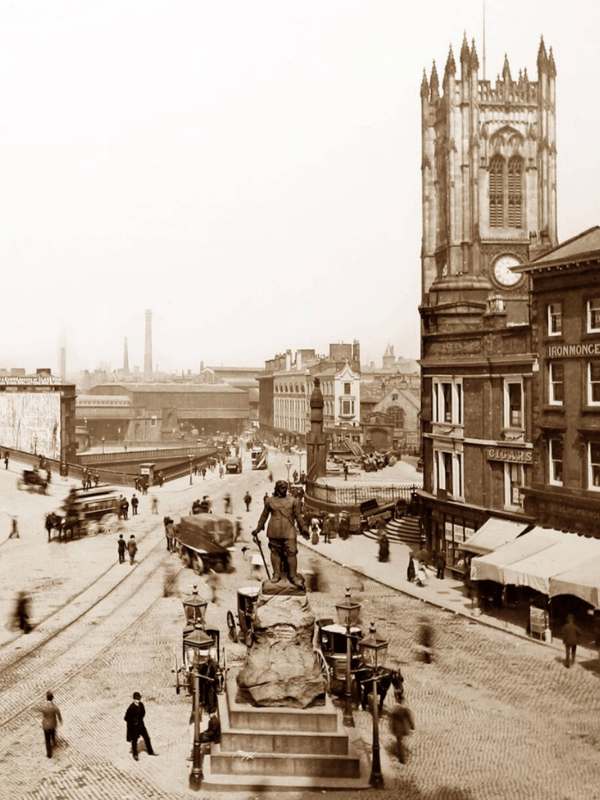
The primary driver of this economic supremacy was the mechanized dominance of the northern manufacturing centers, most notably the massive cotton mills of Lancashire and the heavy iron foundries of the West Midlands. Cities like Manchester—historically named "Cottonopolis"—housed thousands of steam-powered mechanical looms that spun raw cotton imported from global markets.
This raw material was processed into cheap, standardized textiles that were exported across every ocean, destroying the traditional domestic industries of foreign competitors through sheer volume and low pricing. Concurrently, the heavy metal foundries of Birmingham and the Black Country manufactured millions of iron rails, steam pistons, and precision engineering tools, supplying the core infrastructure required to construct the global transport systems of the nineteenth century.
This massive industrial output was heavily backed by a free-market state policy that explicitly favored industrial capitalism over traditional landowning agriculture. A definitive legislative milestone occurred on 23 May 1846 through the passage of the Importation Act 1846, masterminded by the Prime Minister, Sir Robert Peel. This sweeping statute repealed the ancient Corn Laws, abolishing the protective tariffs on foreign grain to deliberately lower food prices for urban laborers, reduce manufacturing production costs, and commit the state to a policy of total free trade. Government inspectors and factory owners enforced highly organized corporate frameworks, standardizing work shifts through the whistle and the factory clock to maximize output from the urban proletariat.
By controlling the primary manufacturing and engineering technologies of the century, Great Britain successfully generated an unprecedented flow of international wealth directly onto the island. This capital influx transformed its major settlements into massive, smoke-choked industrial hubs that ran with machine-like precision, providing the economic baseline required to launch the height of Victorian maritime commerce.
Further Information: The Workshop of the World
Victorian Society, Morality, and Daily Life
1840 - 1890
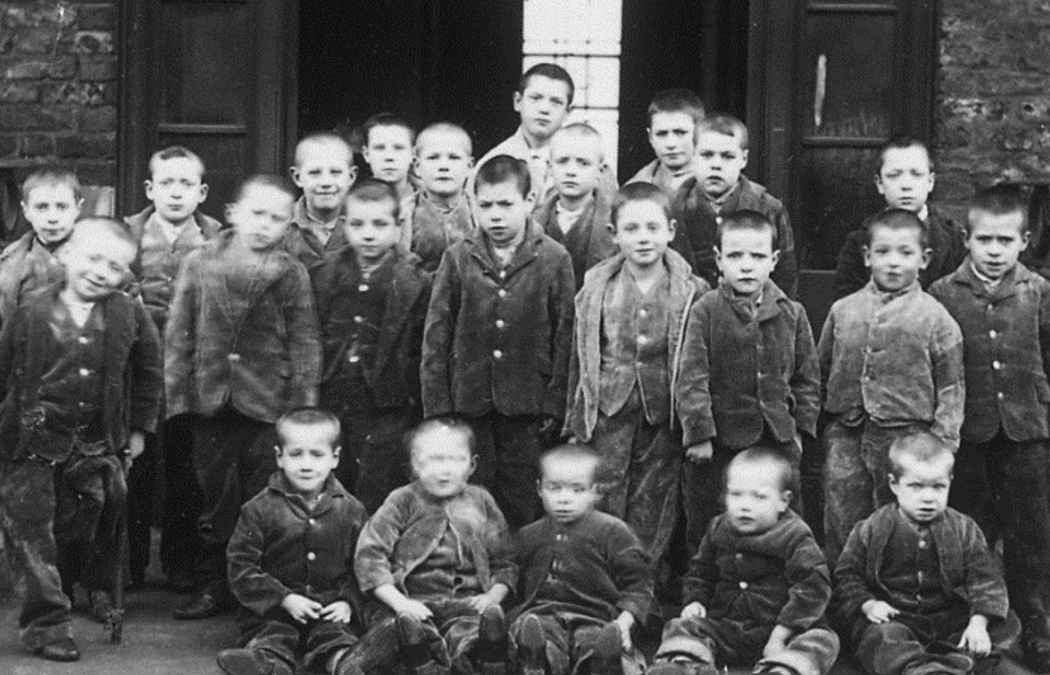
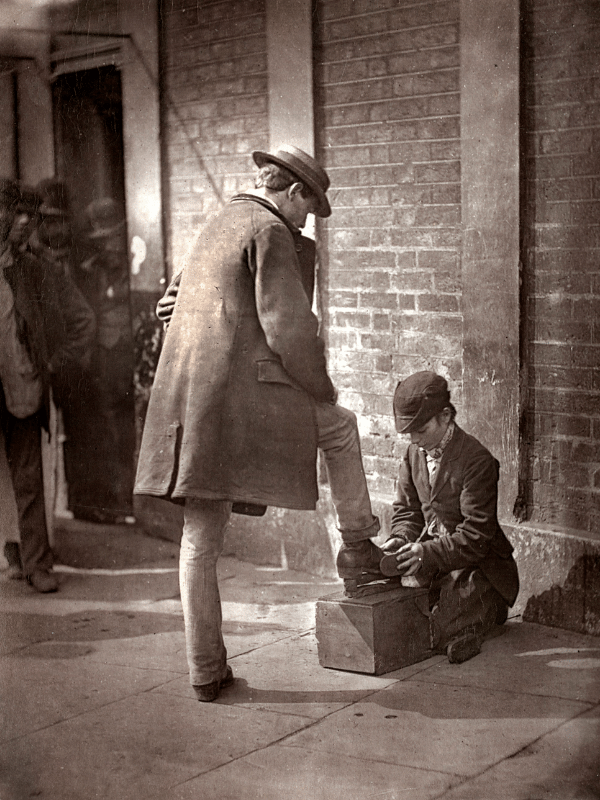
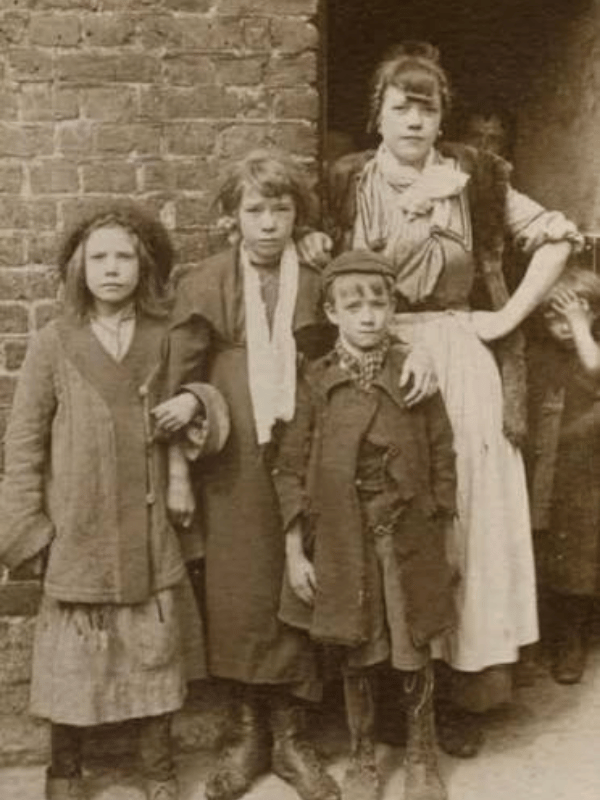
Beneath the vast international architecture of high imperialism, the daily reality of Victorian society was dictated by a highly rigid class system and a strict, public code of social morality. This social framework was heavily anchored to the values of the expanding middle class, who championed the virtues of hard work, personal thrift, strict religious conformity, and the absolute preservation of respectability. It was a culture defined by social surveillance.
Daily life for the vast majority of the population was entirely shaped by the tough environment of the industrial cities, where working-class families lived in dense rows of brick, back-to-back terraced houses positioned directly downwind from the soot-spewing factory chimneys.
To manage the severe health and environmental hazards of this rapid urbanization, the state passed a series of pioneering Public Health and Factory Acts. These statutes restricted child labor, regulated working hours in textile mills, and funded massive underground sewer networks—such as Joseph Bazalgette’s monumental London drainage system—to permanently wipe out deadly cholera epidemics and clear the urban slums.
Social order was strictly maintained through a complex web of legal and cultural disciplines designed to enforce public order at all costs. The Poor Law Amendment Act forced the destitute into highly disciplined, prison-like workhouses to intentionally discourage welfare dependency, while the Matrimonial Causes Act 1857 brought divorce under the jurisdiction of the civil courts but maintained a heavy double standard against women.
This domestic reality created a deeply divided nation, where essentially, a highly confident, technologically advanced elite class lived in absolute luxury, while the working mass functioned as a tightly managed, clock-regulated labor force driving the economic engines of the global superpower.
Further Information: Victorian Society, Morality, and Daily Life
The Great Irish Famine
1845 - 1852
Additional Information: Genetic History of the English People / The Great Famine and the Influx of Irish Labour
In the autumn of 1845, the population and governing consensus of the United Kingdom suffered a catastrophic humanitarian disaster. A devastating airborne potato blight, caused by the oomycete Phytophthora infestans, struck the agricultural plots of Ireland, completely rotting the primary food source for over three million peasant laborers. This agricultural collapse launched the Great Irish Famine, a multi-year crisis defined by widespread starvation, epidemic typhus, and a severe breakdown of security across the island.
The response from the British government back at Westminster was heavily shaped by a rigid adherence to laissez-faire economic theory and a cold, unyielding bureaucracy. Under the Whig administration of Lord John Russell and the direct administrative management of the Assistant Secretary to the Treasury, Sir Charles Trevelyan, the government heavily restricted direct food relief and closed public soup kitchens, arguing that trade forces must be left to correct themselves. The record of this period reveals a horrific story of human collapse; between 1845 and 1852, over one million Irish people died of starvation and disease, while another million were forced into desperate emigration aboard overcrowded "coffin ships" across the Atlantic, permanently emptying out the towns and villages of the island.
The famine triggered a major constitutional showdown at Westminster over the Corn Laws—the high import tariffs on foreign grain that protected the profits of wealthy English landowners while keeping the price of bread artificially high for the starving poor. In 1846, the Conservative Prime Minister, Sir Robert Peel, broke his own party’s protectionist platform, partnering with the Whigs to pass the Importation Act 1846 to completely repeal the Corn Laws and allow cheap foreign grain into the country.
This legislative victory permanently shifted the economic policy of the United Kingdom toward free trade, marking the formal surrender of the old landed interest to the new manufacturing forces of the industrial cities. However, the move shattered the Conservative party into rival factions, driving Peel from power in June 1846 and leaving a permanent layer of bitter political resentment across Ireland that fueled a century of nationalist agitation.
Further Information: The Great Irish Famine
The First Anglo-Sikh War
1845 – 1846 AD
Additional Information: The Second British Empire / The Great Game / Warfare in India: Anglo-Maratha and Anglo-Sikh Wars
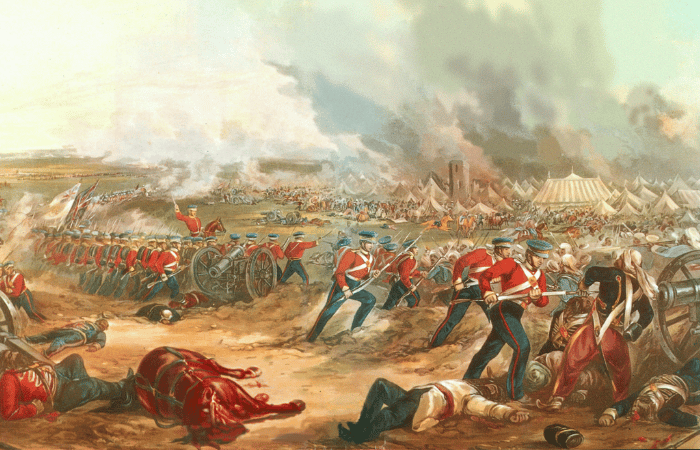
The expansion of British corporate hegemony across northwestern India reached a violent milestone in December 1845 with the outbreak of the First Anglo-Sikh War along the borders of the Punjab. Following the death of Maharaja Ranjit Singh, the independent Sikh Empire fell into severe factional instability, leaving the supreme command of the state in the hands of the Khalsa—a powerful, highly disciplined standing army of over eighty thousand men trained by veteran French and Italian mercenary officers.
Watching this militarization with deep anxiety, the Governor-General, Sir Henry Hardinge, ordered a massive concentration of East India Company troops along the Sutlej River frontier. Believing an invasion was imminent, the Khalsa crossed the river on 11 December 1845, a defensive deployment that the corporate state aggressively treated as an unprovoked declaration of war.
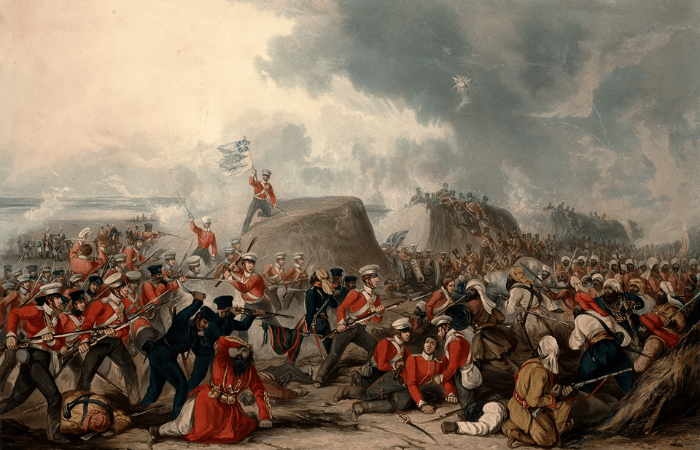
The resulting campaign in the Punjab was characterized by exceptionally bloody, high-casualty frontal engagements that pushed the British army to the absolute brink of tactical defeat. At the Battle of Ferozeshah on 21 December 1845, British and Sepoy infantry under General Sir Hugh Gough launched a series of desperate bayonet charges against heavily fortified Sikh earthworks, facing a devastating artillery cannonade from over one hundred heavy brass guns.
The corporate forces suffered over two thousand casualties in a single night of brutal deadlock, causing Sir Henry Hardinge to order his staff to burn all state papers in anticipation of total defeat. The company was ultimately saved from destruction not by raw military superiority, but by political treason; the prime minister of the Sikh court, Lal Singh, and the commander-in-chief, Tej Singh, were secret corporate informants who deliberately withheld reinforcements and abandoned their own positions at critical moments to fracture the Sikh lines.
The definitive strategic breakthrough occurred on 10 February 1846 at the Battle of Sobraon, where General Gough trapped the main Sikh army against the deep waters of the Sutlej River. Following a continuous, high-volume artillery bombardment, British regiments breached the earthworks, while a sudden rise in the river level—combined with the treachery of Tej Singh, who ordered the destruction of the main pontoon bridge—trapped thousands of Sikh soldiers under a merciless crossfire, costing the Khalsa over ten thousand men.
This total military defeat thoroughly broke the Punjab’s capacity for collective resistance, forcing the child Maharaja, Duleep Singh, to sign the Treaty of Lahore on 9 March 1846. Under the terms of this subsidiary settlement, the corporate state annexed the fertile Jalandhar Doab, stationed a permanent British resident inside the capital to manage the regency layout, and forced the court to surrender the legendary Koh-i-Noor diamond to the British Crown, establishing complete administrative dominance over the frontier.
Further Information: The First Anglo-Sikh War
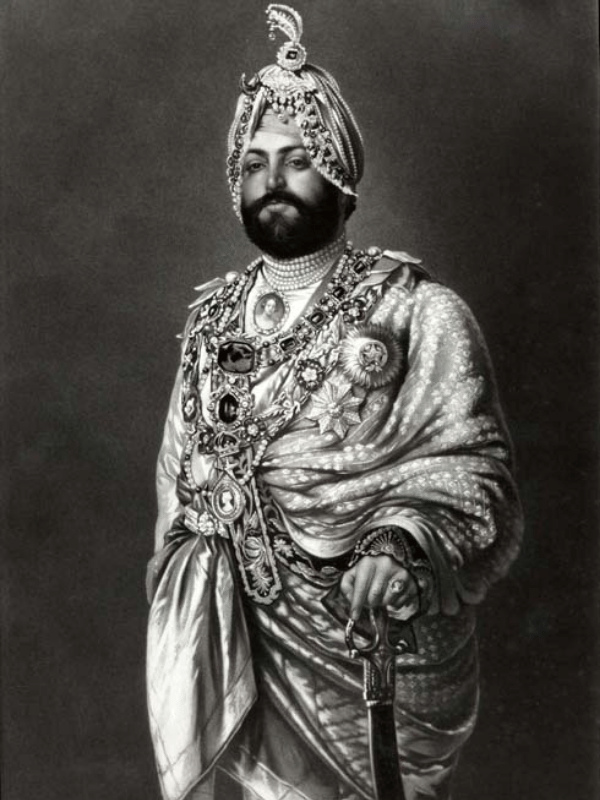
The Second Anglo-Sikh War and Annexation of the Punjab
1848 – 1849 AD
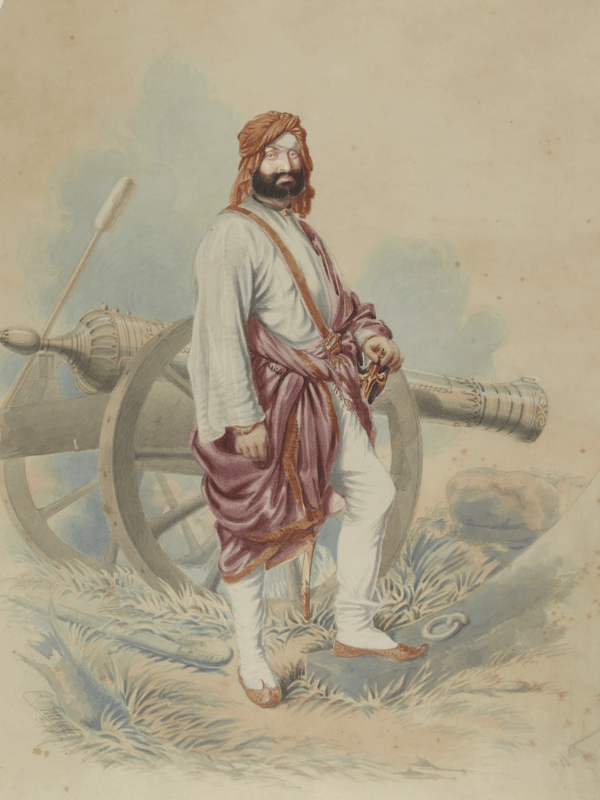
The fragile truce established by the Treaty of Lahore collapsed rapidly in April 1848 with the outbreak of a widespread nationalist uprising across the Punjab. The conflict was triggered at the fortress city of Multan when the local governor, Diwan Mulraj, resigned in protest over corporate tax demands and his troops subsequently murdered two British political agents, Lieutenant William Anderson and Patrick Vans Agnew.
This localized rebellion instantly transformed into a full-scale war of national liberation as thousands of veteran Khalsa soldiers, deeply embittered by their previous defeat and the suffocating presence of the British residency in Lahore, flocked to the banner of Chattar Singh Attariwalla and his son, Sher Singh. Determined to permanently break the independent power of the Sikh state, the new Governor-General, James Ramsay, the 1st Marquess of Dalhousie, aggressively deployed the full military resources of the East India Company, declaring that the Sikh nation had thrust war upon the British and would receive it with a vengeance.
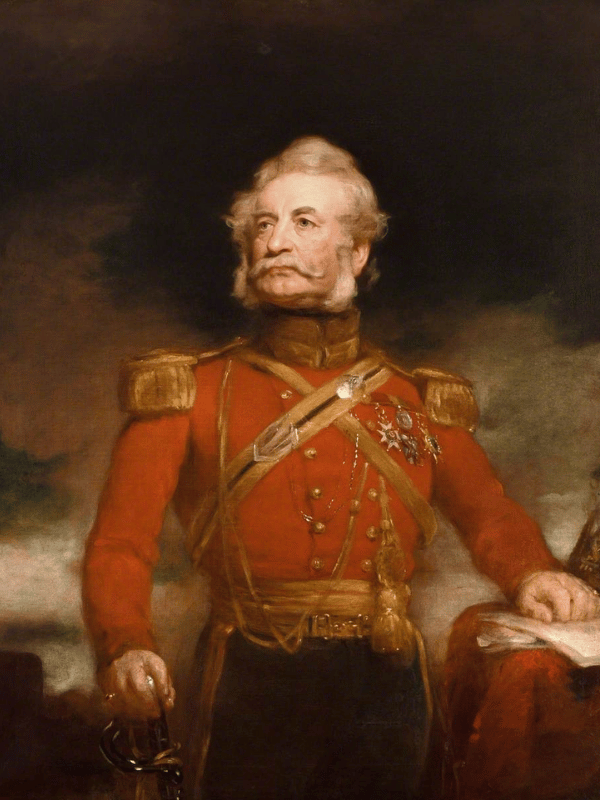
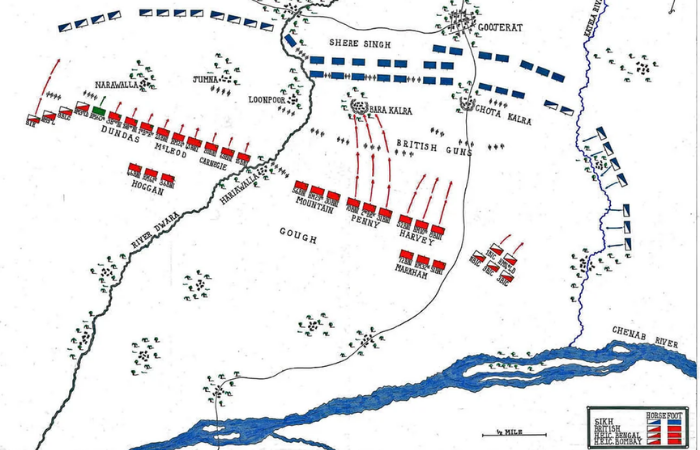
The resulting winter campaign developed into an exceptionally bloody, high-casualty struggle that severely tested the tactical capabilities of the British command. On 13 January 1849, at the Battle of Chillianwala, General Sir Hugh Gough launched a series of blind, poorly coordinated frontal infantry assaults through dense jungle terrain against a heavily dug-in Sikh army under Sher Singh. The Khalsa artillery systematically decimated the advancing columns at point-blank range, while mobile Sikh cavalry squadrons executed devastating counter-charges that completely routed the British horse regiments. The catastrophic engagement cost the corporate forces over 2,400 casualties, resulting in the humiliating loss of three regular infantry regiment colors and four horse artillery pieces, an embarrassment that prompted an outraged Parliament to instantly recall Gough from command.
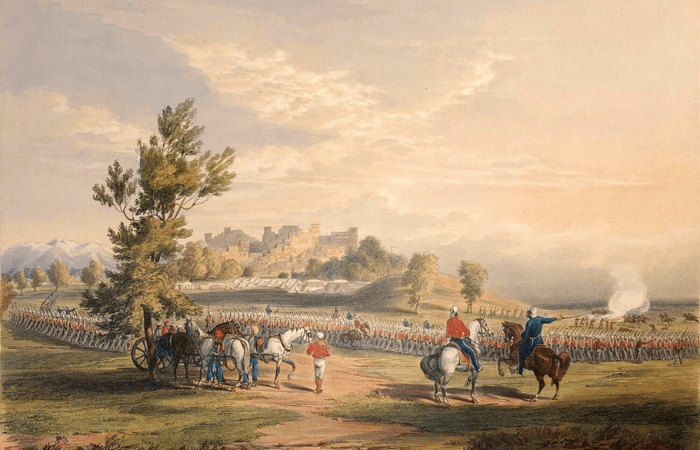
Before his replacement could arrive, General Gough managed to restore his military reputation on 21 February 1849 at the Battle of Gujrat, historically branded as the Battle of the Guns. Bypassing his usual reckless bayonet tactics, Gough deployed a massive artillery vanguard of ninety-six heavy field guns to unleash a continuous, three-hour bombardment that thoroughly smashed the Sikh lines and forced a total tactical rout.
This crushing battlefield victory permanently broke the Khalsa army, forcing the unconditional surrender of the remaining Sikh chieffs at Rawalpindi in March 1849. The Marquess of Dalhousie immediately issued a unilateral proclamation of annexation, dissolving the historic Sikh Empire and incorporating the entirety of the wealthy Punjab province directly into the corporate state machine, a strategic conquest that extended the British imperial frontier straight to the borders of Afghanistan.
Further Information: The Second Anglo-Sikh War and Annexation of the Punjab
The New Zealand Wars
1848 – 1849 AD
The expansion of British colonial settlements across the North Island triggered a protracted, high-attrition conflict with the indigenous Māori population over sovereign authority and land ownership. While the Treaty of Waitangi, signed in 1840, had technically guaranteed Māori possession of their ancestral lands, the colonial administration under Governor George Grey systematically utilized legal loopholes and aggressive forced purchases to satisfy the demands of incoming European immigrants.
This volatile layout erupted into open warfare in March 1845 with the Flagstaff War, initiated when the Ngāpuhi chief Hōne Heke cut down the British flagstaff at Kororāreka four times to protest the suffocating imposition of British customs duties and administrative oversight. The conflict rapidly evolved into an asymmetric war of attrition that pushed the military logistics and tactical assumptions of the British army to their furthest limits.
The hallmark of the conflict was the innovative defensive engineering of the Māori, who constructed specialized fortified strongholds known as pā. Bypassing traditional wood-and-stone bastions, the Māori built low-lying earthworks reinforced by thick layers of green flax padding that expertly absorbed the kinetic energy of heavy British artillery shells. Inside these networks, defenders dug an intricate labyrinth of deep subterranean bunkers, firing trenches, and zigzag communication tunnels that completely shielded them from direct blast fragmentation.
At the Battle of Ohaeawai in July 1845, a reckless frontal bayonet charge by British regular infantry against a hidden pā garrison resulted in a bloody repulse, costing the British over one hundred casualties in less than ten minutes. This defensive model achieved its definitive tactical milestone on 29 April 1864 at the Battle of Gate Pā, where a continuous, eight-hour bombardment by 110 modern artillery pieces—including heavy Armstrong guns—failed to breach the interior bunkers, allowing the hidden Māori defenders to launch a devastating close-range ambush that decimated the invading columns of the 68th Regiment of Foot.
The conflict reached its most destructive phase during the Waikato Campaign of 1863, when Governor George Grey launched a massive, preemptive invasion to crush the Kīngitanga or Māori King Movement, which aimed to unify the tribes and halt all future land sales to the crown. Utilizing a professional force of fourteen thousand British regulars and colonial militia, reinforced by ironclad gunboats patrolling the Waikato River, General Duncan Cameron systematically pushed the Māori forces back through a sequence of heavy infantry engagements, culminating in the heroic Siege of Ōrākau in April 1864.
Trapped without food or water inside an incomplete fortification, three hundred Māori defenders defiantly rejected Cameron’s demands for unconditional surrender, chanting their refusal to yield before launching a desperate breakout through the British lines. Following the total suppression of the primary resistance movements, the colonial government passed the New Zealand Settlements Act 1863, a draconian statute that allowed the crown to systematically confiscate over three million acres of fertile Māori land, permanently fracturing the traditional tribal economy and securing complete British administrative dominance across the islands.
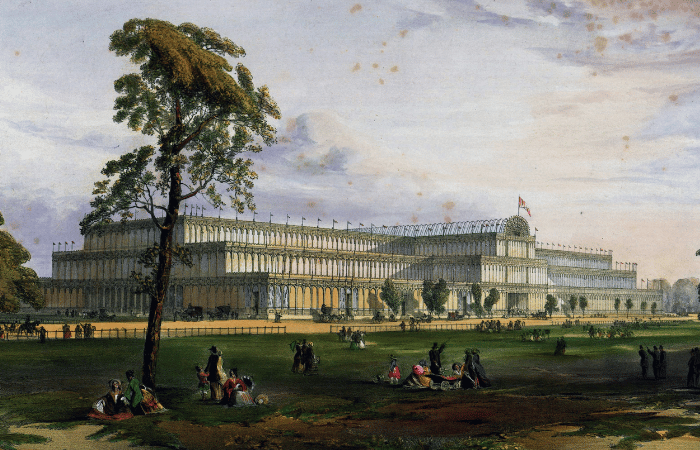
The Great Exhibition of 1851 and the Crystal Palace
1851
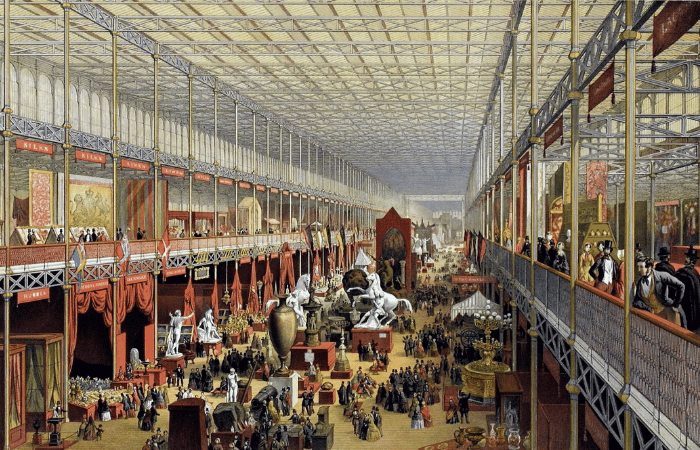
The mid-century point of the Victorian era was celebrated through a monumental cultural and technological festival known as the Great Exhibition of the Works of Industry of All Nations. Brainchild of Prince Albert and organized by a select royal commission, the exhibition opened in London’s Hyde Park on 1 May 1851, functioning as a grand visual arena designed to project Britain’s industrial and civilisational supremacy to the rest of the world.
The pinnacle of this display was the exhibition building itself: the Crystal Palace. Engineered by the glasshouse builder Joseph Paxton, the structure was a revolutionary masterpiece of modular construction, built entirely from a rigid grid of cast-iron columns and over nine hundred thousand square feet of sheet glass. Measuring 1,851 feet long to match the calendar year, the soaring building housed over one hundred thousand individual exhibits from across the globe, with a full half of the exhibition space dedicated strictly to the heavy machinery, steam engines, and raw material extractions of Great Britain and her expanding global colonies.
The Great Exhibition was an extraordinary commercial and political triumph, drawing in over six million visitors—equivalent to a full third of the national population—who traveled to London on fast, cheap excursion trains from across the country. The entry fees generated a massive financial surplus that Prince Albert masterfully used to buy land in South Kensington to establish a permanent national hub of science and art, a legacy that created the Victoria and Albert Museum, the Science Museum, and the Natural History Museum.
By bringing massive working-class crowds and elite nobles together inside a single, glittering cathedral of trade without a single act of radical disorder or political violence, the exhibition successfully proved that the country had mastered its domestic tensions, entering a highly stable era of social peace built entirely on free-market wealth, common law, and industrial confidence.
Further Information: The Great Exhibition of 1851 and the Crystal Palace
The Second Opium War
1856 – 1860 AD
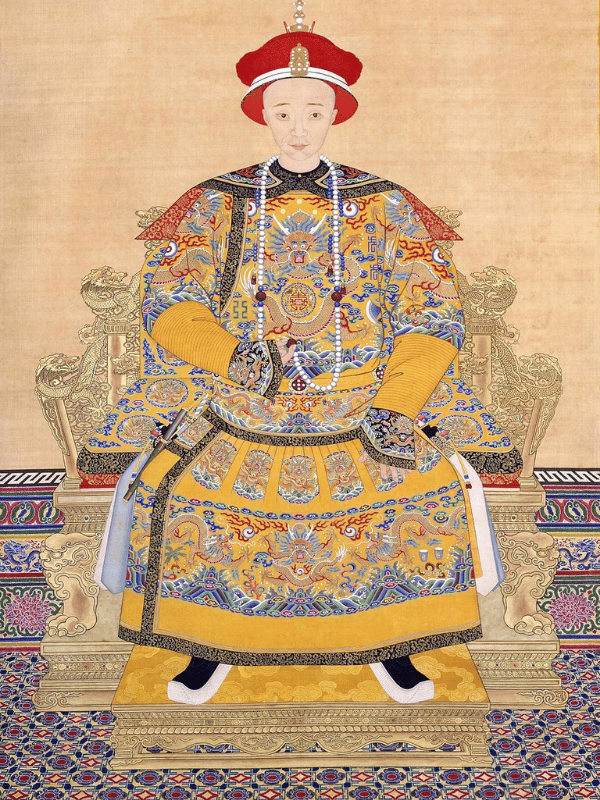
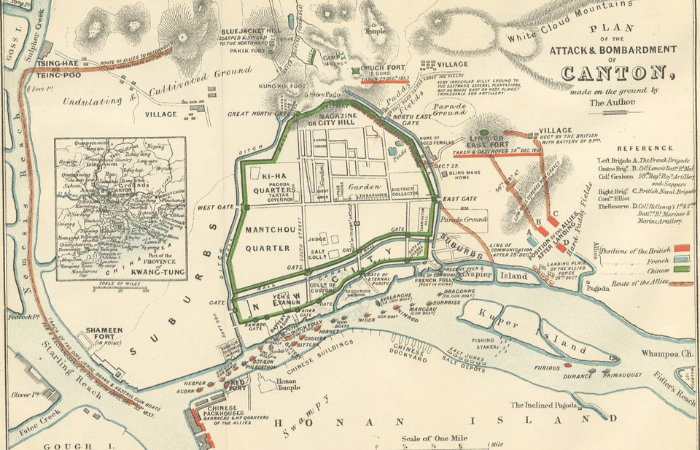
The fragile peace established by the Treaty of Nanking dissolved in October 1856 with the outbreak of the Second Opium War, a conflict driven by British determination to force a total legalization of the opium trade and open all of China to European merchant networks. The immediate diplomatic flashpoint occurred on 8 October 1856 when Qing officials boarded the Arrow, a Chinese-owned trading vessel registered under a British flag in Canton, arresting twelve crewmen on charges of piracy and smuggling.
The British consul in Canton, Harry Parkes, aggressively treated this boarding action as an insult to the crown, demanding the immediate release of the prisoners and a formal public apology. When the hardline Viceroy of Canton, Yeh Ming-chen, released the crewmen but refused to offer an apology, the British command used the incident to launch a massive, punitive military intervention.
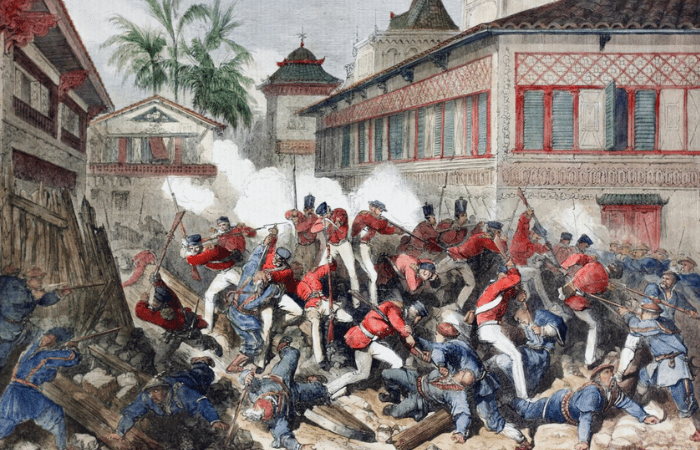
This maritime campaign rapidly expanded into a multi-national coalition effort in 1857 when the French Empire, ruled by Napoleon III, joined Great Britain following the public execution of a French Catholic missionary, Auguste Chapdelaine, by local Chinese authorities in Guangxi. Operating in administrative tandem with French naval forces, a powerful British expeditionary force under James Bruce, the 8th Earl of Elgin, launched a high-velocity offensive up the Chinese coast. Bypassing the outdated shore defenses, the joint Anglo-French fleet used advanced ironclad steam warships to systematically bombard and capture Canton in December 1857, packing the defiant Viceroy Yeh Ming-chen off to a military prison in Calcutta.
To force the imperial court to accept their sweeping commercial terms, the allied fleet sailed north to launch a massive amphibious assault against the strategic Taku Forts guarding the Mouth of the Peiho River, successfully capturing the earthen ramparts in May 1858 and forcing the signing of the Treaty of Tientsin.
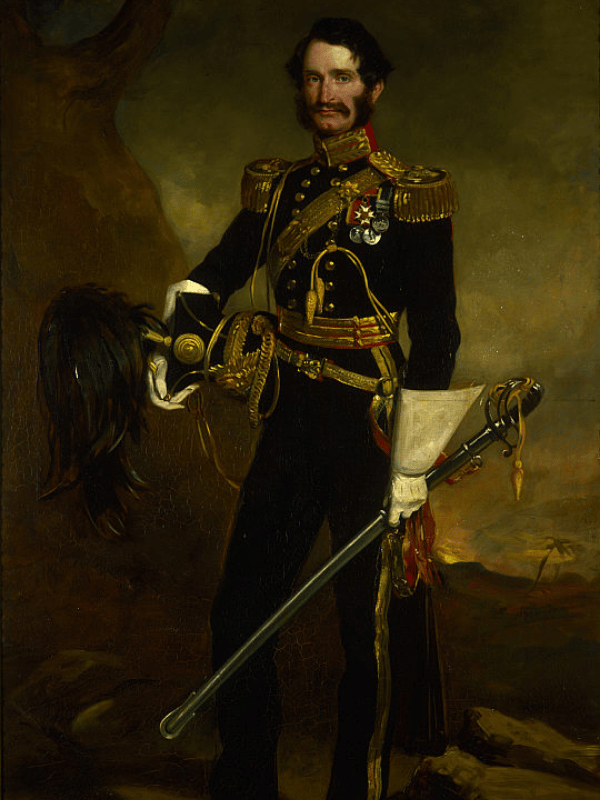
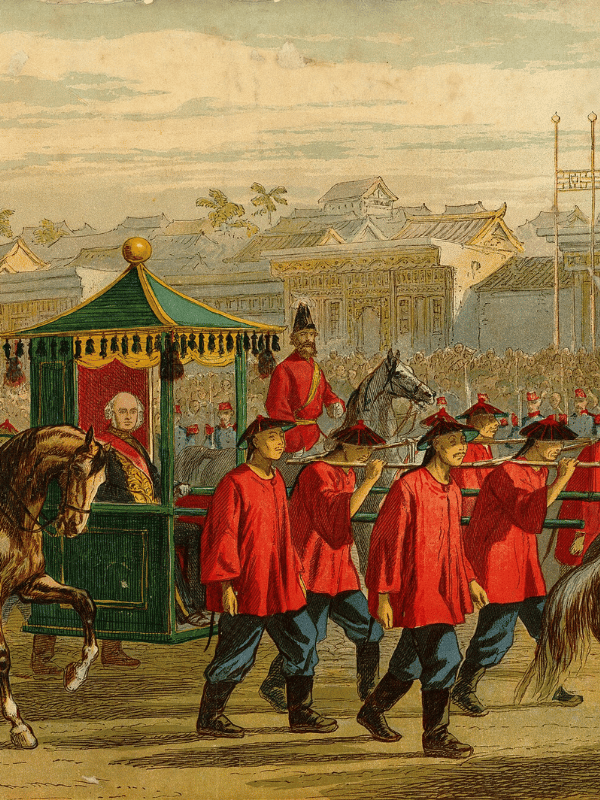
The peace terms collapsed within a year when Qing forces under the Mongol General Sengge Rinchen violated the treaty, launching a surprise artillery barrage from re-fortified earthworks that severely mauled a British fleet attempting to navigate past the Taku Forts in June 1859, destroying three gunboats and inflicting over four hundred casualties. Outraged by this defiance, the Earl of Elgin returned in the summer of 1860 with a massive Anglo-French expeditionary force of eighteen thousand professional troops under the tactical command of Lieutenant-General Sir Hope Grant. Grant’s columns successfully stormed the Taku Forts from the landward side, routed the elite Manchu cavalry at the Battle of Palikao on 21 September 1860, and marched directly into Beijing, forcing the Xianfeng Emperor to flee his capital.
In direct retaliation for the torture and execution of twenty British and French diplomatic envoys under a flag of truce, the 8th Earl of Elgin ordered the total destruction of the Summer Palace, a massive imperial compound consisting of 200 fairytale pavilions and masterwork gardens. Over three days in October 1860, British troops systematically torched the entire complex, reducing it to a smoking wasteland of scorched brick and ash.
This psychological blow thoroughly broke the spirit of the Qing Dynasty, forcing Prince Gong to sign the Convention of Beijing on 24 October 1860. Under its strict terms, the Emperor was forced to legalize the opium trade, grant complete religious freedom across the empire, open Tientsin as a treaty port, pay an enormous indemnity of eight million silver dollars to each allied power, and cede full, permanent sovereignty of the Kowloon Peninsula straight to the British Crown, solidifying Western control over the Chinese gateway.
Further Information: The Second Opium War
The Crimean War and Collapse of European Diplomacy
1854 - 1856
Additional Information: The Second British Empire / The Great Game
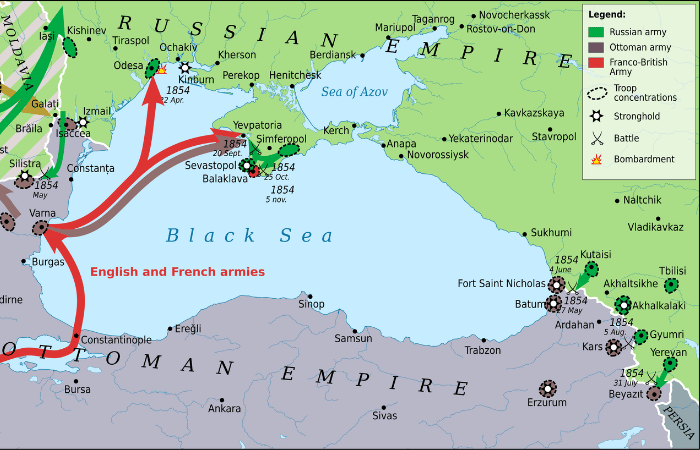
In March 1854, forty years of continental peace engineered at the Congress of Vienna came to a violent end when Great Britain and the French Empire declared war on the Russian Empire. This conflict, known as the Crimean War, was initiated to halt Tsar Nicholas I’s aggressive expansion into the Ottoman Balkans and protect British commercial routes to India through the Eastern Mediterranean. Standing as the first major military confrontation between industrialized superpowers, the war deployed state-of-the-art steam-powered warships, naval mines, and minié-rifle logistics, while simultaneously exposing severe, systemic administrative decay at the heart of the traditional British military machine.
The land campaign on the Crimean Peninsula was defined by extreme logistical incompetence, harsh environmental conditions, and high-attrition tactical maneuvers. At the Battle of Balaclava on 25 October 1854, a severe breakdown in communication between the commander-in-chief, Lord Raglan, and his cavalry officers caused the catastrophic Charge of the Light Brigade. A vaguely worded written order sent the 670-man light cavalry brigade on a suicidal, mile-long frontal assault down a valley bordered by crossfire, charging directly into the teeth of a heavily fortified Russian artillery battery.
While the brigade suffered over 270 casualties in less than twenty minutes, the British infantry—specifically the 93rd Highland Regiment under Sir Colin Campbell—held a stubborn, two-deep defensive line immortalized as the "Thin Red Line" to successfully repel a Russian cavalry charge and save the vital supply port of Balaclava.
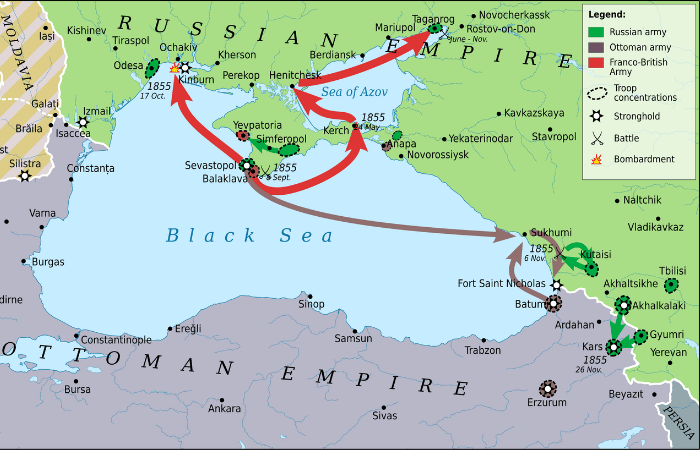
Despite tactical victories at the Alma (September 1854) and Inkerman(November 1854), the British army lacked the transport infrastructure, winter clothing, and medical networks to survive the freezing winter of 1854–1855. Thousands of soldiers died in their tents, not from battlefield wounds, but from preventable diseases like cholera, dysentery, scurvy, and typhus. This horrific reality was carried straight to the home front by William Howard Russell, a war correspondent whose regular, unfiltered dispatches in The Times marked the birth of modern wartime journalism. Russell’s exposure of these failures caused widespread public fury, which directly toppled the coalition government of Prime Minister Lord Aberdeen in January 1855, replacing it with the more assertive administration of Lord Palmerston.
The public outcry forced a radical restructuring of military medical care, allowing Florence Nightingale to arrive at the military hospital in Scutari with a team of thirty-eight nurses. By enforcing strict sanitation protocols, methodical handwashing, and meticulous data tracking, Nightingale transformed field hospital administration and dropped the mortality rate from over forty percent to just two percent. Concurrently, the state deployed the new technologies of the electric telegraph and war photography—pioneered on the ground by Roger Fenton—to manage the domestic information flow.
The allied forces finally brought the conflict to a close in September 1855 by capturing the primary Russian naval fortress of Sevastopol after a grueling eleven-month siege. Formalized through the Treaty of Paris in March 1856, the peace successfully neutralized the Black Sea and blocked Russian naval ambitions, though the true legacy of the war remained internal.
The heavy loss of over 22,000 British lives permanently broke the aristocratic monopoly over state administration, forcing the government to implement the Northcote-Trevelyan reforms to introduce professional, competitive entry examinations for civil service and military staff careers, establishing a modern meritocracy capable of managing the expanding global empire.
Further Information: The Crimean War and Collapse of European Diplomacy
The Anglo-Persian War and Buffer Zone Crisis
1856 - 1857
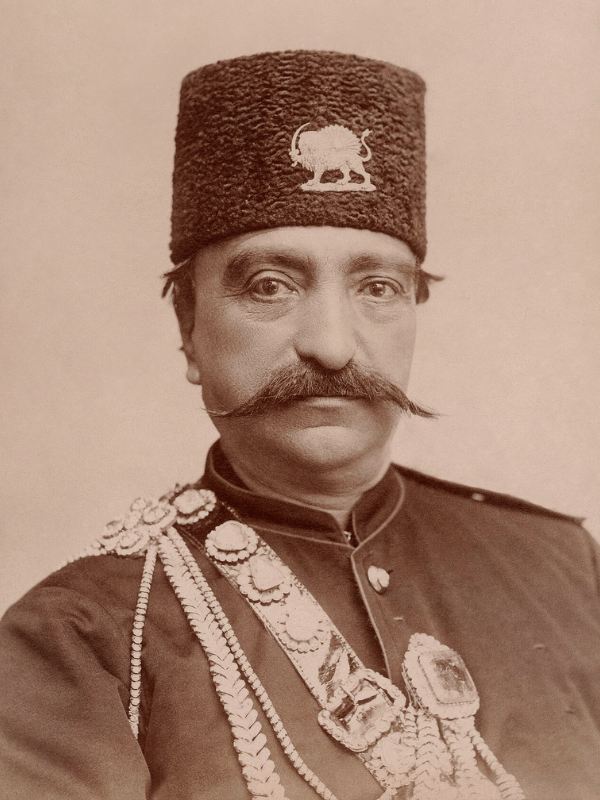
The military escalation along the Persian Gulf in the late autumn of 1856 developed into a short, punitive expedition designed to protect the overland gateways to British India by blocking the territorial expansions of the Qajar dynasty. In March 1856, Naser al-Din Shah dispatched a major military force numbering over twenty thousand regular troops to capture the strategic, independent oasis city of Herat in western Afghanistan, a vital geographic buffer zone that British administrators in Bombay viewed as the northern key to securing the frontiers of the Raj.
After a six-month siege, the city surrendered to the Persian army in October, prompting Great Britain to officially declare war on 1 November 1856. Rather than launching a grueling overland campaign through the Afghan mountains, Major-General Sir James Outram deployed an amphibious strike force directly from Bombay, using a massive fleet of forty transport ships and steam-powered warships from the East India Company's private navy to rapidly seize Kharg Island and bombard the coastal defenses of Bushire, landing nearly five thousand regular soldiers to secure a permanent beachhead.
The decisive confrontation unfolded on 8 February 1857 at the Battle of Kushab, where Outram’s mixed British and Indian regiments shattered the Persian infantry and routed their cavalry lines. Moving rapidly through a midnight sandstorm and a freezing desert rain, the British advance guard caught the main Qajar field force under Shoja-ol-Molk in an exposed plain near the village of Kushab. The 3rd Bombay Light Cavalry, under the leadership of Captain John Forbes, spotted the 1st Regiment of Fars Infantry formed up in a disciplined, bristling defensive square. Forbes launched a direct charge straight into the wall of bayonets.
Lieutenant Arthur Moore leaped his horse completely over the front rank of the square to break the line, while Lieutenant John Malcolmson fought his way in to rescue him, actions that earned both officers the Victoria Cross. The cavalry troopers systematically rode through the formation, causing a total breakdown of the Persian defensive layout. This breach triggered a chaotic retreat across the salt marshes that left over seven hundred Persian soldiers dead on the field, while Outram’s forces suffered fewer than eighty total casualties.
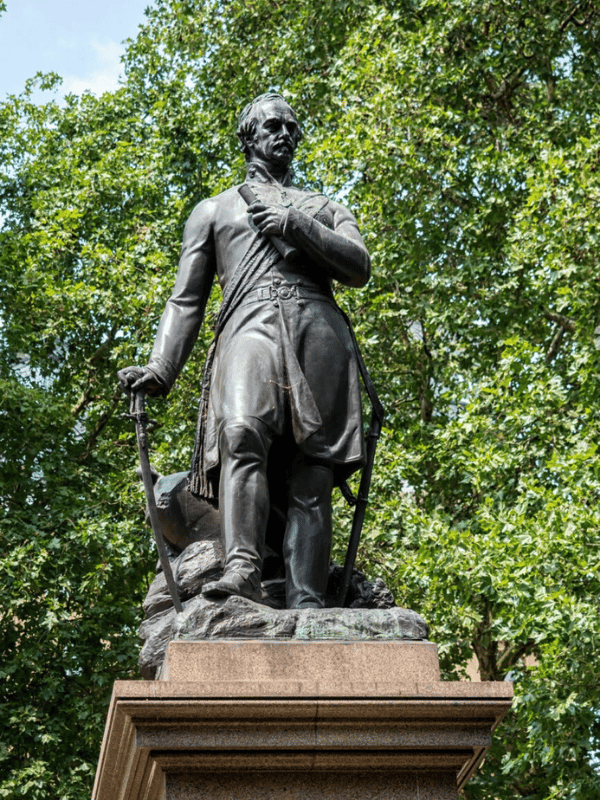
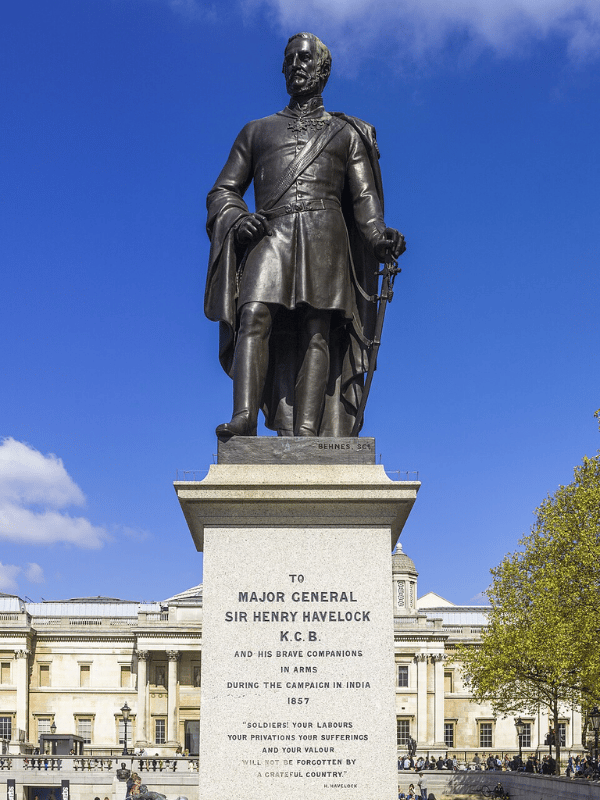
This battlefield collapse was followed in March by a destructive naval bombardment at Mohammera, where steam-frigates like the HMS Berenice and HMS Semiramis advanced up the Shatt al-Arab waterway to completely destroy the Shah's clay-walled river fortifications, deploying infantry brigades under Brigadier-General Henry Havelock to capture the military camps and force the Persian court to sue for peace before their main northern army could be engaged. The conflict officially concluded with the signing of the Treaty of Paris on 4 March 1857, an imperial settlement mediated by Napoleon III that forced the Qajar dynasty to withdraw all troops from Herat and abandon their historical sovereign claims to Afghanistan.
The Indian Uprising of 1857 and the British Raj
1857 - 1858
Additional Information: The Second British Empire / The Sepoy Rebellion
The overseas empire was thrown into a massive security panic in May 1857 by a synchronized military insurrection across northern India. Known historically as the Indian Rebellion of 1857, or the Sepoy Mutiny, this conflict began at Meerut on 10 May 1857 when native Indian soldiers rose in open rebellion against the Honourable East India Company. The rebels rapidly captured the old Mughal capital of Delhi, proclaimed the elderly nominal Emperor, Bahadur Shah Zafar, as their leader, and launched a multi-regional war of national liberation that threatened to permanently sever the primary commercial asset of the realm.
The immediate trigger for the mutiny was the introduction of the Pattern 1853 Enfield rifle, which utilized pre-lubricated paper cartridges that soldiers were required to bite open. Verified reports spread through the ranks that the grease used on these cartridges was composed of a mixture of beef and pork fat, a policy that alienated both Hindu and Muslim troops. This tactical blunder ignited decades of simmering resentment over aggressive corporate annexation policies under the "Doctrine of Lapse" instituted by James Ramsay, the 1st Marquess of Dalhousie, which had stripped native rulers of their ancestral lands, alongside local anxiety regarding the forced cultural and religious anglicization of the subcontinent.
The rebellion quickly expanded into a bloody, asymmetric war defined by high-attrition sieges and severe atrocities on both sides. Rebel forces under Nana Sahib besieged the British residency at Lucknow for eighty-seven days, claiming the life of the Chief Commissioner, Sir Henry Lawrence. Simultaneously, the mass slaughter of captured British men, women, and children occurred at the Bibighar in Cawnpore after they had been promised safe passage, an act that triggered a furious desire for vengeance across the home front.
The British government responded with retributive violence, bypassing corporate structures to deploy over forty thousand professional regular troops. These forces executed a systematic campaign of pacification across the Ganges Valley, conducting mass public hangings of suspected rebels and deploying the psychological tactic of blowing captured sepoys from the mouths of field cannons to project raw imperial terror.
The crushing of the rebellion in 1858 brought a sudden end to over two and a half centuries of corporate rule in India. Parliament passed the historic Government of India Act on 2 August 1858, which completely liquidated the East India Company and transferred all its vast territorial, military, and tax assets directly to the British Crown, launching the era of the British Raj. The state created the Cabinet office of the Secretary of State for India and a highly centralized, competitive civil service grid to run the subcontinent. This direct imperial control was completed on 1 May 1876 when Prime Minister Benjamin Disraeli, the 1st Earl of Beaconsfield, passed the Royal Titles Act, officially proclaiming Queen Victoria as the Empress of India, firmly fixing the subcontinent as the economic engine of the global empire.
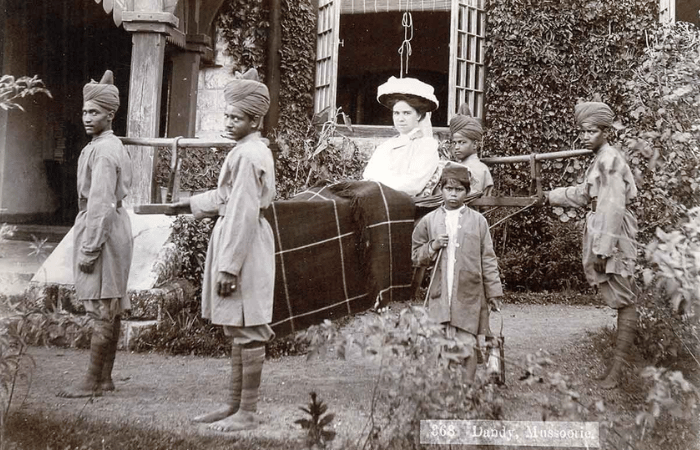
This newly consolidated imperial administration re-engineered the subcontinent into a highly organized, dual-layered theater of authoritarian governance. Operating with a tiny administrative core of just over a thousand elite British officials, the Indian Civil Service successfully managed a population of nearly three hundred million subjects through a calculated policy of defensive collaboration and strict social segmentation.
To prevent any future unified rebellions, the state radically restructured its military architecture, ensuring British soldiers held complete control over all heavy artillery units and deliberately recruiting troops from disparate, non-mutinous regional ethnic groups under the newly fabricated pseudoscientific doctrine of the "martial races." The daily operational reality of the Raj functioned with machine-like corporate efficiency, operating as an unequal, heavily racialized social hierarchy.
While massive amounts of capital were injected to excavate thousands of miles of public railways, deep irrigation canals, and electric telegraph wires, this infrastructure was engineered explicitly to accelerate the extraction of raw materials—including cotton, jute, and wheat—back to the factories of Great Britain. The administration enforced an uncompromising fiscal layout that exacted heavy land taxes from impoverished native farmers, while concurrently failing to construct adequate public food safety nets. This institutional negligence resulted in catastrophic, multi-generational famines across provinces like Bengal and Madras, which cost millions of lives and generated a boiling layer of internal economic distress.
Further Information: The Indian Uprising of 1857 and the British Raj
The Discovery of the Greenhouse Effect
1859
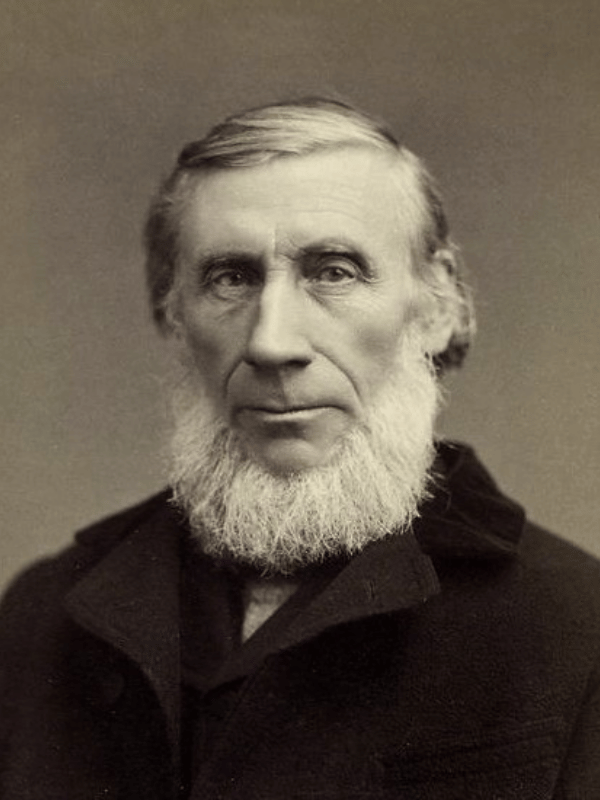
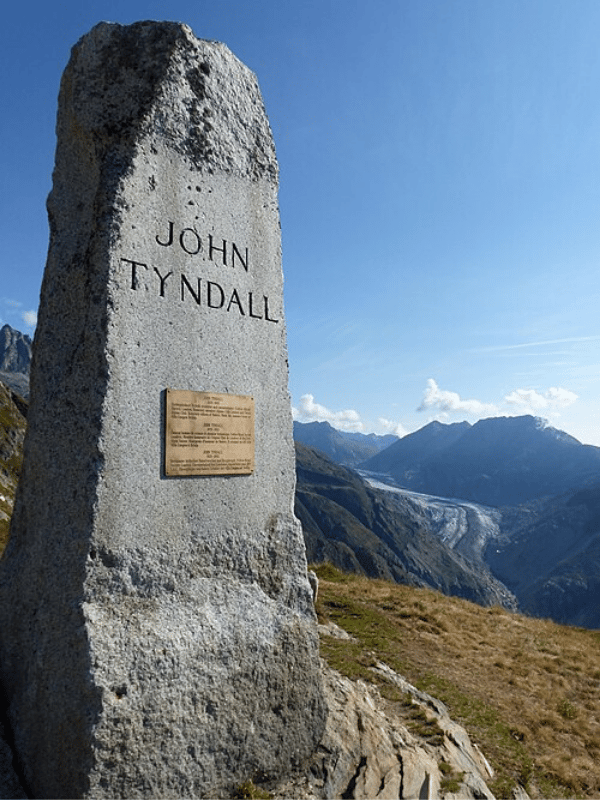
The rapid expansion of coal-powered factories during the Industrial Revolution occurred precisely as Victorian scientists began investigating the fundamental physics of the Earth's atmosphere. The milestone empirical breakthrough in climate science was achieved by John Tyndall, an Irish physicist working as a professor of natural philosophy at the Royal Institution in London.
In 1859, motivated by a desire to understand the geological causes of historical ice ages, Tyndall constructed a highly advanced piece of laboratory equipment: the first ratio spectrophotometer. This device consisted of a long brass tube closed at both ends with polished rock-salt plates that allowed infrared rays to pass through without distortion. By placing a heated Leslie cube at one end to act as a constant radiation source and a highly sensitive thermoelectric pile connected to a galvanometer at the other, he measured exactly how different gases absorbed and radiated invisible heat energy.
While previous researchers had assumed that all atmospheric gases reacted to heat in the same way, Tyndall’s experiments proved that the primary elements of the air—nitrogen and oxygen, which make up 99% of the atmosphere—were completely transparent to radiant heat. Instead, his precise measurements revealed that complex molecules present in tiny quantities, most notably water vapour, carbon dioxide, and methane, acted as powerful heat-trapping barriers. Tyndall demonstrated that these specific gases allowed high-frequency solar energy to pass cleanly through to warm the Earth, but actively blocked the low-frequency, invisible infrared heat rays rising back from the ground. The molecules absorbed this terrestrial radiation and re-radiated it in all directions, reflecting a massive portion straight back to the surface.
By mapping these molecular properties and presenting his definitive findings to the Royal Society in 1861, Tyndall provided the first rigorous experimental proof of the natural greenhouse effect. He concluded that water vapour was the principal blanket controlling regular air temperature and accurately predicted that even minute changes in the concentration of carbon dioxide or hydrocarbon gases could trigger major shifts in the global climate, laying the foundational framework for modern atmospheric physics.
The Origin of Species and Crisis of Faith
1859 - 1860
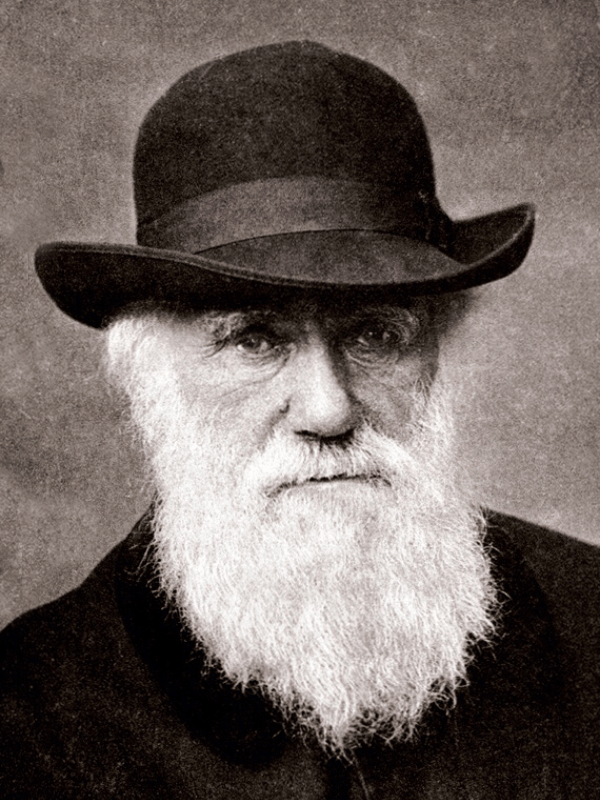
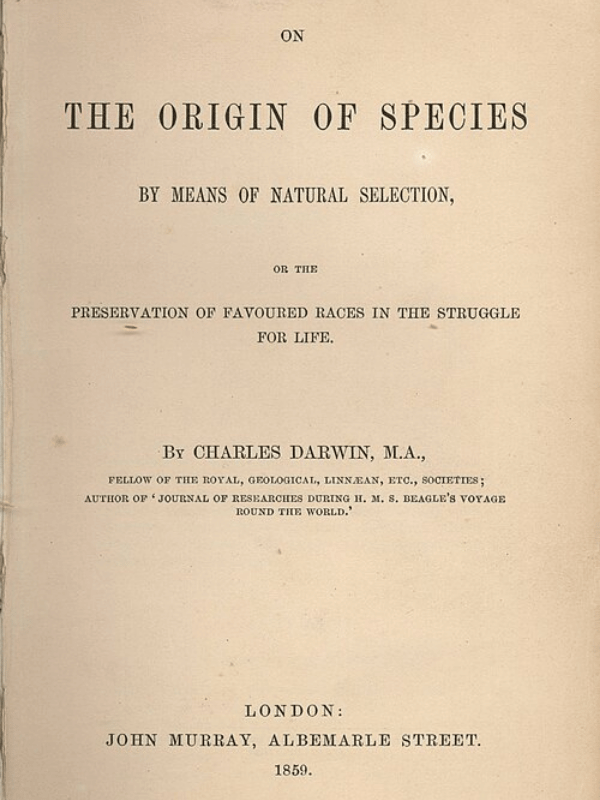
Alongside the intense shocks of imperial warfare, the intellectual life of Victorian society experienced a permanent challenge to its spiritual and scientific beliefs. In November 1859, the naturalist Charles Darwin published his monumental work, On the Origin of Species by Means of Natural Selection. This book completely transformed the human understanding of the natural world, triggering a widespread struggle known historically as the Victorian Crisis of Faith.
Darwin’s theory of evolution relied on close observation and factual records gathered during his five-year maritime voyage aboard HMS Beagle. This evidence-led study completely contradicted the traditional, literal interpretation of the Bible’s creation narrative. By replacing purposeful divine design with a cold process of natural selection where only the fittest variations endured, Darwin’s work permanently broke the old religious monopoly over science, establishing a secular, observational foundation for the modern scientific age.
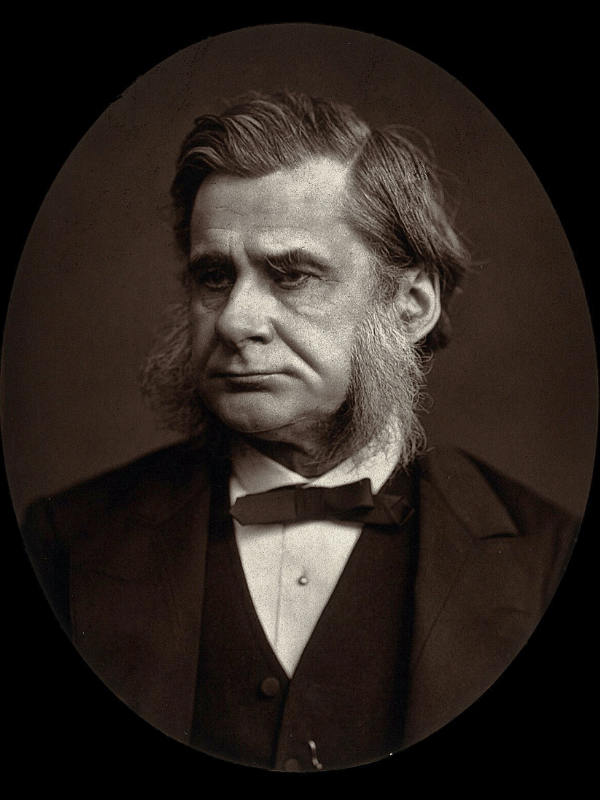
The publication caused immediate, explosive debates across British universities and the Church, most notably at the famous 1860 Oxford evolution debate. Held at the Oxford University Museum, the confrontation pitted the biologist Thomas Henry Huxley—who famously called himself "Darwin’s Bulldog"—against Samuel Wilberforce, Bishop of Oxford, who sought to defend biblical orthodoxy. The proof of deep geological time and biological change deeply damaged the traditional certainties of the ruling class, pushing thousands of educated Victorians into states of intense spiritual anxiety and doubt.
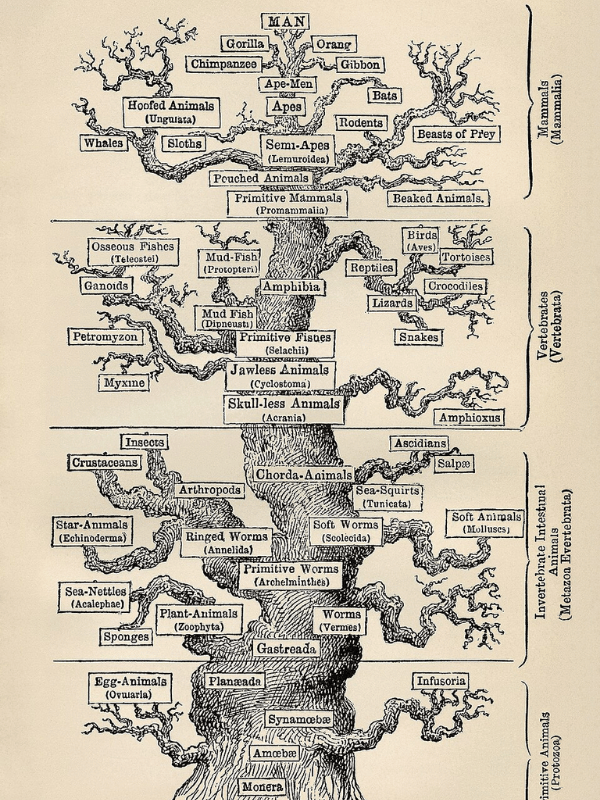
Beyond the British Isles, Darwin's insights catalyzed an immediate international expansion of evolutionary research that pushed his initial concepts into far more radical territories. The most influential of these subsequent works was engineered in Germany by the zoologist Ernst Haeckel. Inspired by a German translation of the Origin of Species, Haeckel formulated the biogenetic law, captured by his famous dictum that "ontogeny recapitulates phylogeny"—the idea that an individual embryo's development mirrors the entire evolutionary history of its species.
Haeckel formalized these radical ancestral links in his pathbreaking 1874 work, Anthropogenie (translated into English as The Evolution of Man). This text featured his iconic "Pedigree of Man" chart, a detailed evolutionary tree that organized all earthly life into a single genealogical sequence, explicitly placing humans at the absolute summit of a lineage descending from primitive fish, amphibians, and primates.
While Haeckel's rigid tree diagram introduced a flawed assumption that evolution moved toward a "perfected" human form—a concept Darwin himself resisted—the text successfully popularized the material reality of human evolution worldwide. The publication of these genealogical trees fundamentally altered the intellectual landscape of Europe, confirming that the spiritual certainties of the old world had been permanently replaced by a unified, evolutionary blueprint of nature.
Further Information: The Origin of Species and Crisis of Faith
The London Underground
1860 – 1863
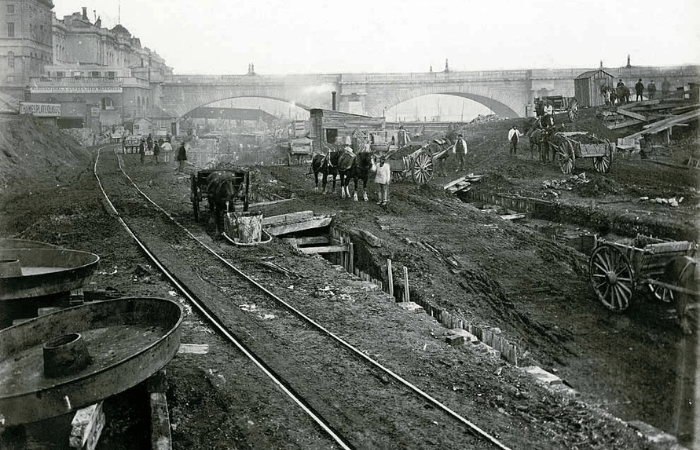
The extreme vehicular traffic of mid-nineteenth-century London—whose streets were completely choked by thousands of horse-drawn carts, omnibuses, and hackney carriages—forced the state to back an unprecedented civil engineering solution beneath the surface of the capital.
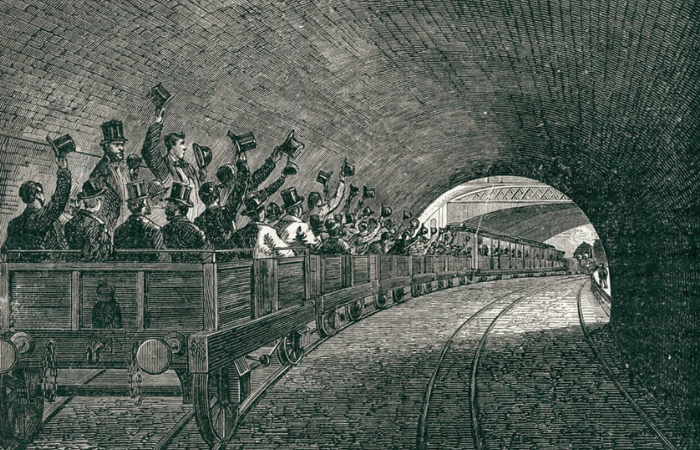
Conceived by the city solicitor Charles Pearson to connect three major main-line railway termini directly to the financial district, the project resulted in the creation of the Metropolitan Railway, the world's very first passenger-carrying underground network. Construction commenced in 1860 under the direction of chief engineer John Fowler. Because the technology to tunnel deep through London Clay did not yet exist, Fowler utilized a disruptive, highly destructive civil engineering method known as "cut-and-cover" excavation.
The mechanics of this method required armies of navvies to dig a massive, open trench exactly 33 feet and 6 inches wide directly along the path of existing thoroughfares like the New Road, completely shutting down surface commerce for years. The laborers constructed thick brick retaining walls along the sides of the trench, built a massive elliptical brick arch over the top to form a roof, and then backfilled the remaining space with earth before completely re-laying the surface road. This process encountered severe physical setbacks, most notably in 1862 when the broad Fleet Sewer burst its banks, completely flooding the deep excavations at Farringdon with over ten feet of wastewater before engineers successfully contained the breach.
The railway officially opened to the public on Saturday, 10 January 1863, running a line of 3.75 miles from Paddington to Farringdon Street. The opening day proved an absolute, overwhelming success, with an eager crowd of 38,000 passengers riding the subterranean trains within the first twenty-four hours. Unlike modern transit networks, these early services were hauled by specialized steam locomotives.
To comply with strict parliamentary rules regarding air quality, Fowler deployed engines fitted with condensing mechanisms designed to divert the exhaust steam back into cold-water side tanks rather than venting it into the air. However, this primitive layout could not capture the heavy sulfurous smoke and soot. The shallow, poorly ventilated tunnels quickly filled with a thick, choking fog that left passengers coughing inside their gas-lit wooden carriages. Despite these grim atmospheric conditions, the sheer speed of the commute completely transformed urban mobility. The line carried an astonishing 9.5 million passengers in its very first year, prompting immediate expansions across the capital and laying the foundational baseline for the massive corporate networks that would eventually develop into the global London Underground.
The Codification of Footbal
1863
The modern sport of association football developed from a centuries-old tradition of chaotic and often violent folk pastimes played across the villages of England. The earliest written record of an organized ball game in the country dates back to around 1174, when the chronicler William Fitzstephen described young men in London heading to the fields for an annual Shrovetide ball match.
These early medieval events had no set rules, no player limits, and often resulted in serious injuries, prompting successive monarchs to issue formal royal decrees banning the sport. In 1314, King Edward II banned the game within the city boundaries due to the great noise caused by hustling over large footballs, followed by similar restrictions from King Henry IV in 1409. Despite this state opposition, the game survived in the rural regions, evolving by the early nineteenth century into highly competitive public school pastimes. However, because each school developed its own isolated laws, matching teams from different institutions found it practically impossible to play without constant arguments on the pitch.
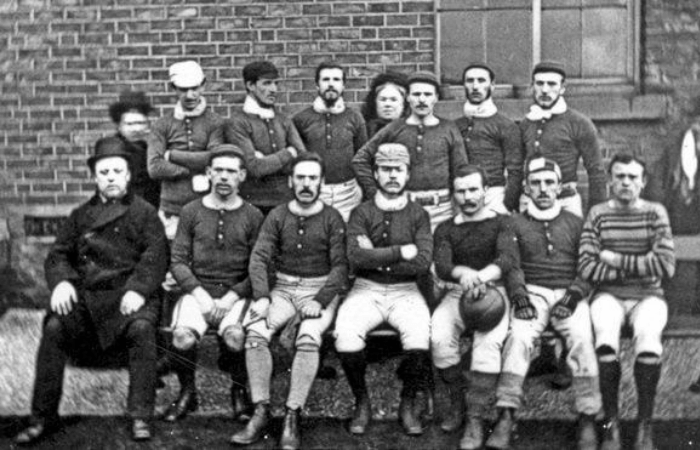
The shift toward a formal, organized sport began in Yorkshire with the founding of Sheffield F.C. on 24 October 1857. Established by cricketers Nathaniel Creswick and William Prest, this institution is officially recognized by FIFA as the oldest independent open football club in the world. The founders drew up the Sheffield Rules in 1858, pioneering crucial elements of the sport including the corner kick, the free kick, and a solid wooden crossbar to replace a simple piece of string.
On Boxing Day in 1860, Sheffield F.C. faced its newly formed neighbors, Hallam F.C., at Sandygate Stadium in a 2–0 victory, launching the world's very first local club rivalry. To resolve the remaining differences between the school rulebooks, a historic meeting of eleven London captains took place at the Freemasons’ Tavern in Great Queen Street on 26 October 1863 to form the Football Association (FA). Led by the first FA secretary, Ebenezer Cobb Morley, the founders voted to outlaw two traditional practices: carrying the ball with the hands and "hacking"—the deliberate kicking of an opponent's shins—officially separating association football from rugby union.
The publication of these thirteen definitive laws on 8 December 1863 allowed the sport to be rapidly exported across the globe via the international trading and military networks of the British Empire. British sailors, railway engineers, and industrial laborers introduced the standardized game to foreign ports, establishing the first clubs across South America and Europe.
The international expansion was reinforced by the historic staging of the very first official international match on 30 November 1872, when Scotland faced England in a 0–0 draw in front of four thousand spectators in Glasgow. During this match, the physically smaller Scottish team introduced "combination play"—the revolutionary tactic of passing the ball between teammates—which completely replaced the traditional English method of individual dribbling. This passing style quickly became the baseline for the sport worldwide.
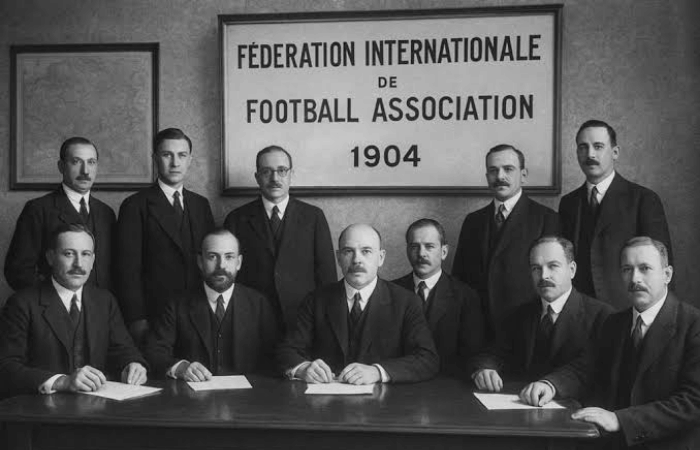
By the time global representatives gathered in Paris to form FIFA in 1904, the English game had successfully spread to every continent, establishing the foundations for a sport that now encompasses 211 national associations and stands as the most popular game on earth.
The Anglo-Ashanti Wars
1824 – 1901 AD
Additional Information: The Second British Empire / Anglo-Ashanti Wars and Subjugation of West Africa
The expansion of British gold and timber trading interests across the West African Gold Coast led to a protracted, five-stage military struggle against the heavily organized Ashanti Empire.
Located in the dense rainforest interior of modern-day Ghana, the Ashanti possessed a highly centralized administrative structure, vast gold reserves, and a disciplined, musketeer-heavy army capable of mounting massive ambush maneuvers. The conflict opened with a severe tactical humiliation during the First Anglo-Asante War in January 1824, when an overconfident British force under the Governor of Sierra Leone, Sir Charles MacCarthy, was completely encircled and annihilated by ten thousand Ashanti warriors at the Battle of Nsamankow. MacCarthy was killed on the field and his skull was lined with gold to be used as a royal trophy cup in Kumasi, an insult that locked the British command into a multi-generational cycle of punitive military operations to reassert imperial authority along the coast.
The campaign reached its definitive, technology-driven climax during the Third Anglo-Ashanti War of 1873, when the Liberal Prime Minister, William Ewart Gladstone, dispatched a highly specialized expeditionary force to completely subjugate the interior. Operating under the supreme command of Major-General Sir Garnet Wolseley, a force of 4,000 British regulars and native allies launched a high-velocity offensive through the jungle depths.
Wolseley overcame the immense geographical layout by importing an engineered, pre-fabricated telegraph system and a miniature railway to maintain an unbroken supply of food and ammunition, while deploying newly invented seven-pounder rifled artillery pieces and early Gatling guns. At the Battle of Amoaful on 31 January 1874, Wolseley's infantry lines used disciplined, high-volume Snider-Enfield rifle fire to break a twenty thousand-strong Ashanti army under Asamoa Kwaku.
The expeditionary force marched straight into the capital city of Kumasi in February 1874, blowing open the royal palace with gunpowder and torching the stone compound before forcing the Ashanti court to sign the Treaty of Fomena, which mandated heavy silver payments and the total abandonment of coastal territory.
The final chapter of Ashanti sovereign independence was closed through a sequence of aggressive administrative extractions near the end of the century. In January 1896, during the Fourth Anglo-Ashanti War, a bloodless British invasion column under Colonel Sir Francis Scott entered Kumasi, arrested the Asantehene King Prempeh I, and exiled him to the Seychelles islands, placing the territory under a direct military residency. The simmering regional anger exploded into a final popular uprising in March 1900, historically branded as the War of the Golden Stool.
The conflict was triggered when the tone-deaf British Governor, Sir Frederick Hodgson, publicly insulted the national spirit by demanding that he be allowed to sit upon the sacred Golden Stool, the ultimate emblem of Ashanti dynastic authority. A multi-tribal rebellion rapidly invested the British fort at Kumasi, forcing a desperate, high-casualty relief operation under Colonel James Willcocks. Following the total suppression of the insurgent lines, the British government issued a unilateral imperial proclamation on 1 January 1901, dissolving the ancient independent empire and annexing the Ashanti territories directly into the crown colony system of the Gold Coast.
Further Information: The Anglo-Ashanti Wars
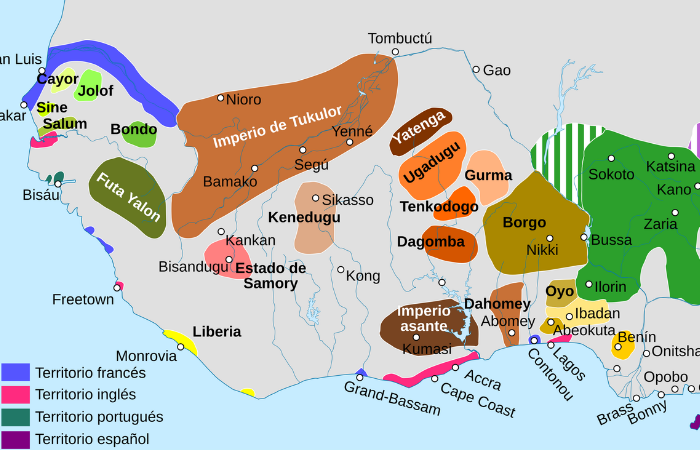
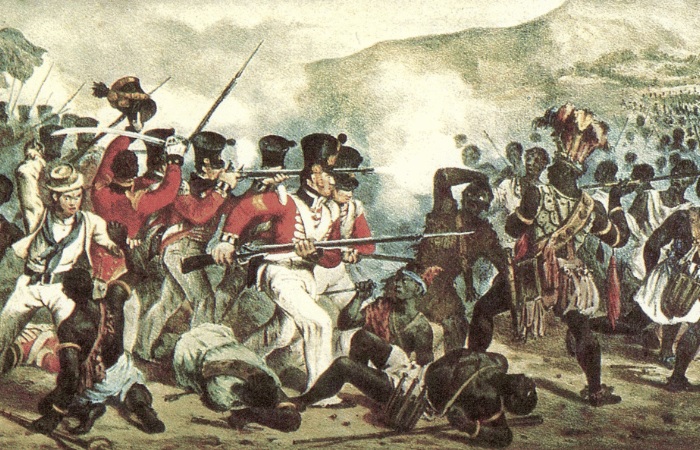
The Abyssinian Expedition
1867 – 1868 AD
The launching of a massive military operation into the mountainous interior of East Africa was driven by an explosive diplomatic crisis involving the detention of British subjects by a foreign crown. The conflict erupted when the Emperor of Abyssinia, Tewodros II, became deeply angered by the complete lack of a formal reply from Queen Victoria to a royal letter he had dispatched proposing an alliance.
In January 1864, the Emperor ordered the immediate arrest and imprisonment of the British Consul, Charles Duncan Cameron, alongside dozens of European missionaries, trapping them inside the high stone fortress of Magdala. When multiple diplomatic missions failed to secure their release, the Conservative Prime Minister, Edward Smith-Stanley, the 14th Earl of Derby, authorized a massive punitive expedition to rescue the hostages and punish the insult to the crown, launching one of the most expensive and successful engineering feats of the nineteenth century.
The supreme command of the operation was entrusted to Lieutenant-General Sir Robert Napier, who realized that the greatest adversary would be the immense, mountainous terrain rather than the enemy army. To execute this complex logistical campaign, Napier built a massive artificial harbor at Zula on the Red Sea coast, constructed two large desalination plants to generate clean drinking water, and laid down eleven miles of railway track to transport heavy equipment across the coastal desert.
The expeditionary force comprised thirteen thousand regular British and Sepoy infantry, twenty-six thousand camp followers, and a vast transport train of over thirty-six thousand pack animals—including forty-four specialized Indian elephants used to carry heavy field artillery pieces. Napier’s columns marched over four hundred miles through narrow mountain defiles and sheer rocky canyons, constructing bridges and roads along the edge of cliffs to reach the base of the Abyssinian plateau in less than three months.
The brief campaign reached its military climax on 10 April 1868 at the Battle of Arogee, just below the fortress walls of Magdala. A force of seven thousand Abyssinian warriors launched a high-velocity downhill charge against the British lines, but their outdated muskets and heavy mortars were completely outmatched by modern technology. The British infantry, including the 4th Regiment of Foot, used their newly issued Snider-Enfield breech-loading rifles to unleash a continuous storm of fire, decimating the attacking columns and inflicting over two thousand casualties in less than two hours, while Napier suffered only twenty wounded.
Realizing his position was entirely hopeless, Emperor Tewodros released all the European hostages unharmed before committing suicide with a pistols shot inside his citadel on 13 April 1868 as British troops breached the gates. Napier’s forces plundered the royal library, packed up hundreds of ancient illuminated manuscripts, and used gunpowder to blow up the stone battlements of Magdala before executing a disciplined, complete withdrawal back to the coast, erasing all trace of their presence and earning Napier the peerage title of the 1st Baron Napier of Magdala.
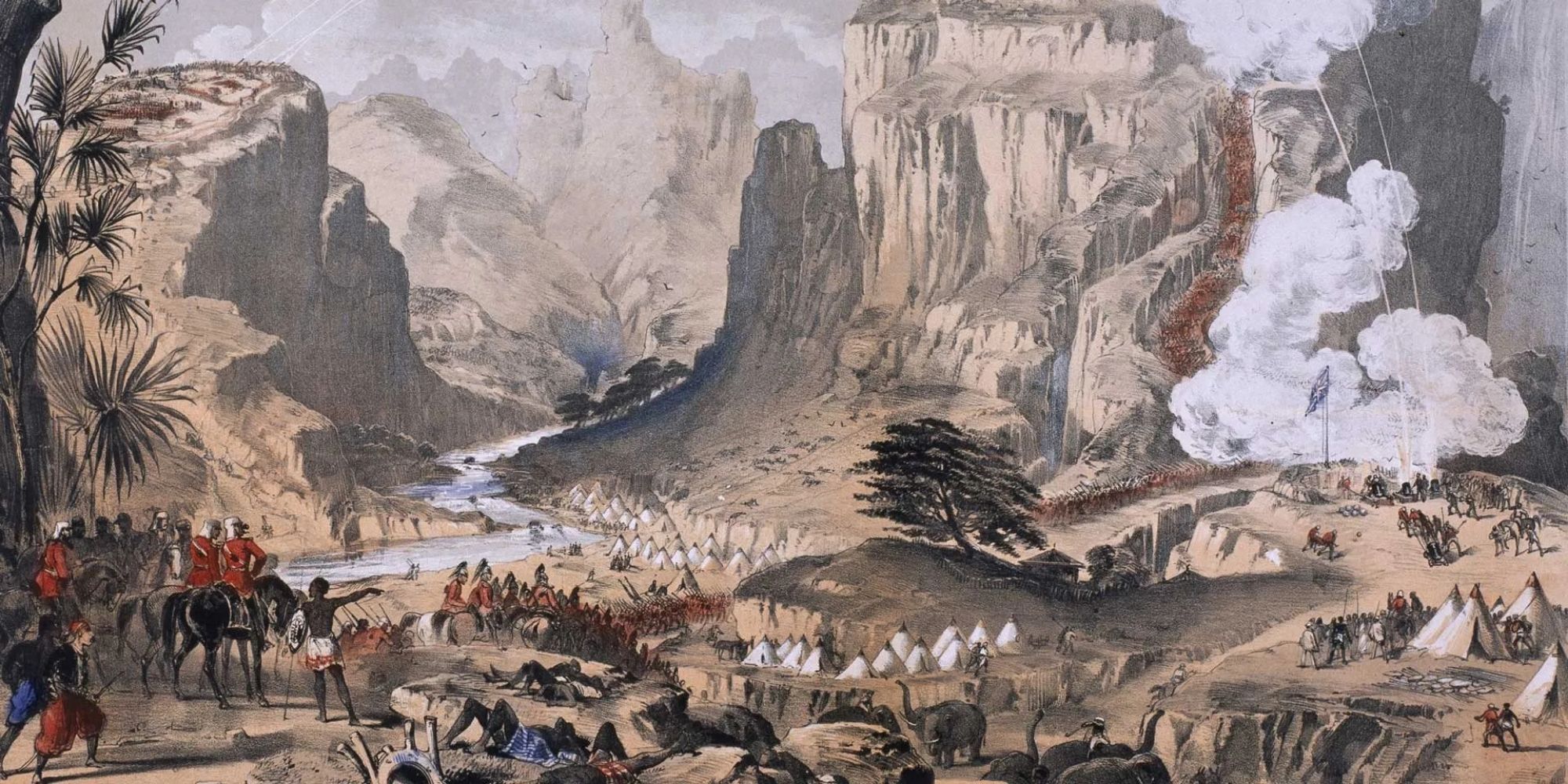
The Trent Affair
1861 AD
The sudden outbreak of the American Civil War forced Great Britain into a delicate geopolitical balancing act, as the Palmerston administration issued a formal declaration of neutrality that recognized the Confederate States of America as a belligerent power while maintaining official diplomatic ties with Abraham Lincoln’s Union government.
This fragile equilibrium fractured into an immediate transatlantic national security crisis on 8 November 1861, when Captain Charles Wilkes, commanding the Union warship USS San Jacinto, intercepted the British mail steamer RMS Trent in the international waters of the Old Bahama Channel. Operating without official orders from Washington, Wilkes fired warning shots across the civilian vessel's bow, dispatched an armed boarding party to systematically search the ship, and forcefully seized two Confederate diplomats, James Murray Mason and John Slidell, who were traveling to London to negotiate a European military alliance.
News of this maritime violation triggered a wave of fury across England, as the public and the press condemned the boarding of a neutral British vessel as an unprecedented insult to the national flag. King Queen Victoria’s cabinet reacted with true institutional firmness, viewing the seizure as a direct breach of international law and a challenge to British maritime sovereignty.
To back its diplomatic demands, the government placed the country on a war footing; the War Office dispatched eleven thousand elite troop reinforcements to British North America, reinforced the Atlantic naval squadrons, and placed an immediate embargo on the export of vital military supplies to the United States. Foreign Secretary Lord John Russell drafted an ultimatum demanding the immediate release of the diplomats and a formal apology, though the language was famously softened by a dying Prince Albert to offer Lincoln an honorable diplomatic exit.
The crisis reached its definitive political turning point in December 1861 when the Union administration, realizing that a simultaneous war against Great Britain would bankrupt the federal treasury and doom the war effort, executed a rapid retreat. Secretary of State William H. Seward officially conceded that Wilkes had erred by failing to bring the RMS Trent to a prize court for legal adjudication, ordering the immediate release of Mason and Slidell to British custody without a formal apology.
By delivering the Confederate envoys to the British warship HMS Rinaldo on 1 January 1862, Washington successfully defused the immediate threat of war.
This peaceful settlement re-established the strategic foundations of transatlantic diplomacy, ensuring that while British-American relations remained deeply strained over Confederate commerce raiders, the immediate danger of British military intervention on behalf of the South was permanently averted.
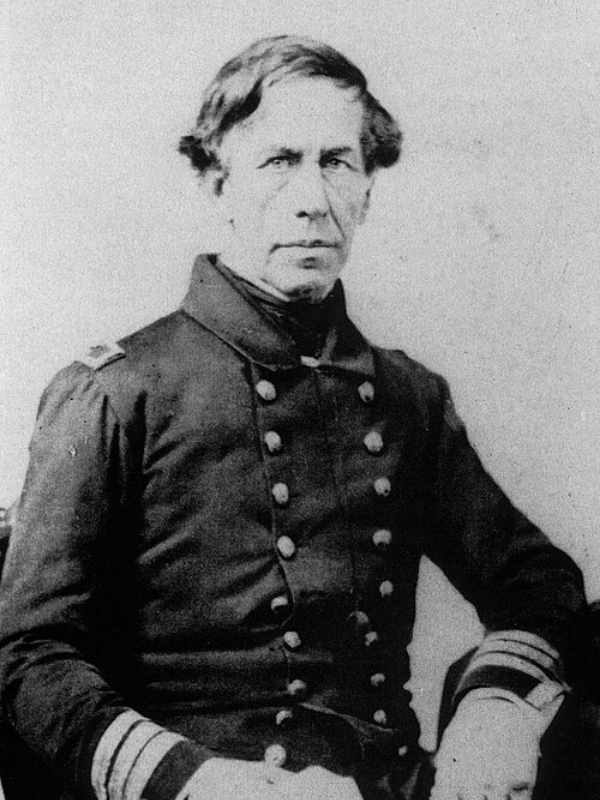
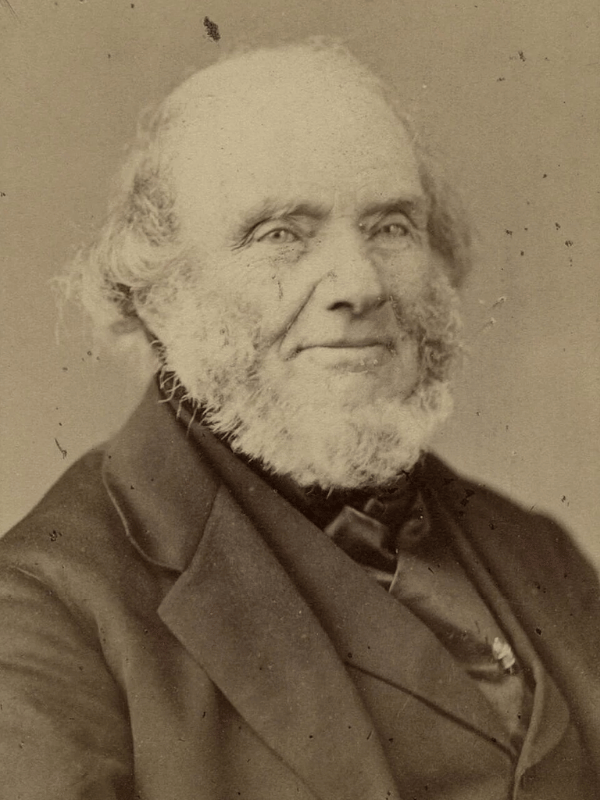
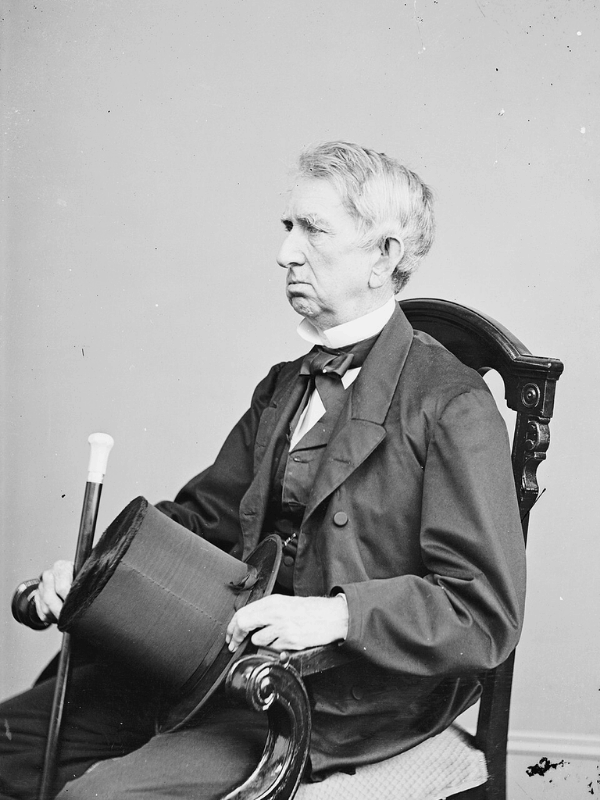
The Fenian Rising
1867 AD
Additional Information: The Edwardian Era / The Irish Home Rule Crisis and the Road to Partition, Interwar Britain / The Anglo-Irish War and the Partition of Ireland, The Age of Migration / The 1998 Good Friday Agreement and Northern Irish Stabilization
The outbreak of uncoordinated armed revolts across Ireland in the early spring of 1867 marked the culmination of a transatlantic revolutionary conspiracy designed to terminate British rule and establish an independent Irish Republic. Organised by the Irish Republican Brotherhood—a secret society founded in Dublin on Saint Patrick's Day 1858 by James Stephens alongside the American-based Fenian Brotherhood—the movement was heavily fueled by the lingering social trauma of the Great Famine. The organization actively recruited thousands of Irish veterans who had gained direct military experience fighting in the American Civil War, shipping these battle-hardened officers across the Atlantic to lead a network of underground cells that had spent months smuggling firearms into hidden urban dumps.
The British authorities inside Dublin Castle actively monitored the plot, using a wide network of embedded police informers to seize hidden weapons caches and arrest key leaders like Colonel Thomas Kelly before the military command structure could issue uniform mobilization orders.
The general insurrection commenced on 5 March 1867, but it immediately dissolved into scattered, isolated skirmishes due to atrocious winter weather and a complete lack of modern repeating rifles. The largest single engagement unfolded at the Battle of Tallaght in County Dublin, where a disciplined detachment of the Irish Constabulary under Sub-Inspector Burke used sandbag barricades and stone walls to intercept several thousand poorly armed insurgents marching from the city center. When the rebel advance guards refused an order to surrender, the constabulary unleashed a series of concentrated rifle volleys that killed one man instantly and wounded dozens more, causing the main body of four thousand insurgents to panic and disperse into the mountain blizzards.
Simultaneously, secondary risings collapsed across Munster and Leinster. In County Cork, a rebel force under Peter O'Neill Crowley engaged British infantry regulars at Kilclooney Wood, resulting in Crowley's death and the capture of his remaining command. Further operations collapsed in total failure, highlighted by the cruise of the American filibuster ship Jacknell, which arrived off Helvick Pier in April only for its crew of veteran volunteers to be instantly captured by waiting imperial troops before landing a single crate of weapons.
The aftermath of the failed rebellion led to sweeping treason trials and mass imprisonments, but the conflict shifted its location to English soil on 18 September 1867. A band of thirty Fenians launched an armed ambush against a police van in Manchester to rescue the arrested leaders Colonel Thomas Kelly and Captain Timothy Deasy. During the assault, a rebel shot out the lock of the carriage door, accidentally killing Police Sergeant Charles Brett inside.
The subsequent hanging of three convicted rescuers—William Philip Allen, Michael Larkin, and Michael O'Brien, immortalized as the Manchester Martyrs—galvanized nationalist sentiment across the Atlantic, shifting the republican movement away from open military rebellion toward agrarian land agitation and political campaigns.
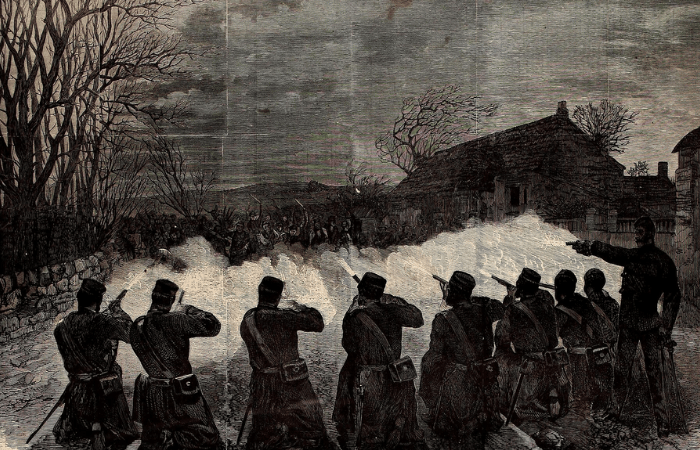
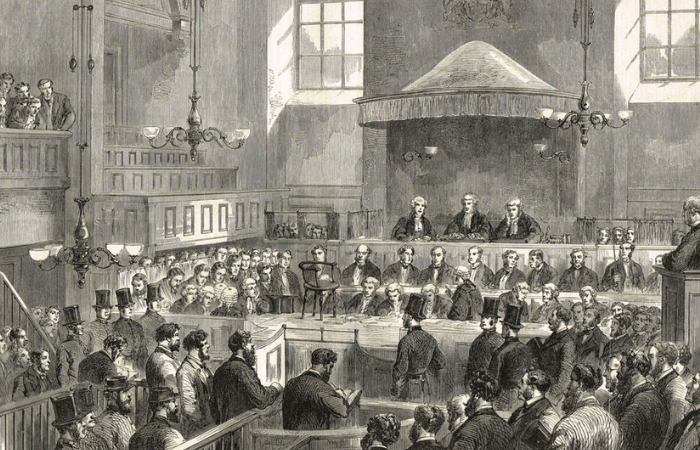
The Anglo-Zulu War and Battle of Isandlwana
1879 AD
Additional Information: The Second British Empire / Southern African Frontier Wars: The Anglo-Zulu War
The outbreak of a high-attrition conflict across the frontiers of southern Africa was triggered by a unilateral, aggressive orchestration to engineer a unified British confederation over the region. Seeking to annex the independent Zulu Kingdom and strip its warrior society of its sovereign defense capabilities, the British High Commissioner for Southern Africa, Sir Henry Bartle Frere, issued a provocative ultimatum to King Cetshwayo kaMpande in December 1878, demanding the immediate disbandment of his entire military system within thirty days.
When the King rejected this breach of his sovereignty, a powerful British invasion force of sixteen thousand professional infantry, cavalry, and native auxiliaries under the supreme command of Frederic Thesiger, the 2nd Baron Chelmsford, marched across the Buffalo River frontier in January 1879 without the authorization or backing of the home ministry in London.
The expansionist campaign suffered an immediate tactical disaster on 22 January 1879 at the Battle of Isandlwana. Lord Chelmsford had split his main column, marching out with his elite scouting divisions while leaving an un-fortified camp of 1,800 British and colonial troops under the temporary command of Brevet Colonel Henry Pulleine. Exploiting this tactical error, a massive Zulu army of twenty thousand warriors under the brilliant strategic command of Ntshingwayo khoza used their traditional "horns of the buffalo" tactical formation to rapidly encircle the camp.
The rapid assault completely overwhelmed the British defensive lines before the regular infantry could establish an effective ammunition distribution chain, transforming the engagement into a desperate hand-to-hand melee. The regular infantry of the 24th Regiment of Foot was entirely annihilated by the short stabbing spears of the Zulu warriors, resulting in a total disaster that cost the British force over 1,300 deaths and the loss of their entire baggage train, marking the worst defeat a modern British army had ever suffered against an indigenous adversary.
The shock of this defeat was partially offset that same evening by a desperate defensive stand at the nearby border trading post of Rorke's Drift. A compact garrison of 139 British soldiers under the joint command of Lieutenant John Chard of the Royal Engineers and Lieutenant Gonville Bromhead of the 24th Regiment of Foot successfully held their perimeter against a relentless, eleven-hour night assault by a secondary Zulu force of four thousand warriors.
Utilizing mealie-bag walls and biscuit boxes to construct barricades, the garrison repulsed consecutive wave charges with disciplined rifle fire, killing over 350 Zulu combatants at a cost of seventeen British deaths, an action that resulted in the distribution of eleven Victoria Crosses to the defenders. Lord Chelmsford subsequently reorganized his columns and brought the war to a definitive end on 4 July 1879 at the Battle of Ulundi, deploying massed Gatling guns and artillery to systematically smash the royal capital, capturing King Cetshwayo and permanently dismantling the sovereign military architecture of the Zulu kingdom.
Further Information: The Anglo-Zulu War and Battle of Isandlwana
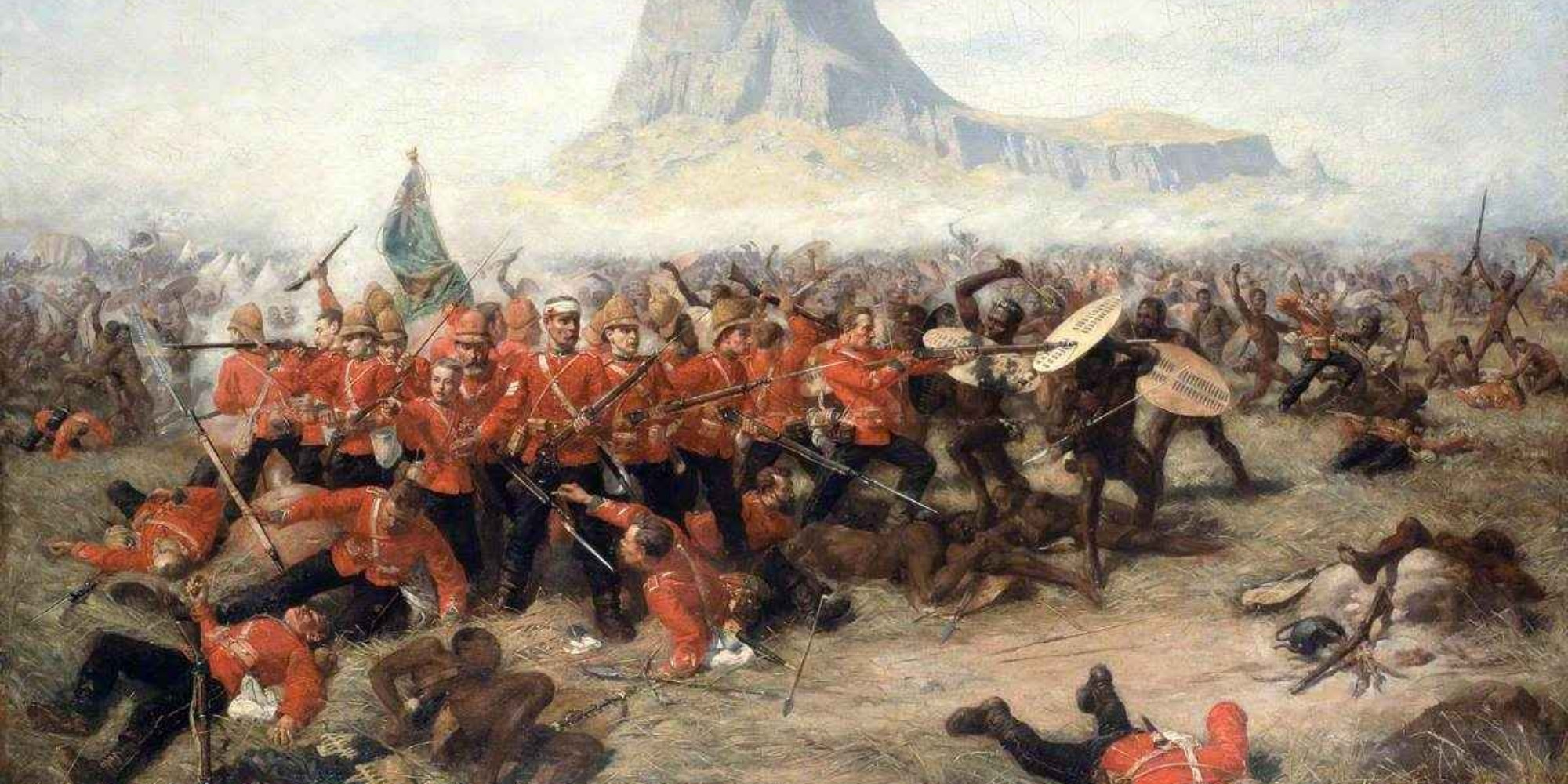
Disraeli, Gladstone, and the Two-Party Political Arena
1867 - 1884
Additional Information: Evolution of English Law and Governance / The Reform Acts and the Transition to Mass Parliamentary Democracy
The late nineteenth century witnessed a consolidation of parliamentary democracy, turning Westminster into a highly disciplined, two-party political arena dominated by the fierce rivalry of two opposing prime ministers: Benjamin Disraeli of the Conservative Party and William Ewart Gladstone of the Liberal Party. This era saw the political life of the country completely reorganized as both parties competed to capture the votes of the newly expanding urban working class, transforming election campaigns into an early form of popular mass entertainment.
To outmaneuver his opponents and leapfrog the Liberal majority, Disraeli managed the passage of the Representation of the People Act 1867 on 15 August 1867, historically known as the Second Reform Act. Working in tandem with Edward Smith-Stanley, the 14th Earl of Derby, Disraeli took a leap in the dark by extending the franchise to all male householders in borough seats and lodgers paying an annual rent of £10.
This statute nearly doubled the national electorate by adding 938,000 voters to the registers, bringing working-class men into the system and breaking the old aristocratic monopoly over elections. Disraeli, subsequently elevated to the peerage as the 1st Earl of Beaconsfield, used this newly expanded electorate to build a popular platform known as Tory Democracy, standardizing the Conservative platform around the defense of traditional institutions, the preservation of the Church of England, and the expansion of the global empire.
Gladstone countered this conservative move by launching a massive program of institutional modernization designed to clean up the government bureaucracy and eliminate aristocratic privilege. Serving as Prime Minister over four distinct ministries, Gladstone introduced the Ballot Act 1872 on 18 July 1872 to mandate the secret ballot, successfully preventing landlord or factory owner intimidation at the polling booths. His administration passed the Cardwell Reforms to abolish the corrupt system of purchasing military officer commissions in the British Army, and established the Elementary Education Act 1870 to build the country's first national system of state-funded primary schools. The rivalry culminated in the passage of the Representation of the People Act 1884—the Third Reform Act—which extended the same borough franchise rules straight into the rural counties, adding a further two million agricultural laborers to the voting registers.
This intense rivalry altered the nature of political campaigns, turning party leaders into national celebrities whose every word was tracked by the printing presses. Gladstone launched the groundbreaking Midlothian Campaign between 1879 and 1880, traveling by train across Scotland to deliver fiery, high-volume outdoor speeches to crowds of over twenty thousand citizens, a tactical campaign model that invented modern political whistle-stopping.
Disraeli matched this public theater through highly calculated imperial spectacles, gifting the Suez Canal shares to the state and passing the Royal Titles Act 1876 to crown Queen Victoria as Empress of India, creating a stark ideological divide between Gladstone's moralistic, non-interventionist foreign policy and Disraeli's aggressive, expansionist imperialism that defined British governance until the end of the century.
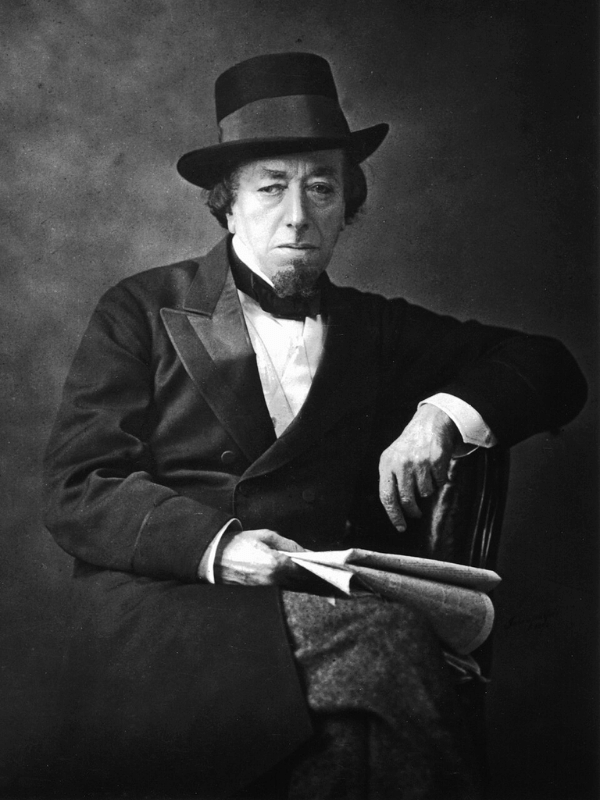
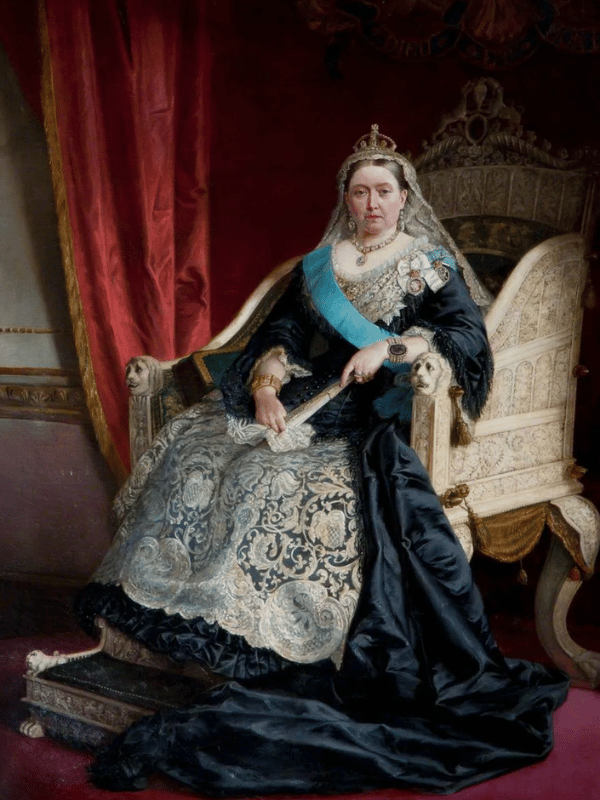
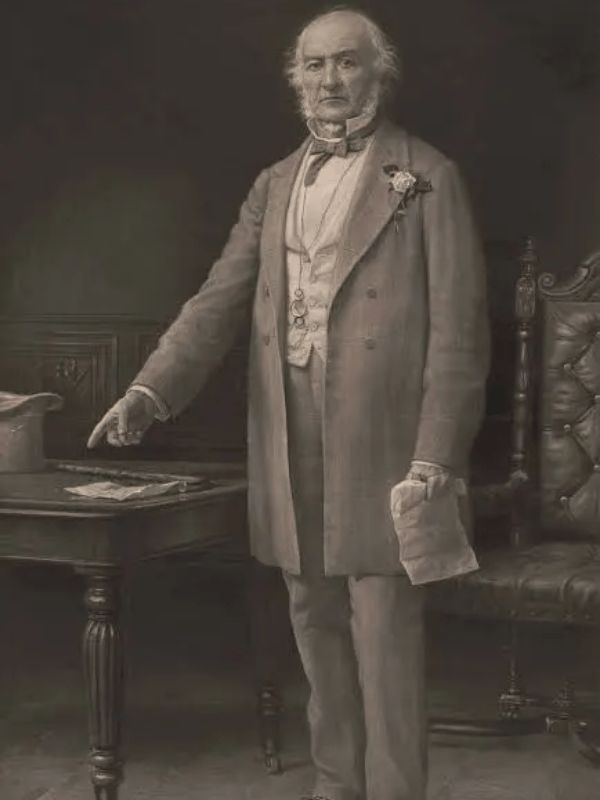
The Suez Canal
1869 - 1882
Additional Information: The Second British Empire / The Suez Canal and Occupation of Egypt
The expansion of parliamentary governance during the late nineteenth century became deeply entangled with the financial affairs of Northeast Africa, turning the Suez Canal into a primary battleground for the fierce rivalry between Benjamin Disraeli and William Ewart Gladstone. Following the canal's completion by French engineers, the Westminster political establishment watched its operations with intense anxiety, recognizing that the narrow waterway had instantly become the primary maritime conduit for eighty percent of all British trade with India.
A spectacular political masterstroke occurred in November 1875 when the ruler of Egypt, Khedive Ismail Pasha, faced complete financial collapse and placed his canal shares on the market. Moving with immediate speed to outmaneuver the French government, the Conservative Prime Minister, Benjamin Disraeli, bypassed Parliament entirely to secure an emergency loan of four million pounds from Baron Lionel de Rothschild, using the capital to purchase the Khedive's forty-four percent corporate stake. Disraeli proudly informed Queen Victoria that the key to India was secure, a financial victory that generated immense popular patriotism across the home front and elevated his prestige at court.
However, this corporate acquisition inadvertently locked the domestic government into a multi-generational cycle of foreign intervention. The subsequent imposition of an Anglo-French financial commission to oversee Egypt's national revenues deeply alienated the native population, sparking a nationalist military revolt in 1881 under Colonel Ahmed 'Urabi.
This anti-European movement presented a profound ideological crisis for the newly elected Liberal Prime Minister, William Ewart Gladstone, who had campaigned aggressively against Disraeli's expansionist imperialism. Faced with intense pressure from the City of London banking houses and a panicked press corps screaming that the canal was about to be sabotaged, Gladstone abandoned his non-interventionist principles.
In July 1882, the Liberal cabinet authorized a full-scale military campaign, deploying the Mediterranean fleet to bombard Alexandria before launching a thirty-thousand-man expeditionary force under General Sir Garnet Wolseley to smash the nationalist army at Tel el-Kebir. This reluctant military intervention triggered a severe fracture within the Liberal party, forced the resignation of anti-war cabinet ministers like John Bright, and established a permanent, de facto military occupation that dominated domestic foreign policy discussions for the remainder of the Victorian age.
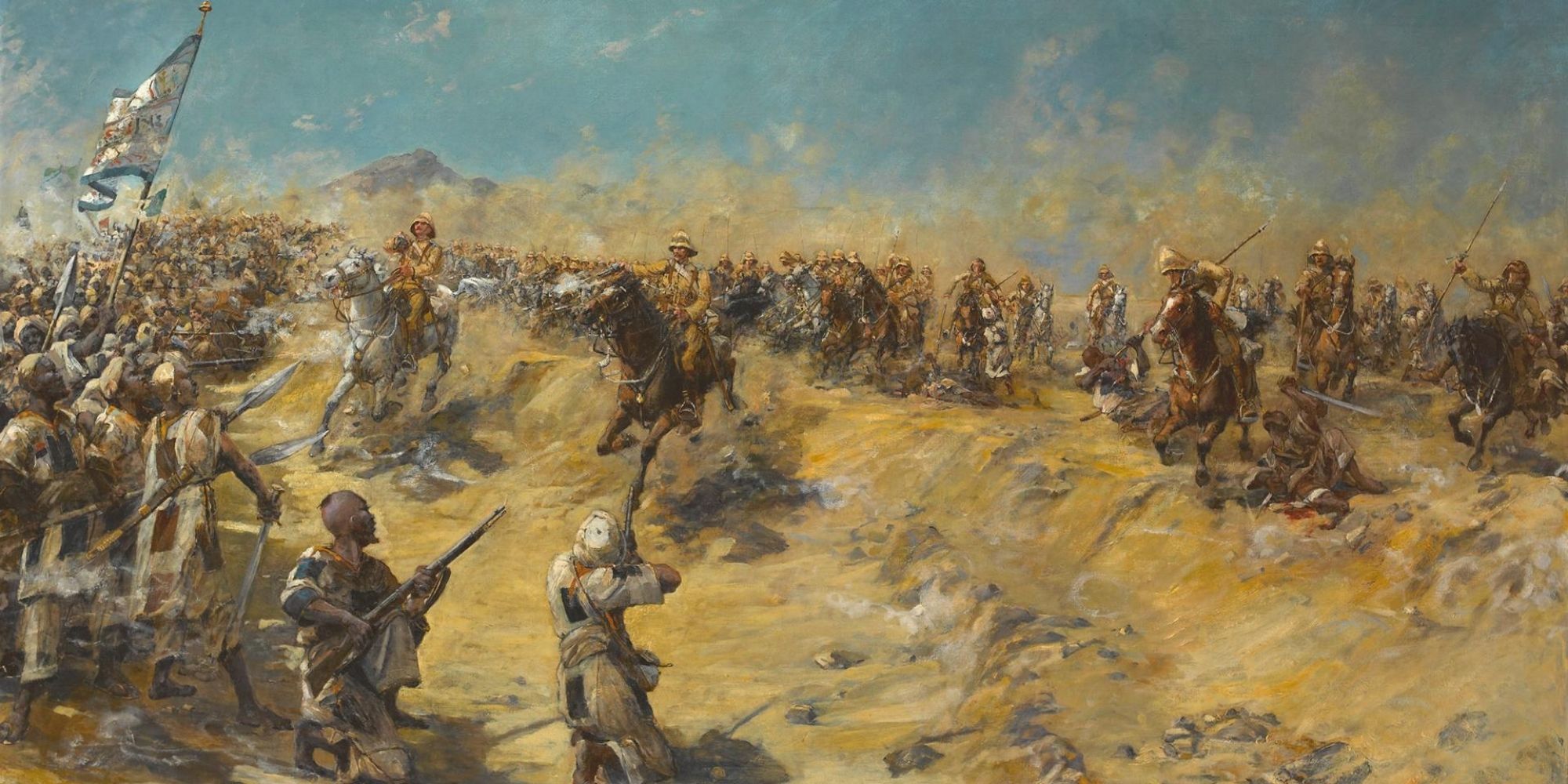
The Mahdist War and Fall of Khartoum
1881 – 1885 AD
The outbreak of a high-attrition conflict across the desert sands of Sudan was triggered by a powerful religious and nationalist uprising against Egyptian administrative rule and British financial oversight. In 1881, a charismatic religious leader named Muhammad Ahmad proclaimed himself the Mahdi—the guided one—and launched a holy war to completely purify Islam and overthrow all foreign occupiers. The Mahdist forces, known as Dervishes, used immense religious fervor and high-velocity massed charges to systematically destroy a succession of poorly led Egyptian armies.
The conflict reached a critical turning point in November 1883 at the Battle of El Obeid, where a ten-thousand-man Egyptian force under the command of a British officer, William Hicks, was entirely surrounded and slaughtered by the Mahdi’s warriors. This catastrophic loss forced the administration of William Ewart Gladstone in London to abandon plans for a total reconquest of the territory and instead issue immediate orders for a complete evacuation of all remaining Egyptian garrisons in Sudan.
To coordinate this massive civilian and military evacuation, the British ministry dispatched Major-General Charles George Gordon to the capital city of Khartoum in February 1884. Gordon, a deeply religious and headstrong officer who had previously served as Governor-General of the region, flagrantly disregarded his defensive evacuation orders upon his arrival. He believed it was his moral duty to crush the Mahdi, choosing instead to fortify Khartoum and transform it into a static bastion to force a direct military intervention from London. The Mahdist forces rapidly responded by encircling the city, initiating a grueling, ten-month Siege of Khartoum that began on 13 March 1884. Trapped without fresh provisions, the garrison of seven thousand Egyptian and Sudanese troops was forced to survive on a starvation diet of weeds, palm pits, and slaughtered donkeys while the Nile waters steadily receded.
Faced with massive public outrage at home over Gordon’s impending doom, a reluctant Gladstone finally authorized a powerful military rescue operation known as the Nile Expedition. This relief column, under the supreme command of Garnet Wolseley, the 1st Viscount Wolseley, deployed a specialized Camel Corps of 1,100 men who fought their way through a desperate, close-quarters melee against ten thousand Mahdist warriors on 17 January 1885 at the Battle of Abu Klea. Despite breaking the enemy lines, the rescue operation proved to be a fatal chronological failure.
On 26 January 1885, two days before the vanguard steamships of the 1st Viscount Wolseley’s relief column arrived at the city docks, a fifty-thousand-strong Mahdist army launched a massive night assault across the dried mudflats of the White Nile. The attackers completely overwhelmed the starving defenders, broke through the defensive lines, and slaughtered the garrison. Major-General Gordon was speared to death on the steps of his palace, his severed head displayed as a trophy in the Mahdi’s camp, a public humilation that permanently fractured public trust in Gladstone’s ministry and left Sudan under independent Mahdist rule for the next thirteen years.
Further Information: The Mahdist War and Fall of Khartoum
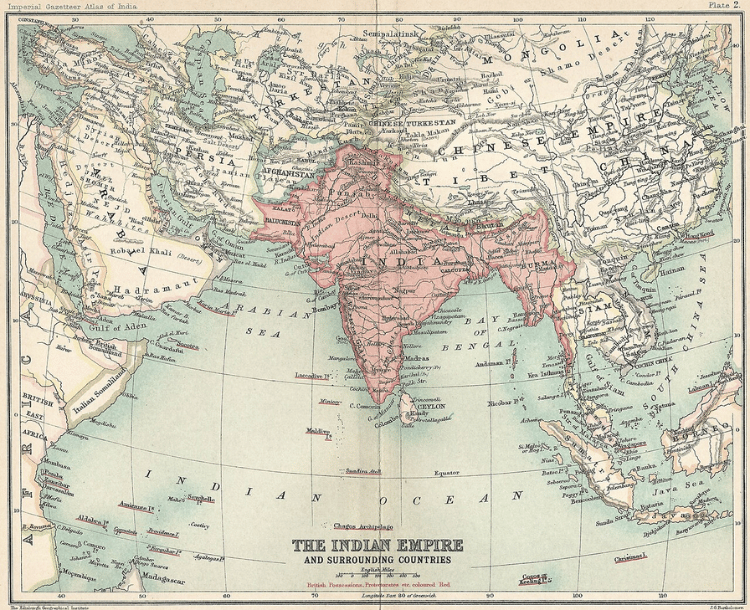
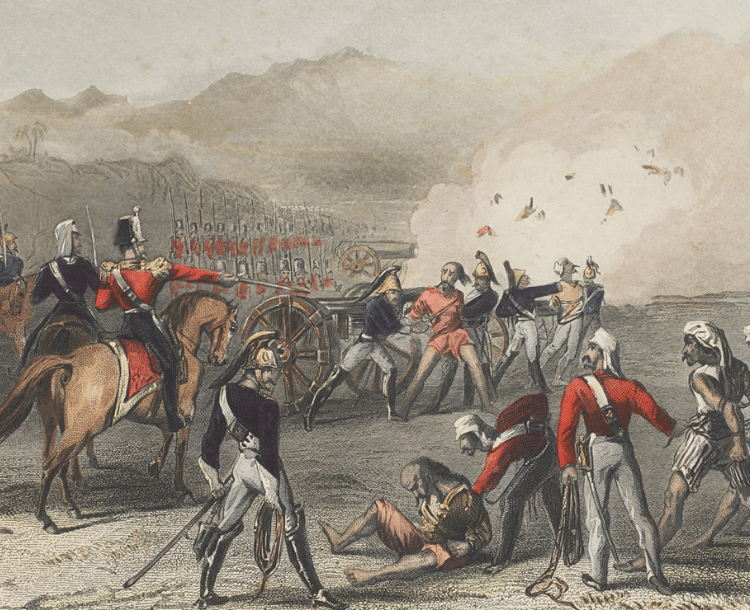
New Imperialism and the Empress of India
1876 – 1895 AD
The final quarter of the nineteenth century witnessed a major ideological and corporate transformation across the empire, shifting away from standard mercantile free trade toward aggressive territorial annexation. This era of New Imperialism was driven by a combination of intense economic competition from newly industrialized continental rivals and the strategic determination to secure permanent raw material monopolies.
A definitive milestone in this ideological shift occurred on 1 May 1876 through the passage of the Royal Titles Act 1876. Masterminded by the Prime Minister, Benjamin Disraeli, the 1st Earl of Beaconsfield, this statute officially proclaimed Queen Victoria as Empress of India. Disraeli guided the bill through Parliament despite fierce opposition from the Liberals, hardcoding a monarchical title designed to match the imperial status of the Russian and German crowns and solidify the British Raj as the center of global power. The proclamation was officially celebrated in India on 1 January 1877 during the massive Delhi Durbar, or Proclamation Durbar, organized by the Viceroy, Edward Bulwer-Lytton, the 1st Earl of Lytton, where sixty-eight thousand spectators gathered in a display of imperial authority while parts of southern India suffered a severe famine.
This state-backed expansionism relied heavily on the resurrection of Elizabethan-style corporate monopoly frameworks, utilizing chartered commercial syndicates to extract minerals and establish governance without direct financial drain on the London treasury. The primary architect of this corporate expansion was the diamond magnate Cecil Rhodes, whose British South Africa Company received a royal charter in October 1889 from the ministry of Robert Gascoyne-Cecil, the 3rd Marquess of Salisbury.
Rhodes aggressively used a private paramilitary force, the British South Africa Police, to bypass local rulers and systematically conquer the vast interior regions of Matabeleland and Mashonaland. His agents used the Maxim machine gun to crush the local Ndebele warriors during the First Matabele War of 1893, naming the newly acquired territories Rhodesia in his own honor. Through his corporate vehicle, the De Beers Consolidated Mines syndicate, Rhodes secured an airtight ninety-five percent monopoly over the global diamond market, while simultaneously exploiting the discovery of massive gold fields along the Witwatersrand in 1886.
This immense extraction of African mineral capital allowed private corporate syndicates to function as the primary administrative machine of the realm, setting a direct course for explosive border friction with the neighboring independent Boer Republics.
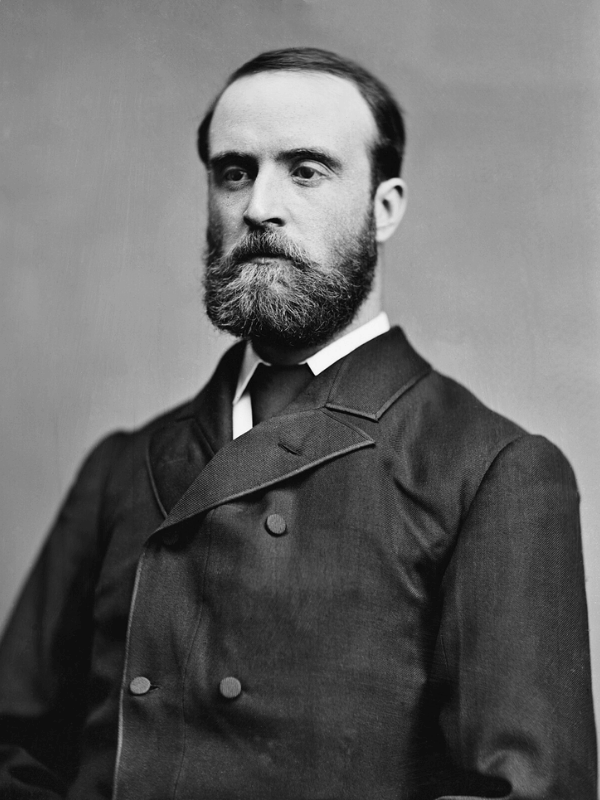
The Irish Question
1879 - 1893
The focus of late Victorian domestic politics was completely dominated by a bitter, unresolved constitutional crisis at the heart of the United Kingdom, the Irish Question. Following decades of economic neglect and agricultural distress after the Great Famine, Irish nationalists organized a highly disciplined, popular resistance movement to dismantle English dominance and reclaim independent legislative power for Dublin.
This resistance relied on two powerful tactics managed by a brilliant Irish politician named Charles Stewart Parnell. First, Parnell backed the Irish Land League, a grassroots rural resistance movement founded by Michael Davitt in 1879 during a period of acute agrarian depression known as the "Land War."
The league launched a social blockade against anyone who took over a farm from an evicted tenant, a tactic historically named a "boycott" after its very first target, Captain Charles Boycott, an English land agent in County Mayo who was completely isolated by the local community.
Second, Parnell transformed the Irish Parliamentary Party at Westminster into a disciplined voting bloc, systematically obstructing everyday parliamentary business through filibusters to force the British government to address Irish grievances.
Parnell’s tactics completely fractured the traditional party alignments of the state, and in 1886, Prime Minister William Gladstone accepted the necessity of concession, introducing the first Irish Home Rule Bill to restore a separate parliament to Dublin. This move split his own Liberal Party into factions, causing a massive political walkout of "Liberal Unionists" led by Joseph Chamberlain that brought down his government and doomed the bill.
When Gladstone introduced a second Home Rule Bill (1893), it passed the House of Commons but was crushed by an overwhelming conservative majority of 419 votes to 41 in the House of Lords, failing to settle the Irish question.
The Berlin Conference and the Scramble for Africa
1884 – 1898 AD
Additional Information: The Second British Empire / The Scramble for Africa
The competitive territorial land grab across the African continent was formalized through an international diplomatic summit designed to prevent a multi-continental war between European rivals. Initiated by the German Chancellor, Otto von Bismarck, the Berlin Conference convened from 15 November 1884 to 26 February 1885, drawing together representatives from fourteen nations—including Great Britain, France, and Portugal—to map out the regulatory layout for the complete partition of Africa.
Sir Edward Malet served as the primary British ambassador during the high-stakes proceedings, navigating the intense geopolitical maneuvers of King Leopold II of Belgium, who secured private ownership of the vast Congo Free State. The resulting Berlin General Act established the draconian legal principle of effective occupation. This clause decreed that no European power could claim a territory unless they demonstrated direct physical governance, stationed military garrisons on the ground, and forced local tribal chieftains to sign binding protectorate treaties, initiating a frantic geographical race that carved up the continent into artificial map lines.
To protect its strategic maritime highway to India and secure its newly acquired corporate territories, Great Britain adopted an aggressive "Cairo to Cape" expansionist policy, aiming to construct a continuous line of British colonies stretching from Egypt straight to southern Africa. Working in close administrative tandem with Robert Gascoyne-Cecil, the 3rd Marquess of Salisbury, who served as Prime Minister, British diplomats used high-stakes treaties to slice up whole regions. They signed the Heligoland-Zanzibar Treaty in July 1890, exchanging the strategic North Sea island of Heligoland with Germany in order to lock in British control over Zanzibar, Kenya, and Uganda.
In western Africa, the state utilized chartered corporate vehicles like the Royal Niger Company under Sir George Goldie to forcibly monopolize the palm oil trade, deploying private constabularies to systematically annex local sovereign states including the Kingdom of Benin, which was plundered of thousands of masterwork brass plaques during a violent punitive expedition in February 1897.
This territorial carving was enforced by superior military technology, utilizing shallow-draft river gunboats and Maxim automatic machine guns to systematically smash native resistance movements. The campaign reached its ultimate military milestone on 2 September 1898 at the Battle of Omdurman in Sudan. A professional Anglo-Egyptian army under Major-General Herbert Kitchener deployed six newly invented Maxim guns and heavy artillery to slaughter twenty thousand Mahdist warriors in less than five hours, completely breaking the Mahdist state at a cost of less than fifty British lives.
This relentless advance completely eliminated the remaining independent African kingdoms, expanding the British imperial footprint over millions of square miles and pushing the global logistics of the empire to its zenith.
Further Information: The Berlin Conference and the Scramble for Africa
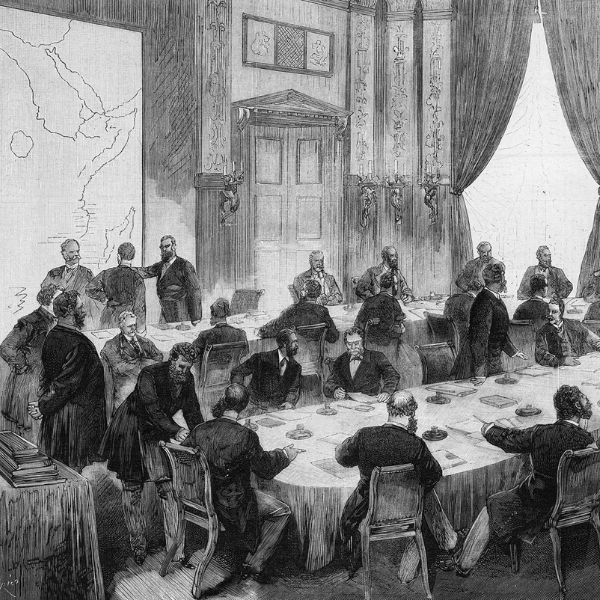
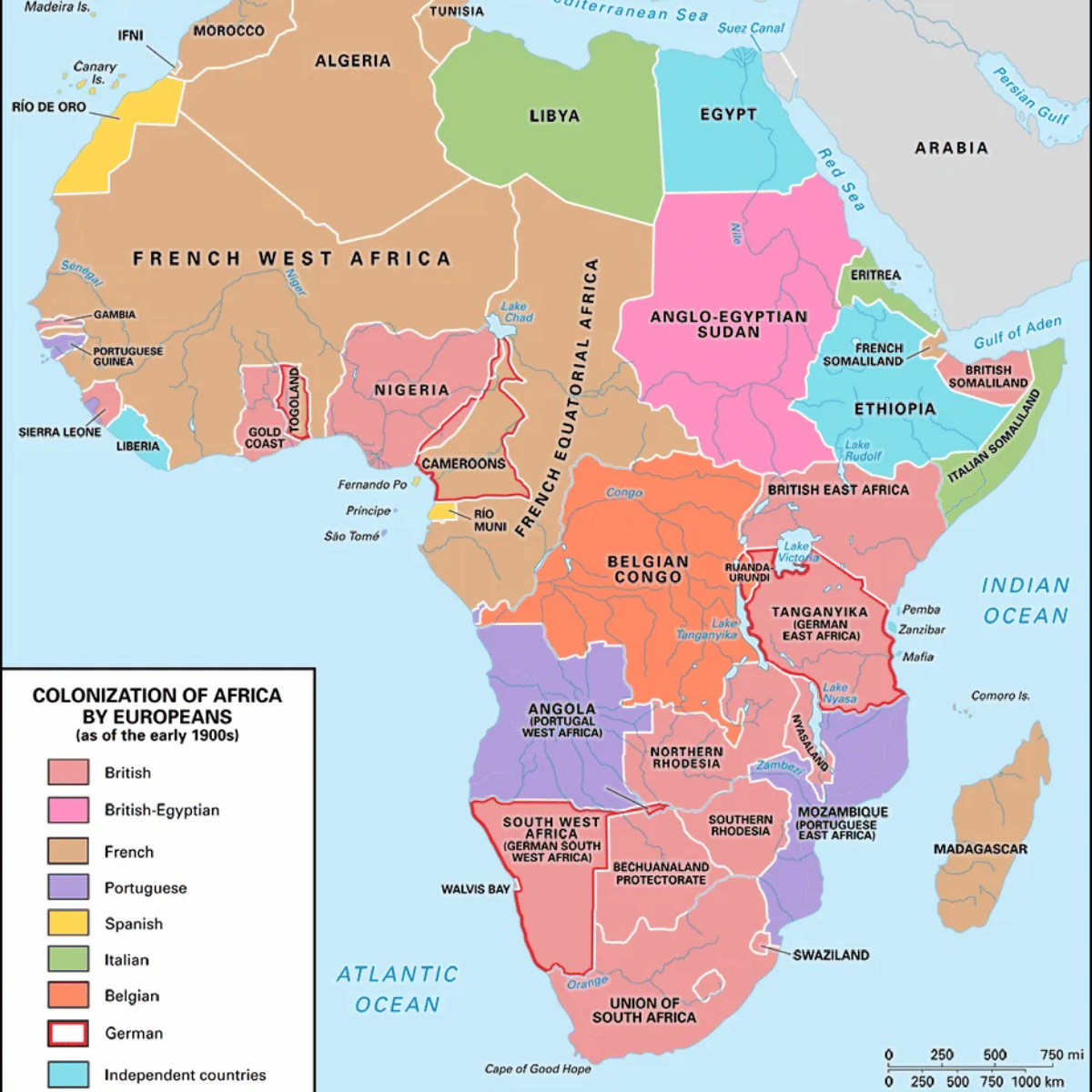
The Boundary Commissions and the Pamir Crisis
1885 – 1895 AD
The late-century confrontation between the British and Russian empires shifted away from military maneuvers toward a legalistic demarcation of borders across the uncharted mountain passes of Central Asia. This rivalry reached an explosive flashpoint on 30 March 1885 with the Panjdeh Incident, where advancing imperial Russian forces systematically routed an Afghan garrison at a disputed oasis south of the Oxus River.
The sudden aggression triggered an immediate national security panic in London, prompting the Gladstone administration to secure an emergency parliamentary war credit of eleven million pounds and mobilize the Royal Navy for global confrontation, bringing the two European superpowers to the brink of war. Realizing that a direct military collision over the Afghan frontier would disrupt regional trade and destabilize India’s northern defences, both governments agreed to defuse the immediate crisis by establishing the joint Afghan Boundary Commission to map the boundaries of the Amir's territory.
This fragile truce collapsed in 1891 when Russian military detachments under Colonel Yonov crossed the Hindu Kush, expelling British intelligence officers from the Pamir Mountains and asserting sovereignty over the critical Wakhan corridor. The threat of Russian Cossack units operating directly above the gateway to India forced the British administration into a rapid counter-offensive, prompting the dispatch of a rival boundary commission backed by veteran infantry regiments to lock down the high-altitude frontier.
The diplomatic deadlock was finally brought to an official conclusion in 1895 through the signing of the Pamir Boundary Commission protocols, a definitive settlement that artificially carved out a narrow strip of land under Afghan sovereignty to serve as a permanent geographic buffer zone between the British and Russian empires.
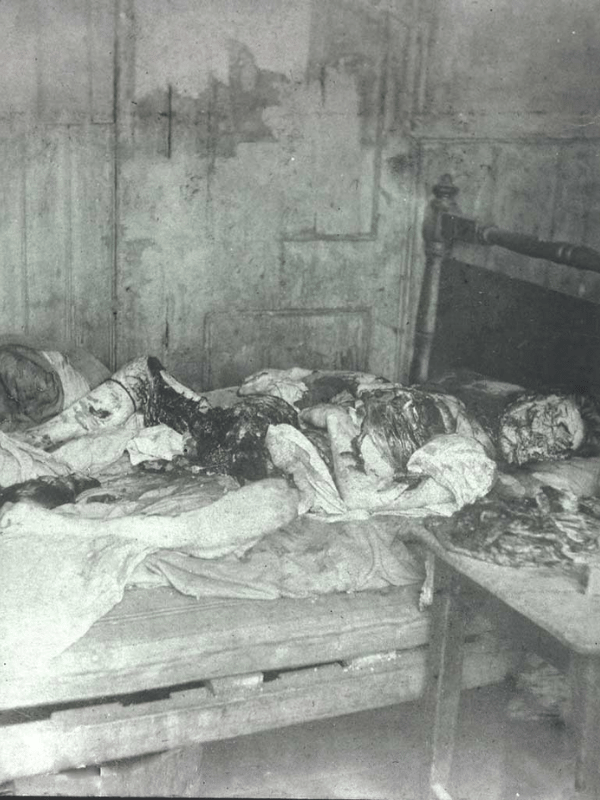
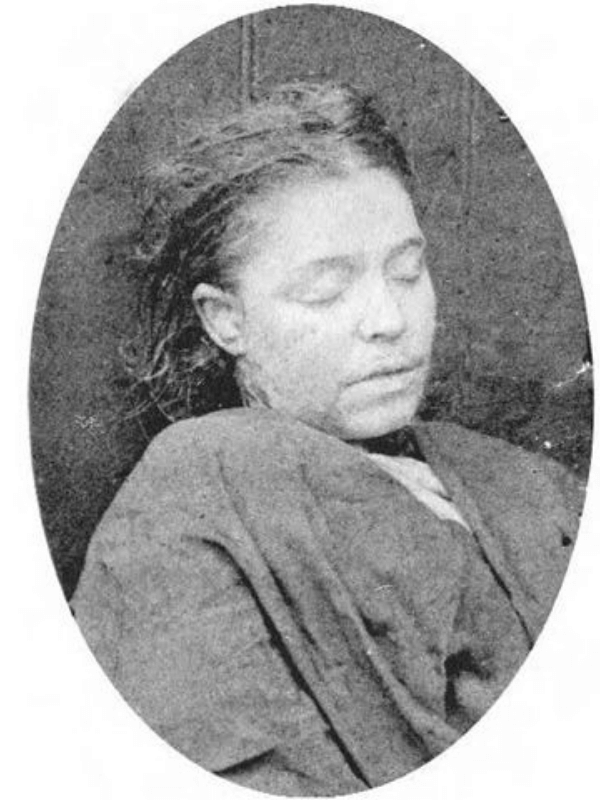
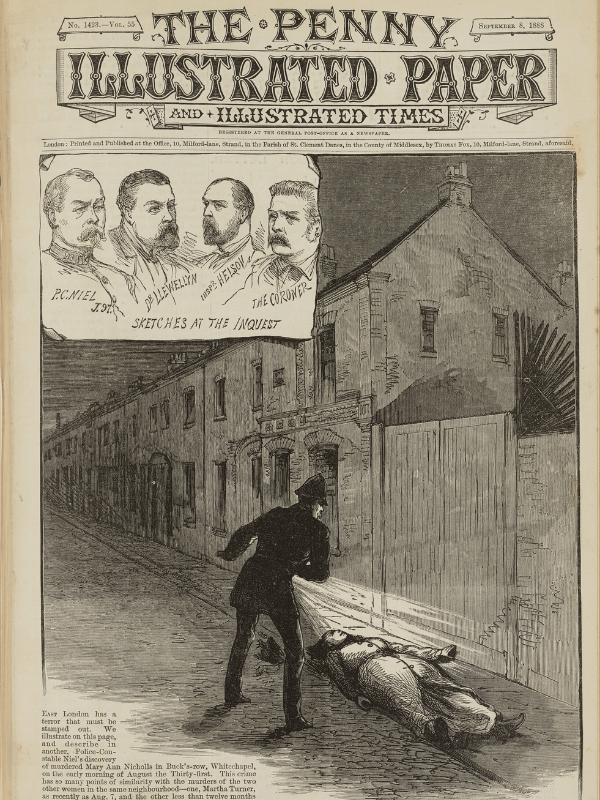
The Whitechapel Murders and Jack the Ripper
1888
The dark underbelly of late Victorian urbanization, poverty, and systemic social neglect was exposed in the autumn of 1888 by a series of horrific, unsolved serial murders in the East End of London. The setting for these crimes was the district of Whitechapel, a densely populated slum where over seventy-eight thousand residents lived in extreme destitution, packed into squalid lodging houses defined by chronic unemployment and exploitation.
Against this grim backdrop, an unidentified serial killer—remembered historically by the media moniker "Jack the Ripper"—brutally targeted women working as casual street prostitutes. The violence escalated across a specific sequence of five canonical victims: Mary Ann Nichols on 31 August, Annie Chapman on 8 September, Elizabeth Stride and Catherine Eddowes during a single "double event" on 30 September, and Mary Jane Kelly on 9 November.
The killer operated with a highly specific, terrifying anatomical precision that suggested a background in butchery or surgical dissection. Each victim was murdered in the dead of night within secluded alleys or dark courtyards, their throats slit from ear to ear before the assailant executed deep abdominal mutilations and, in three cases, systematically removed internal organs such as the uterus and kidneys.
The sheer brutality of the crimes triggered an unprecedented media panic, fueled by a sensationalist press that printed hundreds of unverified rumors and fake letters sent to the Central News Agency by journalists pretending to be the killer. The investigation faced a total failure of coordination due to a bitter bureaucratic rivalry between the Metropolitan Police Force under Commissioner Sir Charles Warren and the separate City of London Police under Major Henry Smith, who clashed over jurisdiction when Catherine Eddowes was found murdered within the City boundaries.
The police deployed over one hundred additional plainclothes officers to patrol the district, utilized bloodhounds in aborted tracking trials, and questioned more than two thousand local tradesmen, but the primitive forensic methods of the era—which lacked fingerprinting or blood-typing—rendered the search ineffective. Frustrated by this official failure, local business owners formed the Whitechapel Vigilance Committee, hiring private private detectives and organizing volunteer night patrols with whistles and clubs to protect their streets. The killings ceased abruptly after the horrific mutilation of Mary Jane Kelly inside her locked room at Miller's Court, leaving the identity of the murderer permanently unresolved.
While suspects ranging from local butcher John Pizer to Polish immigrant Aaron Kosminski were extensively investigated, the failure to secure a conviction deeply damaged public confidence in the home office. However, the international focus on the murders forced a sweeping reassessment of the East End, shocking affluent Victorians into backing immediate philanthropic funding for slum clearance, the closure of the worst lodging houses, and the passage of the Housing of the Working Classes Act 1890 to fundamentally clean up the capital.
Stay Connected
Trade Unionism and New Liberalism
1889 - 1900
The closing decades of the nineteenth century witnessed a profound shift in the industrial counties, as the working class abandoned localized protests to build a powerful network of organized labour. This transformation, known as New Unionism, moved away from small associations of skilled craftsmen to organize vast numbers of unskilled, low-wage industrial workers.
This massive collective strength was clearly shown during the Great Dock Strike of August 1889, when over sixty thousand London dock labourers successfully paralyzed the primary trading port of the country for five weeks, winning their full wage demands and proving that organized labour could halt the commercial life of the nation.
This growing industrial leverage shook the traditional free-market beliefs of the ruling class and fractured old political loyalties. Recognizing that unregulated capitalism could no longer contain the growing class tensions, a new movement of social thinkers and politicians emerged to reshape the country's political ideas.
Led by figures like the young David Lloyd George, this group argued that true individual liberty was impossible without a minimum level of economic security, successfully pushing the legislative agenda toward government-backed social reforms and creating the early blueprint for an organized national welfare system funded by progressive taxation.
To bypass the traditional two-party system entirely, the trade unions joined forces with socialist societies to establish an independent political organization. In February 1900, representatives met in London to form the Labour Representation Committee, appointing Ramsay MacDonald as its first secretary to mark the birth of the modern Labour Party.
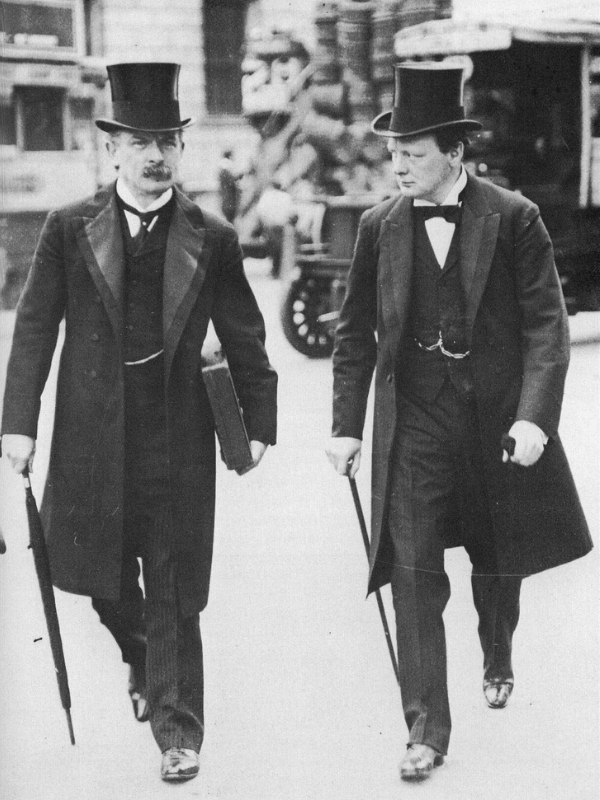
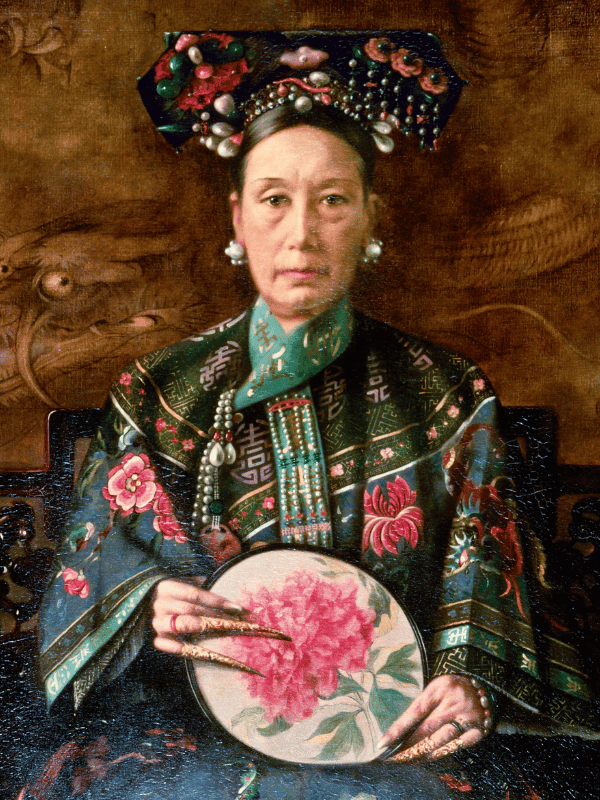
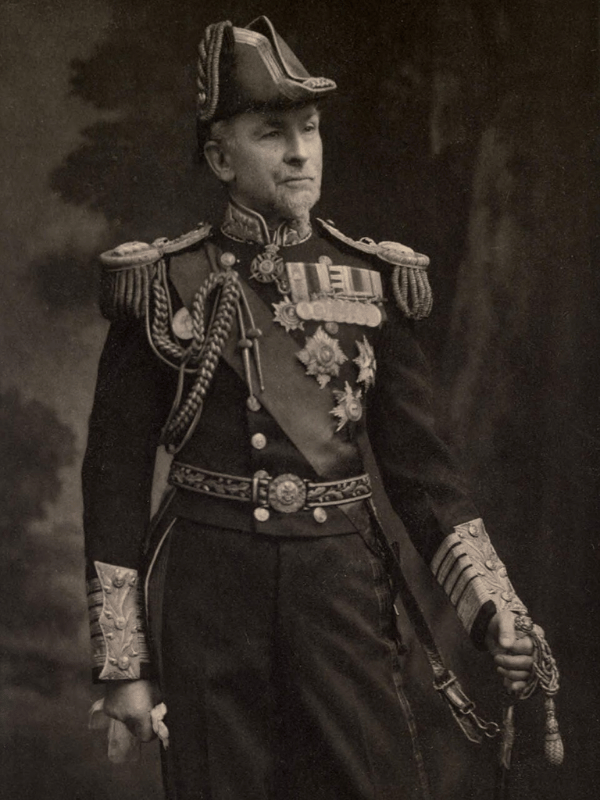
The Anglo-Zanzibar War
1896 AD
The firing of a naval ultimatum at the harbor fortifications of Stone Town on the morning of 27 August 1896 resulted in the shortest recorded war in military history, demonstrating the absolute lethality of late-Victorian gunboat diplomacy during the Scramble for Africa.
The political crisis erupted two days earlier on 25 August following the sudden, suspicious death of the pro-British Sultan Hamad bin Thuwaini, which allowed his anti-imperialist cousin, Sultan Khalid bin Barghash, to instantly seize the throne. Khalid barricaded himself inside the sea-front royal palace with over three thousand armed defenders, Maxim machine guns, and artillery pieces. This unilateral takeover violated the terms of the 1890 Heligoland-Zanzibar Treaty, an imperial agreement that established a British protectorate over the island and explicitly required all royal successors to obtain the formal approval of the British Consul before ascending the throne.
Far from a primitive settlement, the Sultanate of Zanzibar in 1896 operated as an advanced, highly developed maritime trade empire. The island functioned as the primary mercantile gateway for the western Indian Ocean, accumulating immense wealth through its complete monopoly over the global clove trade and its historic control over central African ivory routes. The ruling Omani elite and wealthy Indian merchant classes occupied grand, stone-carved urban complexes across Stone Town. The royal residence itself, the Beit al-Ajaib (House of Wonders) completed in 1883, stood as the tallest structure in East Africa and was the first building on the continent to feature electricity and an automated passenger lift. Militariliy too, Khalid’s defenders did not rely on obsolete weapons; their palace arsenal contained state-of-the-art European repeating firearms purchased directly through international spice revenues.
The primary domestic driver of this booming export economy, however, was a brutal slave plantation system, and while the merchant elite amassed vast fortunes, hundreds of thousands of enslaved mainland Africans were forced to work the extensive clove fields under horrific conditions. British intervention in the royal succession was driven by a dual desire to secure political control over this lucrative trade hub and enforce the formal abolition of slavery, which was legally enacted across the island the following year in 1897.
When the final ultimatum expired at 09:00 AM, Rear-Admiral Harry Rawson commanded a squadron of five Royal Navy warships—including the cruisers HMS Philomel, HMS Thrush, and the heavy flagship HMS St George—to open fire directly on the wooden palace complex at point-blank range. The continuous artillery bombardment tore through the structures, while the guns of the HMS St George instantly sank the sultan's lone armed yacht, HHS Glasgow, in the shallow waters of the harbor to prevent any maritime escape.
The conflict concluded exactly thirty-eight minutes later at 09:38 AM when Khalid fled the burning ruins to seek political asylum at the German consulate, leaving behind over five hundred dead or wounded defenders while the British forces suffered only a single non-fatal injury aboard the HMS Thrush. Later that same afternoon, British administrators installed their preferred loyalist candidate, Sultan Hamoud bin Mohammed, completely dismantling the independence of the sultanate and turning Zanzibar into a de facto crown colony.
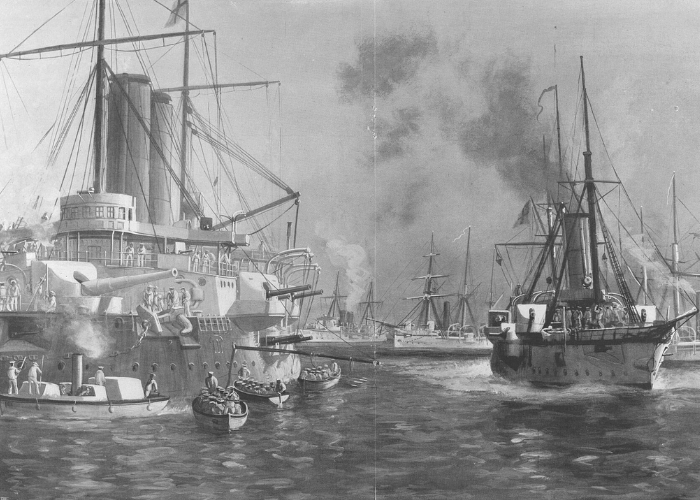
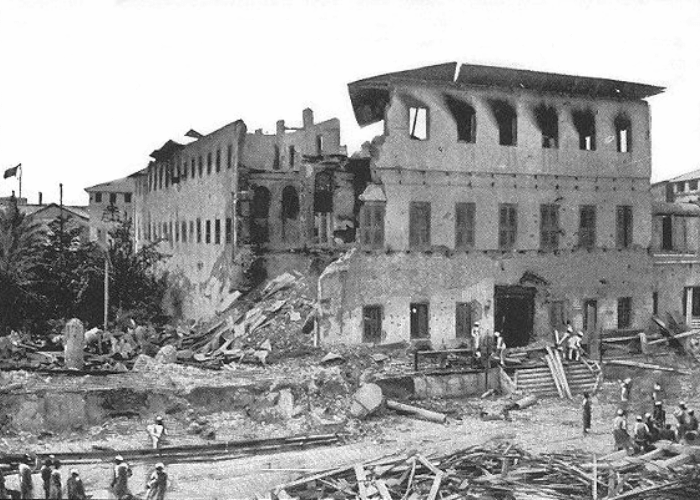
The Boxer Rebellion
1900 AD
The rapid expansion of European commercial zones and railway concessions across northern China sparked a violent, anti-foreign popular uprising at the turn of the century. Organized by a secret millenarian movement historically known as the Boxers, the insurgents blamed the severe economic distress of the country on foreign intervention and Christian missionary conversion campaigns.
The simmering regional anger exploded into open warfare in June 1900 when the Qing Dynasty, under the direction of the Empress Dowager Cixi, declared war against all foreign powers and allied with the Boxer forces. A massive insurgent army marched into Beijing, trapping hundreds of Western families, security detachments, and international diplomats inside the foreign legation quarter, initiating a grueling, fifty-five-day Siege of the International Legations that permanently fractured China's diplomatic relationships with the West.
The response from the great powers was swift and uncompromising, resulting in the creation of the Eight-Nation Alliance—a unique multi-national coalition comprising Great Britain, the United States, Russia, France, Germany, Japan, Austria-Hungary, and Italy. To break the siege, a British expeditionary column of two thousand men under Vice-Admiral Edward Seymour launched an initial rescue attempt, but was heavily mauled by Boxer ambush teams and forced to retreat to Tianjin.
A secondary, more powerful relief army of twenty thousand professional troops under the tactical command of Lieutenant-General Sir Alfred Gaselee launched a high-velocity offensive up the Peiho River valley in August 1900. Utilizing superior artillery coordination and disciplined infantry line formations, Gaselee's columns breached the ancient city walls of Beijing on 14 August 1900, systematically routing the Boxer forces, lifting the fifty-five-day siege, and unleashing a violent wave of plundering and execution across the capital.
The conflict officially concluded on 7 September 1901 through the signing of the Boxer Protocol, a draconian diplomatic settlement forced onto the humiliated Qing court. Under its strict terms, the Empress Dowager was compelled to execute multiple anti-foreign government officials and pay a staggering international indemnity of 450 million silver taels, with Great Britain securing a substantial share to fund its war exchequer.
Furthermore, the treaty authorized the permanent stationing of foreign military garrisons straight inside the capital and required the total destruction of the strategic Taku Forts guarding the passage to the sea, permanently stripping the Qing state of its sovereign defense capabilities and accelerating the definitive collapse of the imperial dynasty.
Further Information: The Boxer Rebellion
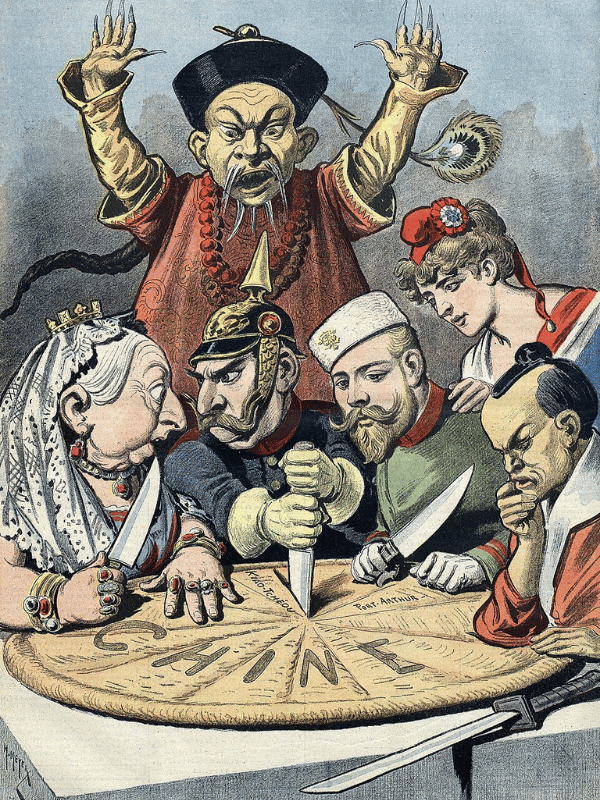
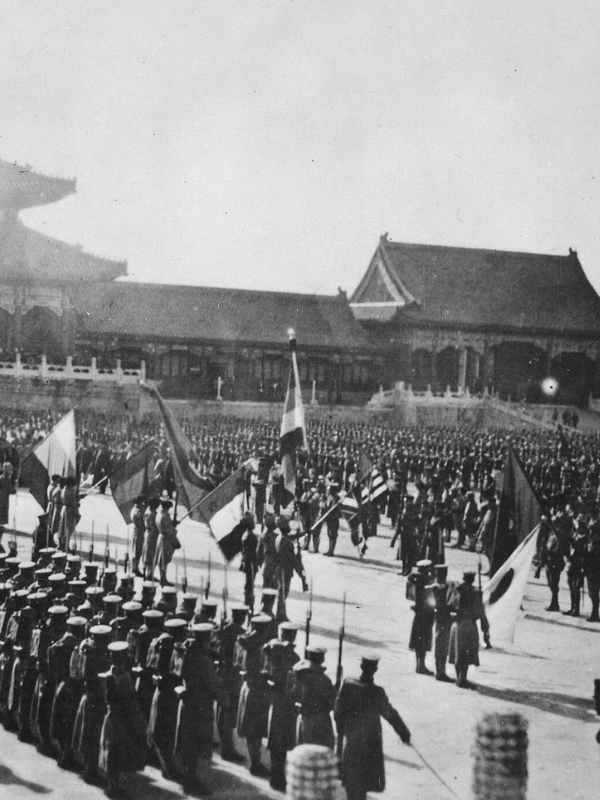
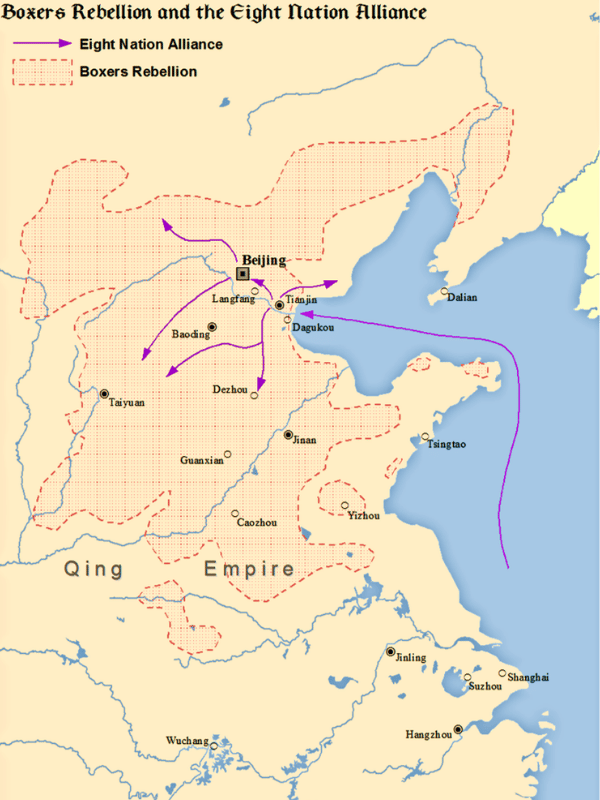
The Boer Wars
1899 - 1902
Additional Information: The Second British Empire / The Second Boer War, The Edwardian Era / The End of the Boer War and Haldane Reforms
The final decades of the Victorian era were dominated by a brutal, deeply exhausting military conflict in southern Africa that shattered the myth of unchallenged imperial supremacy. Although the climactic struggle erupted at the end of the century, the friction was rooted in the First Boer War of December 1880, when the independent, Dutch-settled farmers of the South African Republic, or the Transvaal, revolted against British annexation.
At the Battle of Majuba Hill on 27 February 1881, highly mobile Boer marksmen completely outmaneuvered traditional British infantry columns, killing Major-General Sir George Pomeroy Colley and forcing the ministry of William Ewart Gladstone to sign the Pretoria Convention, which restored internal self-government to the Transvaal. This fragile peace dissolved completely following the sudden discovery of the world’s richest gold reef on the Witwatersrand in 1886. Determined to prevent the Transvaal from using this immense mineral wealth to establish economic dominance, the British Colonial Secretary, Joseph Chamberlain, and High Commissioner Alfred Milner aggressively demanded immediate voting rights for British gold miners, known as Uitlanders. This deliberate diplomatic campaign provoked the Transvaal President, Paul Kruger, to issue a preemptive ultimatum, igniting the Second Boer War in October 1899.
The early months of the renewed war exposed severe failures at the heart of the British army, delivering a shattering blow to imperial prestige. In December 1899, during a catastrophic seven-day window known historically as Black Week, the British army suffered three consecutive defeats. At the Battle of Stormberg on 10 December 1899, a botched night march left over six hundred soldiers stranded to be captured. This was followed on 11 December 1899 by the Battle of Magersfontein, where the Highland Brigade was systematically decimated by hidden Boer trenches at the base of the hills, costing the life of Major-General Andrew Wauchope.
The disaster culminated on 15 December 1899 at the Battle of Colenso, where General Sir Redvers Buller failed to cross the Tugela River, losing ten field cannons and suffering over one thousand casualties against the hidden lines of Louis Botha. These triumphs allowed the Boer commandos to lay siege to the vital British border garrisons at Ladysmith, Mafeking, and Kimberley, trapping thousands of regular troops.
Although Field Marshal Frederick Roberts, the 1st Earl Roberts, subsequently arrived with overwhelming reinforcements to lift the sieges and capture the Boer capitals of Bloemfontein and Pretoria by June 1900, the conflict did not end. Instead, it descended into a multi-year guerrilla war that forced the British government to execute exceptionally desperate tactics. To break the remaining guerrilla commandos led by figures like Christian de Wet, General Herbert Kitchener instituted a ruthless scorched-earth policy, constructing a vast matrix of over eight thousand stone blockhouses wrapped in barbed wire to slice up the open veldt. British forces systematically burned down over thirty thousand Boer farmsteads, slaughtered livestock, and forcefully rounded up displaced civilian families into a network of heavily guarded concentration camps.
The failure to manage these camps properly resulted in a horrific humanitarian crisis. Over twenty-six thousand Boer women and children—alongside more than fourteen thousand Black African laborers in separate encampments—died from epidemic typhus, measles, and starvation. This atrocity was exposed to the British public by the courageous investigation of Emily Hobhouse, whose reports caused widespread moral outrage across the home front and forced the creation of the Fawcett Commission to overhaul camp administration.
Although the conflict concluded with a British victory through the signing of the Treaty of Vereeniging in May 1902, the immense expenditure of over two hundred million pounds and the deployment of nearly 450,000 imperial troops to defeat just eighty thousand farmers exposed deep vulnerabilities in the military. It triggered an acute national anxiety over the physical fitness of working-class recruits, forcing the state to introduce free school meals and medical inspections, and signaled the definitive twilight of Victorian confidence.
Further Information: The Boer Wars
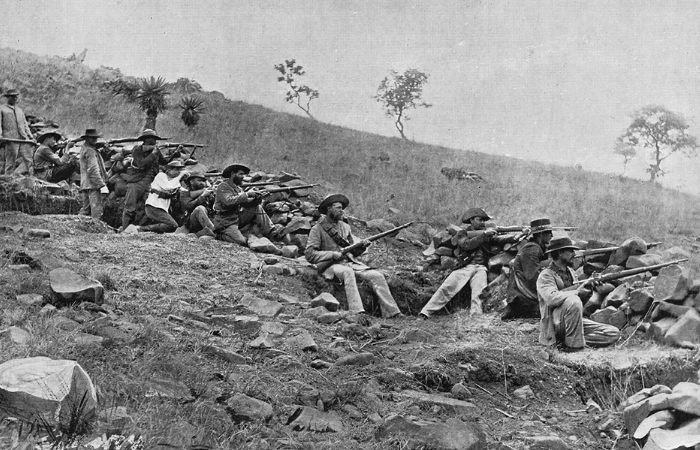
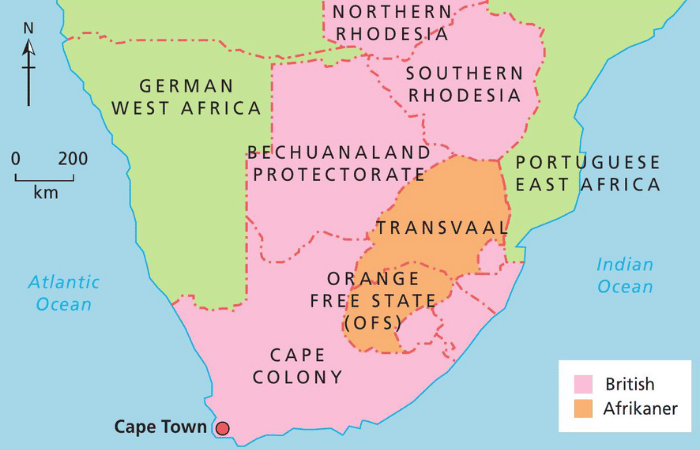
Splendid Isolationism
1885 - 1901
The overarching diplomatic strategy of the late Victorian era was defined by a calculated policy of non-alignment across continental Europe, famously celebrated by contemporary politicians as Splendid Isolation.
Throughout the late nineteenth century, the British government refused to sign any permanent military alliances with rival European superpowers. This strategy, championed primarily by the Prime Minister, Robert Gascoyne-Cecil, the 3rd Marquess of Salisbury, allowed the state to completely avoid entangling alliances while focusing national resources on the defense of its global trade lines and the expansion of the Royal Navy.
Under this framework, the Foreign Office functioned as an independent maritime umpire over global politics, using its unchallenged naval supremacy to enforce a global maritime peace—the Pax Britannica—that protected international trade routes and funneled massive streams of wealth directly into the markets of Great Britain without dragging the nation into an expensive continental war.
The structural backbone for this isolationist approach was the Naval Defence Act 1889, which officially established the Two-Power Standard as a strict statutory requirement for the country. This law required royal shipyards to continuously construct heavy warships, ensuring that the Royal Navy remained at least equal in size and firepower to the combined naval capacity of the next two strongest maritime nations in the world, which at the time were France and Russia.
Parliament authorized an immediate, massive capital investment of £21,500,000 to fund the construction of ten modern battleships—including the formidable Royal Sovereign-class capital ships—alongside forty-two specialized cruisers and eighteen torpedo boats. This massive naval dominance successfully deterred rival European countries from challenging British territories, establishing a deterrent that insulated the home shires from continental aggression.By remaining detached from the dynastic rivalries of Germany, France, and Russia, the British government successfully maintained complete freedom of action, but the policy faced severe geopolitical strains at the turn of the century.
The limitations of isolation became dangerously apparent during the Fashoda Incident of September 1898, when an Anglo-Egyptian force under Major-General Herbert Kitchener confronted a French expeditionary column under Captain Jean-Baptiste Marchand for control of the Upper Nile, pushing both nations to the brink of a global war before France backed down. Furthermore, the outbreak of the Second Boer War in October 1899 left Great Britain completely friendless in Europe, facing a wave of hostile anti-British public opinion from Paris to Berlin.
Recognizing that the rise of the German Imperial Navy and the expansionist policies of the Dual Alliance were permanently altering the naval balance of power, the British command was ultimately forced to abandon Splendid Isolation, signing the Anglo-Japanese Alliance in January 1902 to secure its Pacific frontiers and close the book on Victorian diplomatic history.
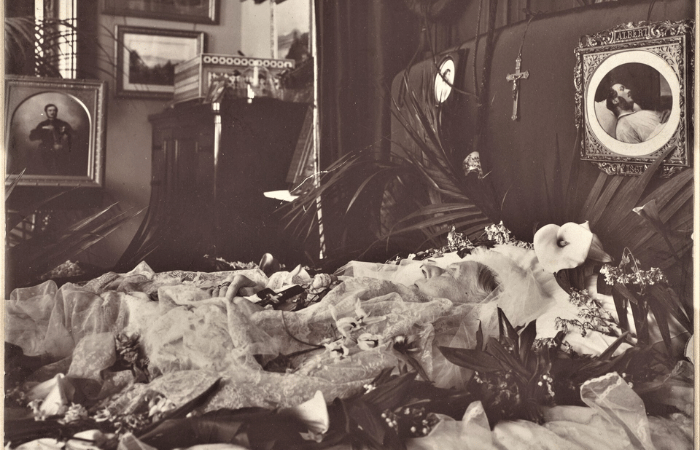
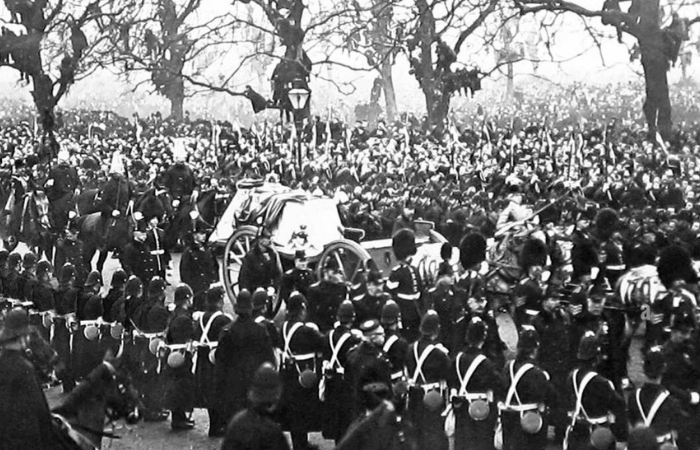
The Death of A Queen-Empress
1901
Additional Information: The Edwardian Era / The Ascension of Edward VII
On the evening of 22 January 1901, Queen Victoria passed away at Osborne House on the Isle of Wight at eighty-one years old, concluding her historic sixty-three-year reign and closing the book on the long Victorian century. Her crown passed instantly to her sixty-three-year-old eldest son, King Edward VII, a transition that concluded the rule of the House of Hanover and marked the birth of the Edwardian era under the new dynastic name of the House of Saxe-Coburg and Gotha.
Her funeral, held at St George's Chapel in Windsor Castle on 2 February 1901, was turned into a massive theater of international diplomacy, drawing together forty monarchs and European royal dignitaries—including her grandson, Kaiser Wilhelm II of Germany—to witness the interment at the Royal Mausoleum at Frogmore. The passing of the Queen marked the final chapter of an era of unparalleled civilisational expansion, during which the British government had successfully transformed the nation, breaking the old patterns of farming life to construct a global industrial superpower. The United Kingdom had successfully navigated severe domestic radical pressures, established a stable parliamentary two-party system, and conquered a vast global territory that stretched across every ocean on the planet.
The new Edwardian government inherited a highly advanced kingdom possessing an unmatched naval fleet, a massive network of industrialized cities, and an elite international banking network centered in the City of London. However, beneath this visual display of imperial power, the state machine faced rising structural anxieties that threatened its long-term security. The heavy economic cost of the ongoing Second Boer War, coupled with the rapid industrial expansion and aggressive naval building programs of Germany and the United States, meant that Great Britain could no longer claim a total monopoly over global manufacturing or maritime commerce.
As the new King ascended the throne, the nation entered the twentieth century with its global logistics pushed to their absolute limits, forcing a profound domestic re-evaluation of its defense capabilities and diplomatic alignments to preserve the sprawling architecture of the global empire.
Victorian Era FAQs