
The Imperial Province:
Roman Britain
The province of Brittania
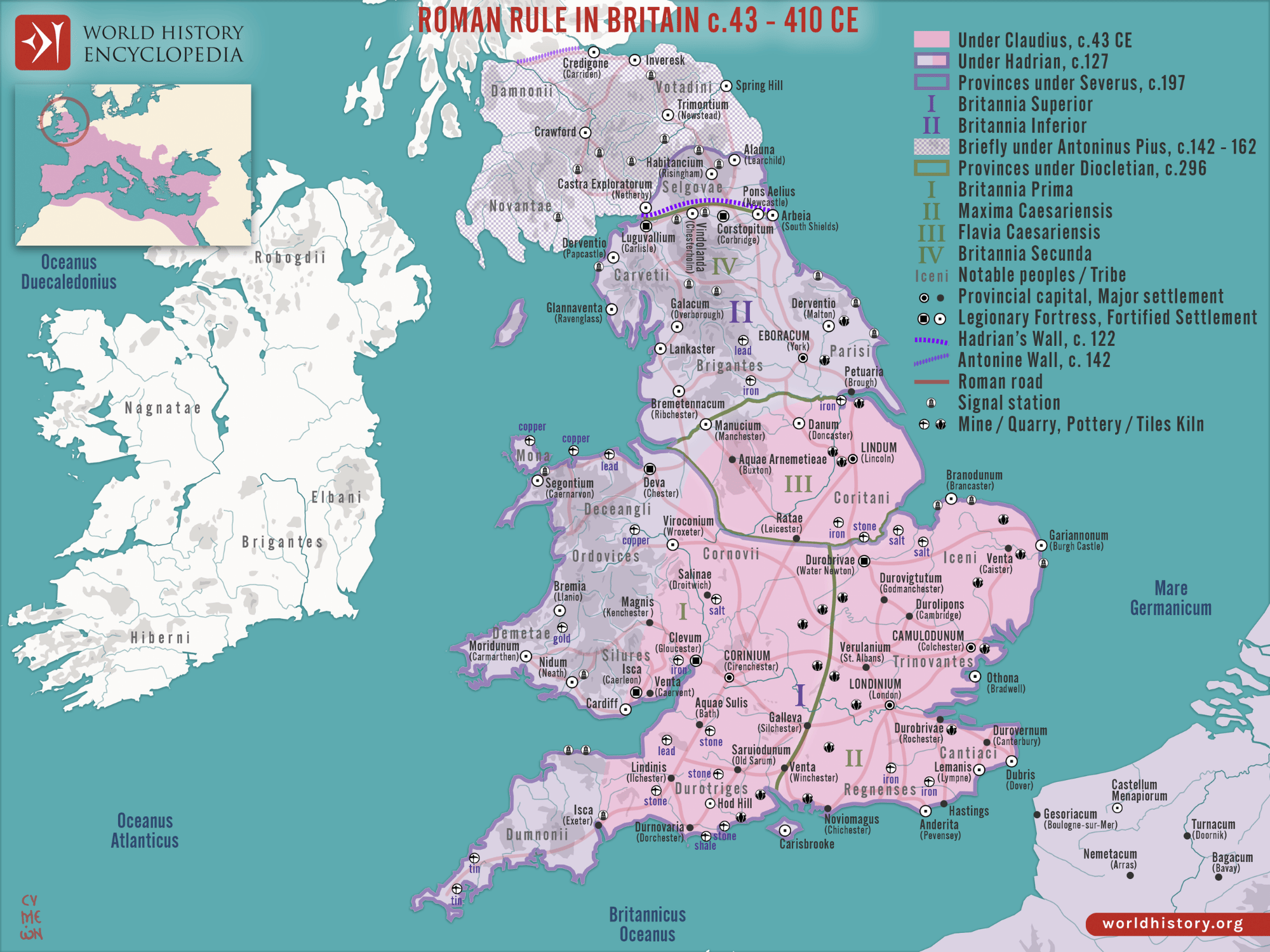
The invasion of Roman legions in 43 AD shattered the tribal isolation of the pre-Roman world, launching a new era defined by rapid urbanization and distant imperial rule. By executing a swift administrative change, the incoming forces ruthlessly swept away the old landscape of loose clan networks and timber hillforts. In its place, they built an integrated province complete with straight military roads, stone-walled cities, and a standardized tax economy.
This imperial era tracks the country's transition from independent native chiefdoms to a highly integrated Romano-British society, documenting the suppression of regional rebellions, alongside the construction of massive frontier barriers like Hadrian’s Wall. Ultimately, this history charts nearly four centuries of occupation that fundamentally restructured the island's infrastructure, legal baseline, and civic centers before the final troop withdrawal in 410 AD.
Page Contents:
Prelude, Mobilisation, and the Channel Crossing
43 AD
Additional Information: Iron Age Britain / The Catuvellauni Succession Crisis
The military invasion of 43 AD resulted directly from a internal political collapse within the native British kingdoms, bringing a definitive end to a century of remote imperial diplomacy. Following Julius Caesar’s expeditions in 54 BC, Rome had managed the wealthy southeastern territories from afar through a delicate network of client states. Friendly tribal rulers, most notably the kings of the Atrebates, were granted protection and trade privileges in exchange for safeguarding Roman commercial interests and neutralising anti-imperial factions.
This diplomatic balance was severed around 40 AD by the death of King Cunobelinus, the ruler of the Catuvellauni power, whose passing sparked a bitter dynastic succession crisis that allowed his two anti-Roman sons, Caratacus and Togodumnus, to seize power. The two brothers launched an aggressive military offensive across the south, overrunning the Atrebatean capital at Calleva Atrebatum and driving the client king, Verica, into political exile across the English Channel.
Arriving at the court of the newly crowned Roman Emperor Claudius, the exiled King Verica made a formal appeal for military restoration. For Claudius—who faced severe political insecurity and senatorial conspiracies in Rome following the assassination of Caligula—this appeal provided the necessary pretext for an invasion. Claudius required a major foreign triumph to secure his hold on the imperial throne, prompting him to cancel the old treaty system and authorise an overwhelming force to launch a permanent conquest.
The campaign was placed under the supreme command of Aulus Plautius, a highly experienced senator and general, who mobilised four elite legions—the Legio II Augusta, commanded by the future Emperor Vespasian, the Legio IX Hispana, the Legio XIV Gemina, and the Legio XX Valeria Victrix—alongside an equal number of specialised auxiliary cohorts, combining into an invasion force of approximately 40,000 soldiers.
The launch of the campaign faced an immediate crisis at the embarkation port of Gesoriacum in Gaul, where the legionaries, terrified by ancient myths that labelled Britain as a lawless world sitting beyond the edge of the known earth, staged a mutiny and refused to board the transport ships. The strike was broken only when Claudius’s imperial representative, Narcissus, arrived to address the troops on behalf of the Emperor, a spectacle that caused such embarrassment and anger among the soldiers that discipline was instantly restored and the legions boarded the fleet. The invasion force crossed the English Channel in three separate divisions to confuse native tribal defences, landing completely unopposed on the southern coast.
The primary beachhead was established at Rutupiae on the coast of Kent, where military engineers immediately constructed a heavily fortified deep-water port, a double-ditch defensive rampart, and a garrison camp, establishing a secure gateway to the continent before the legions marched inland to strike the native coalitions.
Further Information: Prelude, Mobilisation, and the Channel Crossing

Battle of the Stour and the Kentish March
43 AD
Following their unopposed landing at the deep-water port of Rutupiae (Richborough), the Roman legions faced an immediate logistical challenge as they initiated their primary westward march across the dense, trackless woodlands of Kent. Operating with immense caution, Aulus Plautius pushed his columns along the route of the old prehistoric pathways, tracking toward the primary crossing points of the local river networks.
The first major military confrontation on British soil erupted at the River Stour, near modern Canterbury, where the Catuvellauni brothers, Caratacus and Togodumnus, deployed a large force of native warriors to contest the crossing. Utilizing the steep, heavily wooded northern banks of the river to hide their troop numbers, the British launched a series of high-speed guerrilla ambushes, throwing javelins down onto the vanguard of the Legio IX Hispana as the infantry attempted to wade through the rising waters.
Plautius countered this defensive obstacle by refusing to launch a reckless, direct frontal infantry assault across the deep river channel. Instead, he deployed his highly specialized auxiliary troops, sending a vanguard division of river-swimming Batavian and Celtic cavalry to cross the Stour undetected further upstream, bypassing the main British lines. These auxiliary forces swarmed onto the northern bank, executing a coordinated flanking maneuver that targeted the native chariot teams, killing the horses and disabling the vehicles before the British could deploy them on the open plain.
Under the cover of this immediate chaos, the heavy legionary infantry forced their way across the river basin, forming a solid shield wall to drive the native warriors out of the timber line. The engagement ended in a swift tactical success for the Roman columns; the outmanoeuvred British forces broke their formations and scattered into the western woods, executing a rapid retreat to regroup their surviving regional coalitions for a massive, desperate two-day stand at the wider waters of the River Medway.

Battle of the Medway and the Fall of the Southeast
43 AD
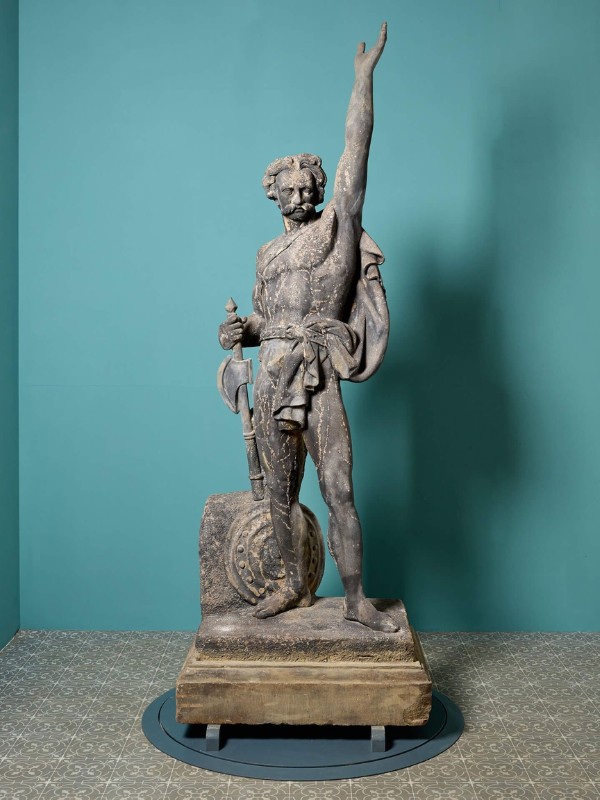
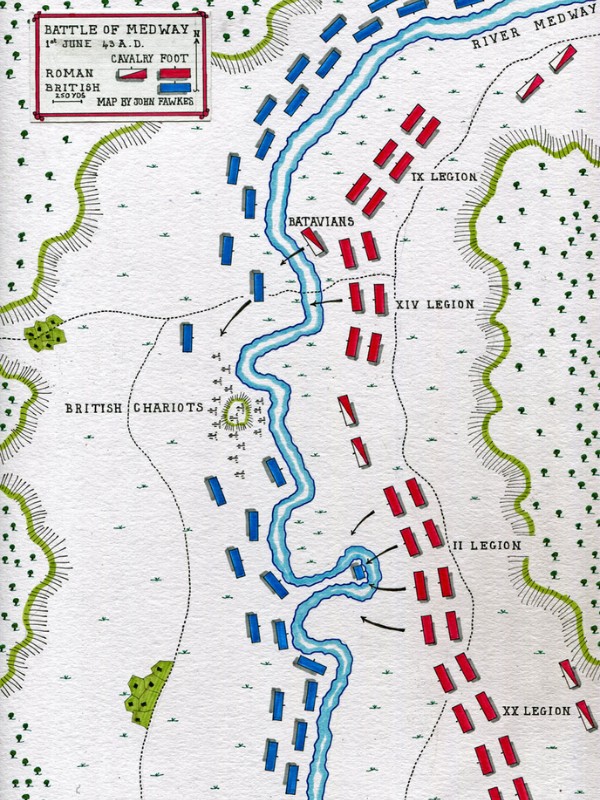
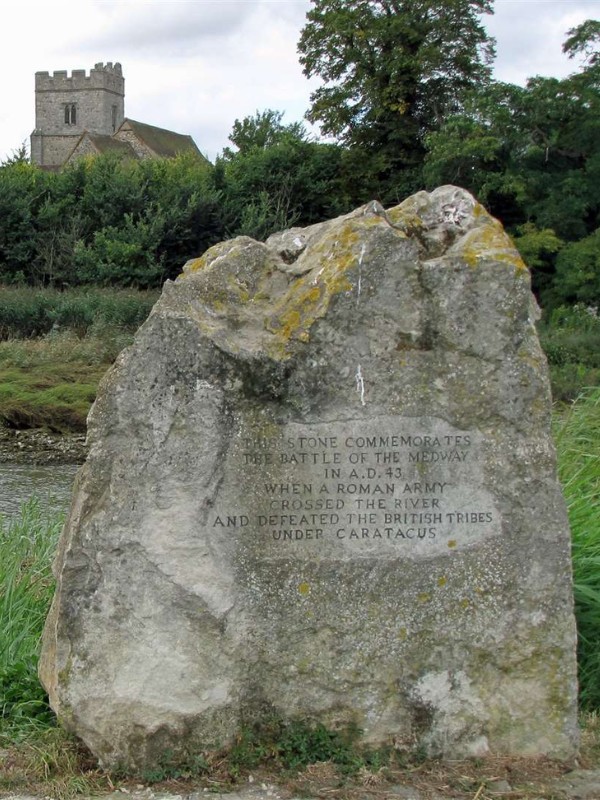
Native resistance was led by the Catuvellauni brothers, Caratacus and Togodumnus, who utilized the river networks of Kent to harass the Roman march until the imperial army forced its way inland, compelling the native coalition to make a stand at the River Medway. The resulting two-day engagement became one of the largest battles ever fought on English soil, with the British deploying a dense shield wall and thousands of chariots along the western bank, operating under the assumption that the deep, fast-flowing water would block the heavy infantry. Aulus Plautius countered this defensive position by sending specialized, river-swimming Batavian and Celtic auxiliary units across the water undetected, launching a surprise assault that targeted the chariot horses to disable the vehicles and cause immediate chaos within the native lines.
The next day, Roman infantry under the command of Vespasian and Hosidius Geta crossed the river to launch a frontal assault against the main British shield wall. The disciplined legions shattered the native formations, inflicting heavy casualties and mortally wounding King Togodumnus. The surviving British forces retreated toward the marshes of the River Thames, leaving the wealthy southeast entirely exposed to the conquerors. Plautius halted his advance at the river crossing to wait for Emperor Claudius, who arrived from the continent with heavy reinforcements, including elements of the Praetorian Guard and war elephants, to lead the final ceremonial march into the captured tribal capital of Camulodunum.
This total military victory sealed the formal submission of eleven regional British kings, who surrendered their sovereignty to Claudius in exchange for being allowed to rule as imperial client monarchs. Chief among these submitting rulers was Cogidubnus of the Regni tribe, along with the unnamed paramount chieftains of the Iceni of Norfolk, the Corieltauvi of the East Midlands, the Cantiaci of Kent, and the Trinovantes of Essex.
This submission allowed the Roman high command to establish the first imperial stronghold on the island, constructing a massive legionary fortress on the site of Cunobelinus's old capital, which was subsequently converted into the provincial capital of Colonia Claudia Victricensis, permanently anchoring the administrative framework of the new Roman province.
Further Information: Battle of the Medway and the Fall of the Southeast
Storming of the Hillforts and the Western Campaigns
43 - 47 AD
Following the fall of the wealthy southeast, the Roman high command divided the invasion army into three massive tactical columns to rapidly subdue the remainder of the island. Legate Titus Flavius Vespasianus—the future Emperor Vespasian—was given command of the Legio II Augusta and deployed on a multi-year amphibious and overland campaign across southern England to conquer the hostile tribal networks of the southwest, most notably the fiercely independent Durotriges of Wiltshire and Dorset, alongside their neighbours, the Belgae.
This movement developed into a gruelling war of siege and attrition against the ancient Iron Age hillfort system, where the native tribes relied on massive earthwork ramparts, deep ditches, and complex labyrinthine entrance gateways to protect their settlements. These chalk fortifications offered little protection against the advanced engineering, field artillery, and ranged tactics of the Roman legions, who utilized heavy scorpiones and ballistas to rain iron-tipped catapult bolts down onto the defenders before advancing behind interlocking testudo shield formations to force the gates.
Physical evidence of this campaign was uncovered during excavations directed by Sir Mortimer Wheeler at Maiden Castle near Dorchester, Dorset, where archaeologists exposed a late Iron Age war cemetery containing thirty-eight burials at the fort’s eastern entrance. These graves revealed the skeletal remains of native warriors cut down in hand-to-hand combat, showing signs of severe trauma from heavy Roman short swords, or gladii.
Multiple skulls bore deep fractures from blade strikes, and one skeleton of a young adult male was even recovered with a heavy iron ballista bolt still embedded through its spine. Vespasian successfully stormed over twenty massive hillforts across the region—including Hod Hill, where military engineers constructed a Roman auxiliary fort directly inside the northwest corner of the captured native ramparts, alongside Spetisbury Rings and Hambledon Hill. He subdued two powerful nations, captured the Isle of Wight, known as Vectis, and established absolute control over the rich lead and silver mining districts of the Mendip Hills.
This campaign systematically dismantled the traditional defensive networks of the southwest, expanding the borders of the Roman province to the western edges of England and securing the rear of the imperial advance before the legions wheeled north and west toward the borders of Wales.
Further Information: Storming of the Hillforts and the Western Campaigns
The Subjugation of Wales and the Caratacus Guerilla War
47 - 51 AD
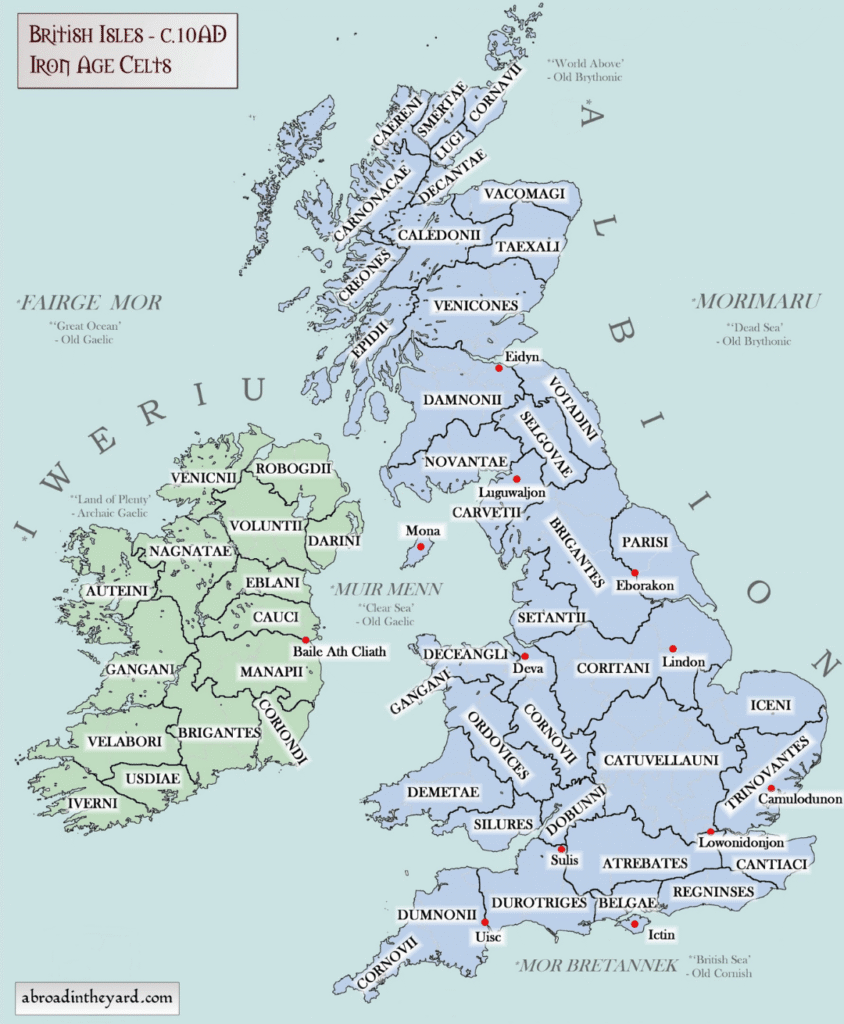
Following the collapse of the southeastern kingdoms and the death of his brother Togodumnus, Caratacus fled westward into the rugged terrain of Wales, utilizing his royal status to unite the Silures of the southeast and the Ordovices of the northwest into a coordinated resistance.
Recognizing that his warriors could not match the heavily armored Roman legions in an open confrontation, Caratacus exploited the steep mountain valleys, high ridges, and rocky passes to execute swift ambushes that stalled the imperial advance into the interior. This frontier war lasted for nearly eight years, forcing the newly installed Roman governor, Publius Ostorius Scapula, to alter his approach by constructing a network of timber-and-earth auxiliary forts and military roads along the Severn and Dee valleys to contain the threat and secure his supply lines.
The conflict reached its climax in 51 AD at the Battle of Caer Caradoc, traditionally located in mid-Wales, where Caratacus positioned his forces along a fortified mountain ridge, using a river—historically noted as the River Severn or one of its tributaries—to block the Roman advance. The Roman legionaries, drawn from the Legio XIV Gemina and Legio XX Valeria Victrix, forced their way across the water, advanced up the rocky slope under a protective formation of interlocking shields, and breached the stone and timber ramparts to break the native defense.
Caratacus escaped the destruction of his army, leaving his wife, daughter, and brothers to be captured by the legions, and fled north across the Pennines to seek safety with the Brigantes. However, the pro-Roman queen of the Brigantes, Cartimandua, chose to protect her lucrative trade treaties, financial subsidies, and client status with the Empire rather than support a rebellion, placing Caratacus in chains to hand him over to Governor Scapula.
Paraded through Rome alongside his captured family as a prize captive, Caratacus delivered a famous speech of such confidence before Emperor Claudius and the Roman Senate that his life was spared, allowing him to spend his remaining days in comfortable Italian exile as a client of the Roman state. Back on the island, this capture did not end the resistance; the Silures immediately launched a fierce counter-campaign that defeated a legion under Scapula's command and kept the western frontier under heavy strain for another generation, safely bounded before the separate uprisings in the east.
Further Information: The Subjugation of Wales and the Caratacus Guerilla War

The Founding of Londinium
47 – 50 AD
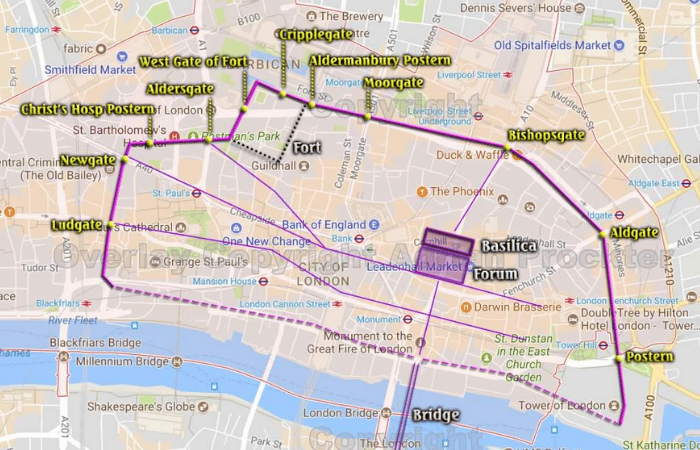
The consolidation of the early Roman province led to the creation of the island’s commercial and administrative capital, a brand-new urban settlement historically recorded as Londinium (London). Before the imperial invasion of 43 AD, the site existed entirely as a vacant, marshy landscape of gravel spits, tidal mudflats, and small streams.
Around ~47 AD, Roman military engineers and surveyors recognized the strategic value of the location on the northern bank of the River Thames, establishing a permanent base centered across two low hills, modern Cornhill and Ludgate Hill, divided by the Walbrook stream. This specific coordinate represented the narrowest point of the lower Thames where the military could realistically construct a massive timber piling bridge, while remaining far enough downstream to allow deep-water continental merchant vessels to sail in from the North Sea basin to drop anchor.
The rapid development of Londinium moved away from the traditional model of a slow-evolving tribal settlement, expanding as a highly planned, western-style commercial boomtown. Roman planners laid out a strict grid system of gravel-paved streets, erecting a high-capacity timber wharf and quay system that stretched for hundreds of metres along the waterfront to handle the massive influx of international maritime trade.
Unlike the official civitas capitals that were built to house the native British aristocracy, Londinium grew as a cosmopolitan merchant hub populated by a diverse influx of continental traders, financiers, artisans, and imperial bureaucrats from Gaul, Italy, and the Rhineland. Excavations across the city’s waterlogged soils have uncovered the physical realities of this early phase, revealing thousands of wooden writing tablets, leather shoes, and imported red-slip terra sigillata pottery. By establishing the main crossroads of the provincial highway system directly at the new bridgehead, the Roman high command transformed this vacant river crossing into the beating economic engine of Britannia.
The demographic expansion of Londinium over the four centuries of occupation was unprecedented on the island. Starting as a small cluster of timber structures housing a few thousand merchants, the population exploded to approximately thirty thousand people by the time of the Boudican Revolt in 60 AD. Following the post-rebellion reconstruction, the population peaked during the early second century at an estimated forty-five thousand to sixty thousand inhabitants, making it by far the largest city in Britannia and a bustling metropolis of the western empire. Because it was a newly founded commercial enclave rather than a traditional native tribal capital, Londinium lacked a conventional local town council or elected civilian mayor. Instead, the administrative hierarchy was headed directly by the Imperial Procurator—the chief financial officer of the province—alongside a highly specialized senior judicial administrator acting under the authority of the Governor.
This administrative apparatus was securely backed by a strong military presence. By the early second century, the Roman high command constructed a massive, twelve-acre stone fortress at Cripplegate in the northwest sector of the city, housing a permanent garrison of up to one thousand elite soldiers who served as the Governor's personal guard, performed police duties, and secured the provincial treasury. The city amassed such immense commercial wealth and administrative density that the imperial bureaucracy permanently relocated the provincial capital from Camulodunum straight to London.
This system consolidated a bustling, highly integrated urban center that sat completely undefended without city walls until the late second century, when the central administration finally threw up a massive, two-mile stone defensive wall to shield the capital from the incoming threats of a fracturing western empire.
Further Information: The Founding of Londinium
The Boudican Revolt
47 – 50 AD
In 60 AD, while Governor Gaius Suetonius Paulinus was commanding the Legio XIV Gemina and Legio XX Valeria Victrix in an assault on the Druidic strongholds on the Isle of Anglesey, a catastrophic rebellion erupted in the east.
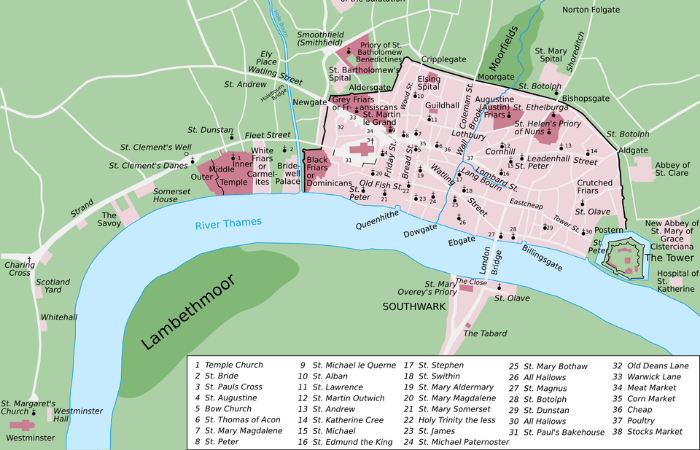
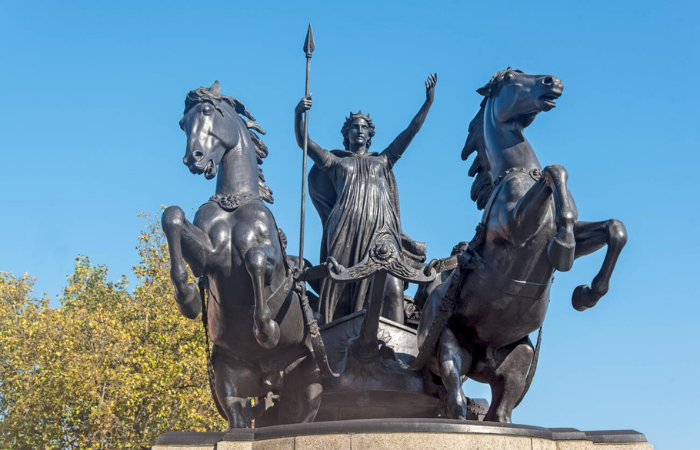
The uprising was triggered when imperial procurator Catus Decianus and his tax collectors aggressively violated the family of the deceased Iceni client-king, Prasutagus. Bypassing his will, which left half his kingdom to the Emperor Nero to secure peace, Roman agents plundered his estates, publicly flogged his widow, Boudica, and assaulted his daughters. In response to these insults, Boudica raised the Iceni and formed a military alliance with the neighbouring Trinovantes, who were deeply embittered by the forced expulsion of their lands to build a retirement settlement for Roman veterans. Together, they launched an uncompromising war of vengeance against the Roman occupation.
The rebel army swept across the undefended southeast, targeting populated Roman settlements that lacked defensive walls. They first stormed Camulodunum (Colchester), destroying the temple of Claudius where citizens had barricaded themselves, before systematically burning Londinium (London) and Verulamium (St Albans). Along their marching route, the insurgents ambushed and routed a rescue column of the Legio IX Hispana under the command of Quintus Petillius Cerialis, slaughtering nearly all the infantrymen.
This immense urban devastation remains clearly visible across southern England today as a distinct, continuous archaeological stratum of red and black charred ash, scorched brick, and melted daub known as the Boudican Destruction Layer. According to the Roman historian Tacitus, approximately seventy thousand Romans and loyal provincials were killed by the rebel forces through hanging, crucifixion, and impalement.
Governor Suetonius Paulinus rode desperately south along the network of Roman roads, briefly reaching London but choosing to abandon the city due to a severe lack of immediate troops. He retreated to gather his scattered infantry, eventually assembling a highly disciplined force of roughly ten thousand men for a definitive showdown, historically located at the Battle of Watling Street.
Though outnumbered nearly ten to one by the massive British host, Paulinus displayed immense tactical presence, positioning his forces inside a narrow V-shaped defile backed by dense woods to prevent his lines from being flanked. The British rebels, overconfident in their victory, brought their families in a vast semi-circle of wagons to watch the battle, inadvertently blocking their own escape. The disciplined Roman infantry loosed devastating volleys of heavy javelins, or pila, before forming tight wedge formations to charge into the packed British mass alongside their auxiliary cavalry.
This counter-offensive broke the uncoordinated lines, turning the battle into a slaughter that claimed the lives of an estimated eighty thousand natives. Boudica escaped the immediate field but ended her life by poison shortly after, permanently breaking the political and military power of the southeastern tribes. Following this complete military victory, the Roman high command executed a brutal, systematic campaign of retribution across the territory of the rebellious tribes, deploying fresh reinforcements from Germany to burn the remaining native farmlands and slaughter the remaining livestock of any clan that had wavered in its loyalty.
This severe reaction threatened to plunge the entire province into a permanent, man-made famine until the newly appointed imperial procurator, Julius Alpinus Classicianus, intervened by writing directly to the Emperor Nero in Rome, arguing that Governor Paulinus's harsh punitive policies were destroying the economic potential of the colony and preventing the resumption of peaceful crop cultivation. Nero recalled the Governor, initiating a fundamental shift in Roman provincial administration from aggressive military conquest to a sophisticated policy of peaceful Romanisation and administrative integration.
For the southern tribes, the aftermath transformed their entire society; their traditional warrior elites completely abandoned their old hillforts to settle in newly constructed, planned Roman towns like Chichester, Silchester, and Winchester, where they built grand stone forums, public baths, and luxury villas.

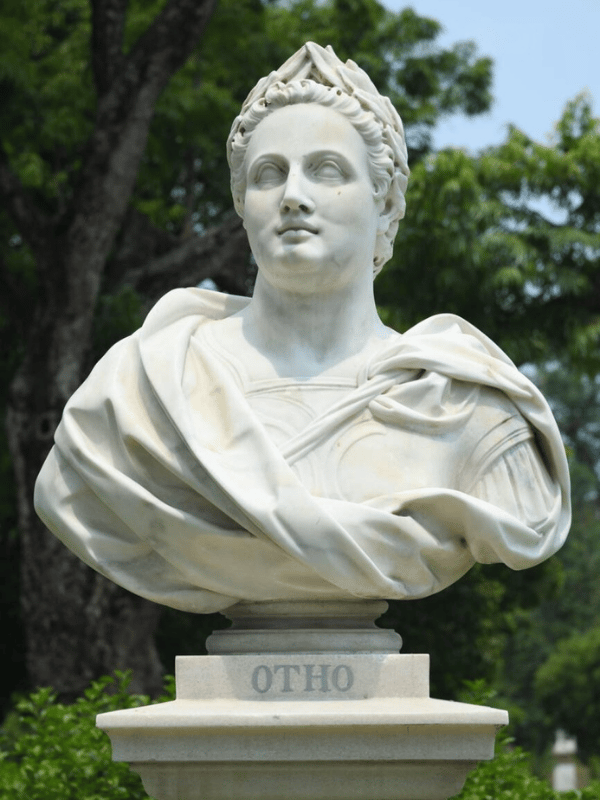
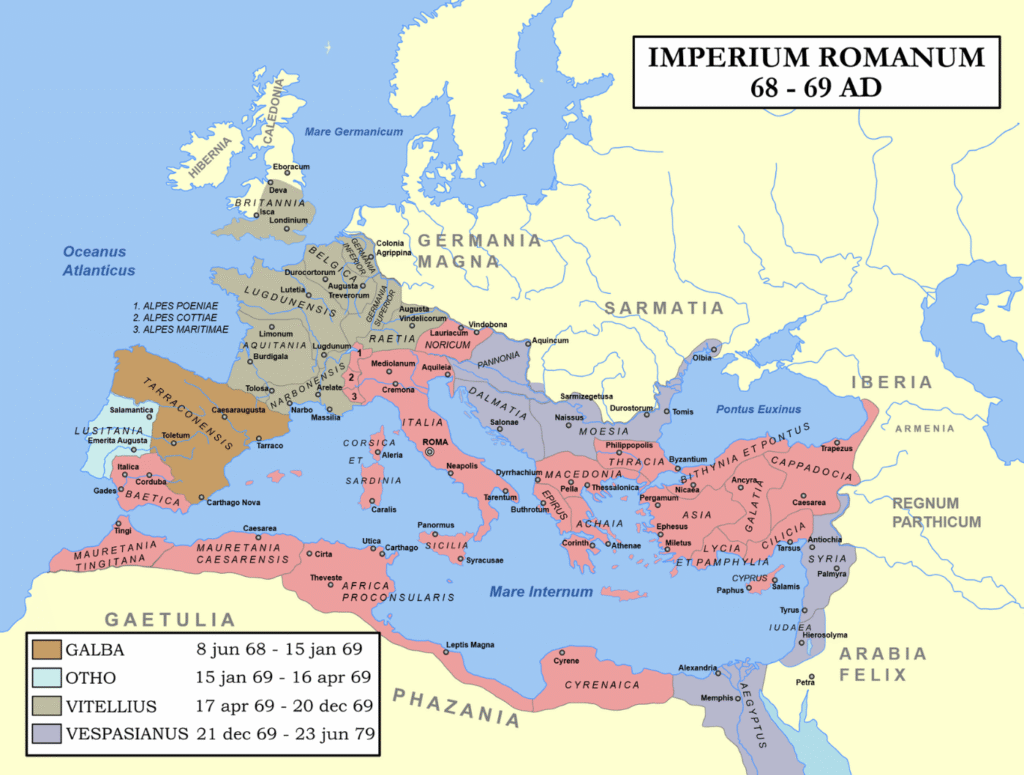
The Year of the Four Emperors and the Brigantian Crisis
67 - 69 AD
The fracturing of imperial authority following the suicide of the Emperor Nero in 68 AD plunged the Roman world into a destructive civil war known as the Year of the Four Emperors, transforming the frontier province of Britannia into a volatile theater of military mutiny and tribal rebellion. The island's central command collapsed into a severe political crisis driven by a bitter domestic feud between the civilian governor, Marcus Trebellius Maximus, and the military commander of the Legio XX Valeria Victrix, Roscius Coelius.
Trebellius Maximus, adhering to a soft governance policy focused on urban reconstruction and economic pacification following the Boudican devastation, had deeply alienated his troops by restricting their plunder opportunities and withholding active field campaigns. Capitalising on this widespread military discontent, Coelius accused the governor of hoarding treasury funds and pocketing the army’s rations, inciting an armed mutiny among the island's four elite legions.
The political architecture of the province dissolved completely when the massed legionaries sided with Coelius, forcing the disgraced Governor Trebellius Maximus to flee the island to seek refuge on the continent. Left entirely without a civilian governor, Britain was run as a military junta by the legionary legates until the temporary Western Emperor Vitellius dispatched a new governor, Vettius Bolanus, to stabilize the command. However, Vitellius was forced to strip the island of its defensive garrisons to fuel his own continental campaigns against his eastern rival Vespasian, withdrawing a specialized vanguard force of eight thousand veteran British auxiliary troops across the English Channel. This massive extraction of professional manpower left the northern frontiers dangerously exposed, completely destabilising the regional equilibrium and allowing the long-standing domestic conflicts within the neighboring client nations to explode into open warfare.
The most catastrophic consequence of this military vacuum occurred within the massive northern client kingdom of the Brigantes. The pro-Roman queen, Cartimandua, who had previously secured her wealth and client status by surrendering the rebel leader Caratacus to the legions, finalized a bitter divorce from her anti-Roman husband, Venutius, replacing him in her bed and throne with his own armor-bearer, Vellocatus. Fueled by personal vengeance and backed by the anti-imperial faction of the tribe, Venutius launched a massive civil war to overthrow the queen, gathering thousands of armed warriors and securing allied native reinforcements from outside the Roman province to invade Cartimandua's core territories. Realising that her depleted forces could not withstand the onslaught, the queen appealed desperately to Governor Bolanus for military protection.
Because his core legions were under-strength and tied down securing the south, Bolanus could not deploy an overwhelming force, sending only a small vanguard column of auxiliary infantry and cavalry to intercept the invaders. These units fought a series of brutal, high-attrition skirmishes against Venutius’s forces, but they were entirely unable to break the back of the northern resistance or salvage the client state. The auxiliary forces successfully executed a rearguard operation to rescue Queen Cartimandua from her collapsing capital, extracting her alive under military escort before Venutius’s army systematically overran the entire Brigantian kingdom.
This strategic disaster completely erased the vital northern buffer zone that had protected the Roman lowlands for twenty-five years, transforming northern England into an aggressive, hostile anti-imperial power and setting the framework for the upcoming total conquest of the north under the Flavian emperors.
Further Information: The Year of the Four Emperors and the Brigantian Crisis

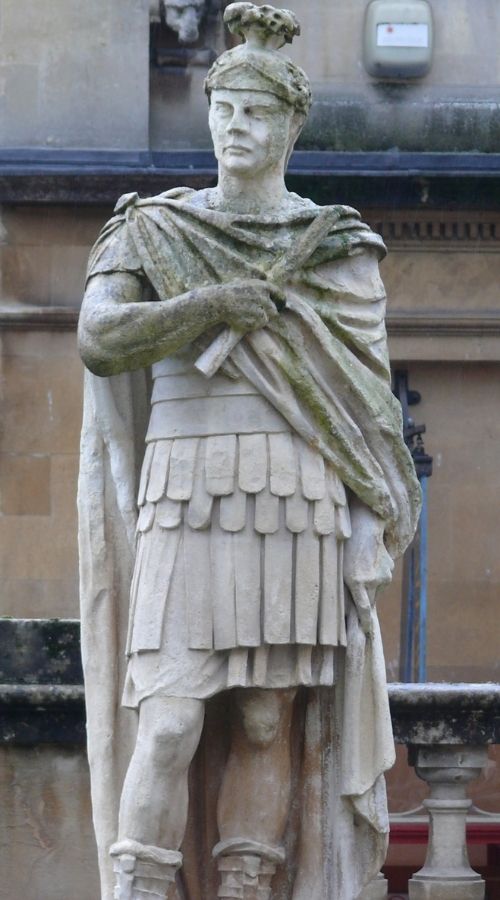
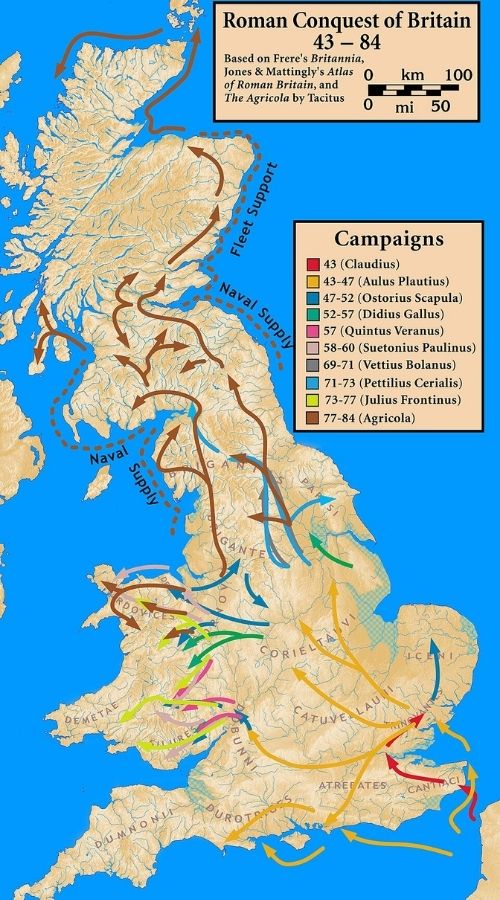
Flavian Expansion and the Battle of Mons Graupius
77 – 84 AD
The suppression of the Boudican Revolt was followed by a period of aggressive military expansion under the Flavian emperors. Recognizing that an independent north threatened the stability of the southern lowlands, successive governors pushed the imperial frontiers deep into northern England and Scotland.
The pinnacle of this northern expansion occurred under the command of Governor Gnaeus Julius Agricola, who launched a multi-year land and sea campaign, marching his legions through Yorkshire and Northumbria while constructing permanent military bases, including the Gask Ridge watchtowers in Perthshire and the massive, fifty-hectare legionary fortress at Inchtuthil. To support his ground troops, Agricola used the Roman navy to scout the northern coastlines, chart the Orkney Islands, and intercept enemy supply lines, becoming the first commander to verify that Britain was an island mass.
In 84 AD, Agricola’s campaign reached its peak at the Battle of Mons Graupius in northeastern Scotland. Facing a coalition of thirty thousand Caledonian warriors led by the war chief Calgacus—who famously declared in his pre-battle speech that the Romans "make a desert and call it peace"—Agricola deployed eight thousand auxiliary infantry and three thousand cavalry to hold the front line, keeping his core Roman legions in reserve. The auxiliary troops, composed of four Batavian and two Tungrian cohorts, outmanoeuvred the highlanders in close-quarters combat using their heavy gladii and shield-bosses, while the cavalry routed the Caledonian chariots and charged the infantry from the rear. The encounter ended in a rout, inflicting an estimated ten thousand native casualties and breaking the back of the northern resistance.
Although Rome withdrew the Legio II Adiutrix—not the Legio XX Valeria Victrix—from the far north shortly after the victory to reinforce the Danube frontier during the Dacian Wars, abandoning the incomplete timber fortress at Inchtuthil, Agricola’s campaigns successfully subdued the southern and northern territories. By establishing a permanent military presence up to the Tyne-Solway line, these campaigns brought the entire landscape under imperial governance, laying the groundwork for the future fixed border systems of the empire.
Further Information: Flavian Expansion and the Battle of Mons Graupius
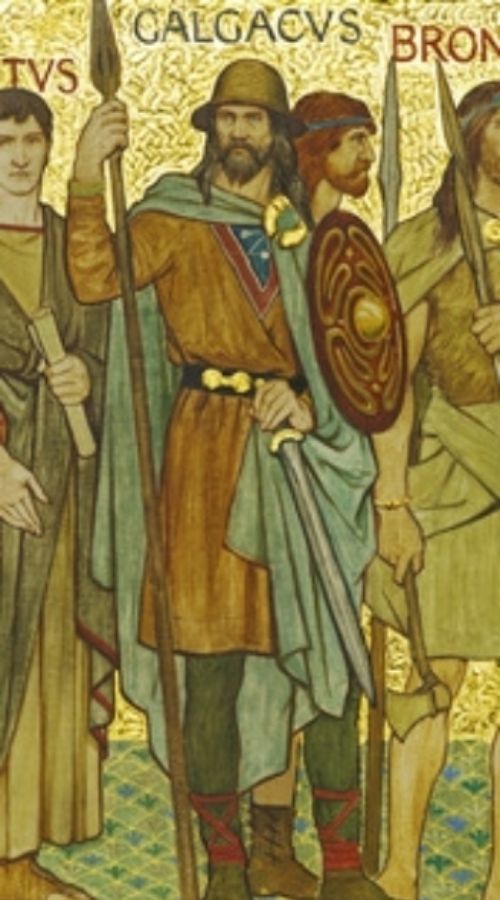
Tacitus and the Recording of Britannia
98 AD
The entry of the island into classical history reached its most significant literary turning point at the close of the first century, when the Roman senator Tacitus provided the most detailed surviving account of the country and its native tribes.
Tacitus himself never physically traveled to the island, gathering his knowledge from the safety of Rome and continental Europe. His deep understanding of the northern frontier came entirely from a close family connection, having married the daughter of Gnaeus Julius Agricola, the Roman governor who ruled Britain from 77 to 84 AD.
Following Agricola's death, Tacitus used the general’s private military letters, journals, and personal memories to write a biography known as the Agricola, which was completed around 98 AD.
Through these detailed family papers, Tacitus mapped out the geography, the harsh climate, and the distinct traits of the different British tribes. He recorded the clear physical differences across the country, describing the red hair and large limbs of the northern Caledonians, which he thought showed a Germanic link, while noting that the southern tribes closely matched the Gauls across the sea. His work gave Rome a clear picture of imperial expansion, tracking Agricola's long campaigns into the north, the fierce clash with the native tribes at the Battle of Mons Graupius, and the naval voyage that proved for the first time that Britain was an island.
Further Information: Tacitus and the Recording of Britannia
Stay Connected
Hadrian’s Wall and the Fixed Northern Frontier
122 AD
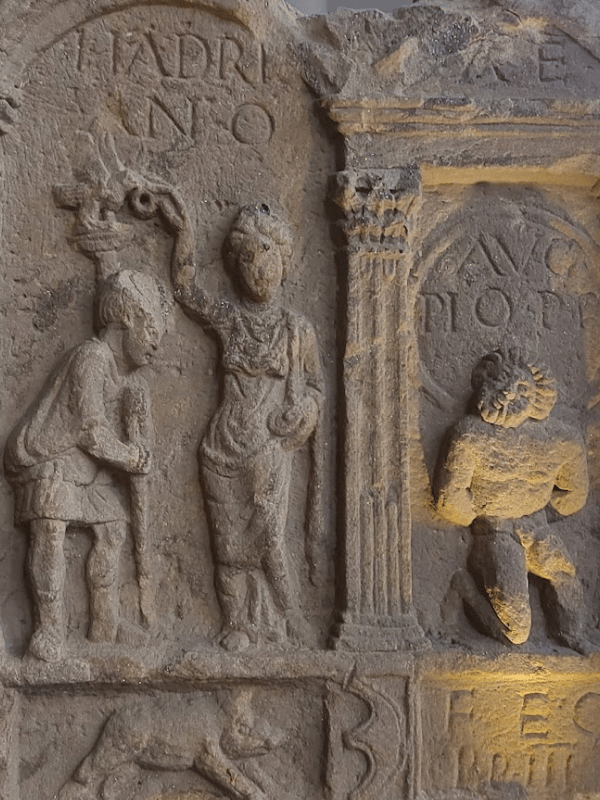
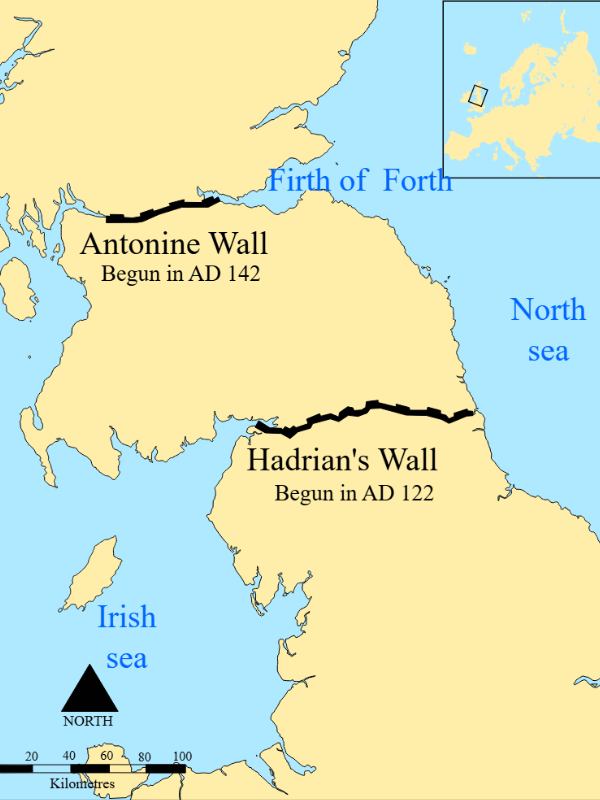
By 122 AD, the Roman Empire shifted its focus away from expanding its territories toward the permanent defense of its existing borders. To secure the northern frontier of the province, Emperor Hadrian personally visited Britain and ordered the construction of a stone barrier stretching seventy-three miles across the narrow neck of the island, from the River Tyne to the Solway Firth. Building the wall was an extensive engineering project executed by professional legions, including the Legio II Augusta, Legio VI Victrix, and Legio XX Valeria Victrix.
The barrier itself stood up to fifteen feet high and ten feet wide, built with a turf or solid stone core before being faced with dressed limestone blocks. It was protected by a deep outer ditch to the north and an earthwork ditch system to the south, known as the Vallum. Every single Roman mile along the structure featured a fortified gatehouse, or milecastle, with two smaller observation towers positioned between them, allowing sentries to signal movements rapidly across the line.
The wall functioned as a sophisticated military and customs checkpoint rather than a passive defensive trench. It housed a permanent garrison of up to 10,000 auxiliary soldiers stationed in large, stone-walled forts built directly into the defensive network, such as Housesteads and Vindolanda. These bases featured stone barracks, granaries, and heated bathhouses, allowing the military to regulate all trade and population movements between the northern tribes and the Roman province. This arrangement permanently fixed the northern boundary of Britannia for nearly three centuries, transforming the untamed frontier into a highly regulated economic zone.
Further Information: Hadrian’s Wall and the Fixed Northern Frontier

The Antonine Wall and Northern Retreat
142 - 162 AD
In 142 AD, the newly crowned Emperor Antoninus Pius overturned the defensive policy of his predecessor, ordering an aggressive military advance back into the Scottish Lowlands. He dispatched the experienced Governor Quintus Lollius Urbicus to spearhead the campaign, leading the Legio II Augusta, Legio VI Victrix, and Legio XX Valeria Victrix to push the frontier nearly one hundred miles north of Hadrian’s line.
Overrunning the lowland tribes, most notably the Votadini and the Damnonii, Urbicus established a new defensive barrier across the narrowest neck of the island between the Firth of Forth and the Firth of Clyde. This frontier, designated as the Antonine Wall, represented the high-water mark of Roman territorial ambition on the island, momentarily expanding the borders of the empire to its absolute northernmost limit.
Because premium building limestone was scarce in the central lowlands of Scotland, Roman engineers altered their architectural layout, constructing the thirty-nine-mile barrier entirely out of heavy, layered turf blocks laid on a solid cobblestone foundation. The wall measured four metres wide at the base and stood approximately three metres high, topped with a defensive wooden palisade walk. To the north, it was protected by a massive, forward V-shaped ditch up to twelve metres wide and four metres deep, explicitly designed to break the momentum of any charging infantry.
The network featured nineteen fortified garrison camps spaced roughly two miles apart, including Rough Castle, Bar Hill, and Bearsden. These forts housed a permanent garrison of seven thousand auxiliary troops who regulated local movement and guarded the communication network.
The occupation of the Antonine Wall was a brief and volatile experiment that lasted for only two decades. Unlike the highly pacified lowlands of the south, the independent northern tribes—collectively known as the Caledonians and the Maeatae—systematically targeted Roman supply lines with guerrilla ambush tactics. The defence of the turf line proved exceptionally expensive, dangerous, and resource-heavy, providing little economic return for the provincial treasury.
By 162 AD, faced with severe, rising military crises along the Danube frontier in continental Europe, the Roman high command ordered a complete withdrawal from Scotland. The auxiliary garrisons systematically dismantled and burnt their own timber fort barracks before retreating south, completely abandoning the turf line to return to the permanent, stone-faced security of Hadrian’s Wall.

The Rebellion of Clodius Albinus
193 – 197 AD
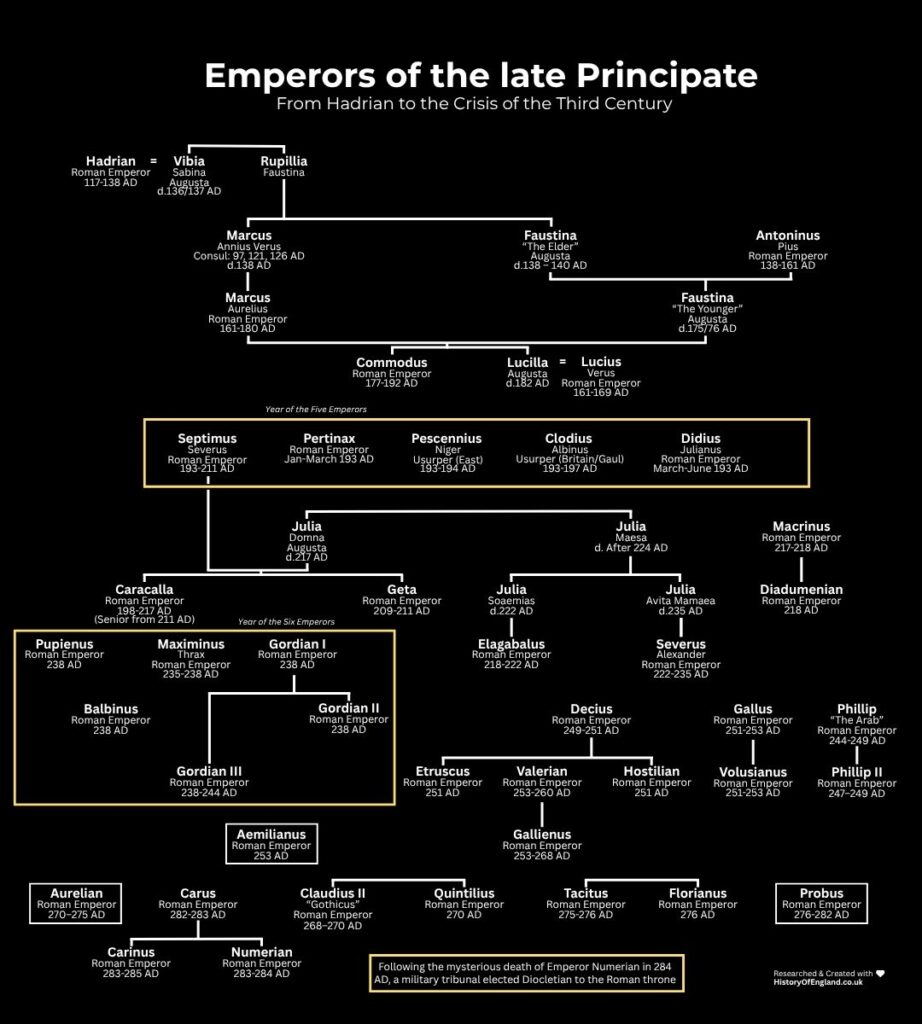
The fracturing of imperial authority following the assassination of the Emperor Commodus in 192 AD plunged the Roman world into a civil war known as the Year of the Five Emperors, converting the distant province of Britannia into a formidable launchpad for military usurpation. Capitalising on the chaotic succession crisis in Rome, the aristocratic governor of Britain, Decimus Clodius Albinus, secured the allegiance of the island’s three elite legions—the Legio II Augusta, Legio VI Victrix, and Legio XX Valeria Victrix—alongside numerous auxiliary units.
Albinus was a highly ambitious senator born into an elite aristocratic family in Hadrumetum, North Africa. He was backed by a powerful network of Roman senators who despised the rising power of military dictators and viewed the wealthy, well-trained British garrison as the perfect tool to reclaim aristocratic control over the imperial throne.
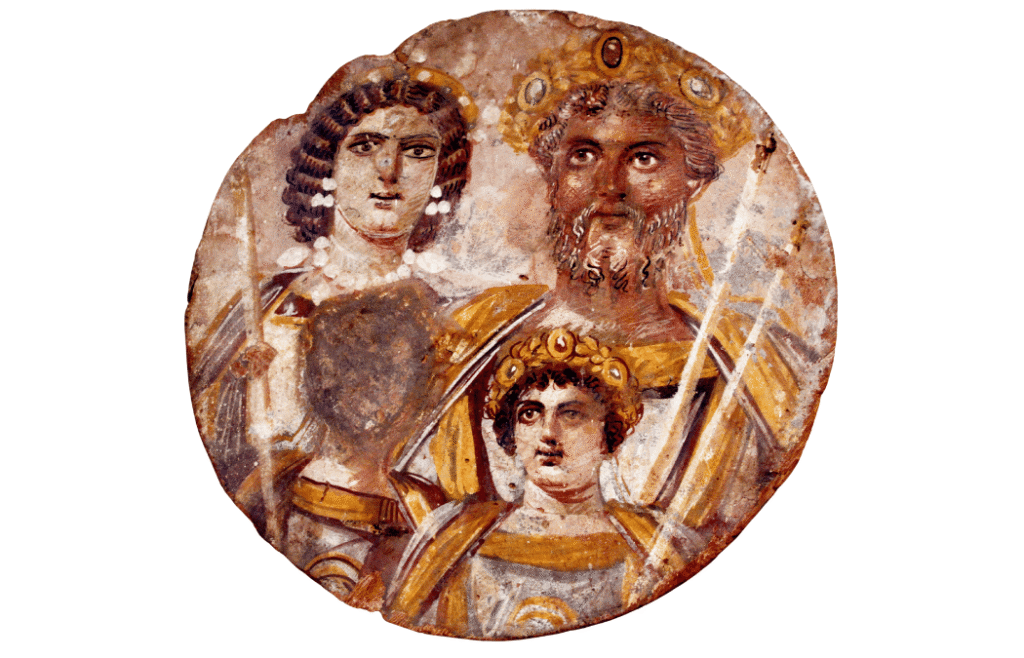
Initially placated by his chief rival, Septimius Severus, who offered Albinus the official title of Caesar and the nominal succession to secure his neutrality, the British governor maintained a fragile peace until Severus consolidated his power in the East by destroying his other rival, Pescennius Niger. Realising that his position was marked for immediate elimination after Severus broke his promise and named his own young son, Caracalla, as successor, Albinus took the supreme step of declaring himself Augustus in late 196 AD, initiating a sweeping militarisation of the province to contest the western throne.
To launch his continental offensive, Albinus stripped the island entirely of its defensive garrisons, transporting an armada of over forty thousand veteran troops across the English Channel into Gaul to establish his temporary capital at Lugdunum (modern Lyon). This massive extraction of manpower left the northern frontiers of Britannia dangerously exposed, destabilising the regional equilibrium and allowing the hostile northern tribal coalitions—most notably the Caledonians and the newly formed confederation of the Maeatae—to breach the undefended stone line of Hadrian's Wall, burning milecastles and plundering the northern lowlands.
The campaign reached its climax on 19 February 197 AD at the Battle of Lugdunum, where the allied British legions collided with the superior forces of Septimius Severus in one of the largest and most destructive engagements in Roman history, involving an estimated 150,000 soldiers on the field. Following hours of a high-attrition deadlock that tested the raw endurance of both armies, Severus's cavalry reserves executed a decisive flanking manoeuvre that broke the British lines and turned their retreat into a chaotic, bloody rout.
Clodius Albinus fled into a house near the River Rhône and committed suicide to avoid capture, a total failure that resulted in the systematic plunder of Lugdunum and a brutal imperial purge of the British senatorial aristocracy. His head was severed and sent to Rome as a warning to his supporters, permanently weakening the administrative structure of the province just as the Roman high command was forced to send fresh units north to rebuild its broken frontier defences.olkl;qwwwwwwwuyhhhhhhhhhhhhhhhhhhhh
Further Information: The Rebellion of Clodius Albinus

The Partition of Britain: Superior and Inferior
197 – 211 AD
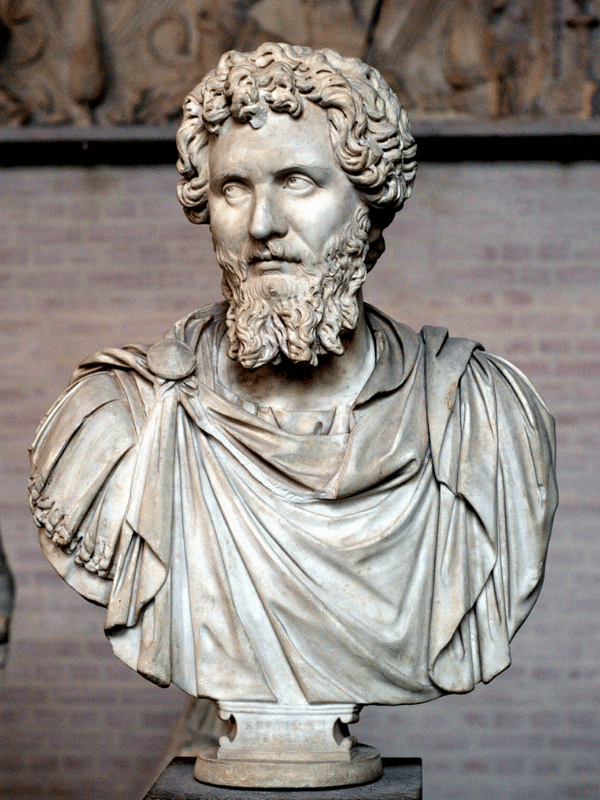
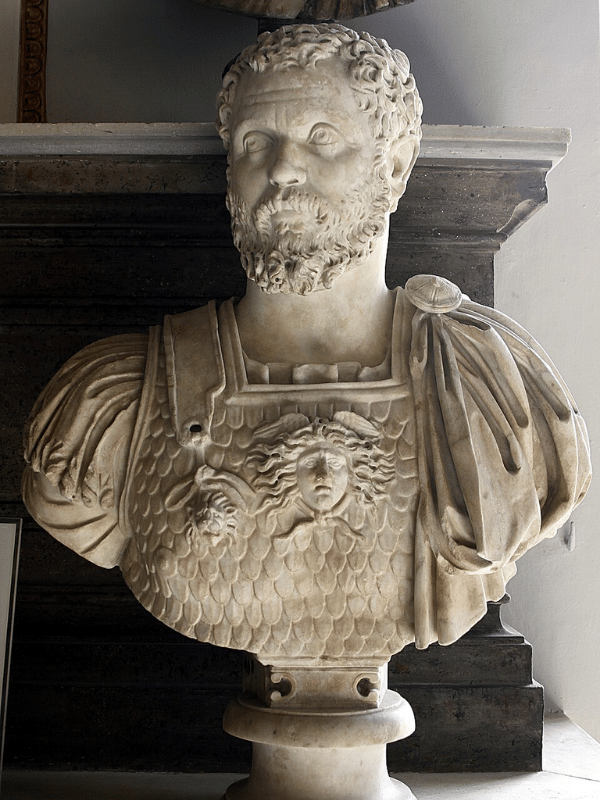
The crushing defeat of the British legions at Lugdunum left the province of Britannia completely defenseless, financially ruined, and marked for immediate imperial retribution. Following the suicide of Clodius Albinus, the victorious Emperor Septimius Severus unleashed a brutal, state-backed purge across the Western world, executing twenty-nine Roman senators who had financed the British usurpation from Rome.
To ensure that no future governor of Britain could ever leverage the island's three elite legions to launch another coup against his family, Severus made a radical, permanent administrative decision. He implemented a sweeping geopolitical partition of the island, enacting a policy of decentralization that split the single territory into two separate, smaller administrative provinces: Britannia Superior (Upper Britain) and Britannia Inferior (Lower Britain).
This partition was engineered explicitly to separate and isolate the command structures of the regular legions. Britannia Superior, administered from the wealth-driven commercial capital of Londinium (London), held direct authority over two of the island's three regular legions—the Legio II Augusta stationed at Isca Augusta (Caerleon) and the Legio XX Valeria Victrix at Deva Victrix (Chester).
This southern province retained a massive auxiliary network to secure the mountain frontiers of Wales and the shipping lines of the southwest. Conversely, Britannia Inferior was administered from the highly fortified military capital of Eboracum (York). This northern province held a single regular legion—the Legio VI Victrix—but maintained direct operational control over the vast network of auxiliary forts and frontier garrisons that guarded the broken stone line of Hadrian's Wall. By forcing the two new governors to act independently, the Severed administration successfully prevented a singular, consolidated command over the forty-thousand-man British garrison.
To repair the catastrophic damage caused by the northern tribal incursions during Albinus’s absence, the newly appointed governor of Britannia Inferior, Virius Lupus, was forced to implement an immediate policy of high-stakes frontier diplomacy. With his single legion heavily depleted, Lupus purchased a temporary peace from the aggressive Maeatae tribal confederation by paying an immense financial subsidy in gold bullion. This emergency bribe bought the Roman high command one decade of vital preparation time.
Between 197 and 207 AD, Roman engineering corps launched a massive, coordinated reconstruction campaign across the north, rebuilding the torched stone milecastles at Birdoswald and Housesteads, repairing the ruined granaries at Corbridge, and re-metalling the military supply roads to prepare the split province for the arrival of the Emperor’s massive punitive expeditions in 208.

Agrarian Industrialization, Extraction, and Trade
70 – 350 AD
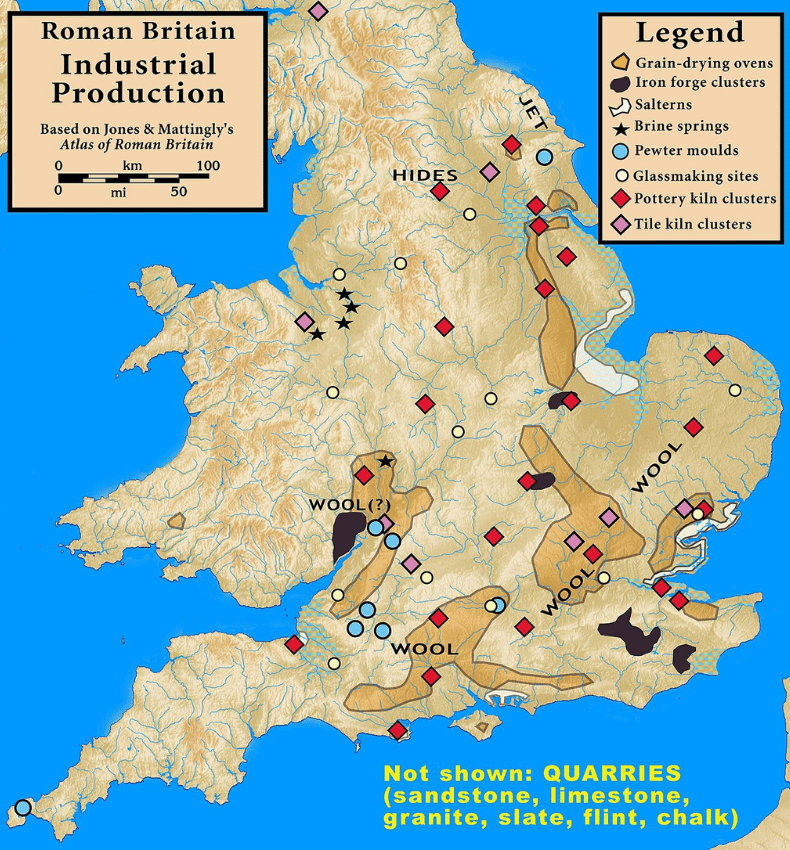
The stabilization of the frontiers allowed the Roman administration to develop Britannia into a highly productive territory for the wider empire, shifting the economy from local farming toward an organized system of large-scale mineral extraction and agricultural production managed by imperial officials and traders. Administrators took control of the silver-bearing lead mines of the Mendip Hills, the copper workings of North Wales, and the tin deposits of Cornwall, utilizing forced labor to manufacture standardized metal ingots stamped with the name of the reigning emperor.
In southwest Wales, at Dolaucothi, engineers constructed a large hydraulic gold mining complex, building extensive aqueduct channels to channel mountain water for hushing, a process that released sudden torrents of water to wash away loose topsoil and expose the deep veins of precious metal beneath the hills.
At the same time, rural agriculture was expanded through the introduction of the villa system, where wealthy landowners established stone-built farming estates equipped with iron-share plows and grain-drying ovens to increase crop yields. This growing surplus of grain, leather, and wool was directed along the newly constructed military road networks to supply the frontier garrisons stationed along the northern walls.
Large volumes of British wheat were also transported across the North Sea to sustain the legions and urban centers of Gaul and Germany, deeply integrating the province into the international commercial markets of the Roman world and transforming the island into a vital breadbasket for the western empires.
Further Information: Agrarian Industrialization, Extraction, and Trade
The Romanisation of Britain
70 – 300 AD
Four centuries of imperial rule permanently reshaped the physical geography of Britain through an extensive, state-sponsored program of urban development and road engineering.
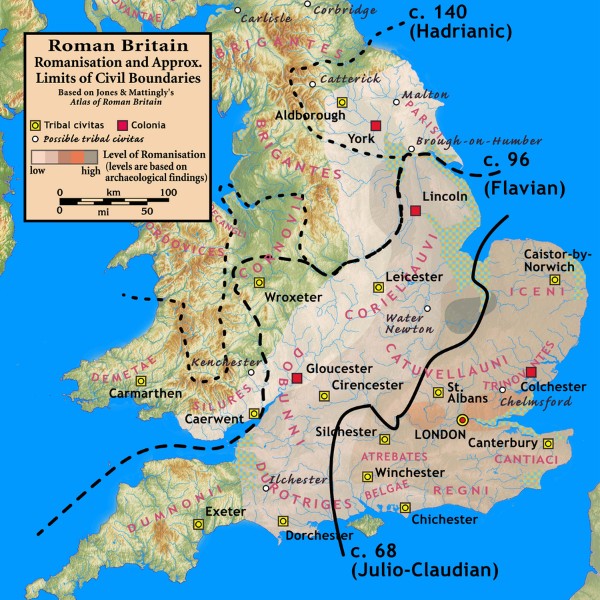
Roman military surveyors constructed over two thousand miles of paved, straight highways—such as Watling Street, Fosse Way, and Ermine Street—linking every major garrison and administrative center directly to the Channel ports. This advanced transport network allowed for the rapid deployment of legions across the country, while transforming the old, winding trackways of the prehistoric landscape into a single, highly integrated commercial layout.
The rural areas were organized into a series of localized administrative districts, traditionally known as civitates, which were explicitly based on old Iron Age tribal boundaries but governed entirely from brand-new, Roman-style capitals. Cities like Londinium (London), Glevum (Gloucester), Corinium (Cirencester), and Eboracum (York) were built using a highly standardized grid system, stone masonry, and tiled roofs. A large central forum and a monumental stone basilica sat at the heart of every urban hub, acting as the primary legal and economic centers where local magistrates administered Roman civil law and collected provincial taxes.
This rapid urban growth drove a profound process of cultural integration among the native population. The descendants of the Iron Age tribal chiefs gradually abandoned their traditional timber roundhouses to move into sprawling brick townhouses and country villas heated by underfloor hypocaust systems and decorated with intricate mythological mosaic floors. They adopted Latin as the official language of legal business, wore the traditional Roman woolen toga, and frequented public stone bathhouses and amphitheatres.
By systematically turning the native aristocracy into urban administrators, merchant elites, and provincial tax collectors, Rome successfully secured the loyalty of the province through the introduction of written law and material luxury rather than relying on raw military force alone.
The Caledonian Campaigns of Septimius Severus
208 – 211 AD
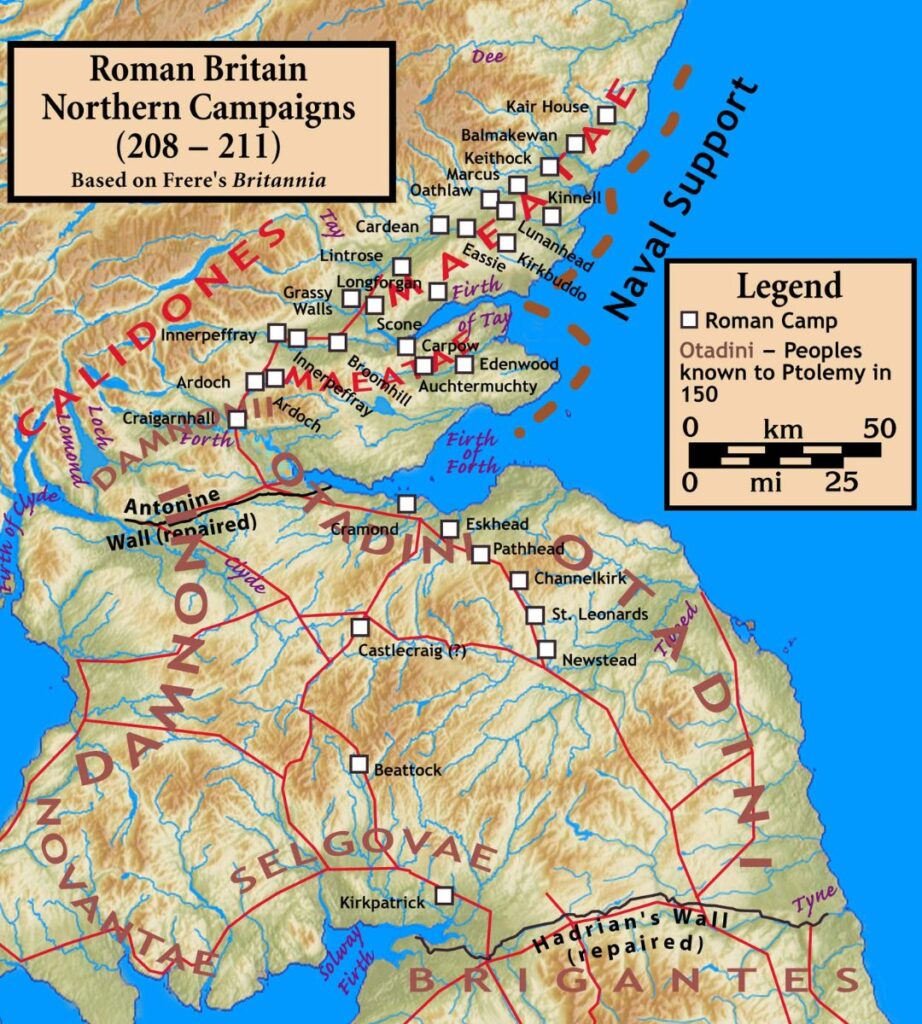
Determined to pacify the northern frontier and repair the damage caused by decades of tribal incursions, the ageing and gout-ridden Emperor Septimius Severus arrived in Britannia in person in 208 to launch a brutal, scorched-earth war of attrition. Accompanied by his sons Caracalla and Geta, alongside a massive imperial task force of over forty thousand legionaries and Praetorian guards, Severus established his administrative headquarters at the northern fortress of Eboracum.
The military executed a massive logistical expansion, clearing dense forests, constructing extensive corduroy roads through the Caledonian marshes, and launching an enormous naval supply fleet into the North Sea to support the advancing columns. Rather than meeting the imperial army in an open, decisive field action, the Maeatae and Caledonii tribes adopted highly effective guerrilla tactics, launching swift, high-attrition ambushes from the highlands that inflicted thousands of casualties on the overextended Roman lines.
Faced with this evasive resistance, Severus abandoned traditional campaign ethics and ordered his legions to systematically devastate the countryside, burning tribal settlements, slaughtering livestock, and destroying crops to induce artificial famine. This unrelenting pressure successfully forced the tribal coalitions to sue for a temporary peace in 210, yielding significant territory to the empire.
However, the equilibrium collapsed into immediate rebellion within months, prompting a furious Severus to order a campaign of total genocide against the northern populations. This escalation was permanently halted by the Emperor's death at Eboracum on 4 February 211, whereupon his successor, Caracalla, eagerly abandoned the expensive northern campaigns to secure his position in Rome, withdrawing the legions back to the fixed stone architecture of Hadrian's Wall and splitting Britannia into two separate administrative provinces to prevent future governors from amassing dangerous concentrations of military power.
Further Information: The Caledonian Campaigns of Septimius Severus
The Saxon Shore Fort Network
275 - 350 AD
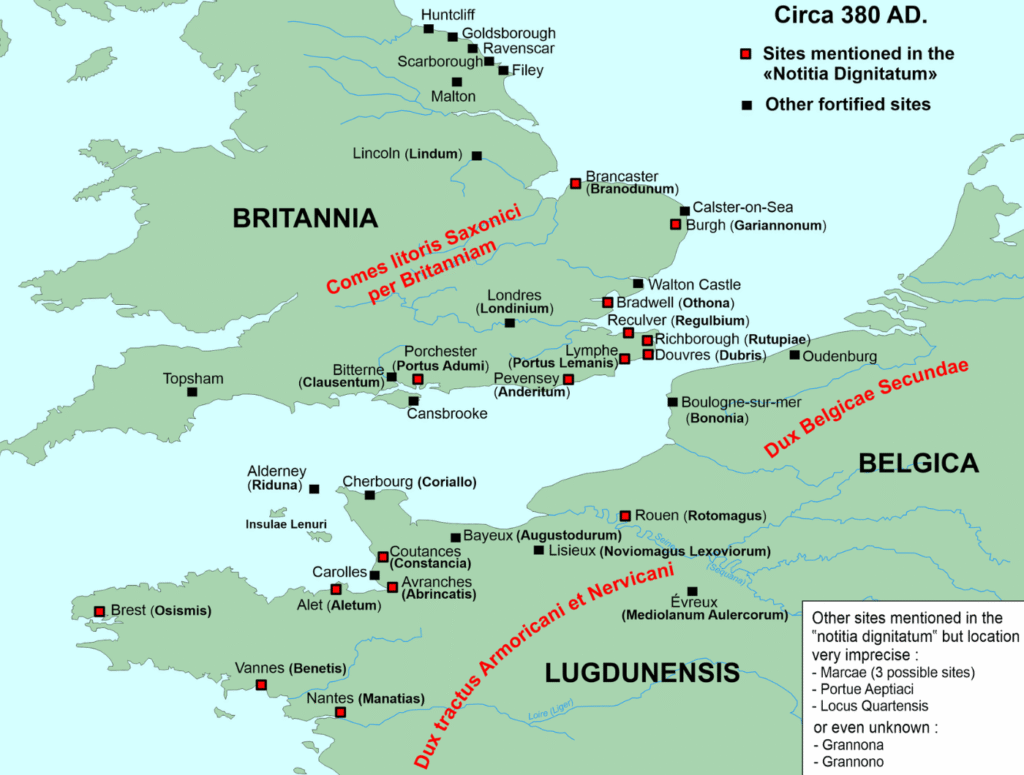
By the late third century, the safety of Britain was threatened by a severe maritime crisis as Germanic seafaring raiders, predominantly Saxons and Franks from the North Sea coasts of Germany and Denmark, launched piratical attacks across the English Channel. These groups targeted vulnerable coastal merchant vessels and sailed up tidal river inlets to plunder undefended lowland farming estates, threatening the movement of regional goods.
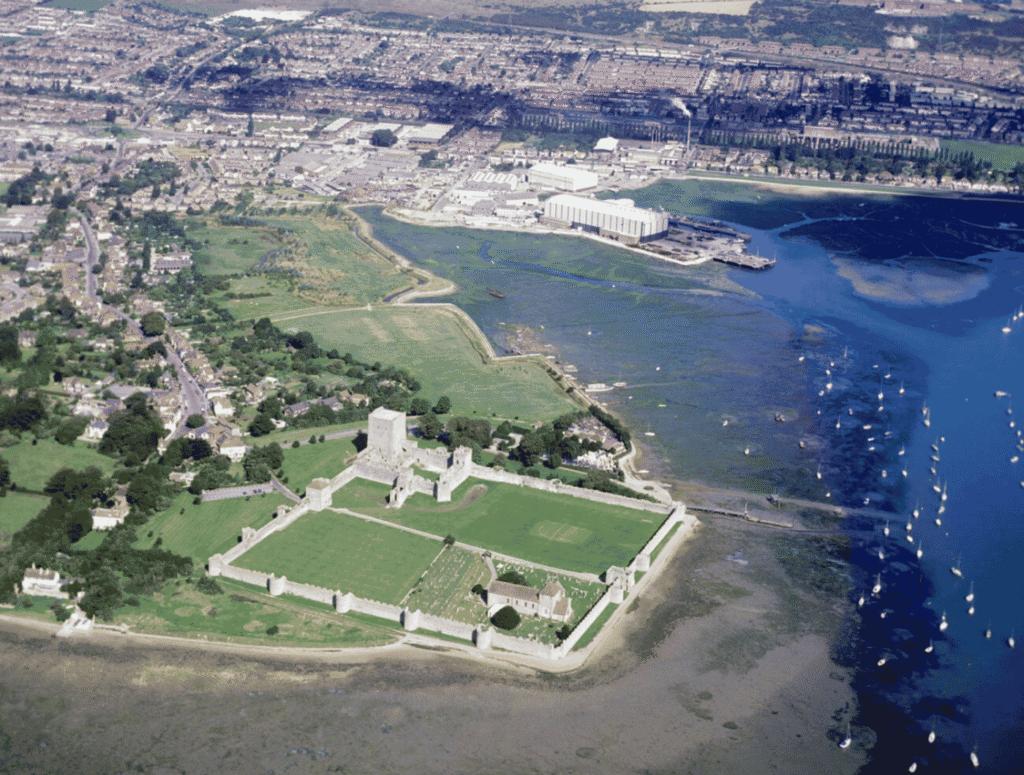
To secure the province against these incursions, the imperial administration constructed a coastal defensive line known as the Saxon Shore Forts. This fortification system eventually comprised a chain of stone fortresses built along the east and south coasts of England, stretching from Branodunum on the Wash down to Portus Adurni in Hampshire. Sites like Burgh Castle, Reculver, and Richborough featured thick stone walls constructed from flint and clay tiles, reinforced with projecting semi-circular bastions designed to support defensive catapult weapons.
The shore forts functioned as combined military bases and vital trade hubs rather than simple defensive garrisons, housing permanent units of marine infantry and cavalry while serving as protected depots to safeguard grain stores and facilitate maritime commerce. Operating alongside the regional fleet, the Classis Britannica, these bases allowed Roman forces to secure vital shipping lanes. This defensive network maintained a continuous presence along the coastlines, establishing a highly monitored maritime boundary that protected the economic interests of the province and repelled seaborne threats until the final decades of imperial administration.
Further Information: The Saxon Shore Fort Network
Diocletian and the Creation of the Tetrarchy
284 – 305 AD
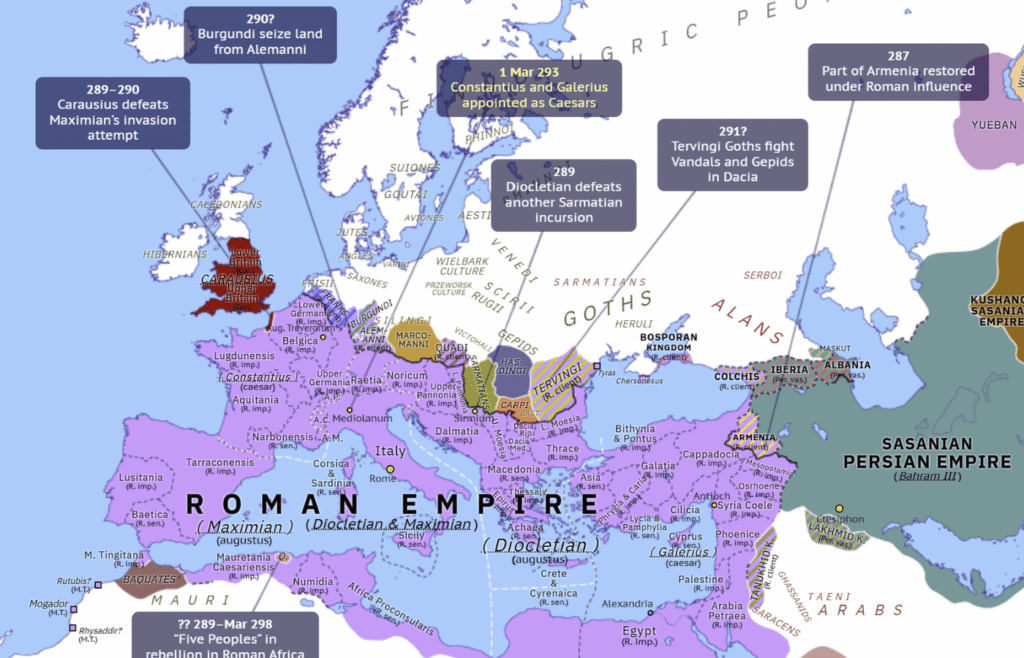
The systemic instability and near-continuous military coups that had devastated the Roman Empire during the third-century crisis were brought to a definitive end by the sweeping administrative reforms of the Emperor Diocletian. Ascending the throne in 284 AD, Diocletian recognized that the vast territorial expanse of the empire was too geographically complex to be governed effectively by a single absolute monarch, especially given the constant threat of frontier invasions and localized legionary rebellions. To solve this executive crisis and remove the threat of internal military coups, Diocletian created a revolutionary constitutional framework known to history as the Tetrarchy, or the "Rule of Four."
Under this new structure, the Roman world was partitioned into two halves, the West and the East, each governed by a senior emperor bearing the title of Augustus, who in turn appointed a junior emperor bearing the title of Caesar to assist them and act as their legal successor. Diocletian took command of the wealthy East as the senior Augustus, appointing his trusted military companion Maximian as Augustus of the West, while later installing Galerius and Constantius Chlorus as their respective Caesars in 293 AD. This administrative partition fundamentally re-engineered the daily operation of Britain. The island was pulled into the western sphere under the direct authority of Caesar Constantius Chlorus, who utilized his new imperial base at Augusta Treverorum (Trier) to systematically plan the maritime reconquest of the breakaway Britannic Empire under Carausius and Allectus.
To permanently dismantle the traditional power bases of ambitious provincial governors who frequently utilized their local commands to launch rebellions, Diocletian executed a radical bureaucratic reorganization that completely separated civil administration from military command. Across Britain, the old system of two large provinces was abolished. Instead, the island was subdivided into four smaller, tightly monitored provinces: Maxima Caesariensis, Britannia Prima, Britannia Secunda, and Flavia Caesariensis.
These four territories were grouped into a brand-new administrative tier known as the Diocese of the Britains, overseen by a supreme civilian governor carrying the title of Vicarius. While the civilian Vicarius and his provincial governors managed tax collection, judicial courts, and grain supplies, military authority over the island's garrison was stripped from them entirely and placed into the hands of specialized frontier commanders, the Dux Britanniarum (Duke of the Britains) and the Comes Maritimi Tractus (Count of the Saxon Shore).
Further Information: Diocletian and the Creation of the Tetrarchy

The Carausian Revolt and Britannic Empire
286 – 296 AD
The rise of a formidable maritime threat along the English Channel sparked a provincial usurpation in 286 AD, when a highly decorated Menapian naval commander named Carausius completely severed Britannia from the central administration of Rome. Tasked by the Western Emperor Maximian to lead the Classis Britannica fleet against destructive Saxon and Frankish pirates, Carausius faced immediate execution when imperial officials discovered a corrupt operational pattern: he was deliberately allowing raiders to plunder coastal settlements before intercepting them to seize the accumulated spoils for his personal treasury.
To protect his life and capitalize on his immense popularity among the seafaring legions, Carausius executed a coup, declaring himself Emperor of a separate Britannic Empire (Imperium Britanniarum) that encompassed Britain and northern Gaul. This rogue state successfully leveraged its total maritime supremacy to repel Maximian’s initial invasion fleet in 289, forcing the central empire to temporarily recognize his independent regional apparatus, which directly challenged the legitimacy of the newly formed Diocletianic Tetrarchy.
To legitimize his breakaway realm, Carausius launched a sophisticated political propaganda campaign, utilizing newly established, highly advanced mints in Londinium (London) and Clausentum (Bitterne, near Southampton) to mass-produce high-purity silver coinage. These coins bore the unprecedented Latin inscriptions Expectate veni ("Come, long-awaited one") and Redeunt saturnia regna ("The Golden Age returns"), explicitly styling the usurper as a savior of classical renewal and liberty.
However, the political architecture of this independent empire collapsed into internal instability in 293 when the Western Caesar, Constantius Chlorus, successfully besieged and captured Carausius’s primary continental stronghold at Gesoriacum (Boulogne-sur-Mer), cutting off the rogue state from its European trade routes and its control over northern Gaul. Exploiting this strategic disaster, Carausius's chief financial minister, Allectus, assassinated the usurper to seize the throne, plunging the island into a three-year period of repressive, isolated misrule.
The Britannic Empire reached its final moments in the summer of 296, when Constantius Chlorus launched a coordinated, two-pronged amphibious invasion. While one fleet division under the Praetorian Prefect Julius Asclepiodotus sailed from the mouth of the Seine through a dense morning fog to elude Allectus’s naval patrols, Constantius spearheaded the main fleet from Boulogne. Asclepiodotus's forces landed near the Isle of Wight, marched inland, and completely routed Allectus's mercenary forces of Frankish and Saxon auxiles at a battle traditionally located in Hampshire, executing the assassin on the field.
When the surviving, retreating mercenaries attempted to sack and plunder the capital, a detached column of Constantius’s fleet sailed up the River Thames just in time to slaughter the routers in the city streets, an event immortalized on a famous medallion minted in Trier showing Constantius Chlorus as the Redditor Lucis Aeternae—the Restorer of Eternal Light—welcomed by a kneeling personification of London before the city walls.
Further Information: The Carausian Revolt and Britannic Empire


The Proclamation of Constantine the Great
306 AD
The death of the Western Augustus, Constantius Chlorus, at York (Eboracum) on 25 July 306 AD abruptly ended his efforts to secure the northern frontier. Chlorus had spent the previous year conducting intensive, punitive military expeditions past Hadrian’s Wall, successfully containing the Caledonian Picts and forcing them into a tributary settlement. His sudden death immediately disrupted the delicate balance of power in the West, presenting the regional military command with an urgent political void that bypassed standard imperial protocols.
Rather than adhering to the rigid legal frameworks established by Diocletian’s Tetrarchy system—a complex constitutional structure designed to distribute power between two senior Augusti and two junior Caesars to systematically eliminate military coups—the veteran British legions took an unprecedented political gamble. Spearheaded by the influential Alamannic king Chrocus, who commanded a powerful force of Germanic auxiliary cavalry on the island, and the fiercely loyal legionaries of the Legio VI Victrix, the garrison at York executed a pre-planned acclamation. Bypassing Rome’s official constitutional framework, the massed infantry and cavalry gathered outside the legionary headquarters to clothe the twenty-four-year-old Constantine in the imperial purple, saluting him as Augustus.
This military acclamation marked a radical, permanent shift in the administrative structure of the Roman world, directly violating the established rules of the Tetrarchy, which dictated that the junior Western Caesar, Flavius Valerius Severus, should automatically ascend to the vacant western throne. Forced to acknowledge the unyielding reality of the situation, the senior Eastern Augustus Galerius reluctantly compromised to prevent the immediate outbreak of a destructive civil war, granting Constantine the subordinate title of Western Caesar while reserving the position of Augustus for Severus.
Seizing upon his powerful British launchpad, Constantine consolidated his hold over the island’s vast agrarian resources, silver mines, and veteran infantry units. He systematically rebuilt the fortresses along the Ouse and Humber estuaries, ensuring his base was secure before launching a series of ambitious continental campaigns that would systematically dismantle the Tetrarchy over two decades of civil strife, ultimately reshaping the religious and political layout of western civilisation.
Further Information: The Proclamation of Constantine the Great
Mobilisation, Milvian Bridge, and the Council of Arles
312 – 314 AD
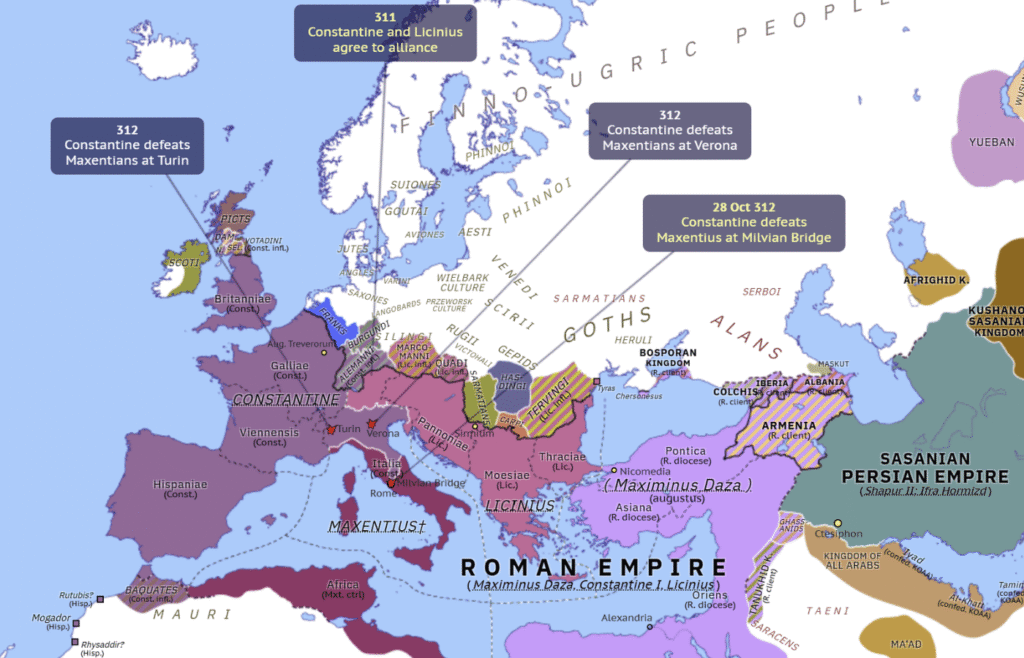
Following his sudden imperial acclamation at York, Constantine rapidly transformed the British provinces into the primary military springboard for his continental ambitions. In early 312 AD, determined to march on Rome and eliminate his imperial rival Maxentius, Constantine made a high-stakes strategic choice to strip the northern frontiers of their finest defensive armor. He mobilized a massive expeditionary force across Gaul, taking nearly a quarter of Britain's regular infantry units and specialized auxiliary cavalry divisions.
This veteran British core—composed of elite detachments (vexillationes) from the Legio VI Victrix and highly mobile Germanic auxiliary cavalry units under the command of the Alamannic king Crocus—marched directly across the Alps, serving as the frontline shock troops for the invasion of Italy.
Constantine’s campaign across the northern Italian plains was characterized by high-velocity tactical engagements. At the Battle of Turin, his heavy infantry systematically outmanoeuvred Maxentius's clibanarii—formidable, fully armored cavalrymen—by using specialized wedge formations and iron-tipped clubs to crack open the enemy's armor, forcing a total collapse of the city's defenses. Moving rapidly eastward, the British vanguard faced an even more grueling siege and open-field clash at Verona. In a fierce night action outside the city walls, Constantine’s veteran cohorts completely destroyed the elite Praetorian vanguard commanded by Maxentius’s senior general, Ruricius Pompeianus, securing control of northern Italy and clearing the open highway down toward Rome.
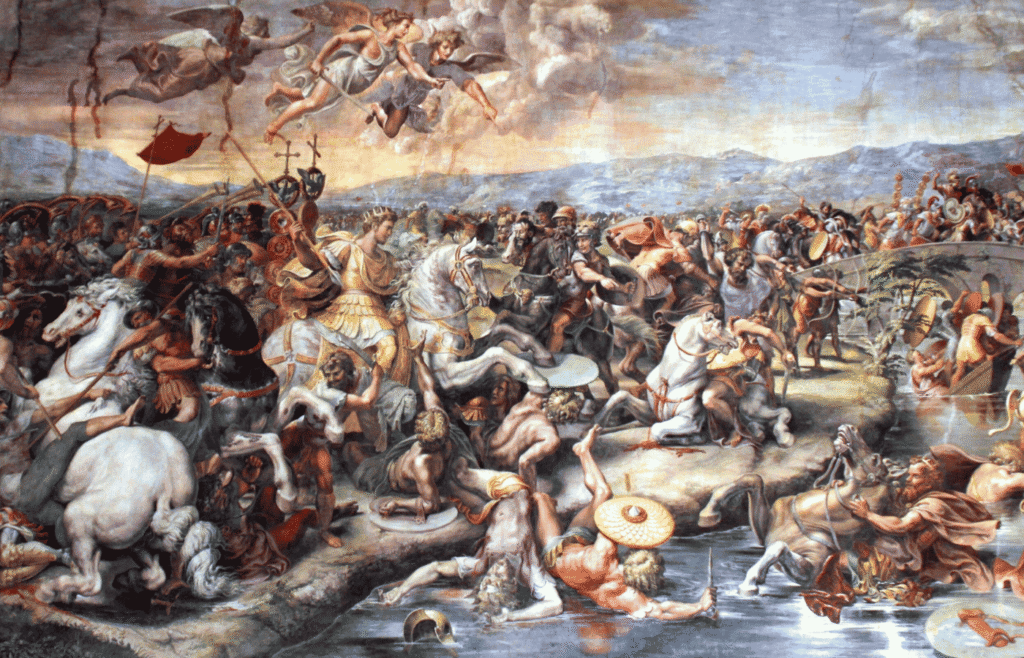
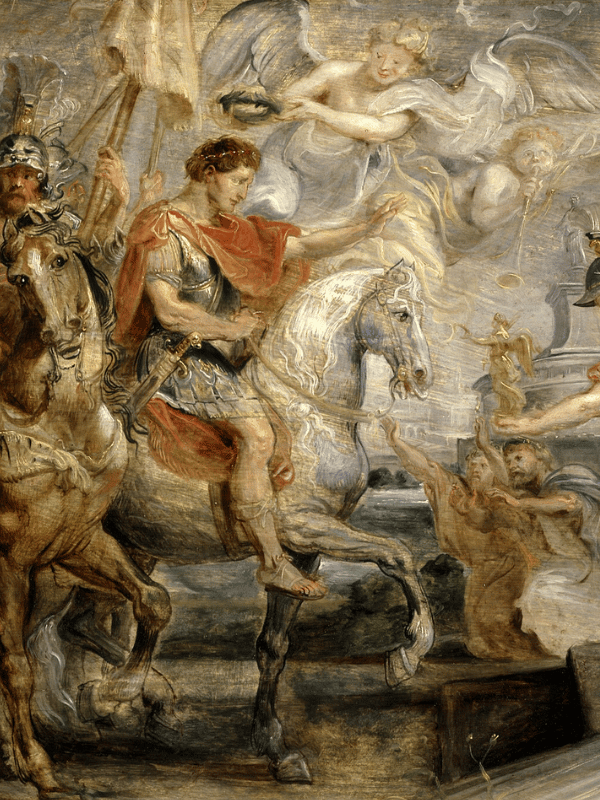
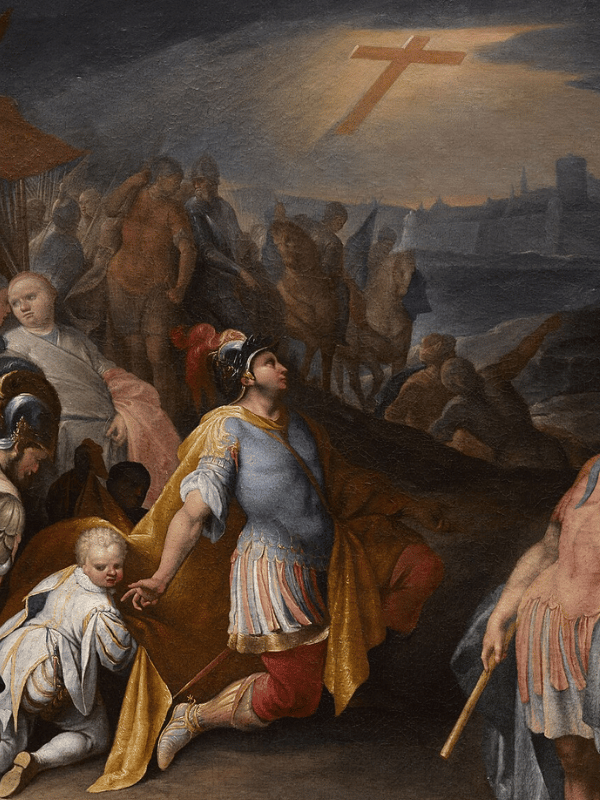
The entire campaign reached its legendary, definitive climax on 28 October 312 AD at the Battle of the Milvian Bridge, just outside the northern gates of Rome. On the eve of the battle, according to contemporary accounts by Lactantius and Eusebius, Constantine ordered his soldiers to mark their shields with the Chi-Rho monogram—a symbol representing the first two letters of Christ's name—following a profound celestial vision. The British and Gallic legions formed an unbreakable shield wall along the banks of the Tiber River, resisting waves of heavy cavalry charges.
As Constantine’s mobile field forces launched a coordinated counter-offensive, Maxentius’s lines fractured into a chaotic panic. The retreating troops overcrowded a wooden pontoon bridge adjacent to the stone Milvian Bridge, causing the structure to buckle and collapse. Maxentius himself plunged into the deep, fast-flowing waters of the Tiber and drowned under the immense weight of his own iron armor, while thousands of his Praetorian Guards were slaughtered on the riverbanks, a total tactical victory that won Constantine undivided control over the western Roman world.
This landmark military victory instantly dragged the historically isolated British church into the heart of mainstream imperial politics. Following the issuance of the Edict of Milan in 313 AD, which granted complete religious freedom across the empire, the formal integration of the island into the newly Christianized state machine became visible in August 314 AD at the Council of Arles in southern Gaul. Convened directly by Constantine, who utilized the imperial post system (cursus publicus) to transport church leaders across the Western world at the state’s expense, the council was designed to resolve a pressing theological schism that threatened the internal stability of the wealthy North African provinces: the Donatist controversy.
The Donatists argued that any sacraments administered by priests or bishops who had surrendered sacred scriptures to Roman authorities during Diocletian’s Great Persecution were completely invalid. This created a bitter, multi-layered divide against the orthodox hierarchy. Constantine presided over the council as an impartial arbitrator, gathering a high-level administrative delegation of sixteen bishops from Italy, Gaul, Spain, and Britain to establish a unified imperial orthodoxy.
The surviving official attendance registers record a fully functioning ecclesiastical delegation from the British provinces. The records show the presence of three high-ranking British bishops representing the regional civic capitals: Eboracus (York), represented by Bishop Eborius; Londinium (London), represented by Bishop Restitutus; and Lindum Colonia (Lincoln), represented by Bishop Adelfius. To ensure full legal representation, the delegation included a native priest named Sacerdos and a deacon named Arminius, representing the minor administrative shires.
The council debated heavily for weeks before issuing twenty-two binding canon laws that fundamentally reshaped the legal and social framework of the evolving Christian empire. The assembly decided to completely reject the Donatist position, ruling that the validity of a sacrament depended on the holy office itself rather than the personal history of the individual priest. Crucially for the Roman military state, the bishops passed Canon 3, which decreed that any Christian soldier who deserted the imperial legions during times of peace would face immediate excommunication, effectively transforming the church into a powerful tool to enforce military discipline.
The council also established a fixed, empire-wide date for the celebration of Easter to standardize the liturgical calendar across all provinces. The active participation of the British bishops in creating these far-reaching imperial laws proved to the world that late Roman Britain was deeply embedded within the political, religious, and legal framework of the state, possessing an organized, well-funded church hierarchy that could steer international policy centuries before the collapse of direct Roman administration.
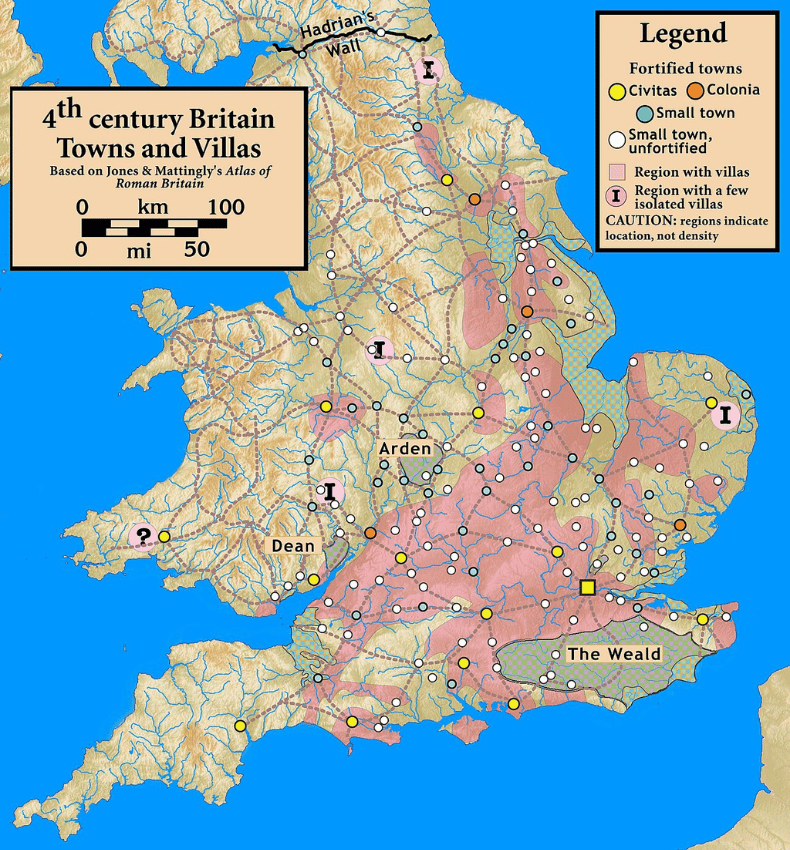
As Constantine’s reign consolidated into undivided rule over the Roman world, Britain entered a golden twilight of economic prosperity and domestic security known as the Constantinian Pax. With the northern frontiers stabilized by his earlier campaigns, the island became a vital agricultural breadbasket for the western empire. Wealthy Romano-British aristocrats invested massive capital into expanding the lowland villa estates of southern and southwestern England, constructing grand country houses decorated with intricate geometric mosaics, advanced underfloor hypocaust heating systems, and private bath complexes. Urban life shifted from military fortification to peacetime commerce, as the peace stimulated a boom in regional textile manufacturing, pottery production, and tin extraction.
This booming agrarian economy generated vast grain surpluses that were systematically exported via massive merchant fleets down the Rhine River to feed the Roman legions guarding the Germanic frontiers, transforming the island into one of the most stable and affluent territories in the late western empire before the dynastic divisions of the mid-fourth century.

The Late Roman Church and the Pelagian Heresy
314 – 410 AD
The gradual transition of Britain from a classical pagan province into a highly organized Christian society altered the cultural and political layout of the late western empire. Following the declaration of religious tolerance by Constantine the Great, the elite families of the Romano-British aristocracy steadily abandoned their traditional civic temples to invest their private wealth directly into the construction of local churches, Christian funerary chapels, and grand estate mosaics featuring early Christian iconographies, such as the famous Chi-Rho monogram discovered at the Frampton villa. By the late fourth century, the footprint of the British church had expanded across the southern lands, organized around a formal network of regional urban bishoprics that exercised immense social authority over the local population as the traditional civic machinery of the empire began to contract.
This growing religious maturity generated a profound intellectual crisis that shook the theological foundations of the entire Mediterranean world, driven by a brilliant, highly educated British monk named Pelagius. Born on the island in the mid-fourth century, Pelagius migrated to Rome around 380 AD, where he became deeply shocked by the moral laxity, corruption, and spiritual apathy he observed among the city's Christian aristocracy. In response, he developed a radical, highly demanding theological doctrine that rejected the concept of Original Sin, arguing instead that humanity possessed an uncompromised, complete free will (liberum arbitrium) that allowed individuals to achieve moral perfection and salvation through their own conscious choices and rigorous personal effort, without requiring the unearned intervention of divine grace.
This home-grown British philosophy sparked a furious international backlash, initiating a high-stakes ideological war with the premier theologians of the age, most notably Saint Augustine of Hippo. Augustine viewed Pelagius’s denial of inherited sin as a dangerous attack on the core tenets of the Christian faith, arguing that humanity was entirely corrupted and could only be saved through the unmerited grace of God.
Despite being formally condemned as a dangerous heresy by multiple continental church councils and banned by an imperial decree issued by Emperor Honorius, the Pelagian doctrine returned to Britain via returning merchants and scholars. The heresy spread rapidly across the island, finding a highly receptive audience among the wealthy, independent-minded Romano-British villa owners who were increasingly forced to rely on their own local resources and self-defense capabilities as the Western Roman state machine collapsed.
To eradicate this persistent theological rebellion and restore imperial orthodoxy, the western church was forced to launch a series of high-stakes diplomatic counter-missions to the island during its final decades of Roman administration. In 429 AD, Pope Celestine I dispatched a highly charismatic, aristocratic French bishop, Saint Germanus of Auxerre, to launch a sweeping anti-Pelagian campaign across Britain.
Germanus traveled through the southern shires, out-debating local Pelagian teachers in massive public assemblies outside London and St Albans. He pairing his theological arguments with practical military leadership, rallying the local Romano-British defense forces to win the famous, bloodless "Hallelujah Victory" against a combined raiding column of Picts and Saxons by using a mountain ambush tactic, a final intervention that demonstrated how deeply intertwined the defense of the British soul had become with the defense of its borders.
The Civil Wars of Constantine and Licinius
316 – 324 AD
The decade following the Council of Arles witnessed the gradual, violent breakdown of the shared governing pact between the western and eastern courts, transforming Britain into a highly secure financial engine and recruitment reservoir that fueled Constantine’s push for undivided imperial rule. Following their mutual issuance of the Edict of Milan, Constantine and his eastern colleague, Licinius, divided the governance of the Roman world along a sharp geopolitical axis. However, their relationship was poisoned by immediate political friction, deep religious divergences, and conflicting dynastic ambitions.
Licinius increasingly viewed Constantine's aggressive patronage of the Christian church as a direct threat to traditional Roman state machinery, prompting him to initiate localized purges of Christian civil servants within his eastern domains. Constantine, operating from his primary western capitals at Trier and Arles, seized upon these ideological divisions to frame his impending campaigns not merely as a war for territorial expansion, but as a supreme holy crusade to liberate the eastern provinces.
The first open rupture erupted in the autumn of 316 AD, when Constantine launched preemptive strike into the Balkans, initiating the brief but bloody War of Cibalae. Marching an army of twenty thousand veteran western troops into modern Croatia, Constantine encountered a massed eastern infantry line commanded by Licinius. Following a brutal, day-long battle of high attrition that lasted until nightfall, Constantine’s disciplined frontline infantry executed a decisive uphill charge that shattered the eastern center, forcing Licinius to execute a chaotic nighttime retreat toward Thrace and leave twenty thousand of his men dead or captured. Although this initial phase concluded with a tense, fragile peace treaty signed at Serdica in 317 AD—which forced Licinius to yield Greece, Illyricum, and the Balkan provinces to the western court—the compromise was merely a tactical pause that allowed both emperors to launch a massive, multi-year militarisation program across their respective territories.
To finance this expanding military footprint and build a vast maritime armada, Constantine heavily exploited the isolated stability of the British provinces. While the continental frontiers of Gaul and Italy were constantly destabilized by troop movements, Britain remained a protected, affluent sanctuary under the Constantinian Pax. Constantine imposed punishing annual tax assessments on the wealthy Romano-British villa class, demanding immense grain supplies, high wool yields, and raw metal outputs to supply his continental supply bases. At the same time, imperial press-gangs systematically combed the British shires, extracting thousands of young, native British auxiliaries and low-ranking frontier horsemen to replenish his elite mobile field columns (comitatenses). This massive extraction of domestic wealth and manpower severely drained the provincial economy, but it successfully provided Constantine with the liquid capital and physical reinforcement needed to wage a war of total obliteration against his eastern rival.
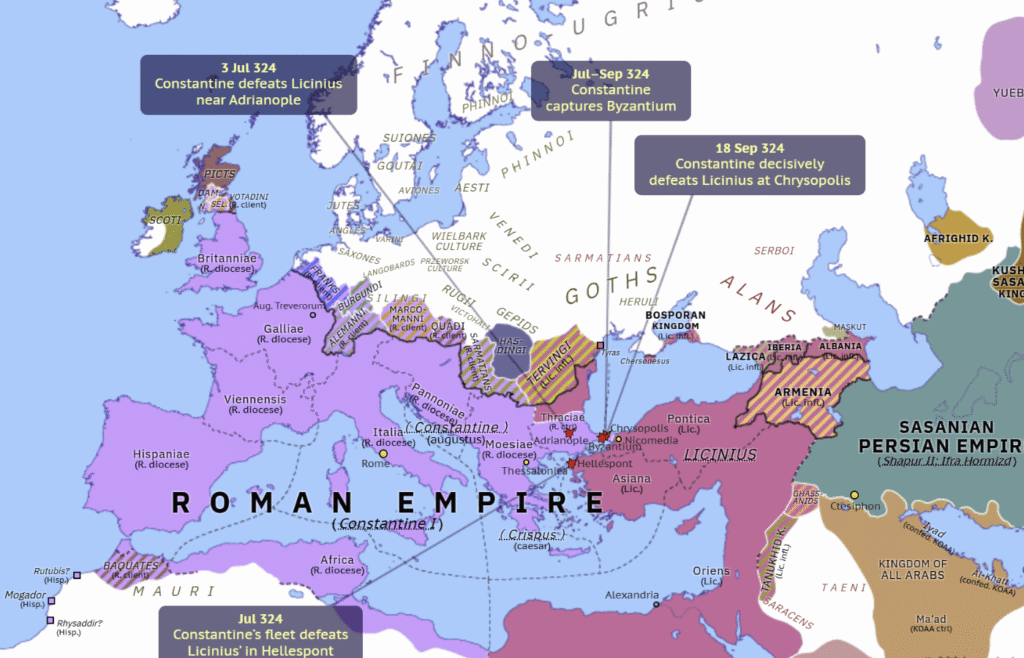
The final, decisive showdown erupted in the summer of 324, initiating a multi-theater campaign that brought the entire Roman world to the brink of collapse. Pulling elite cohorts away from the Rhine frontiers and the northern lookouts of Hadrian’s Wall, Constantine mobilized a massive force of 120,000 veteran infantrymen and ten thousand cavalrymen, matching them with a newly built fleet of two hundred transport ships assembled at Thessalonica.
Licinius countered by assembling an immense eastern host of 150,000 combatants, backed by a powerful Egyptian and Phoenician fleet of three hundred warships under the command of his admiral Amandus.The armies collided on 3 July 324 at the Battle of Adrianople, where Constantine’s western shock troops scaled steep riverbanks under a relentless barrage of missile fire, systematically out-flanking the eastern lines to slaughter over thirty-four thousand of Licinius’s troops and force the survivors to barricade themselves inside Byzantium.
The conflict rapidly shifted to the sea, where Constantine’s eldest son, the Caesar Crispus, commanded a light, highly agile western fleet against the massive eastern armada blocking the Hellespont. Over two days of chaotic naval warfare, Crispus utilized superior maritime maneuvering and a sudden, violent southern gale to smash Amandus’s warships against the rocky cliffs of Asia Minor, destroying one hundred and thirty ships and killing over five thousand eastern sailors.
Stripped of his maritime supply lines, Licinius evacuated Byzantium and retreated across the Bosphorus to make a final, desperate stand at Chrysopolis on 18 September 324. In a chaotic infantry clash that tested the raw physical endurance of both armies, Constantine’s veteran legions completely overwhelmed the raw, un-seasoned eastern recruits, executing a total tactical slaughter that left twenty-five thousand dead on the field. Licinius fled to Thessalonica but was arrested and executed shortly after, permanently dismantling the Tetrarchy system, ending decades of civil strife, and locking Britain into a centralized global autocracy that directed state revenues to build Constantine's new Christian capital at Constantinople.
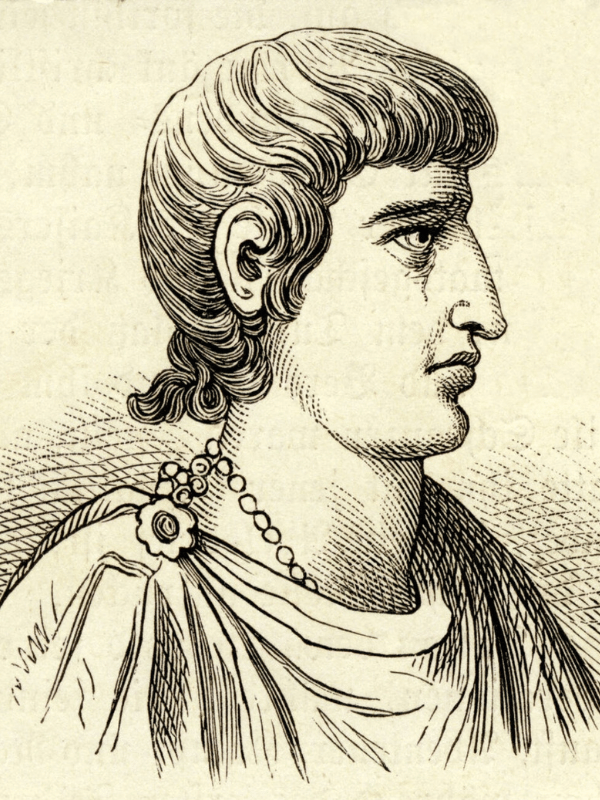
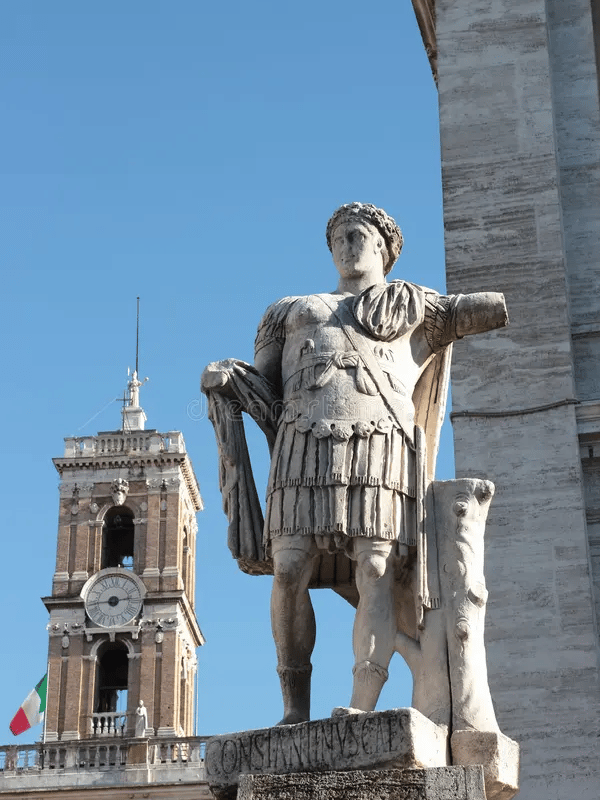
The War of the Three Brothers
337 – 340 AD
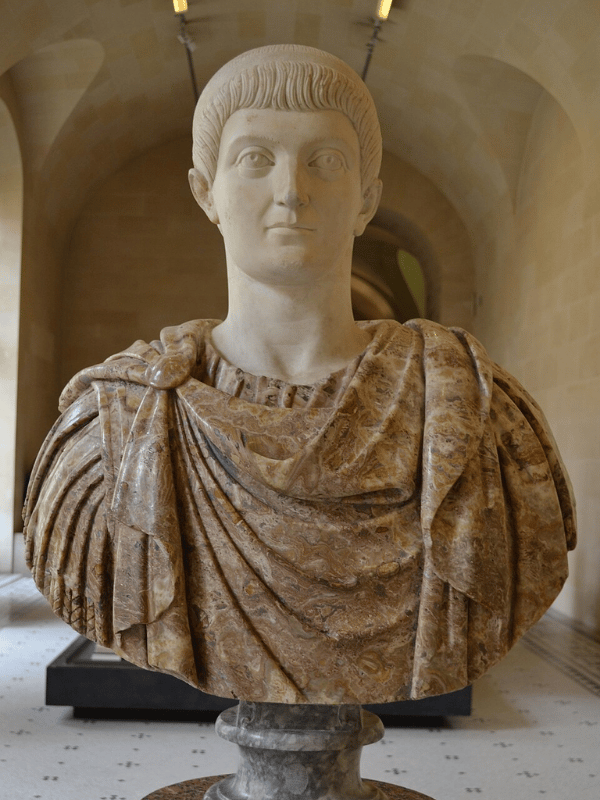
The complex administrative and dynastic friction that plunged Roman Britain into its first major fourth-century crisis was rooted in the highly volatile inheritance scheme devised by Constantine the Great prior to his death on 22 May 337 AD. Seeking to future-proof his family’s control over a sprawling empire, Constantine had divided the Roman world into a delicate jigsaw puzzle of regional commands distributed among his three surviving sons—Constantine II, Constantius II, and Constans—and his two favored nephews, the Caesar Dalmatius and the King of Kings Hannibalianus.
This elaborate system of checks and balances collapsed into an immediate explosion of dynastic bloodshed. Within months of the old Emperor’s passing, an engineered military purge erupted inside Constantinople, orchestrated by the imperial palace guard and tacitly encouraged by the brothers. The mutinous troops systematically slaughtered the male side-branches of the family, executing both Dalmatius and Hannibalianus along with their closest senatorial advisors to eliminate any external competition for the throne.
With their cousins eliminated, the three surviving brothers met in September 337 at Viminacium in Pannonia to partition the bloody remains of the empire into three immense, highly competitive imperial domains. The middle brother, the calculating twenty-year-old Constantius II, secured the wealthy Eastern provinces and the ongoing, high-stakes war against the Sasanian Empire. The youngest brother, the seventeen-year-old Constans, assumed command over Italy, Illyricum, and North Africa. Meanwhile, the eldest brother, the twenty-one-year-old Constantine II, claimed direct control over the western triad of Britain, Gaul, and Spain, establishing his primary imperial court and military administrative capital at Augusta Treverorum (Trier).
As the senior Augustus by birthright, Constantine II arrogantly claimed a right of guardianship over his teenage brothers, demanding a formal administrative veto power over their localized legislative decrees and territorial adjustments. While Constantius II remained heavily occupied along the remote Euphrates frontier tracking Persian troop deployments, this overbearing stance sparked immediate political friction between the western court at Trier and the young Constans in Italy.
Constans rapidly grew to resent his older brother's constant interference in his domestic governance. The relationship between the two western siblings completely fractured when Constantine II aggressively demanded that Constans cede the wealthy provinces of North Africa to the western exchequer. To undermine Constans's security, Constantine II cut off the supply of elite western auxiliary legions to Italy. Conversely, he watched with growing envy as Constans accumulated massive tax revenues from the highly lucrative Mediterranean grain trade.Determined to assert his supreme authority and tap into new revenue streams to finance his expanding military establishment, Constantine II turned back to his western domains, aggressively leveraging the agrarian wealth, heavy wool yields, and state-owned silver mines of the British shires to fund a massive, high-velocity preemptive strike against Italy.
In the early spring of 340, Constantine II stripped the northern frontiers and the newly built Saxon Shore fortresses of Britain of their primary mobile field forces (comitatenses), embarking them across the English Channel to join his main invasion column in Gaul. Leaving the British frontiers dangerously undermanned and exposed to early coastal raiding, the eldest brother led his army across the Alpine passes, launching a surprise winter invasion of northern Italy while Constans was occupied fighting a defensive war against barbarian incursions along the Danube frontier.
The campaign proved to be a rapid operational disaster. Expecting a completely disorganized and panic-stricken defense, Constantine II marched his cavalry vanguard carelessly down the road toward the strategic hub of Aquileia. Constans's forward generals, who had moved rapidly down from Illyricum to intercept the invasion, set a sophisticated trap along the path of the advance. They deployed a light force to feign a chaotic retreat, drawing the overconfident elder brother straight into a massive, pre-planned cavalry and heavy infantry ambush concealed inside the dense woodlands bordering the Alsa River loops.
The engagement was a total tactical slaughter. Constantine II's vanguard was surrounded and cut to pieces by heavily armored Italian lancers. The Emperor himself was unhorsed during the close-quarters melee, repeatedly stabbed by enemy infantrymen, and his body was unceremoniously cast into the shallow mud of the Alsa River to prevent his followers from recovering it. Left entirely without an heir, the western empire dissolved overnight.
The victorious twenty-year-old Constans marched west to immediately annex Britain, Gaul, and Spain into his own domain, unifying the entire Western Roman world under his sole command and leaving his brother Constantius II isolated in the East. This sudden transfer of power forced the panicked British civic councils and depleted garrison commanders to swear rapid oaths of loyalty to a young, fiercely orthodox Christian master, setting off a decade of deep political realignment, intense military restructuring, and frontier paranoia across the isolated province.
Further Information: The War of the Three Brothers
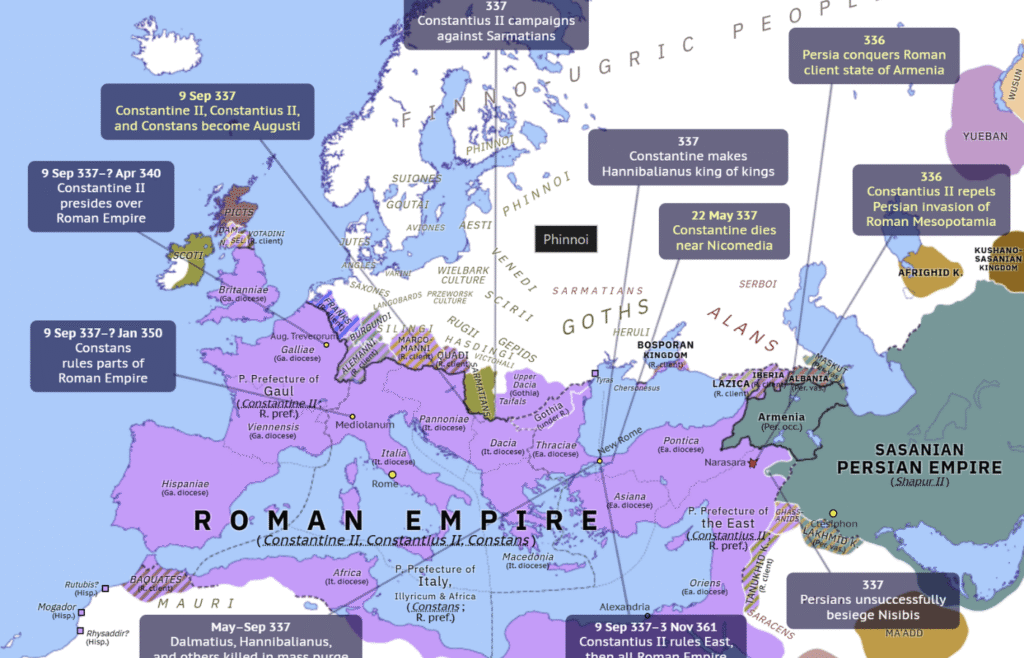
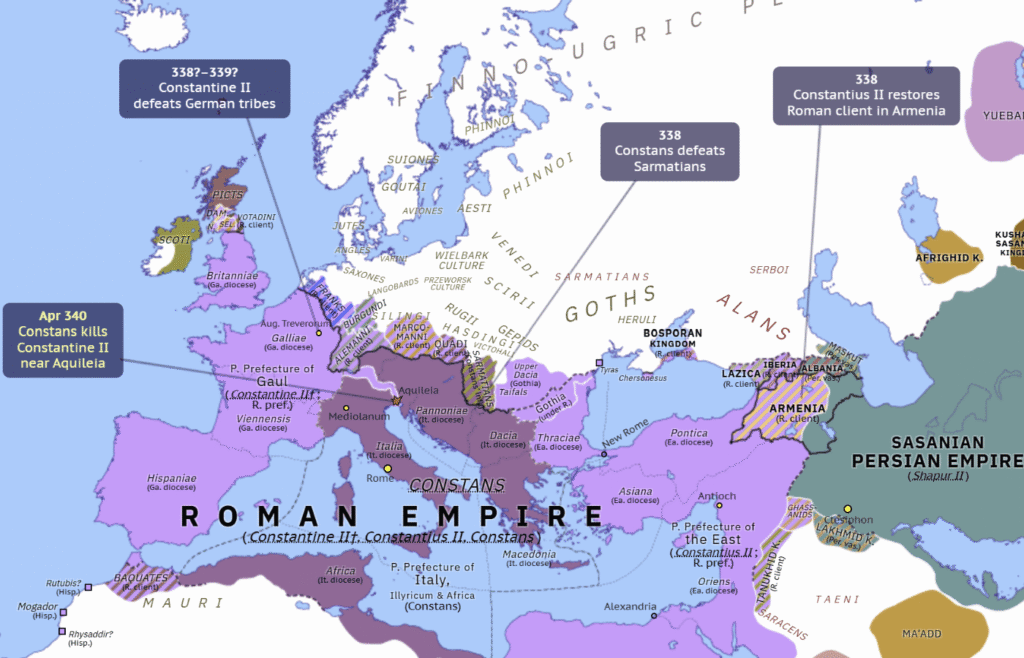
The Magnentian Usurpation and the Purges of Paulus Catena
350 - 353 AD
The administrative and economic stability established across the Diocese of the Britains was violently shattered in January 350 AD by a sudden political coup on the continent that plunged the western provinces into a reign of terror. Magnentius, a highly decorated commander of the elite imperial palace guards who was of barbarian Frankish and British descent, launched a military rebellion in Gaul to assassinate the Western Emperor Constans.
Securing the immediate allegiance of the western legions, including the entire garrison of Britain, Magnentius proclaimed himself Augustus and established a rival imperial court. To fund his subsequent civil war against Constantius II—the surviving Eastern Augustus and brother of the murdered Constans—Magnentius subjected the British gentry and urban elites to aggressive extraction, demanding heavy taxes, stripping temple treasures, and seizing the agricultural wealth of the villa estates to sustain his massive mercenary armies.
The continental rebellion reached its bloody end in August 353 at the Battle of Mons Seleucus in southeastern France, where the superior eastern forces of Constantius II completely routed the rebel lines, driving Magnentius to commit suicide to avoid capture. Following this military triumph, Constantius II launched a severe political counter-offensive to systematically root out and eliminate any western aristocrat who had supported or funded the usurper. To execute this domestic purge across the isolated island of Britain, the Emperor dispatched a notoriously ruthless imperial notary named Paulus, who was universally feared across the Roman world under the sinister nickname Paulus Catena, or "Paul the Chain", due to his expertise in fabricating false charges of treason and binding his victims in chains of legal entrapment.
Arriving in Britain with absolute powers, Paulus Catena established a temporary tribunal to conduct a sweeping political inquisition against the Romano-British landed elite. He weaponised anonymous accusations, torturing innocent civilians and seizing the vast country estates of any wealthy family suspected of nominal compliance during the three-year usurpation. The civilian governor of the British diocese, a highly respected administrator named Martinus, grew deeply horrified by the widespread lawlessness and suffering inflicted upon his people. Recognizing that the notary was intentionally destroying the social fabric of the province to enrich the imperial treasury, Martinus boldly intervened, threatening to resign his office and pleading with Paulus to halt the arbitrary arrests.
Paulus responded with immediate hostility, turning his apparatus against the governor by publicly accusing Martinus himself of treason and ordering his immediate arrest. Outmanoeuvred and realizing he could not secure a fair trial against the emperor's favorite agent, Martinus drew his sword in a desperate act of defiance, charging at Paulus to assassinate the notary inside the tribunal chambers.
The blow slipped, merely wounding Paulus in the arm before the governor's retinue could intervene. Faced with immediate execution and the certain ruin of his family, Martinus turned the blade upon himself, committing suicide on the spot. Paulus Catena utilized the governor's tragic death to justify an even more brutal wave of executions, tortures, and property confiscations, permanently alienating the Romano-British elite from the central imperial government and leaving the northern frontiers dangerously vulnerable to the upcoming border conspiracies.
Further Information: The Magnentian Usurpation and the Purges of Paulus Catena


The Barbarian Conspiracy
367 – 369 AD
The collapse of regional security across the Diocese of the Britains occurred in 367 AD through a massive, multi-front onslaught historically recorded by the contemporary writer Ammianus Marcellinus as the Barbarian Conspiracy (Barbarica Conspiratio). This crisis was not a series of random, isolated border skirmishes. It functioned as a highly synchronized, coordinated alliance of multiple non-Roman nations explicitly targeting the vulnerabilities of the imperial defense network.
In the north, the Picts—subdivided into the Dicalydones and Verturiones—united with the Attacotti and the Goidelic-speaking Scots from Ireland to launch a massive assault that breached the stone line of Hadrian’s Wall. Concurrently, North Sea Saxon pirates and Frankish raiders launched destructive amphibious assaults along the southern and eastern shorelines, trapping the provincial high command in a vice-like strategic bottleneck.
The initial success of this multi-front invasion was driven by internal treason from the Arcani—also recorded as the Areani—a specialized frontier scouting unit stationed in hidden outposts deep beyond Hadrian's Wall. Tasked with monitoring tribal movements and reporting troop build-ups, these scouts accepted lucrative bribes of gold and plundered goods from the enemy chieftains. They deliberately fed false intelligence and pacifying reports back to the Roman high command in exchange for a share of the spoils.
Free to advance without warning, the barbarian coalitions overran the northern lowlands and bypassed the frontier forts. They ambushed and killed Nectaridus, the Count of the Saxon Shore (Comes Maritimi Tractus), while completely outmanoeuvring and capturing Fullofaudes, the Duke of the Britains (Dux Britanniarum). With both supreme commanders eliminated, the defensive infrastructure collapsed, allowing mobile raiding bands to spend over a year plundering agricultural villa estates, enslaving civilians, and driving the economy into total chaos.
The widespread anarchy across the countryside was only arrested in 368 when the Emperor Valentinian I dispatched an elite expeditionary force under the command of Count Theodosius. Landing at the port of Rutupiae (Richborough), Theodosius marched his veteran units—the Batavi, Heruli, Iovii, and Victores—directly to Londinium (London). He established a primary base of operations within the walled city, dividing his army into small, fast-moving tactical units to systematically hunt down the scattered raiding bands who were weighted down by heavy loads of plundered property and captured slaves.
By 369 AD, Theodosius successfully cleared the southern lowlands, rebuilt the ruined cities, and restored the stolen booty to the civilian inhabitants. He then marched north to refortify the damaged sectors of Hadrian's Wall, ruthlessly executing the ringleaders of the internal desertions and the Roman deserters who had joined the raiders. To permanently prevent future security betrayals, the general executed the traitorous leaders of the Arcani and disbanded the entire scouting unit, replacing the corrupted border apparatus with a network of newly engineered, heavily fortified coastal signal stations stretching along the Yorkshire coast to restore the peace of the realm.
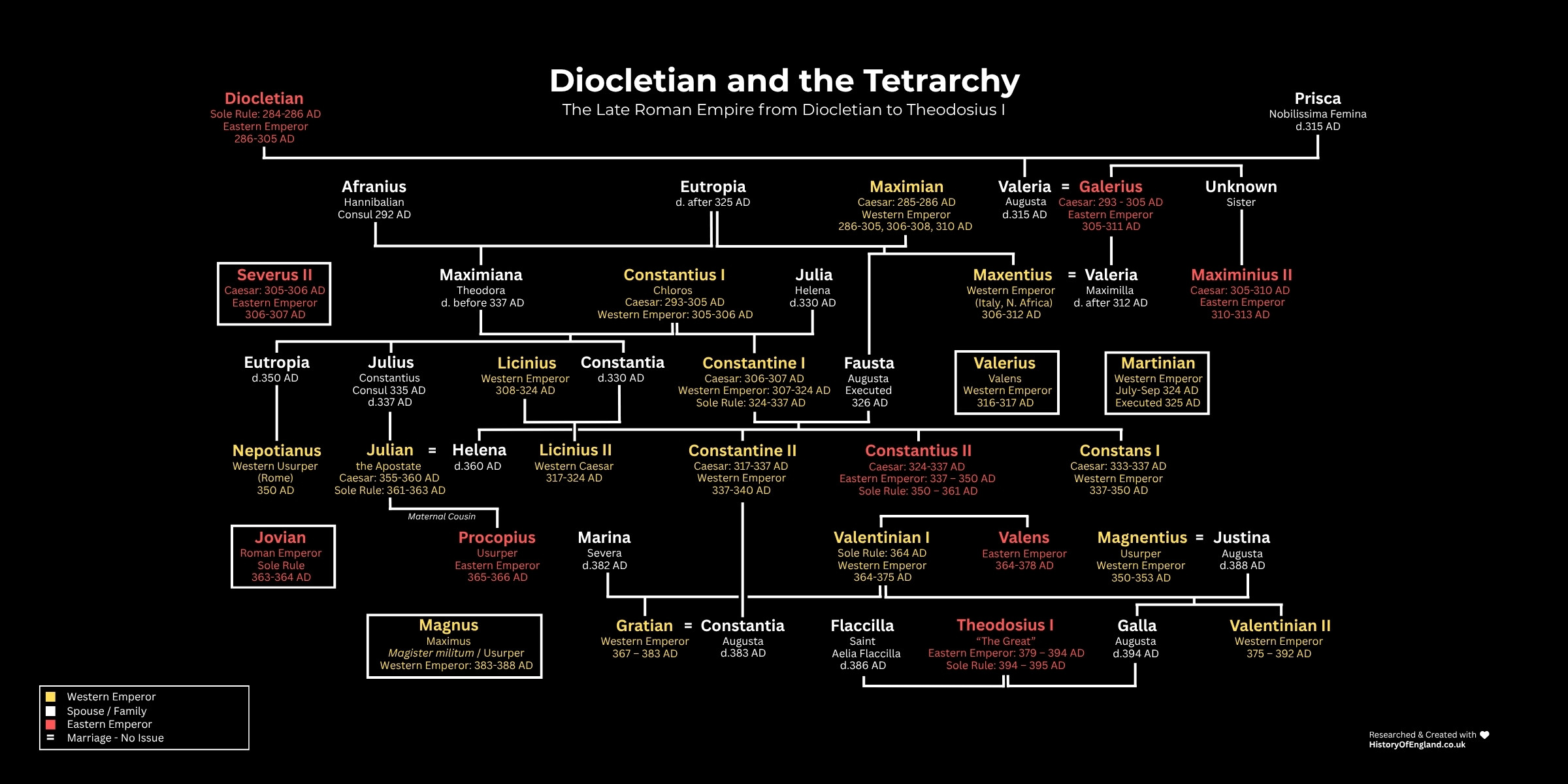
The Theodosian Restoration and Rise of the Eastern Court
368 – 379 AD
The operations executed by Count Theodosius the Elder between 368 and 369 AD were part of a massive geopolitical realignment that ultimately elevated his family to the supreme imperial throne of the late Roman world. The background to this rise began in 364, when the sudden death of Emperor Jovian left the empire without an heir. The high military command elected Valentinian I, an aggressive Pannonian officer, to the western throne.
Recognizing the impossibility of defending the vast imperial borders single-handedly, Valentinian immediately enacted a formal division of the Roman world, elevating his younger brother Valens to co-Augustus to govern the East from Constantinople, while he established a frontline western court at Augusta Treverorum (Trier) to drive back constant Germanic invasions. It was this dual-emperor court that dispatched Count Theodosius the Elder to Britain in 368 to clear out the multi-front barbarian invasions, a counter-insurgency campaign that restored the island's tax base and earned the elder general a promotion to Master of Horse (Magister Equitum), placing him in supreme command of the western mobile field army.
While the elder Count stabilized the West, his son—the future Emperor Theodosius the Great—was meticulously trained to command the highest military offices. Operating under his father's direct guidance, the younger Theodosius won independent fame along the volatile Danube frontier as the military commander (Dux) of Moesia, leading elite legionary cohorts to completely destroy an invading column of Free Sarmatians in 374. However, the family's spectacular political ascent was violently disrupted by a brutal court conspiracy. Following the sudden death of Valentinian I from a stroke in late 375, corrupt factions within the western palace at Trier manipulated the succession to secure a fragile minority rule under Gratian and the infant Valentinian II.
To prevent a military coup by the popular elder general, these court factions engineered a rapid, state-backed treason charge against Count Theodosius the Elder, arresting and publicly executing the restorer of Britain at Carthage in early 376. Devastated by his father's judicial murder, the younger Theodosius immediately resigned his command and fled the continent, seeking safety in exile on his ancestral estates in northwestern Spain.
The catastrophic events of the Gothic War across the eastern empire forcefully dragged the younger Theodosius out of retirement and onto the imperial throne. In 376, a massive migration of Gothic tribes crossed the Danube to escape the Huns, fleeing into Roman territory. The corrupt mismanagement of local Roman border officials sparked an immediate, violent tribal rebellion that culminated on 9 August 378 in the legendary Battle of Adrianople. In a tactical disaster that shook the foundations of western civilization, the Eastern Augustus Valens recklessly charged the Gothic lines without waiting for western reinforcements; his field army was surrounded and cut to pieces, resulting in a total slaughter that left twenty thousand Roman soldiers and the Emperor Valens himself dead on the field.
Faced with a complete military and administrative void in the East, the Western Augustus Gratian realized his remaining forces were entirely insufficient to contain the rampaging Gothic columns. Reversing his court's hostile stance against the family, Gratian urgently recalled the younger Theodosius from his Spanish exile in the autumn of 378, granting him the title of supreme commander over the eastern forces. The younger general proved his brilliant tactical capability within weeks, leading a scratch force to smash a new Sarmatian raid in the Balkans. Impressed by this immediate stabilization, Gratian officially proclaimed the thirty-two-year-old Theodosius as Eastern Augustus on 19 January 379 at Sirmium.
Further Information: The Theodosian Restoration and Rise of the Eastern Court
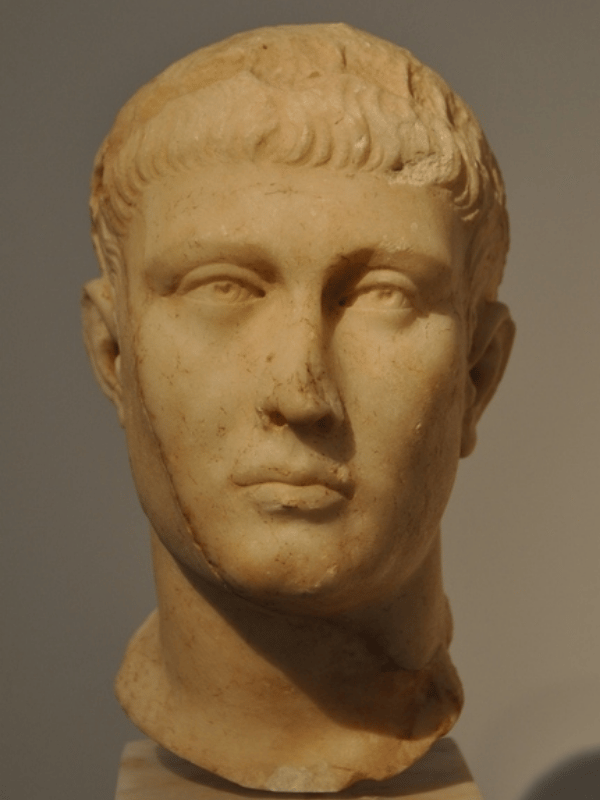
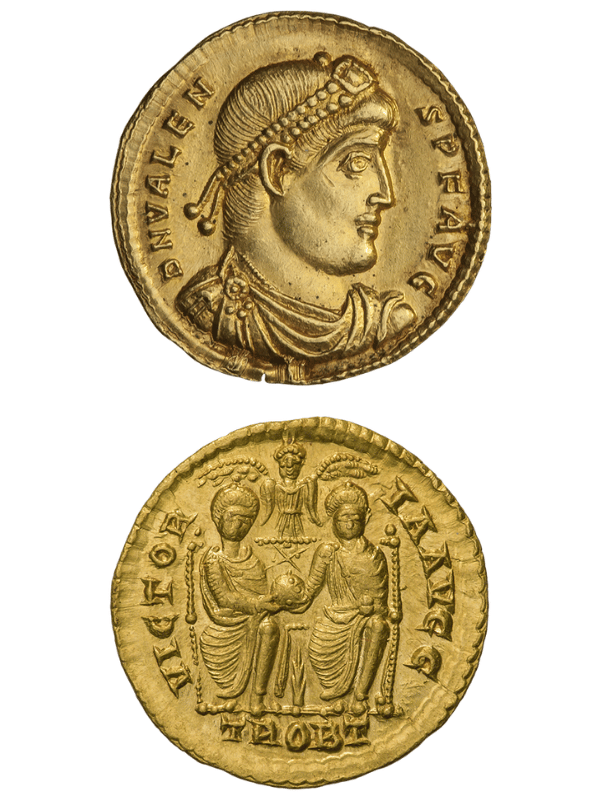
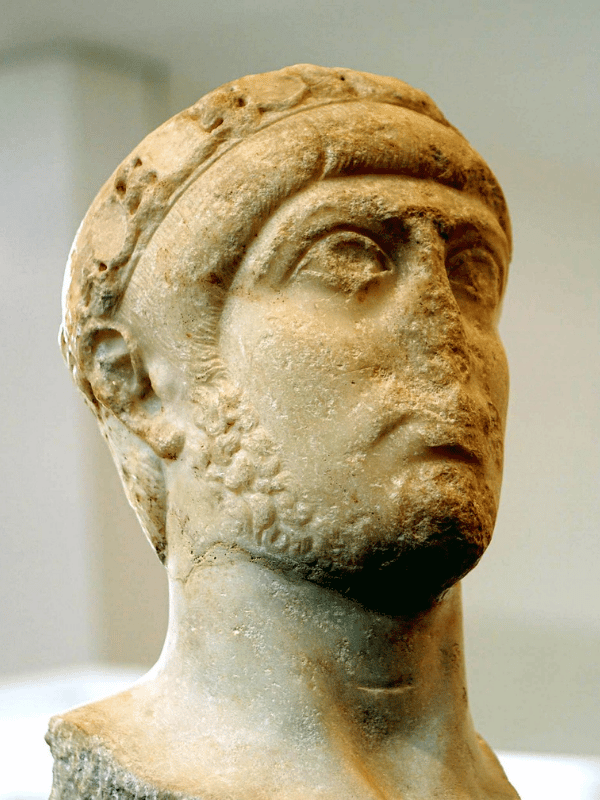
The Usurpation of Magnus Maximus
383 – 388 AD
The stabilization achieved by the Theodosian restoration proved short-lived as the wider political architecture of the Roman Empire fractured into a severe constitutional crisis. Following the death of the Emperor Valentinian I, the governance of the West was divided between his two sons: the twenty-four-year-old Emperor Gratian, who ruled the northern provinces from his imperial courts at Augusta Treverorum (Trier) and Lutetia (Paris), and his four-year-old half-brother, Valentinian II, who held nominal authority over Italy and North Africa from Milan.
Gratian deeply alienated the veteran Western legions by displaying an open, insulting preference for Alan mercenary cavalry, whom he dressed in traditional Roman uniforms and appointed to senior executive commands over native officers. Turning the Diocese of the Britains into a volatile engine of military insurrection, the isolated and underfunded legions on the island resolved to overthrow the central court, choosing a charismatic, high-status commander to spearhead their rebellion.
In the spring of 383 AD, the Spanish-born general Magnus Maximus—a highly decorated military commander who had served with distinction under Count Theodosius during the campaigns against the Barbarian Conspiracy—was formally acclaimed as Augustus by his troops. The acclamation was executed at the strategic coastal fortress of Segontium (Caernarfon, Wales), where Maximus commanded the specialized auxiliary networks guarding the western approaches against Irish piracy.
To secure his continental legitimacy and contest the western throne, Maximus executed an aggressive military extraction that permanently re-engineered the defensive infrastructure of the island. He stripped the northern frontiers and the Welsh Marches entirely of their professional fighting forces, transporting an armada of over forty thousand veteran troops across the English Channel into Gaul. This massive extraction of manpower was so complete that traditional Welsh legend later recorded the event as the definitive departure of the Roman armies, leaving large sections of western and northern Britain permanently undefended.
Landing at the mouth of the Rhine, Maximus’s forces swarmed into northern Gaul, where Gratian’s remaining continental legions immediately deserted the Emperor to side with the British usurper. Gratian fled toward Lyons but was intercepted and summarily executed by Maximus's master of horse, Andragathius, on 25 August 383. Establishing his magnificent imperial capital at Trier, Maximus successfully consolidated his hold over the prefecture of Gaul, encompassing Britain, Spain, and France. He launched a sophisticated administrative and religious campaign, mass-producing high-quality silver and gold coinage from active mints at Trier, Lyon, and Arles, while fiercely defending Nicene orthodoxy against heretical factions to force the Eastern Augustus, Theodosius I, to temporarily recognize him as a legitimate co-emperor.
The short-lived security of this breakaway Western domain fell apart completely in 387. Seeking total control, Maximus broke the regional balance of power by launching an aggressive amphibious and overland invasion across the Alps into Italy, driving the young Emperor Valentinian II into political exile in the East. This bold territorial over-reach triggered an immediate and devastating military counter-strike by the Eastern Augustus Theodosius I, who raised a massive coalition army of eastern legions and Gothic federates to track down the British rebel.
The two military machines met in the summer of 388 at the Battle of the Save in modern Croatia, where Theodosius's superior forces completely routed Maximus’s front lines. Maximus retreated to Aquileia, where he was captured, stripped of his imperial vestments, and executed by public beheading on 28 August 388 AD. His total military defeat resulted in the execution of his son, Flavius Victor, and a brutal purge of his Western supporters, leaving the stripped island of Britain completely exposed to incoming northern threats without the necessary personnel to repair its broken frontier defenses.
Further Information: The Usurpation of Magnus Maximus

The Stilichonian Restoration and the First Pictish War
396 – 402 AD
The execution of Magnus Maximus left the Western Roman Empire under the centralized but increasingly fragile authority of the Emperor Valentinian II, and subsequently the Emperor Honorius, who ruled the West from his court at Mediolanum (Milan). However, actual executive and military command over the Western empire was held by the brilliant half-Vandal Magister Militum and regent, Flavius Stilicho.
Stilicho faced a crumbling geopolitical landscape; the permanent extraction of forty thousand veteran troops by Maximus had decimated the frontier garrisons of the British diocese, creating a defensive vacuum that invited a series of devastating, uncoordinated maritime and land invasions. Around c. 396 AD, the northern Picts, Irish Scots, and Saxon pirates launched a coordinated, multi-front assault that plunged the northern and western shires back into a state of severe frontier warfare, threatening to shatter the remaining administrative infrastructure of the province.
Faced with this security crisis, Stilicho launched a highly successful naval and ground counter-offensive, recorded by the contemporary court poet Claudian as the First Pictish War. Operating with true logistical efficiency between c. 396 and 398, Stilicho dispatched a powerful Roman task force to the island to reinforce the Legio VI Victrix and coordinate a joint response with the Classis Britannica fleet.
Claudian’s panegyrics, most notably On the Consulship of Stilicho, capture the tactical reality of this campaign, famously personifying Britannia as a warrior clad in a wolf-skin cloak who praises the general for delivering her from the terror of marine incursions. Stilicho’s amphibious forces aggressively hunted down the Goidelic-speaking Scots in the Irish Sea and intercepted the Saxon pirates in the Channel, while his ground columns cleared the northern Lowlands of the invading Dicalydones and Verturiones Pictish tribal factions.
Concurrently, Roman military engineers engaged in a comprehensive refortification campaign along the Tyne-Solway line to secure these hard-won territories. They repaired the decaying, breached masonry of Hadrian's Wall, cleared the blocked defensive ditches, and completely rebuilt the ruined milecastles at strategic outposts like Birdoswald and Housesteads. To counter the threat of maritime surprise attacks, the high command constructed a brand-new network of stone-faced coastal signal stations along the high cliffs of the Yorkshire coast, including Scarborough, Filey, Huntcliff, and Goldsborough.
These specialized fortifications featured thick, square stone towers up to thirty metres high, surrounded by a curtain wall and a deep ditch, allowing sentries to use fire beacons by night and smoke signals by day to rapidly communicate incoming North Sea pirate fleet movements directly to the regional cavalry garrisons. This aggressive, multi-layered campaign successfully stabilized the frontier, subduing the Caledonian coalitions and restoring a temporary era of economic peace and agricultural security to the Romano-British villa gentry across the southern shires.
This final imperial restoration was broken in 401 when a national security crisis erupted at the heart of the Western Empire. Alaric I, the King of the Visigoths, launched a massive invasion of Italy, marching a veteran barbarian army across the alpine passes to directly besiege the Emperor Honorius inside Milan. Faced with the immediate collapse of the imperial core, Stilicho was forced to implement a desperate military consolidation, sending urgent orders to every western province to strip their frontiers and send all available troops to defend Italy.
In the spring of 402, the elite Legio VI Victrix and its entire accompanying auxiliary network were permanently withdrawn from their northern British stations and transported across the Channel to fight Alaric at the Battle of Pollentia. This fatal extraction of manpower completely stripped the island of its premier professional fighting force, permanently collapsing the defensive grid of Hadrian's Wall and leaving the local civilian population entirely isolated immediately before the catastrophic barbarian crossing of the Rhine in 406.
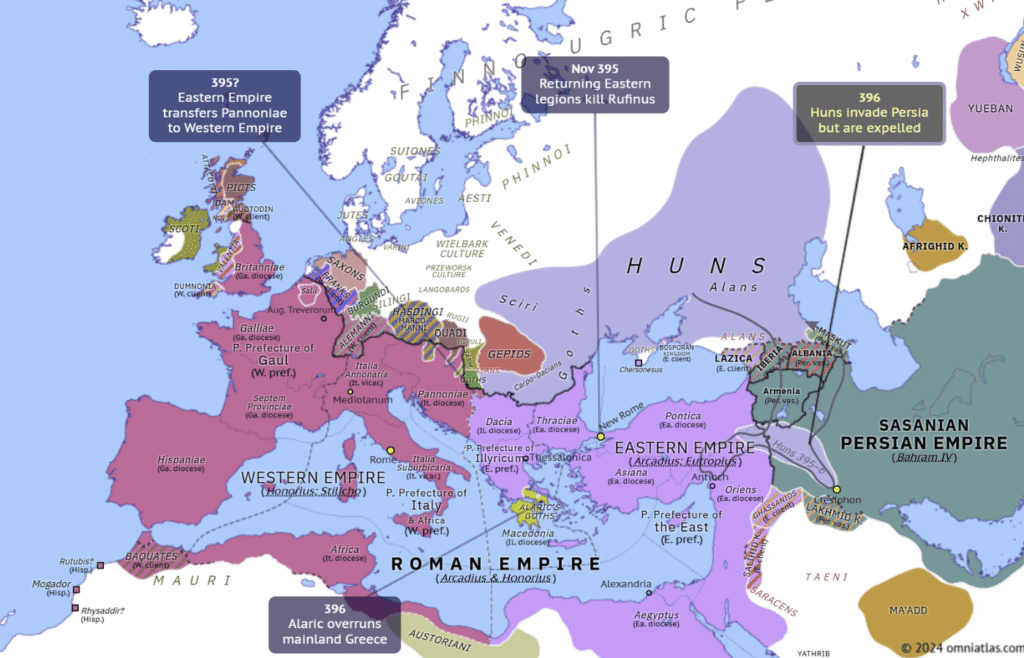

The Usurpation of Constantine III
407 AD
The total collapse of the Rhine frontier on the freezing night of 31 December 406 AD—when a massive barbarian coalition of Vandals, Alans, and Suebi swarmed across the frozen river into Gaul—left the isolated province of Britannia facing an immediate, existential national security crisis. Terrified that the encroaching Germanic tribes would swiftly cross the Channel to plunder the undefended British coastline, the remaining garrison units mutinied against the passive, inactive Western Emperor Honorius, who remained securely barricaded inside his lagoon capital at Ravenna.
After rapidly electing and assassinating two short-lived local usurpers named Marcus and Gratian within a matter of months, the desperate legions inside Eboracum (York) and Londinium (London) turned to a common, low-born soldier who possessed nothing but a fortuitous dynastic name: Flavius Claudius Constantinus. Proclaimed as Emperor Constantine III in the spring of 407, this ambitious commander immediately executed a highly volatile military strategy to secure continental legitimacy and protect the western provinces from complete collapse.
To confront the barbarian hordes and contest the western throne, Constantine III stripped Britannia of its final professional fighting forces, withdrawing the remaining elements of the Legio II Augusta, Legio VI Victrix, and Legio XX Valeria Victrix, alongside their auxiliary networks, across the Channel into Gaul. He established his temporary imperial capital at Arelate (modern Arles) in southern France, using these veteran British units to lock down the alpine passes and secure the borders of Hispania. This permanent extraction of military manpower left the local Romano-British population entirely isolated, an abandonment that permanently crippled the defensive infrastructure of the province.
Whilst Constantine III initially achieved significant tactical successes—systematically driving the Germanic raiders out of northern Gaul, securing the Rhine crossings with newly raised auxiliary cohorts, and forcing a desperate Emperor Honorius to temporarily recognise him as co-Augustus in 409—his overstretched political architecture collapsed into complete failure by 411 AD. His primary general in Hispania, Gerontius, revolted against him, proclaiming a rival usurper named Maximus and launching a direct assault against Constantine's core territories.
Exploiting this internal rebellion, Honorius's supreme military commander, the brilliant general Flavius Constantius—the future Emperor Constantius III—launched a swift imperial counter-offensive, trapping Constantine III inside Arles. Following a grueling four-month siege, Constantine III surrendered on the condition of safe passage, but he was summarily executed by beheading along his return route to Ravenna in September 411, leaving the stripped island of Britain completely exposed to incoming northern threats without any hope of imperial military restoration.
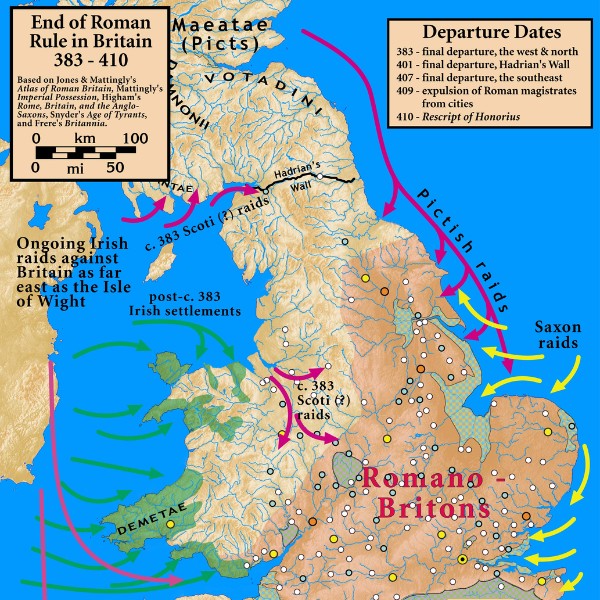
Roman Withdrawal
409 - 410 AD
Additional Information: Anglo-Saxon England / Roman Withdrawal and Civilisational Collapse
By 409 AD, the departure of Constantine III had left Britannia isolated from the Western Roman Empire, and with the remaining field armies deployed to Gaul, a coalition of Saxon pirates and Picts launched a coordinated offensive across the lowlands. Recognising that the imperial government was bankrupt, native civic leaders took a revolutionary step,staging a coup, expelling the remaining Roman tax collectors, and organising militias to resist the invaders.
In 410, the British councils sent a diplomatic embassy to Emperor Honorius, appealing for military restoration and financial subsidies. Honorius, facing a direct threat to his capital and an empty treasury, sent back a blunt reply known as the Rescript of Honorius, in which he instructed the British that the empire could deploy zero troops, and that the native populations must arrange for their own defence from that point forward.
With this single decree, formal Roman governance over the island was permanently terminated, the legions never returned, and the administrative machinery that had bound Britain to continental Europe for nearly four centuries vaporised, with the island fracuring into a patchwork of competing territories led by local warlords.
The speed of transition helped to plunge the island into an institutional vacuum that set the stage for the future "Groans of the Britons" and the migration of the Anglo-Saxon tribes.
Roman Britain FAQs