
Imperial Retreat:
Post-War Britain
The road to Ethnocide is paved with good intentions
Additional Information: The House of Windsor
The surrender of Japan in August 1945 launched a volatile, forty-five-year era of domestic re-engineering and rapid imperial retreat, forcing Great Britain to navigate the realities of a bankrupt treasury and a bipolar Cold War landscape. While emerging from the Second World War as nominal victors, the state immediately faced severe economic contractions at home, forcing a total reliance on emergency American loans and the implementation of a strict domestic rationing system to avoid total financial collapse.
While exploring this post-war era, we track the state's transition from the world's premier global empire to a contracted European nation, examine the creation of the taxpayer-funded welfare state alongside the early legislative frameworks that opened the door to mass post-colonial migration, and witness the steady decline of traditional heavy industries that permanently altered the country's economic baseline.
Page Contents:
Austerity, Rations, and the Marshall Plan Aid
1945 – May 1951
Additional Information: Britain in the Second World War / American Aid: Cash and Carry, and Lend-Lease
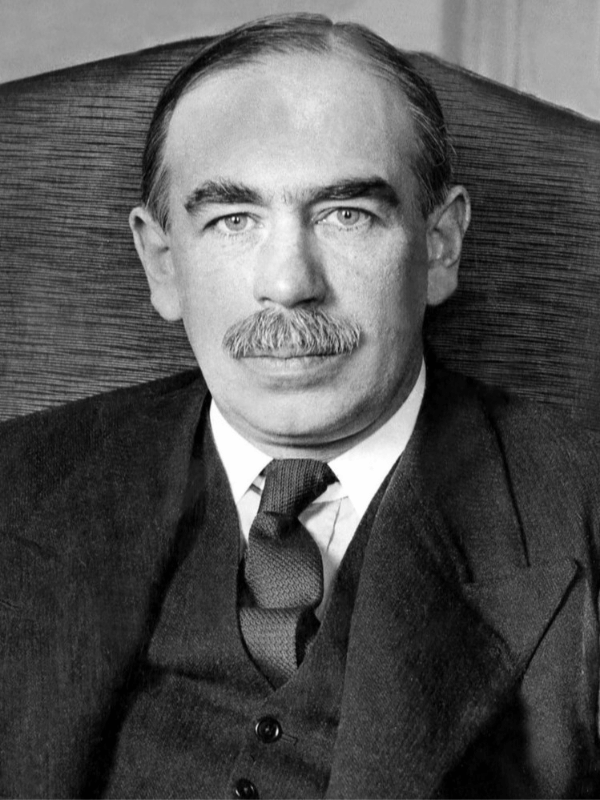
On 2 September 1945, the United States government abruptly terminated its wartime Lend-Lease aid program, leaving Great Britain to confront immediate financial insolvency. Having sacrificed the vast majority of its overseas investments and accumulated an external debt of over £3.5 billion to win the conflict, the state lacked the liquid cash to pay for vital imports of food and raw materials. To prevent a collapse of the sterling area, Prime Minister Clement Attlee dispatched economist John Maynard Keynes to Washington to secure an emergency line of credit.
The resulting Anglo-American loan agreement, signed in December 1945, provided a $3.75 billion American loan paired with a $1.25 billion Canadian credit line, but it carried strict, punitive conditions. Most notably, the terms forced Britain to make the pound sterling freely convertible into US dollars by July 1947, a premature maneuver that triggered a catastrophic run on British gold reserves and forced the state to institute a prolonged period of domestic spending cuts.
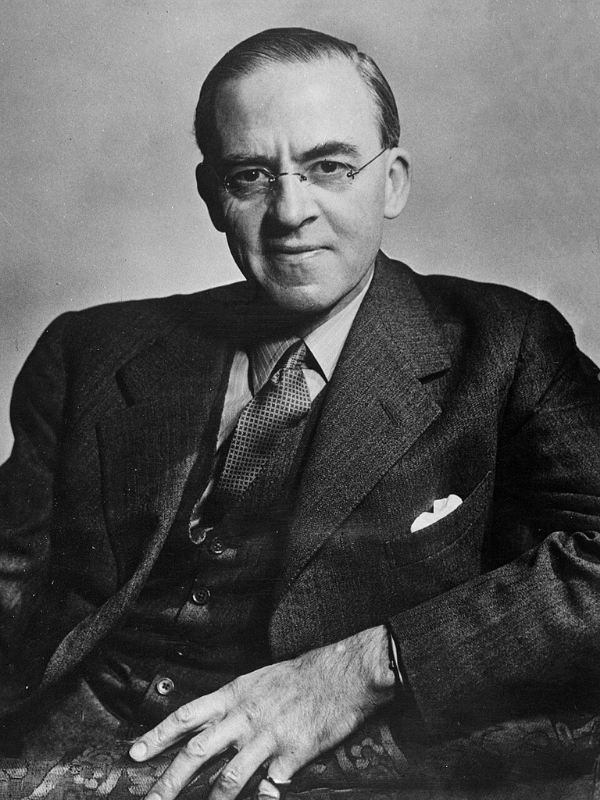
The termination of this American aid forced the Labour government to implement the emergency loan and severe domestic spending cuts known as the Age of Austerity, a crisis stabilized only by the arrival of $2.7 billion in Marshall Plan funding in 1948. To repair the balance of payments, Chancellors of the Exchequer Hugh Dalton and Sir Stafford Cripps prioritized manufacturing exports over domestic civilian consumption, diverting British-built cars and textiles straight to overseas markets.
Daily life across the country was characterized by material shortages, utility restrictions, and a tightening rationing system that was far more restrictive than during the war itself. Under Cripps’s direction, the Ministry of Food rationed bread for the first time in British history in July 1946, followed in November 1947 by potatoes, while reducing the weekly meat allowance to a single shilling's worth per citizen. Concurrently, severe winter blizzards in early 1947 paralyzed the national grid, shutting down over 20,000 factories due to a 4-million-ton coal deficit and leaving millions in unheated homes.
The state was stabilized in April 1948 through the US-funded European Recovery Program, popularly known as the Marshall Plan. Great Britain became the largest single recipient of this reconstruction funding, receiving $2.7 billion in financial credits and raw material shipments. This dollar influx allowed the government to stabilize national credit, balance its foreign payments, replace rolling stock across the newly nationalized railway lines, and rebuild bombed infrastructure.
However, this economic lifeline did not immediately ease domestic restrictions. Cripps deliberately used the Marshall Plan capital to consolidate the state's central reserves and pay down national debt rather than expanding civilian consumption, ensuring that the rationing of basic food items dragged on until July 1954, nearly a decade after the conclusion of global hostilities.
The Formation of the United Nations
1945 AD
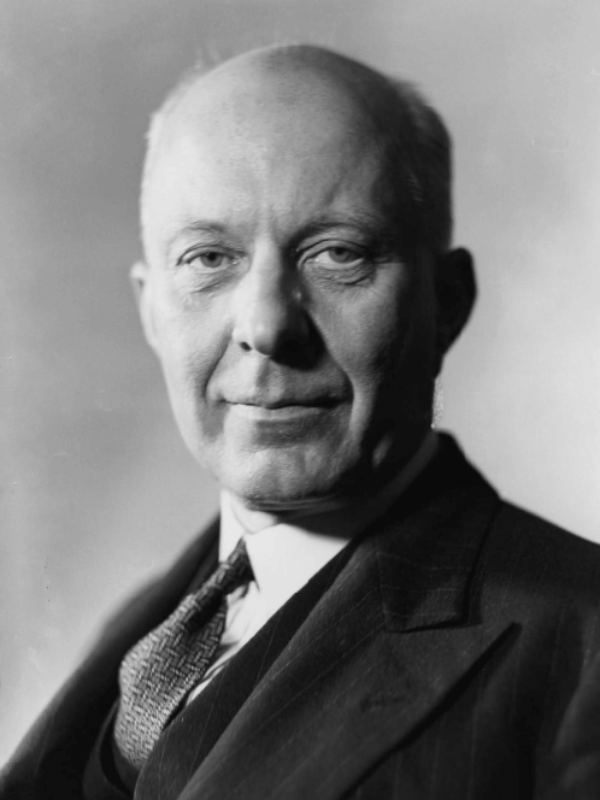
In August 1944, diplomatic representatives from Great Britain, the United States, and the Soviet Union assembled at the Dumbarton Oaks Conference in Washington to draft the organizational blueprint for a new international security body. These negotiations continued at the Yalta Conference in February 1945, where Prime Minister Winston Churchill, President Franklin D. Roosevelt, and Premier Joseph Stalin finalized voting protocols and frameworks to protect their post-war interests.
The legislative process moved to the San Francisco Conference in April 1945, where delegates from fifty nations gathered to review and codify the foundational text. The signing of the United Nations Charter on 26 June 1945 established a global security framework to replace the failed League of Nations, creating the UN Security Council to manage international peace through binding legal authority.
To direct international security operations, the victorious powers engineered an executive organ called the UN Security Council, granting permanent seats and absolute veto privileges to Great Britain, the United States, the Soviet Union, France, and China—the designated "Big Five" victors of the global conflict. Instead of relying on the unbinding arbitration codes of the League, the new charter established a legally binding security framework under Chapter VII, which explicitly authorized the collective deployment of land, air, and maritime forces to halt sovereign aggression. This shift transformed international law from a system of voluntary compliance into a centralized mechanism of collective security backed by the military assets of the great powers.
However, the architecture of this international compromise faced immediate instability after its official ratification on 24 October 1945, as the rapid escalation of the Cold War polarized the council. The persistent deployment of the Soviet veto by Foreign Minister Vyacheslav Molotov routinely blocked the organization's decisions, turning the Security Council into a diplomatic battlefield rather than an instrument of global policing.
This political breakdown challenged the administration of the first UN Secretary-General, Trygve Lie, failing to provide a unified security baseline and forcing Western nations to seek alternative regional military alliances, such as the North Atlantic Treaty Organisation in 1949, to protect their frontiers from Soviet expansion.
Further Information: The Formation of the United Nations
Clement Attlee, the NHS, and the Welfare State
1945 – October 1951
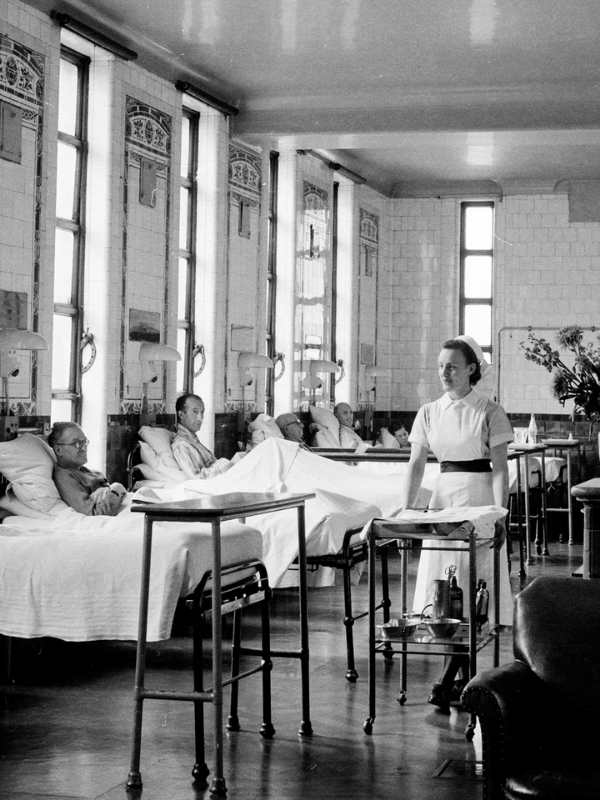
Following the landslide political shift of the July 1945 General Election, Prime Minister Clement Attlee took office with a 146-seat parliamentary majority to initiate a transformation of the domestic state. The government began enacting the recommendations of the 1942 Beveridge Report, passing the National Insurance Act 1946 to mandate a universal system of taxpayer-funded social benefits.
This legislation established a compulsory nationwide safety net providing state-funded pensions, sickness benefits, maternity allowances, and unemployment pay to the adult population to insulate families from economic hardship.
The centerpiece of this transformation was the creation of the National Health Service on 5 July 1948. Masterminded by Minister of Health Aneurin Bevan, the government passed the National Health Service Act 1946 to nationalise 2,688 private and municipal hospitals across England and Wales, converting the medical infrastructure into a single system funded through taxation. For the first time, citizens were granted the right to free medical, dental, and optical care at the point of delivery.
To secure medical cooperation, Bevan compromised with the British Medical Association, allowing hospital consultants to continue treating private patients alongside their public duties.
Simultaneously, the Attlee government nationalised the infrastructure of the industrial economy to manage post-war reconstruction. Parliament passed a sequence of statutes to take control of 958 coal mines under the National Coal Board, the entire railway network under the British Transport Commission, electricity grids, gas works, and the iron and steel foundries.
This expansion of the state was finalized through the National Assistance Act 1948, which abolished the last remnants of the Victorian Poor Law by transferring local poor relief to a centralized National Assistance Board. This network established the foundations of the post-war consensus, creating a welfare state designed to protect citizens from the cradle to the grave.
The British Mandate of Palestine and the Creation of Israel
1945 – May 1948
Additional Information: Britain in the First World War / The Balfour Declaration, Interwar Britain / The League of Nations and the Mandate System / Jewish Terrorism in the Interwar Years, Britain in the Second World War / The Zionist Movement in WW2, Decline and Decolonisation / The Palestine Mandate Crisis
The mid-century crisis in the eastern Mediterranean developed from decades of irreconcilable British administrative duplication and imperial mismanagement. Following the 1936–1939 Arab Revolt, an armed nationalist uprising against British rule that was ruthlessly suppressed by over twenty thousand imperial troops, the British government sought a permanent structural solution to the region's ethnic gridlock.
In July 1937, a royal commission led by William Peel, 1st Earl Peel, published the landmark Peel Commission Report. This document provided the very first formal proposal for partition, concluding that the mandate was inherently unworkable due to mutually incompatible national aspirations. The report recommended dividing the territory into a small Jewish state, a larger Arab state merged with Transjordan, and a permanent British enclave encompassing Jerusalem and Bethlehem to protect the holy sites.
However, this proposal was aggressively rejected by the Arab leadership, internally fractured by the Zionist executive, and ultimately ignored and abandoned by the British government via the White Paper of 1939, which instead capped Jewish immigration at 75,000 arrivals over five years to secure Arab wartime loyalty. This policy reversal left hundreds of thousands of European Jews trapped on the continent on the eve of the Holocaust, fueling deep, long-standing resentment against the mandatory authorities.
By 1945, the British administration in Mandatory Palestine struggled to manage a severe political crisis fueled by the mass influx of Jewish Holocaust survivors fleeing European persecution and the intense opposition of the native Arab population. This dilemma quickly devolved into an open insurgency against British rule. A massive British military garrison of 100,000 soldiers—nearly one-tenth of the entire British Army—found itself trapped in a coordinated guerrilla campaign launched by Zionist paramilitary organizations, principally the Irgun and Lehi. These groups operated under a joint command structure known as the Hebrew Rebellion Movement, launching a wave of sabotage, train bombings, and urban ambushes to make the occupation financially and politically unsustainable for Great Britain.
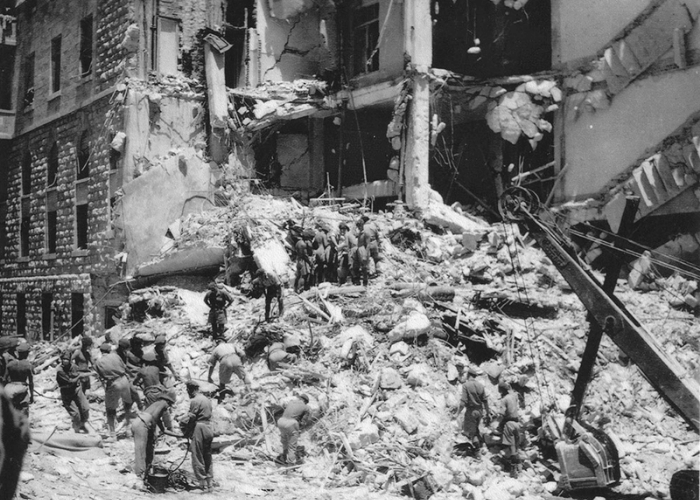
The campaign reached a devastating climax on 22 July 1946 when Irgun operatives dressed as Arab kitchen workers infiltrated the King David Hotel in Jerusalem, which housed the central headquarters of the British civil administration and military command. The militants placed milk cans packed with 350 kilograms of TNT in the basement beneath the building's south wing. The subsequent detonation collapsed all six floors of the wing, killing 91 people, including 28 British civil servants, 41 Arabs, 17 Jews, and 5 military personnel.
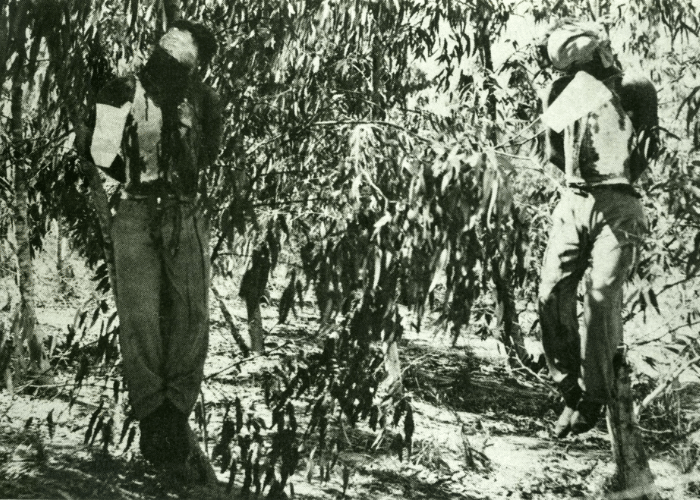
Rather than backing down, the British government placed Palestine under strict martial law, a move that prompted further militant retaliation. In February 1947, Lehi bombed the British Officers’ Club in Jerusalem, killing seventeen people, and in July 1947, the Irgun kidnapped and hanged two captured British army sergeants, Clifford Martin and Mervyn Paice, booby-trapping their corpses in a eucalyptus grove to deter British executions of militant prisoners.
Exhausted by the immense financial drain of maintaining a wartime garrison, facing fierce diplomatic pressure from the United States to permit immediate immigration, and buckling under the domestic austerity crisis at home, the British government decided to abandon the territory entirely. In February 1947, Foreign Secretary Ernest Bevin announced that Great Britain would surrender the mandate to the United Nations and execute a total military evacuation by 14 May 1948. Refusing to enforce the subsequent UN partition plan or facilitate any formal transition of power, British authorities focused exclusively on their own safe withdrawal. The moment the final British soldiers boarded transport ships at Haifa harbor, the administration dissolved its presence without installing any replacement authority, leaving the territory to slide immediately into the First Arab-Israeli War.
The collapse of the mandate achieved the core political objectives of the underground campaigns, providing a direct path for the militant leadership to enter constitutional politics in the newly founded State of Israel. Menachem Begin, the commander of the Irgun who had authorized the King David Hotel bombing and spent years evading a £10,000 bounty by the Palestine Police Force, founded the Herut party and was eventually elected as the sixth Prime Minister of Israel in 1977.
Similarly, Yitzhak Shamir, a principal leader of the Lehi who had helped plot the 1944 assassination of Lord Moyne, entered the national intelligence agency, Mossad, before serving two terms as Israeli Prime Minister during the 1980s and 1990s. The transition of men once branded as terrorists by the British Foreign Office into internationally recognized heads of state altered the geopolitical landscape, demonstrating to anti-colonial movements across the globe that armed defiance against the Crown could lead to sovereign power.
Further Information: The British Mandate of Palestine and the Creation of Israel
Partitioning British India
August 1947
Additional Information: The Tudor Period / Foundation of the East India Company, The Georgian Era / The EIC Expands, The Victorian Era / The Indian Uprising of 1857 and the British Raj, Decline and Decolonisation / Retreat from the Raj and the Partition of India
In February 1946, a widespread mutiny across seventy-eight ships of the Royal Indian Navy paired with escalating communal rioting demonstrated that British administrative control over the subcontinent was rapidly disintegrating.
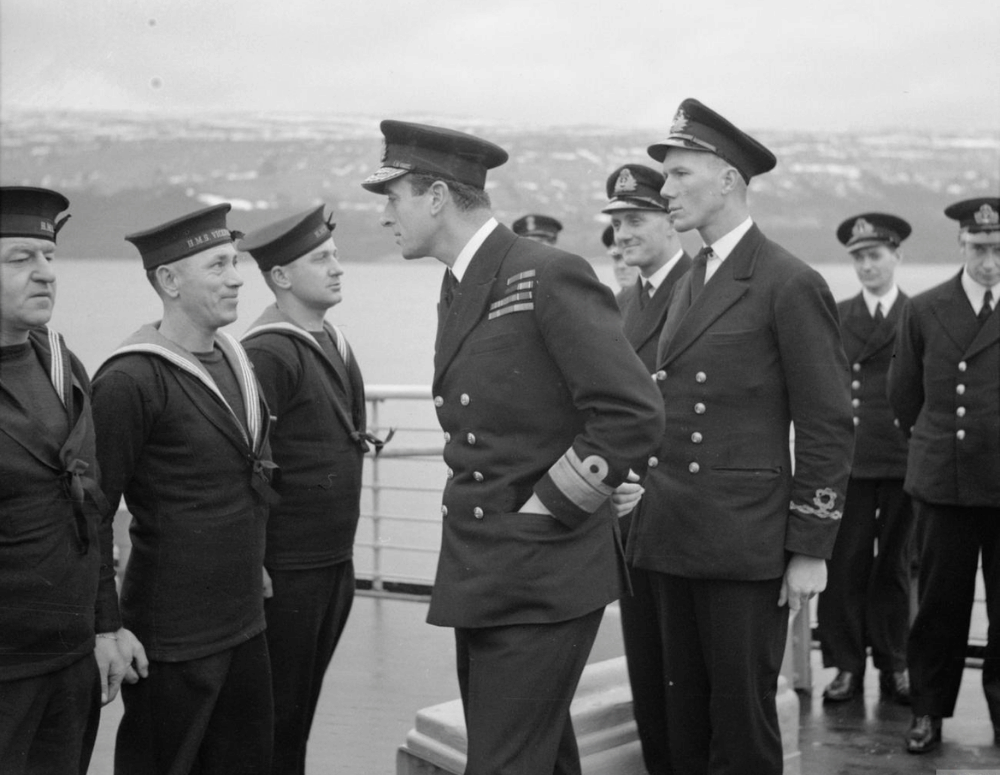
Facing a massive domestic deficit at home alongside this fierce anti-colonial resistance, Prime Minister Clement Attlee determined that the Treasury could no longer sustain the heavy expenditures required to garrison and police the Indian subcontinent. To extract its forces before an absolute collapse occurred, the Cabinet initiated a rapid retreat from its premier colonial possession, dispatching the last Viceroy, Rear-Admiral Lord Louis Mountbatten, to New Delhi in March 1947 with explicit orders to terminate British rule at the earliest opportunity.
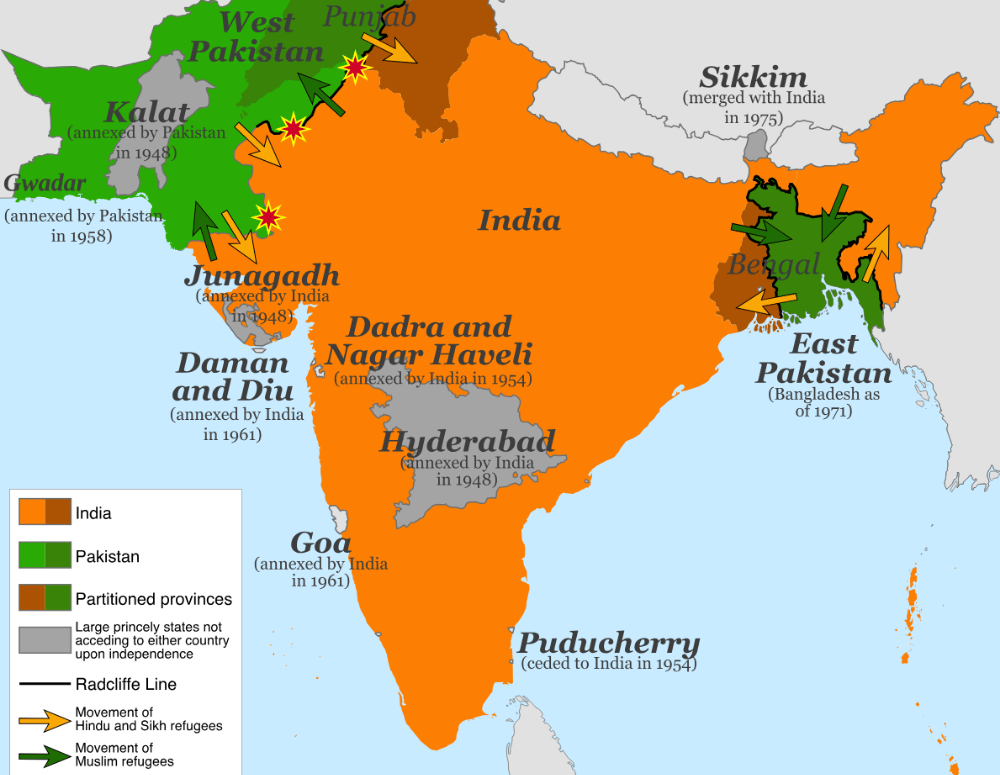
Operating under intense political pressure from London to prevent British troops from being trapped in an impending civil war, Mountbatten made the unilateral decision to move the official date of withdrawal forward by ten months, shifting the deadline from June 1948 to August 1947. To divide the vast territory before this compressed exit, a British lawyer with no prior knowledge of Indian geography, Sir Cyril Radcliffe, was appointed chairman of the boundary commissions and given just five weeks to sketch the new international borders. Working in isolation with inaccurate census data and obsolete topographical charts, Radcliffe carved the subcontinent along religious lines to establish a Hindu-majority India and a geographically split, Muslim-majority Pakistan, fracturing the ancient agrarian Punjab in the west and the densely populated Bengal region in the east.
The immediate consequence of this hurried truncation of imperial borders was a catastrophic humanitarian disaster. When British governance formally dissolved at midnight on 15 August 1947, the newly drawn Radcliffe Line was finally unmasked to the public, instantly splitting towns, villages, and railway grids in half. This sudden territorial fracture caused the chaotic, forced migration of over 14 million people who fled across the new frontiers to escape ethnic cleansing, resulting in a breakdown of law and order that claimed an estimated one million civilian lives through the systematic slaughter of refugee trains and brutal communal massacres.
Throughout this horrific bloodshed, the remaining British army units—including the 1st Battalion, Royal Scots—stood down inside their military cantonments under strict orders from Whitehall to refuse intervention and focus solely on protecting their own lines of retreat. The final contingent of British forces officially marched through the Gateway of India in Bombay on 28 February 1948 to board transport ships for Europe, bringing a definitive end to nearly two centuries of the British Raj and leaving the region to slide into the first of several Indo-Pakistani wars over the disputed territory of Kashmir.
Further Information: Partitioning British India
The British Nationality Act 1948
August 1947
Additional Information: Genetic History of the English People / The British Nationality Act 1948 and Post-Colonial Influx
In the immediate post-war years, a critical shortage of workers across the nationalised industries and hospitals of the newly constructed welfare system prompted Parliament to review the state's legal framework for citizenship. Looking to preserve the cohesion of the global empire during a period of rapid decolonisation, the Labour government under Prime Minister Clement Attlee drafted legislation to formally redefine imperial status.
Officials in Whitehall mistakenly assumed that geographic distances, maritime travel costs, and the devastation of the war would naturally deter mass population movements. They calculated that the new status would remain a largely symbolic gesture of imperial belonging while maintaining constitutional ties between the mother country and its dependencies.
The passage of the British Nationality Act 1948 granted all subjects in the colonies the unrestricted right to enter, live, and work in Great Britain without immigration controls, establishing the definitive legal framework for the subsequent decades of inward migration. Given Royal Assent on 30 July 1948 and taking effect on 1 January 1949, the statute created the explicit legal status of Citizen of the United Kingdom and Colonies (CUKC). Crucially, the legislation treated the domestic population of Great Britain and the populations of all remaining colonial territories as a single, massive population pool encompassing an estimated 800 million people.
The law entirely omitted any passport controls, employment vouchers, or immigration visas for these subjects. By granting equal citizenship status and unrestricted entry to millions at the exact moment Great Britain was constructing a taxpayer-funded welfare state, the poorly calculated legislation opened a permanent door for post-war immigration.
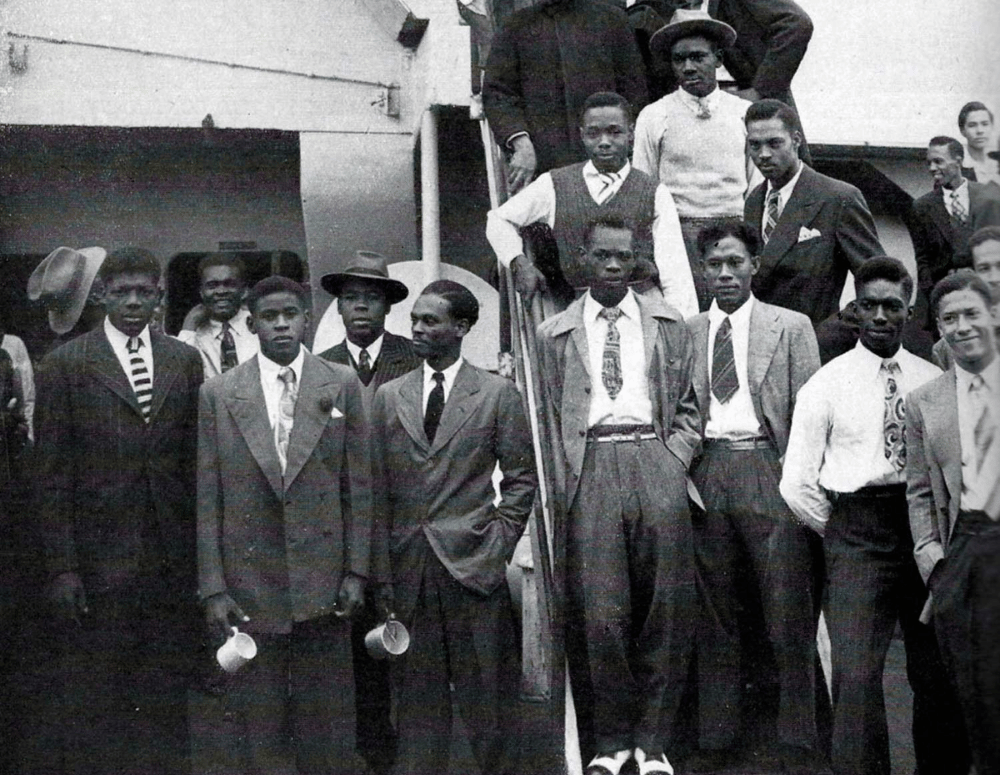
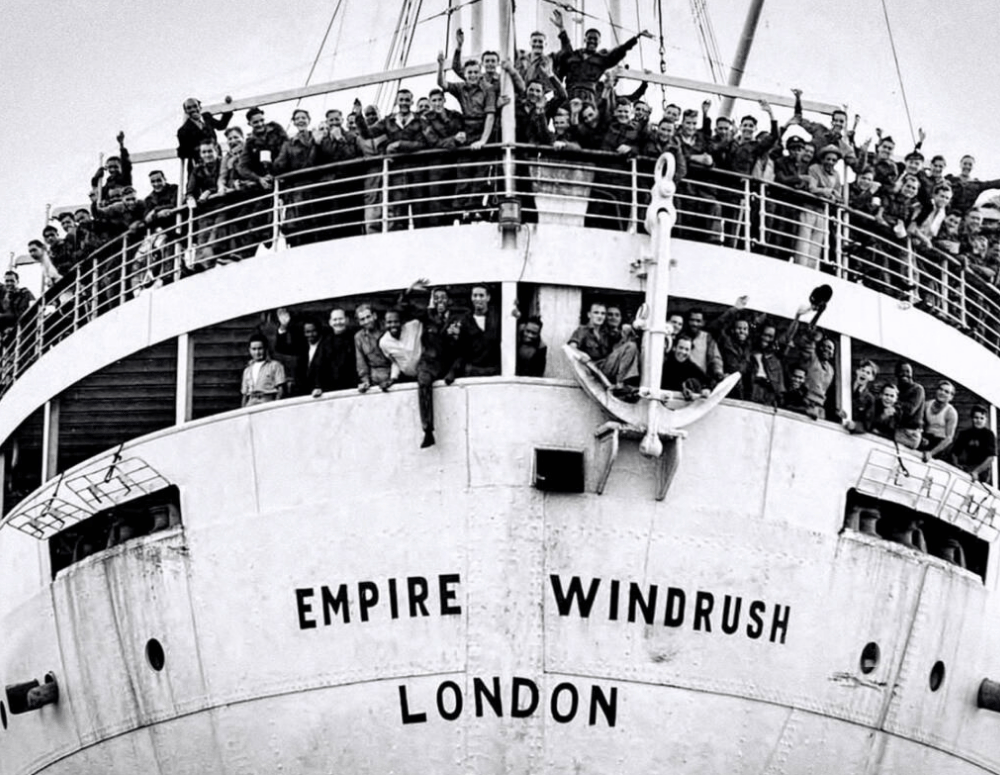
The manifestation of this demographic shift commenced just weeks before the bill became law, when the HMT Empire Windrush arrived at Tilbury Docks on 22 June 1948. Carrying 492 Caribbean passengers to fill vacancies in London Transport and the newly formed National Health Service, the vessel highlighted a growing trend of economic arrivals that caught the government entirely unprepared. The rapid influx drew immediate, intense pushback both inside Westminster and among the wider public. In June 1948, a group of eleven Labour Members of Parliament sent a formal letter of complaint to Prime Minister Attlee, warning of excessive, unvetted inflows and demanding immediate administrative restrictions.
By June 1950, the escalating scale of arrivals forced the creation of a specialized Cabinet committee tasked with finding legislative means to check the immigration of colonial subjects into the home islands. However, official irresolution and bureaucratic delays prevented early intervention, allowing annual entry figures to surge from 3,000 in 1953 to over 136,000 by 1961. A substantial and growing segment of the native British population viewed the sudden, top-down re-engineering of their communities with profound disapproval and anxiety, regarding the 1948 Act as a destabilizing measure enacted without public consent.
The unvetted transformation of historical urban centers fueled deep-seated public resentment over the scale of the demographic turnover, cementing the 1948 statute as one of the most controversial pieces of legislation in the modern history of the realm. The act remained the open legal baseline for immigration until the state finally imposed strict entry parameters via the Commonwealth Immigrants Act 1962.
The Empire Windrush
June 1948
The arrival of the troopship HMT Empire Windrush at Tilbury Docks on 22 June 1948 initiated the post-war migration era under conditions of immediate ministerial alarm and systemic state opposition. The vessel—a former German cruise liner named the Monte Rosa that had been seized as a war prize—had departed from Kingston, Jamaica, carrying a contingent of 1,027 passengers, including 802 who listed their last place of residence as the Caribbean.
Rather than being invited by the British government to resolve structural economic crises, the passengers had simply answered a commercial advertisement offering cheap £28 passages to fill an empty hold on the ship’s return journey. Behind closed doors, the arrival provoked immediate panic within the Whitehall establishment. Colonial Secretary Arthur Creech Jones dispatched a confidential memo to the Cabinet warning that the government was opposed to the influx and would take all possible steps to discourage it, while senior officials went so far as to draw up plans to divert the vessel mid-Atlantic to East Africa to use the passengers as agricultural laborers.
When these diversion tactics failed and the ship docked, the hostility of the political class broke into the open. On the exact day the Windrush arrived, eleven Labour Members of Parliament sent a formal letter to Prime Minister Clement Attlee, explicitly warning that an influx of coloured people would impair the harmony, strength, and cohesion of public life and cause discord across the nation.
In Parliament, Minister of Labour George Isaacs issued a stern public statement declaring his profound regret over the arrival and stating his hope that no encouragement would be given to others to follow their example. Seeking to pacify parliamentary rebellion, Attlee wrote a private reassurance to the dissenting members, stating that the migration was merely a one-off anomaly and that it would be a great mistake to take the emigration of this Jamaican party too seriously.
The state's refusal to plan for or accommodate the arrivals created an immediate housing crisis in London. Lacking any official lodging provisions, over 200 of the migrants were forced to shelter inside the deep-level air-raid shelters at Clapham South before securing private tenancies. When entering the domestic workforce, the passengers faced widespread "colour bars" that excluded them from skilled employment, commercial pubs, and private clubs.
Finding housing proved equally difficult, as landlords across urban centers like Brixton and Notting Hill routinely displayed signs reading "No Blacks, No Irish, No Dogs." To ensure such an influx never repeated, the Home and Colonial Offices quickly coordinated an aggressive deterrence campaign in the West Indies; ticket prices were artificially raised, passport approvals were severely tightened, and colonial officials were deployed to run public information campaigns warning potential travelers that there were absolutely no jobs or housing available for them in Great Britain.
The Creation of NATO
1949 AD
Additional Information: Britain in the Second World War / The Atlantic Charter and Re-alignment of Global Power
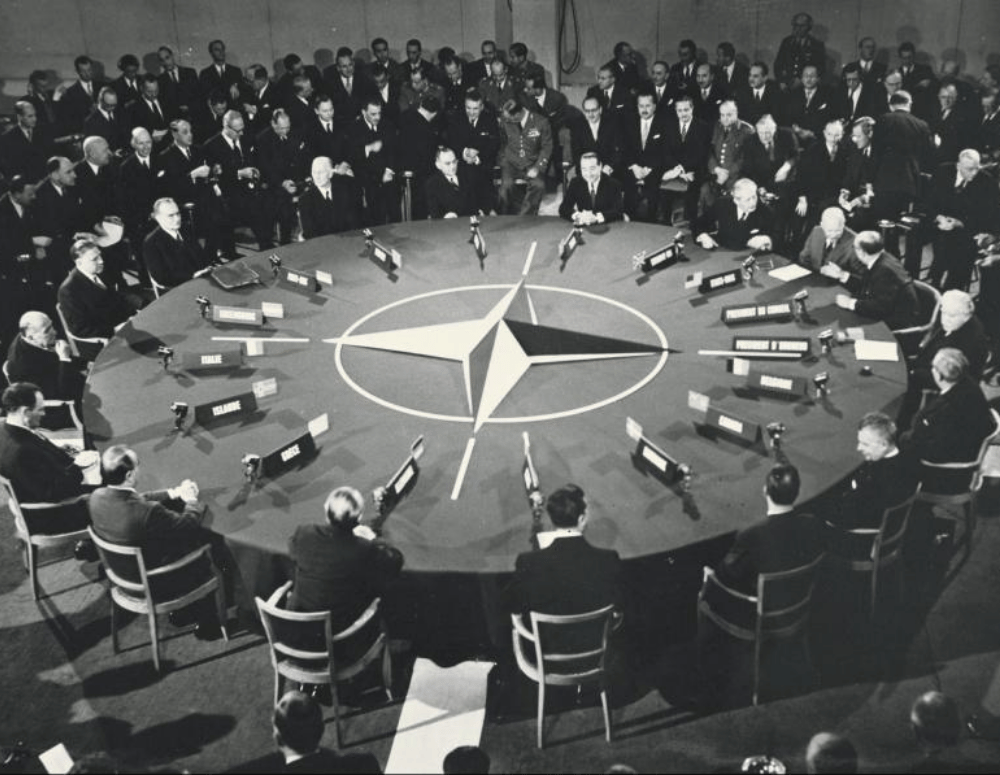
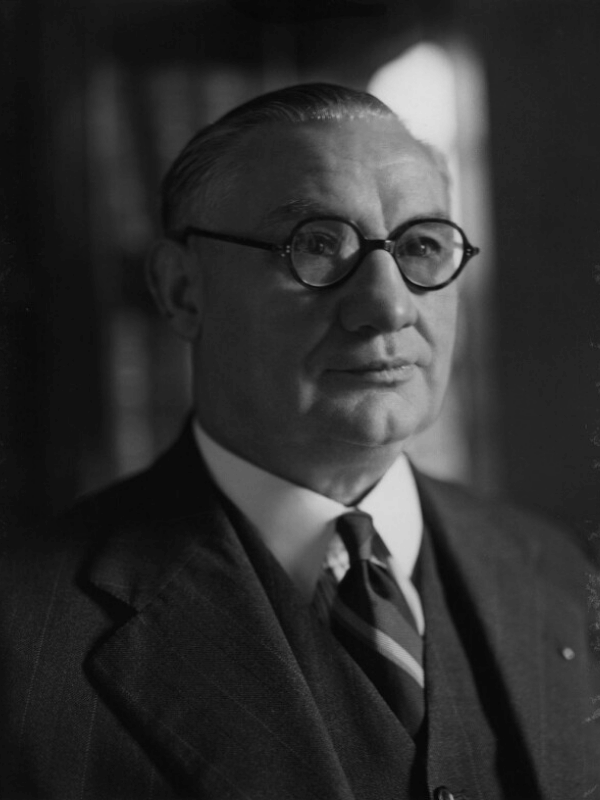
In March 1948, British Foreign Secretary Ernest Bevin coordinated with European diplomats to sign the Treaty of Brussels, establishing a collective defensive pact between Great Britain, France, Belgium, the Netherlands, and Luxembourg. The rapid consolidation of Soviet influence across Eastern Europe—climaxing in the communist coup in Czechoslovakia—and the subsequent eleven-month Berlin Blockade forced the Western democracies to confront an immediate security crisis.
Realising that the United Nations Security Council was permanently paralyzed by Soviet vetoes, Bevin used the Brussels pact to prove to Washington that the Western European nations were willing to coordinate their military mobilization and pool their resources. This diplomatic groundwork led directly to an international summit in Washington D.C., aimed at constructing a broader transatlantic security system that could deter a conventional Soviet invasion of the continent.
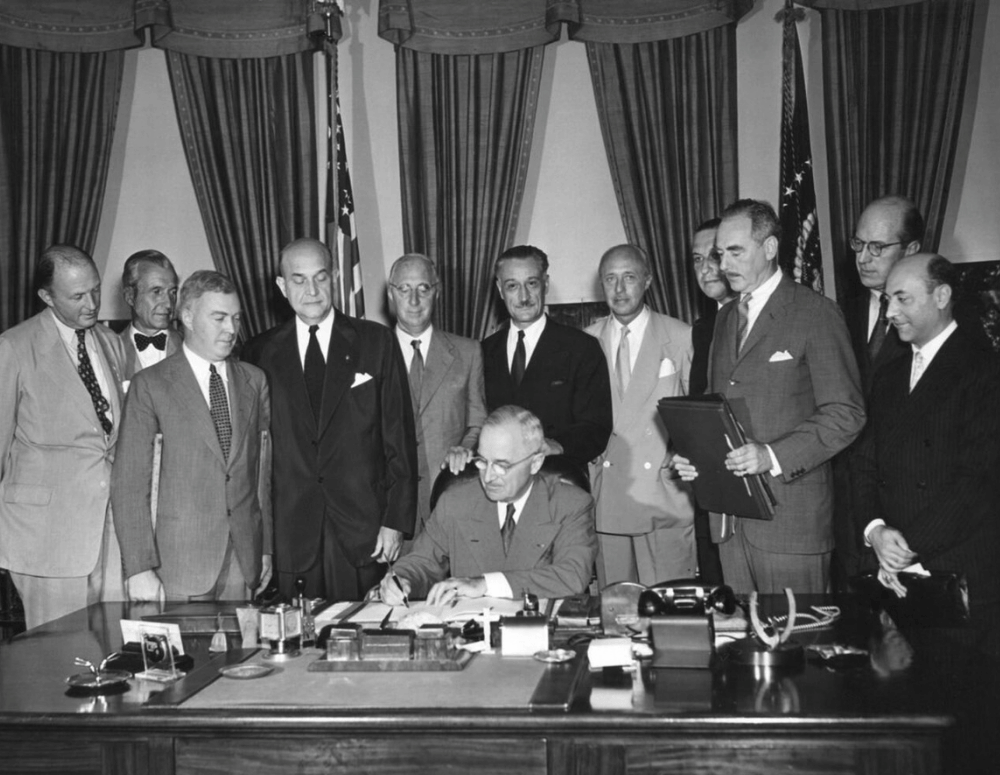
The signing of the North Atlantic Treaty on 4 April 1949 established a historic peacetime military alliance between twelve Western nations, committing the military power of the United States to the defense of Western Europe under the mutual defense clause of Article 5. The operational core of this alliance declared that an armed attack against any single member state would be treated as an attack against them all, requiring each signatory to take immediate action, including the use of armed force, to restore international security. This mutual-defense mechanism fundamentally altered the strategic layout of the Cold War, forcing the United States to abandon its isolationist traditions and permanently station its conventional field armies, tactical air wings, and nuclear deterrent directly on European soil.
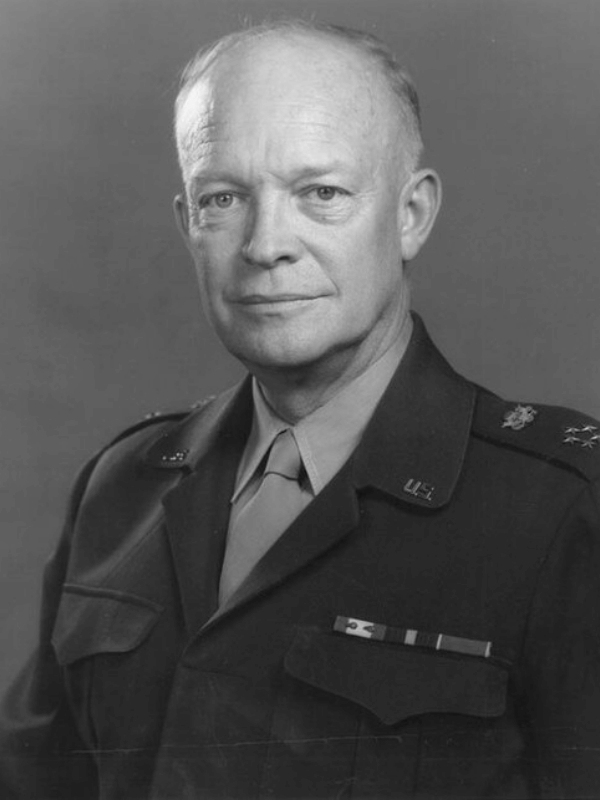
To convert this political treaty into a functioning combat force, the alliance established a centralized military command structure in April 1951 known as the Supreme Headquarters Allied Powers Europe, established just outside Paris and placed under the command of General Dwight D. Eisenhower. This integrated framework standardized tactical doctrines, integrated logistics networks, and organized dozens of international divisions into a unified front along the Iron Curtain. The creation of this security architecture established a firm geopolitical equilibrium that successfully anchored the borders of the democratic West for the remainder of the century.
Further Information: The Creation of NATO
Abadan Crisis and Nationalisation of Anglo-Iranian Oil
May – October 1951
Additional Information: Decline and Decolonisation of the British Empire / The Abadan Crisis
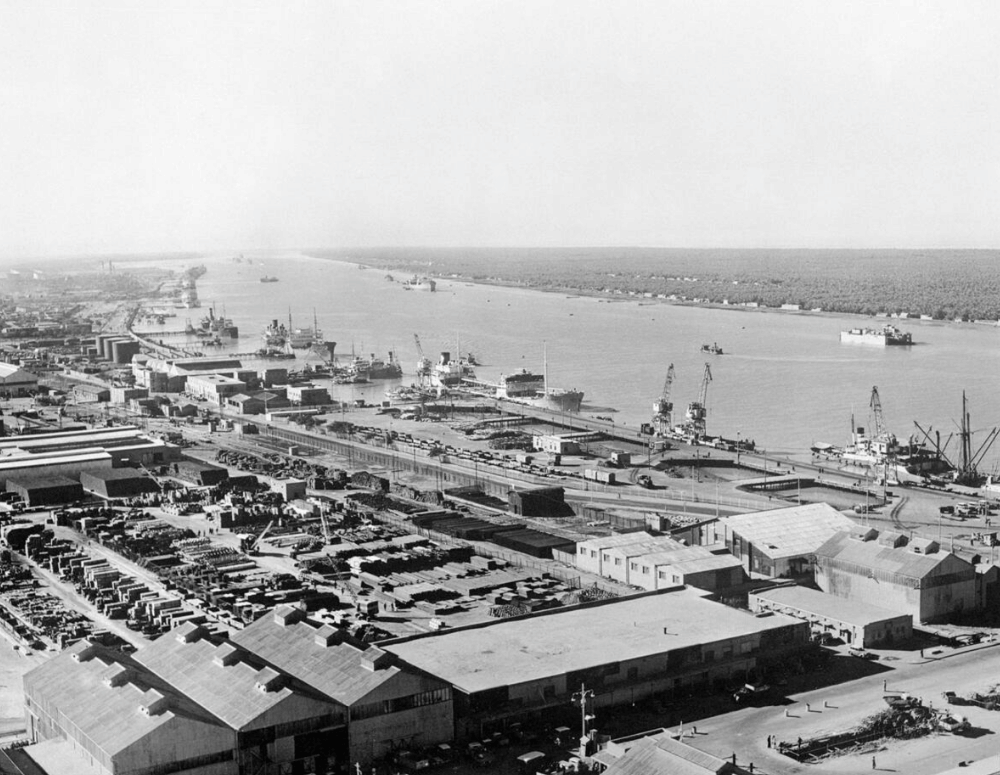
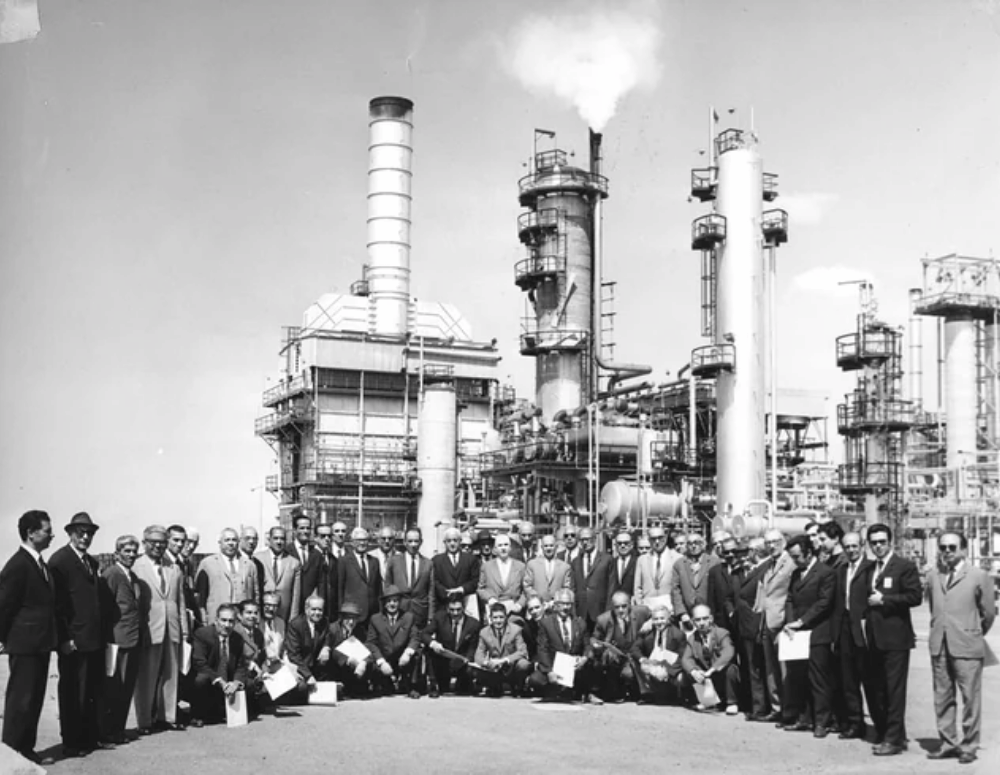
In March 1951, the Iranian Parliament voted unanimously to nationalise the assets of the Anglo-Iranian Oil Company (AIOC), a commercial monopoly in which the British state held a 51% majority shareholding. Headquartered at the Abadan refinery on the Persian Gulf—the largest oil refinery complex in the world—the firm supplied the Royal Navy with fuel oil and generated tax revenues for the Treasury, making its legal expropriation a threat to the strategic resources of the United Kingdom. Dr Mohammad Mossadegh assumed office as Prime Minister in April 1951 to enforce the expropriation law, prompting immediate retaliation from London.
The nationalisation of the Anglo-Iranian Oil Company on 1 May 1951 initiated the Abadan Crisis, a confrontation that concluded on 19 August 1953 when a joint MI6-CIA covert operation overthrew Prime Minister Mohammad Mossadegh to restore Western oil access. The Attlee government responded by launching an economic warfare campaign to force an Iranian capitulation.
Bypassing direct military invasion plans due to diplomatic pressure from the United States—which feared a British attack would prompt a Soviet intervention under the 1921 Soviet-Persian Treaty—the state enforced a maritime blockade of the Persian Gulf. British naval cruisers intercepted international oil tankers, executing a global embargo on Iranian petroleum exports that bankrupted Tehran's treasury. Simultaneously, the Foreign Office withdrew British technical engineers from the Abadan refinery, bringing Iranian oil production to a standstill.
Despite these embargoes, Mossadegh refused to surrender the nationalised assets, prompting the re-elected Churchill administration to execute a covert plan in late 1952 and 1953. Working with intelligence assets, MI6 operatives under Monty Woodhouse collaborated with the American CIA under Kermit Roosevelt to launch Operation Boot. By bribing military officers, orchestrating street riots, and distributing black propaganda, this joint intelligence offensive executed a coup d'état on 19 August 1953, overthrowing the democratically elected Mossadegh and restoring the Shah of Iran, Mohammad Reza Pahlavi, to power.
While this operation restored Western access to Iranian oil fields, the Abadan Crisis demonstrated the decline of British unilateral leverage, proving that the post-war state could no longer protect its global monopolies without the cooperation and logistical support of the United States. Following the crisis, the AIOC was renamed the British Petroleum Company in 1954, but its exclusive monopoly was replaced by a consortium of international oil companies.
The Festival of Britain
May – September 1951
In 1947, the Labour government approved a plan to commemorate the centenary of the 1851 Great Exhibition while celebrating the nation's survival and reconstruction following the Second World War. Masterminded by the Lord President of the Council, Herbert Morrison, the project was organized to serve as a display of national recovery and design innovation. The organizers selected a bombed twenty-seven-acre industrial wharf on the South Bank of the River Thames in London, clearing old tenements and shot towers to construct a landscape of modernist architecture.
The launch of the Festival of Britain on 3 May 1951 established a national cultural and design exhibition that drew 8.5 million visitors to London's South Bank, showcasing British recovery from post-war austerity and the destruction of the Blitz. The centrepiece of the exhibition was the South Bank site, which featured the Dome of Discovery—the largest dome in the world at that time—and the Skylon, a futuristic steel spire that appeared to float unsupported in the air. The pavilions housed exhibits celebrating British scientific achievements, television engineering, and industrial designs, presenting a sleek, forward-looking aesthetic.
The Festival of Britain achieved commercial and psychological success, drawing over 8.5 million visitors to the South Bank while triggering more than 2,000 localized events across the country's counties. It provided the public with a manifestation of material progress, standardizing the clean lines of mid-century modern design across the country's homes and town halls. The festival also featured the Royal Festival Hall, the only permanent building retained on the South Bank site after the event concluded.
While the incoming Conservative administration under Winston Churchill ordered the swift demolition of the Dome of Discovery and the Skylon in October 1951 to clear the site of what they viewed as socialist planning monuments, the festival had already re-engineered the architectural landscape. It established the baseline for the Festival Style that influenced post-war school construction, town centre rebuilding, and public interior design across the United Kingdom for a generation.
The Cold War , Berlin Airlift, and Nuclear Deterrents
June 1948 – October 1952
In August 1946, the United States Congress passed the McMahon Act, abruptly terminating all transatlantic atomic cooperation and cutting off Great Britain from the shared laboratory research she had helped pioneer during the wartime Manhattan Project. Recognizing that Britain could not maintain her status as a global power without sovereign atomic capabilities, Prime Minister Clement Attlee secretly convened a select cabinet committee in January 1947 to authorize an independent British nuclear weapons program under the deceptive codename "Gen 75."
Led by physicist Sir William Penney, British scientists and engineers established a research hub at Fort Halstead and began construction on the massive Windscale plutonium production reactors in Cumberland. Working from wartime schematics, they re-engineered an implosion-design plutonium weapon, modifying it with a levitated core to maximize explosive yield. Concurrently, to meet expanding global commitments against the Soviet bloc, Parliament passed the National Service Act 1948, introducing permanent peacetime conscription that mandated all able-bodied young men aged 17 to 21 to execute 18 months of compulsory military service.
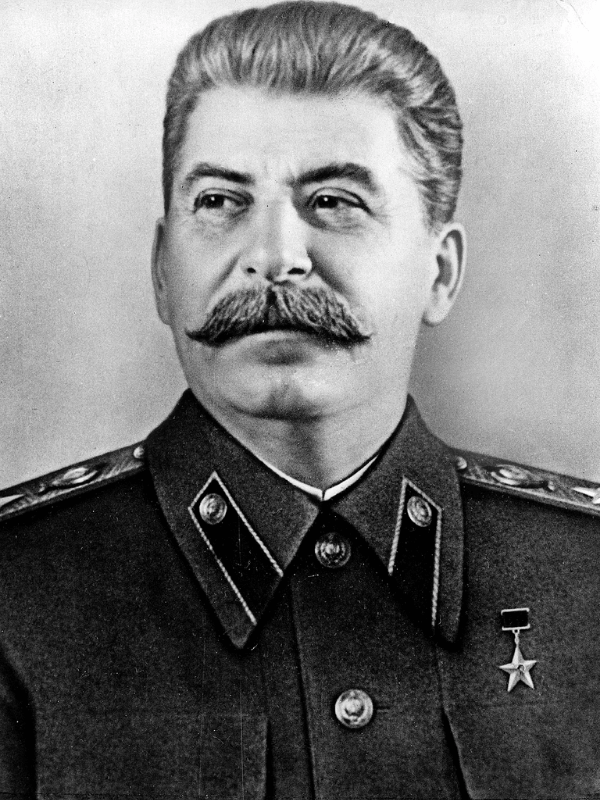
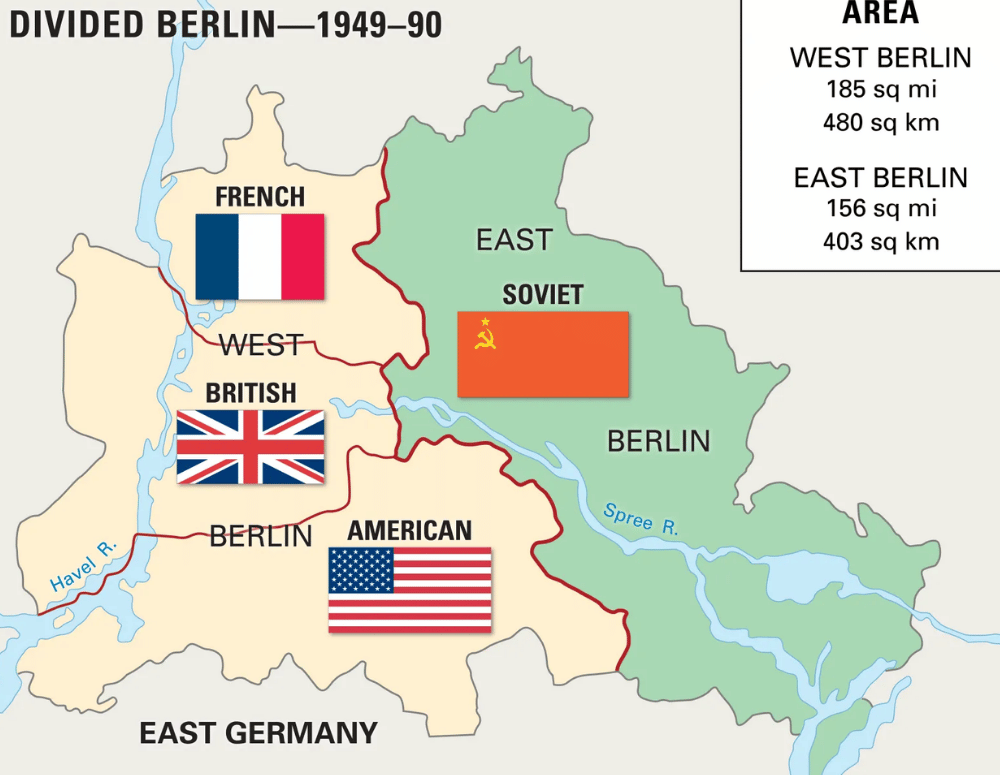
This escalating global standoff faced its first severe, existential tactical test on 24 June 1948 when Soviet forces under the direct orders of Joseph Stalin suddenly severed all rail, road, and water access to the Allied sectors of West Berlin. Triggered by the Western introduction of the stable new Deutsche Mark currency to revive the broken German economy, the blockade aimed to starve the 2.2 million citizens of the western sectors into political submission and force the evacuation of the Allied garrisons. Cut off inside the Soviet occupation zone, West Berlin possessed just 36 days of food and 45 days of coal reserves.
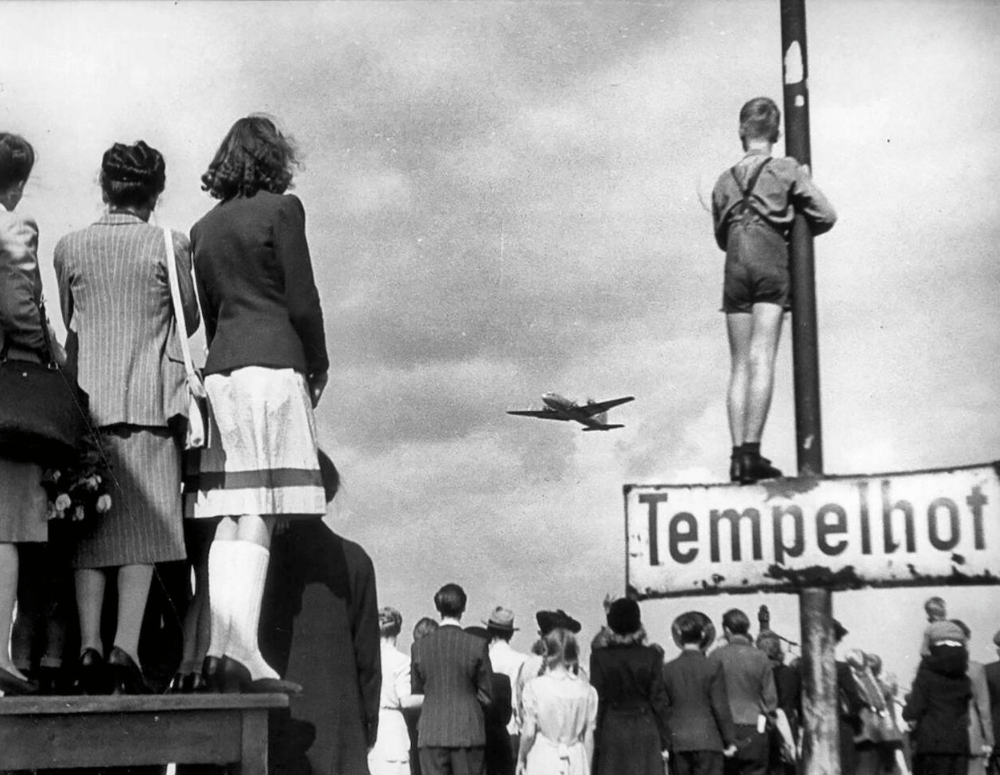
Rather than executing a humiliating military retreat or risking a conventional ground war by attempting to force armored divisions through the overland corridors, the Western powers resolved to supply the besieged city entirely by air. The Royal Air Force swiftly partnered with the United States Air Force to launch the historic Berlin Airlift. While the American contribution was code-named Operation Vittles, the massive British aerial resupply network was designated Operation Plainfare. Operating through three strictly defined, narrow international air corridors crossing Soviet-controlled airspace, the Allies initiated an unprecedented masterclass in aviation logistics that would sustain an entire metropolis from the skies for nearly a year.
Over the subsequent eleven months, British transport fleets—including a massive coalition of private commercial crews operating converted wartime bombers like the Handley Page Halton, Avro Tudor, and Short Hythe flying boats—maintained a continuous, unbroken chain of supply flights. Flying day and night through the dangerously narrow, heavily congested international air corridors, these crews converged on the bustling airfield at RAF Gatow in the British sector.
Operating under the ceaseless pressure of a clockwork flight schedule where a new aircraft touched down every few minutes, the British contribution achieved phenomenal totals. Moving far beyond basic rations, British crews delivered 542,236 tonnes of vital cargo, which included 241,000 tonnes of food—heavily relying on compact, lightweight dehydrated potatoes and powdered milk—alongside 165,000 tonnes of industrial coal to keep the city's power stations running. Strikingly, British civilian contractors also flew in 92,000 tonnes of wet fuel, single-handedly providing 100% of the liquid gasoline and oil that kept West Berlin from freezing or grinding to a halt. This overwhelming aerial triumph completely broke the Soviet siege, forcing Stalin to officially reopen the borders on 12 May 1949 without the Allies ever firing a single shot.
Foreign Secretary Ernest Bevin brilliantly capitalised on this monumental aerial victory, utilizing the momentum of the broken blockade to bind Western Europe and North America into a permanent defensive shield. On 4 April 1949, Bevin signed the North Atlantic Treaty as a founding signatory, establishing the North Atlantic Treaty Organisation (NATO). Rather than acting as a passive partner, Bevin drove the Western powers to accept a system of shared military defense where an attack on one nation was legally treated as an attack on all.
This international pact instantly transformed the British home islands and the newly deployed British Army of the Rhine—stationed permanently inside occupied West Germany—into a heavily fortified frontline bulwark designed to blunt any potential Soviet armored assault across the European frontier. By positioning 55,000 professional British troops directly in the path of the Soviet sphere of influence, the state guaranteed that Great Britain would be automatically entangled in any continental conflict, deterring Soviet aggression through the threat of immediate, full-scale British retaliation.
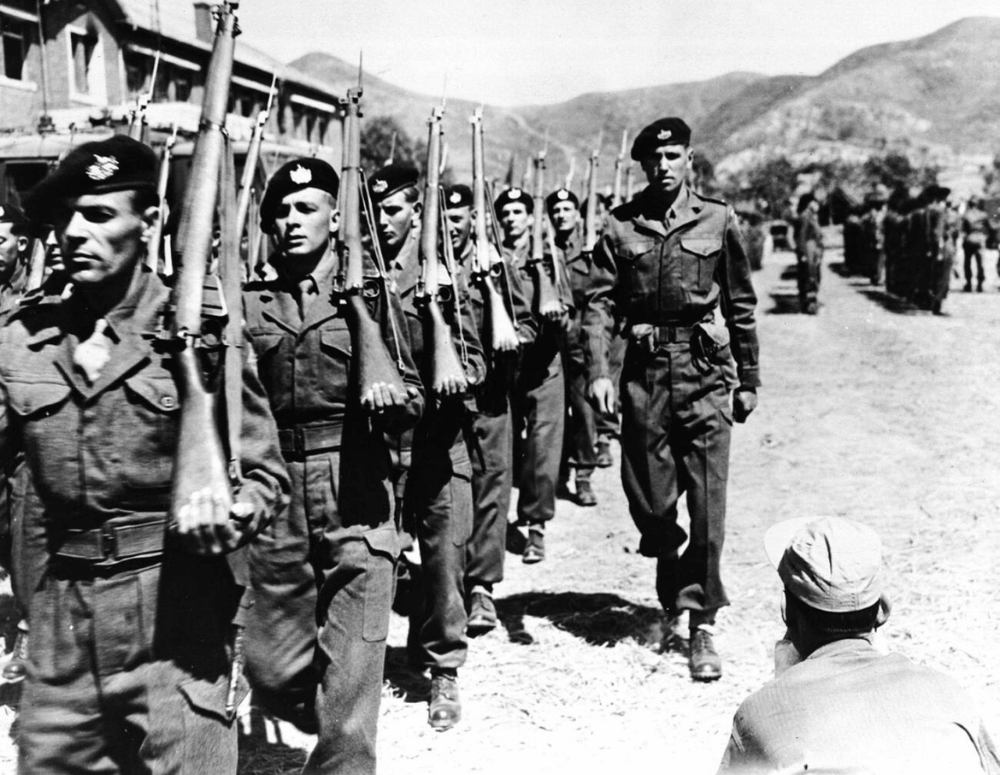
In June 1950, the outbreak of the Korean War forced the British government to dramatically expand its compulsory national service obligation from eighteen months to a full two years to counter the immediate threat of global communist expansion. Spurred by the North Korean invasion across the 38th parallel, Prime Minister Clement Attlee committed over 81,000 British personnel to the United Nations coalition, establishing the second-largest Western contingent in the theater. To defend the shifting lines, the 27th British Commonwealth Brigade and the 29th Independent Infantry Brigade Group were deployed directly into the mountainous Korean peninsula.
These forces engaged in desperate defensive actions against an avalanche of Chinese communist troops who entered the war in late 1950. This crisis culminated in the bloody Battle of the Imjin River between 22 and 25 April 1451. Tasked with blocking the main traditional invasion route to the capital city of Seoul, the outnumbered 1st Battalion, Gloucestershire Regiment—comprising roughly 700 men under the command of Lieutenant-Colonel James Power Carne—was completely surrounded on Hill 327 by a massive force of 30,000 attacking troops from the Chinese 63rd Army.
Describing the desperate situation to his superiors as merely "a bit sticky," Lieutenant-Colonel Carne and his men held their positions for three days under constant bombardment, exhausting their ammunition and fighting in hand-to-hand combat to stall the communist advance. When the defensive perimeter finally collapsed, 10,000 Chinese soldiers had fallen, and though 59 British soldiers were killed and over 500 captured into brutal prisoner-of-war camps, the stand of the "Glorious Glosters" successfully saved Seoul from capture.
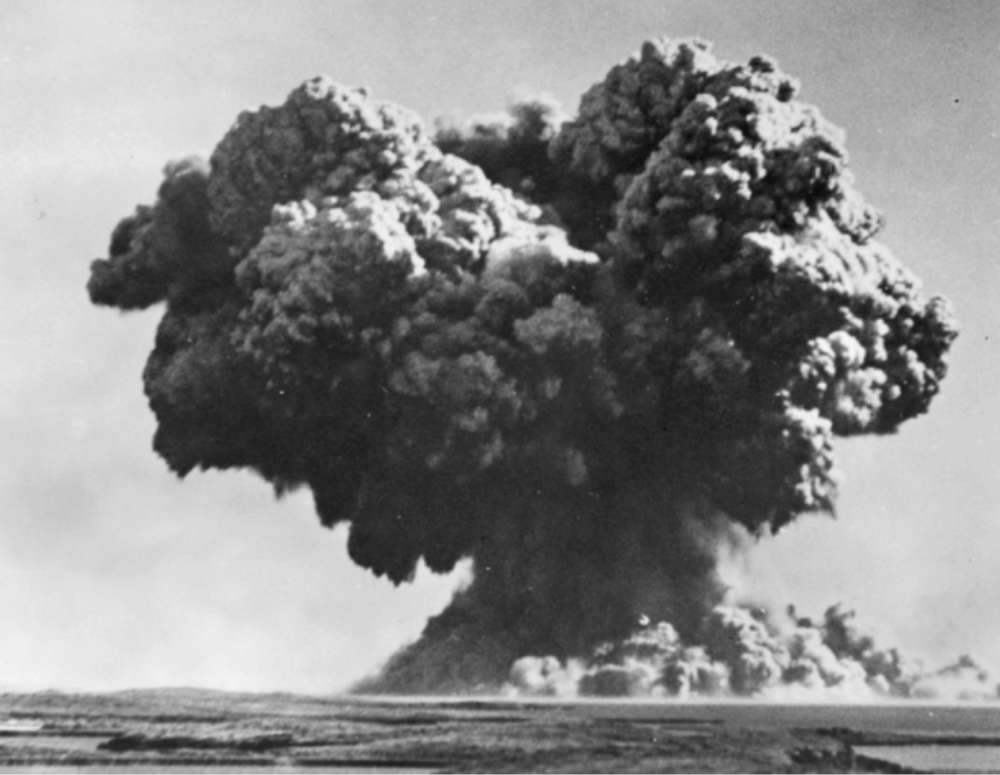
To address the severe conventional military imbalance on the continent, the state accelerated its independent nuclear program. On 3 October 1952, Britain executed her first atomic bomb test under Operation Hurricane, detonating a 25-kiloton nuclear device inside the hull of the River-class frigate HMS Plym off the Montebello Islands of Western Australia. The deliberate placement of the bomb inside the ship allowed scientists to analyze the devastating fallout and hydrodynamic effects of a clandestine, ship-borne nuclear blast inside a major British port.
This atomic breakthrough led directly to the development of the "V-bomber" force, a specialized fleet of high-altitude strategic aircraft designed to deliver the airborne nuclear deterrent deep into Soviet territory. The four-engine Vickers Valiant entered active service in February 1955, followed by the delta-wing Avro Vulcan in 1956 and the crescent-wing Handley Page Victor in 1958.
Operating from reinforced concrete runways across eastern counties—principally RAF Scampton, RAF Waddington, and RAF Marham—these strategic bombers stood on permanent quick-reaction alert, their crews trained to scramble within four minutes of an early warning radar alert. This offensive capabilities matrix was reinforced by the Blue Streak medium-range ballistic missile program initiated in 1954 and the Operation Mosaic thermonuclear tests in May 1956.
By successfully detonating its first hydrogen bomb variants in the Pacific during Operation Grapple in May 1957, Great Britain permanently secured its position as the world's third independent thermonuclear superpower, establishing a credible doctrine of massive retaliation that defined British defense policy for the remainder of the Cold War.
The sudden acquisition of thermonuclear power coincided with a drastic reordering of British military doctrine. In April 1957, Minister of Defence Duncan Sandys published a revolutionary Defence White Paper that fundamentally restructured the armed forces for the atomic age. Concluding that there was no viable conventional defense against a multi-megaton hydrogen bomb attack, Sandys ordered a massive shift away from expensive conventional troop numbers in favor of total reliance on the nuclear deterrent.
The policy resulted in the termination of peacetime National Service by 1960 and stripped the armed forces from 700,000 men down to an all-regular cadre of 375,000 personnel. Believing that manned fighter aircraft would soon be rendered entirely obsolete by supersonic technology, Sandys cancelled numerous advanced British aerospace projects—including supersonic interceptors and bombers. Instead, the state committed its financial resources to automated air defense networks like the Bristol Bloodhound surface-to-air missile system and the development of the Blue Streak medium-range ballistic missile to succeed the V-bomber fleet.
Further Information: The Cold War , Berlin Airlift, and Nuclear Deterrents
The Clean Air Act 1956
June 1956
In December 1952, a severe anticyclone paired with a temperature inversion trapped a stagnant layer of cold, coal-smoke-laden air over the capital for five consecutive days. For over a century, the urban landscapes of industrial shires had been defined by a soot-choked atmosphere driven by the burning of soft bituminous coal across factory furnaces, railway locomotives, and domestic fireplaces.
This Great Smog of London paralyzed the transport infrastructure and caused an estimated 12,000 premature deaths from acute respiratory failure, forcing a parliamentary committee to investigate urban public health standards.
The passage of the Clean Air Act on 5 July 1956 introduced the first national legislation to control urban air pollution, empowering local councils to establish smoke control areas that ended the lethal "pea-souper" smogs. Moving away from localized public health guidelines, the statute granted local municipal councils the power to establish monitored "Smoke Control Areas" across towns and cities. Within these designated zones, emitting dark smoke from any chimney became a criminal offense, forcing industrialists and homeowners to convert their heating systems to authorized smokeless fuels, electricity, or gas.
To facilitate this infrastructure change, the national Treasury provided direct financial subsidies to cover up to 70% of the conversion costs incurred by households who replaced open coal grates with gas fires or electrical heaters. The passage of the act achieved a visible transformation of the country’s physical environment. By removing sulfur dioxide and particulate soot from the urban atmosphere, the law ended the lethal smogs, reduced urban respiratory diseases, and tripled winter sunshine hours across cities like London, Manchester, and Sheffield.
Furthermore, this legislative shift had an impact on the socio-economic geography of the country. It accelerated the decline of the domestic coal-mining industry, changed the architecture of suburban housing estates by eliminating the requirement for brick chimneys, and allowed municipal authorities to sandblast decades of black industrial soot off historic civic monuments to expose their original stone surfaces.
The Suez Crisis and Collapse of Prestige
July – November 1956
Additional Information: Decline and Decolonisation / The Suez Crisis and the Collapse of Power
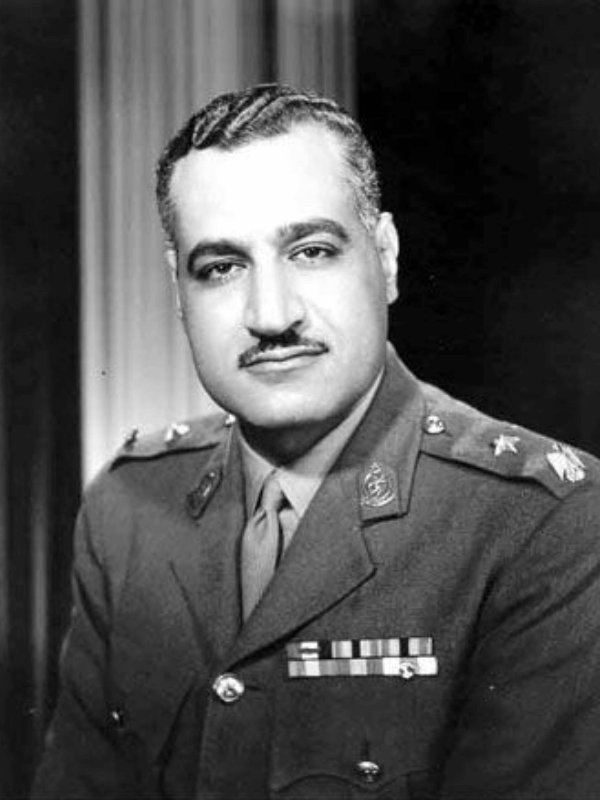
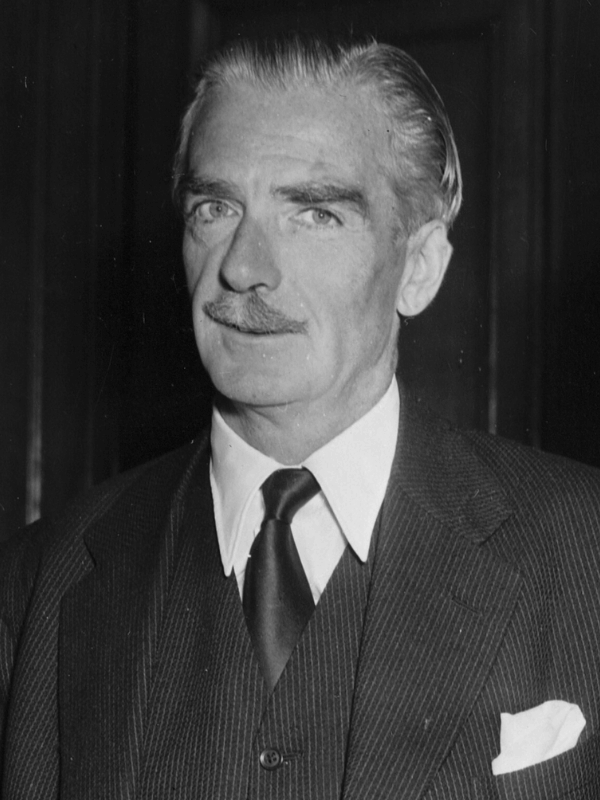
In July 1956, Egyptian President Gamal Abdel Nasser nationalised the Suez Canal Company, a corporate asset owned primarily by British and French shareholders that controlled the vital maritime artery linking Europe to Asia. Prime Minister Anthony Eden, whose health was failing and whose political outlook was defined by the appeasement crises of the 1930s, viewed the move as an existential threat to the oil supply lines of the United Kingdom, which depended on the canal to transport two-thirds of its petroleum from the Persian Gulf.
Rejecting diplomatic arbitration and bypassing both his own Cabinet and the United States government, Eden entered into a secret military agreement with France and Israel at a villa in Sèvres, France. This pact, formalised on 24 October 1956 as the Protocol of Sèvres, outlined a coordinated operation designed to depose Nasser and restore European ownership of the canal.
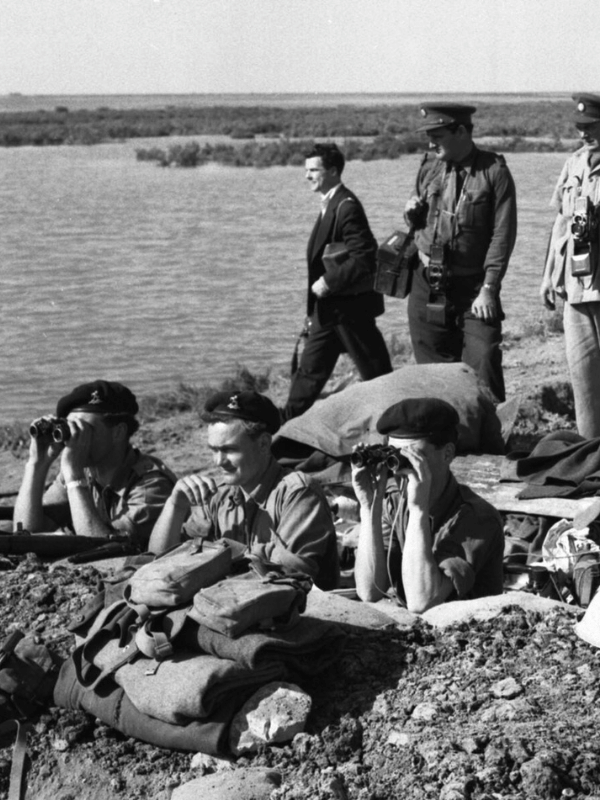
Under the terms of this secret protocol, Israel launched a sudden invasion of the Egyptian Sinai on 29 October 1956, providing the pre-planned pretext for Great Britain and France to intervene as neutral peacemakers. The allies launched Operation Musketeer, unleashing a heavy aerial bombardment before landing paratroopers and marine commandos at Port Said to reoccupy the canal zone. While the Anglo-French forces secured their immediate targets, the political framework collapsed within forty-eight hours. Nasser responded by scuttling forty ships to completely block the canal, while the Soviet Union threatened rocket attacks against London and Paris, creating a global geopolitical panic.
The primary cause of the collapse was a financial counter-offensive launched by the United States. Furious that Eden had concealed the invasion and disrupted the Atlantic alliance, US President Dwight D. Eisenhower used America's immense financial leverage to crush the British currency. The United States blocked the United Kingdom from accessing International Monetary Fund emergency credits, while the US Treasury prepared to dump its massive holdings of sterling bonds to collapse the value of the British pound.
Facing a rapid run on its gold and dollar reserves, which dropped by $279 million in November alone, the British Cabinet ignored Eden's protests and voted to capitulate. Chancellor of the Exchequer Harold Macmillan informed the Cabinet that the country faced imminent bankruptcy within weeks if they did not stop, forcing Eden to issue a ceasefire order on 6 November 1956.
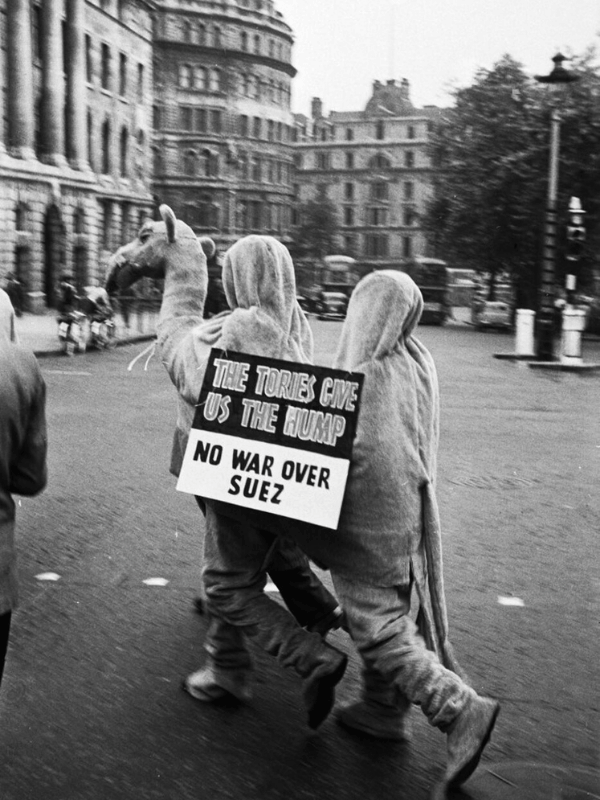
The Anglo-French forces executed a humiliating evacuation from Egypt, completed by 22 December 1956, leaving the canal under sovereign Egyptian control. The Suez Crisis shattered the political establishment, exposed the financial dependence of Great Britain on the United States, and forced the resignation of Anthony Eden in January 1957. By demonstrating that the United Kingdom could no longer maintain a global empire or deploy independent military power without American permission, the crisis marked the definitive end of Britain's status as a global superpower, accelerating the decolonisation of its remaining African and Asian territories.
The Birth of the Eurodollar Market
1957 - 1979
Additional Information: The Age of Migration / The Financial Empire
The rapid evacuation of British forces from Egypt and the resulting collapse of sterling authority forced an immediate re-engineering of the financial networks inside the City of London. To defend the remaining gold and dollar reserves of the state from the severe run triggered by the Suez defeat, the Treasury imposed draconian emergency capital controls in the spring of 1957. These statutory restrictions barred London merchant banks from using British currency to finance third-party international trade—the historic commercial system known as merchanting credits. This was a catastrophic blow that threatened to destroy London’s position as the clearing center of global commerce, as it prevented British brokers from arranging credit for international shipping lines operating between foreign nations.
Facing commercial irrelevance, an executive named Sir George Bolton at the Bank of London and South America, alongside key financiers at Midland Bank, executed an innovative technical workaround. They realized they could maintain their international brokerage business by completely bypassing the British pound, choosing instead to handle surplus deposits of American dollars that were accumulating outside the United States.
A major catalyst for this new pool of capital came from the early Cold War strategy of the Soviet Union. Fearful that the United States government would freeze their assets held in New York banks, Soviet state corporations transferred their massive dollar holdings to the Moscow Narodny Bank in London and the Banque Commerciale pour l'Europe du Nord in Paris. The cable address for the Paris bank was "Eurobank," causing typesetters and clerks to log these stateless funds on their ledger sheets as Eurodollars.
The Bank of England issued a landmark accounting ruling that completely transformed global finance: any transaction conducted in London between two non-British residents using a foreign currency was officially exempt from domestic banking regulations, lending caps, cash reserve requirements, and parliamentary oversight. This regulatory loophole allowed the Eurodollar market to expand with extraordinary speed, growing from 1.5 billion dollars in 1959 to over 85 billion dollars by 1971, completely outpacing the regulated domestic money supplies of western Europe.
As the formal British Empire collapsed across the globe throughout the 1960s, City law firms and colonial administrators actively repurposed the remaining island outposts—specifically the Cayman Islands, the British Virgin Islands, Jersey, and Guernsey—to shield this expanding pool of capital. Scribes drafted specialized secrecy codes that permitted the creation of anonymous trust funds and shell companies. In 1966, the Cayman Islands enacted the Banks and Trust Companies Regulation Law, which turned the Caribbean dependency into a specialized booking center where international banks could legally record their Eurodollar loans free from corporate income taxes.
Simultaneously, financiers like Siegmund Warburg pioneered the Eurobond in 1963, issuing a fifteen-million-dollar international loan for the Italian toll-road operator Autostrade entirely in stateless London dollars. By locking these complex mechanisms into the legal codes of the island dependencies, British financial architects ensured that while the physical territory of the empire dissolved, an invisible network of capital remained tied directly to the London clearing houses, setting the stage for the massive digital wealth expansions of the late twentieth century.
The Wind of Change and Retreat from Empire
February 1960
Additional Information: Decline and Decolonisation / The Wind of Change
In March 1957, Great Britain granted formal independence to Ghana under the leadership of Kwame Nkrumah, initiating a retreat from colonial holdings in sub-Saharan Africa. The loss of independent geopolitical prestige during the Suez Crisis accelerated this retreat from empire, as the government recognized that it no longer possessed the financial capital or the domestic military will to suppress rising anti-colonial nationalism. This realization shifted administrative policy away from colonial coercion toward a program of managed independence across the African continent.
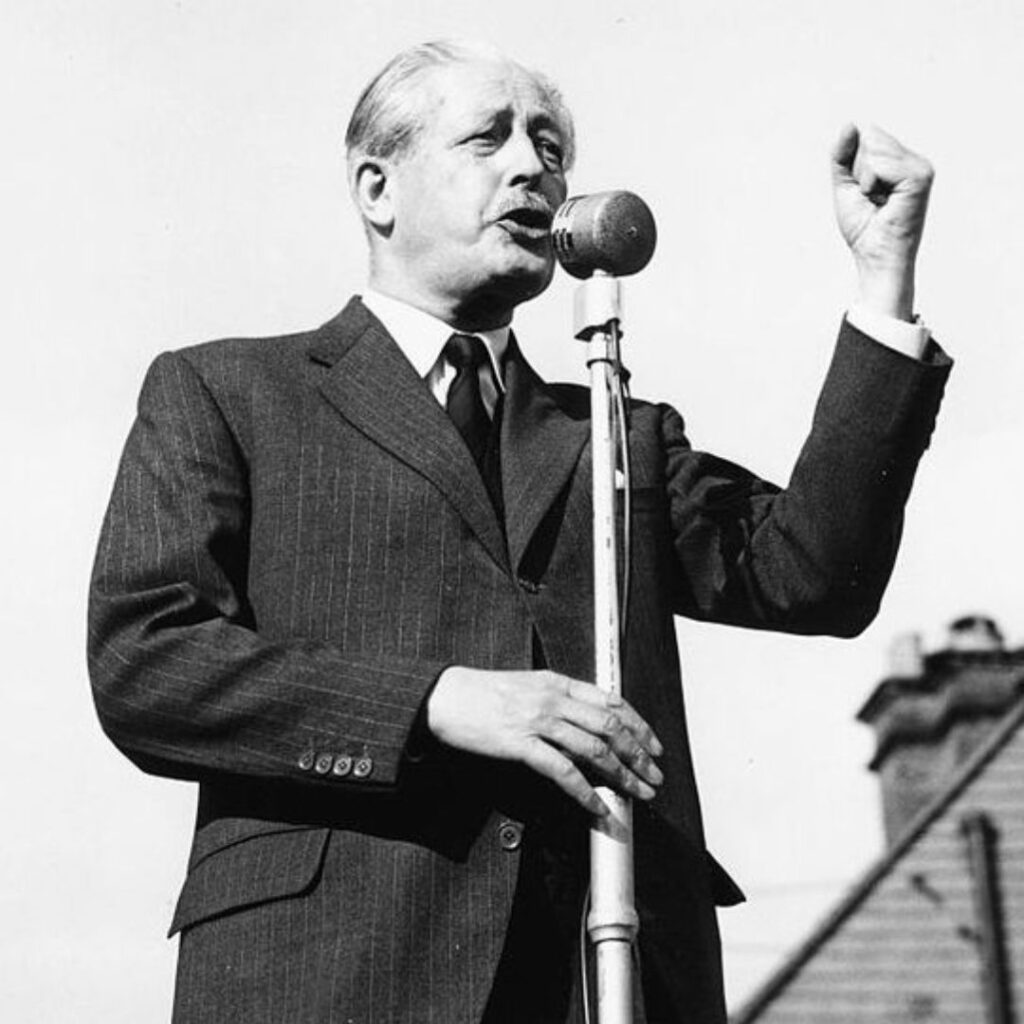
Prime Minister Harold Macmillan’s "Wind of Change" speech in February 1960 signaled the acceleration of British decolonisation, leading to the liquidation of colonial borders and formal independence for Ghana, Nigeria, Kenya, and Zambia. The baseline for this transformation was articulated on 3 February 1960 by Macmillan during a speech to the Parliament of South Africa in Cape Town.
Macmillan declared that a wind of change was blowing through the continent, forcing the British state to accept that national consciousness was a political fact that could not be blocked. Over the next decade, Macmillan’s Colonial Secretary, Iain Macleod, managed the rapid dismantling of the empire's borders.
The state lowered the Union Jack across dozens of territories, granting formal independence to Nigeria on 1 October 1960, Kenya on 12 December 1963, and Zambia on 24 October 1964. Civil servants and colonial lawyers drafted new written constitutions, handing over the levers of governance to national political leaders before boarding transport ships to return to Europe.
This retreat from East and West Africa was paired with the formal withdrawal from Aden in 1967 and the "East of Suez" military pullout announced in 1968, permanently bringing an end to the British Empire.
The Statute of Westminster Expansion
April 1949 – August 1965
In April 1949, Commonwealth prime ministers assembled at a historic summit in London to address a constitutional crisis that threatened to fracture the global network as the newly independent nation of India prepared to adopt a republican constitution. Prior to this summit, the rigid legal framework laid down by the Statute of Westminster 1931 dictated that all member states must be united by a common allegiance to the British Crown, a requirement that made it legally impossible for republics to maintain their membership.
To prevent a catastrophic breakdown of global British influence, Prime Minister Clement Attlee and Indian Prime Minister Jawaharlal Nehru negotiated a delicate compromise to re-engineer the legal relationship between the United Kingdom and its former colonial dependencies.
The signing of the London Declaration on 27 April 1949 fundamentally decoupled the Commonwealth from its white-dominion identity, dropping the mandatory oath of allegiance to the Crown and replacing it with a new formula that allowed sovereign republics to remain full members. Under this historic treaty, India—which officially became a republic on 26 January 1950—and later Pakistan in 1596 were permitted to retain their membership while recognizing the British monarch solely as the symbolic "Head of the Commonwealth." As independent Asian and African states threw off colonial rule during the 1950s and 1960s, this "New Commonwealth" underwent a massive expansion that transformed a territorial empire into a voluntary diplomatic alliance of equal, sovereign nations.
The expansion of this voluntary alliance served a vital purpose for the post-war British state, functioning as a highly effective vehicle for global soft power. It allowed London to preserve its global commercial monopolies, maintain the lucrative sterling-area financial arrangements, and project diplomatic influence across its former territories without the immense financial and military expense of maintaining permanent garrisons or colonial civil services.
To institutionalize this sprawling diplomatic grid, the member states established the Commonwealth Secretariat at Marlborough House in London in August 1965, creating an independent administrative organ led by its first Secretary-General, Arnold Smith of Canada, to manage joint political, economic, and cultural initiatives across the globe.
Further Information: The Statute of Westminster Expansion
The Notting Hill Riots
29 August – 5 September 1958
The social framework of post-war London was severely fractured by a wave of targeted racial violence that exposed deep hostilities over housing and post-colonial migration. At the turn of the decade, the working-class district of Notting Hill was a densely populated area defined by poverty, sub-standard housing, and exploitation by aggressive landlords.
Following the British Nationality Act 1948, thousands of Caribbean migrants settled in the area to help rebuild the city, placing them in direct competition with local residents for day-to-day resources. Encouraged by far-right political movements like the White Defence League under the slogan "Keep Britain White," gangs of aggressive white youths known as "Teddy Boys" began deliberately targeting the West Indian population.
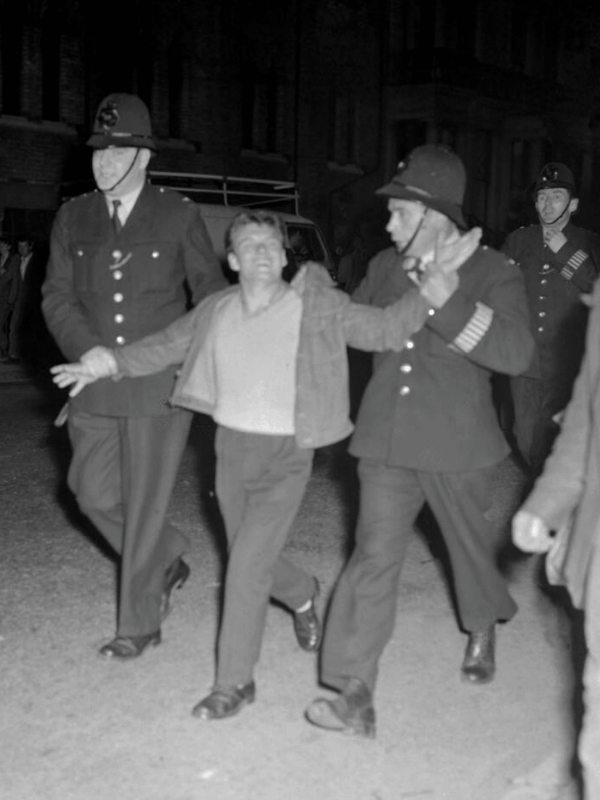
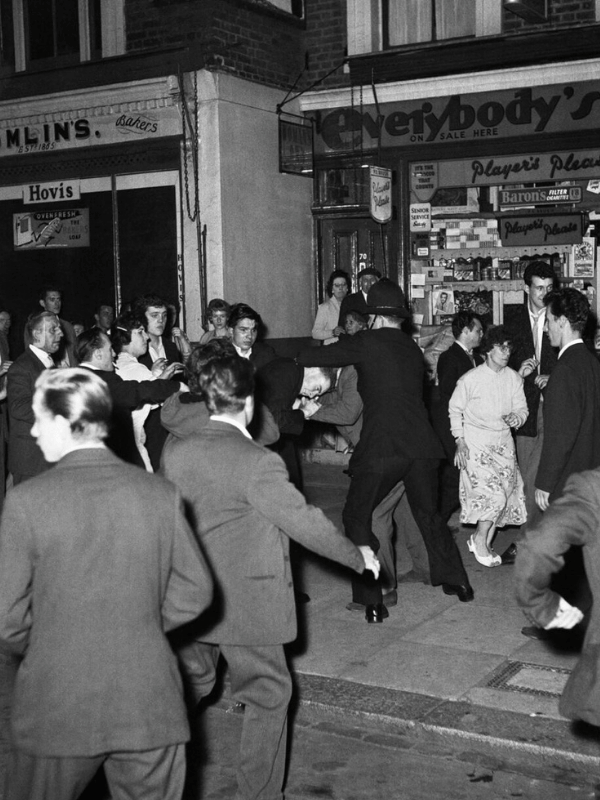
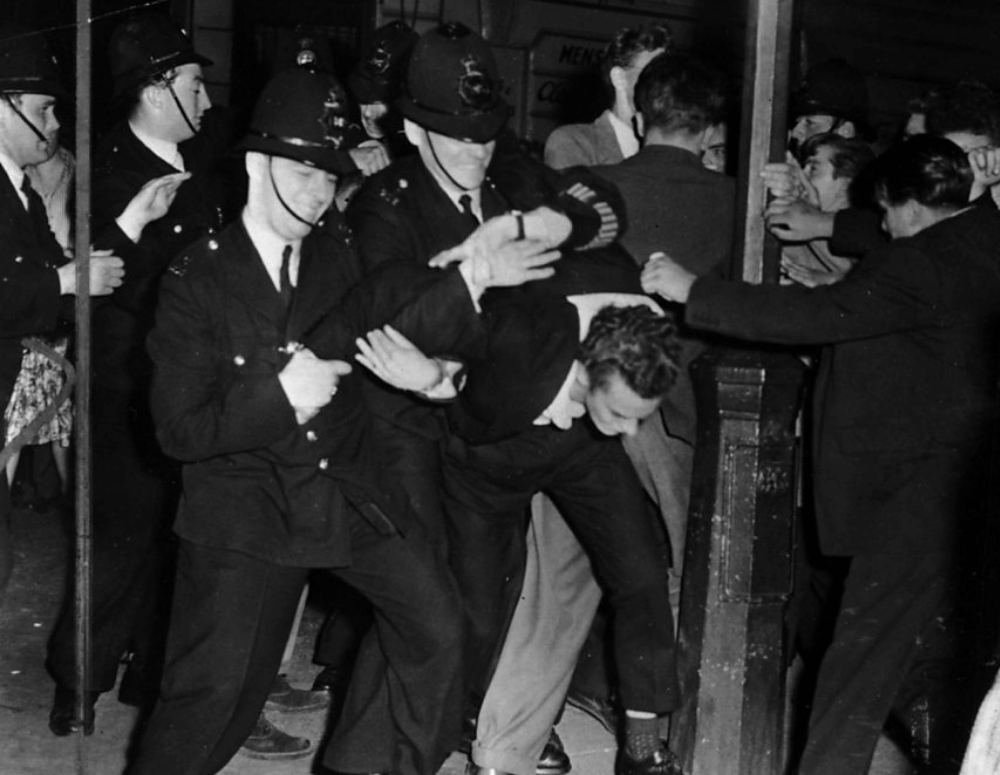
The localized tension exploded into major civil unrest on the evening of 29 August 1958 outside the Latimer Road underground station. An argument between a white Swedish woman, Majbritt Morrison, and her Jamaican husband, Raymond Morrison, escalated into a physical confrontation when a group of white youths intervened. The next evening, 30 August, a hostile mob of three hundred to four hundred white rioters descended on the streets of Notting Hill, armed with iron bars twisted from area railings, butcher's knives, and weighted leather belts. The rioters marched through the neighborhood, systematically hunting black residents, smashing windows, and throwing petrol bombs into the homes of West Indian families on Bramley Road.
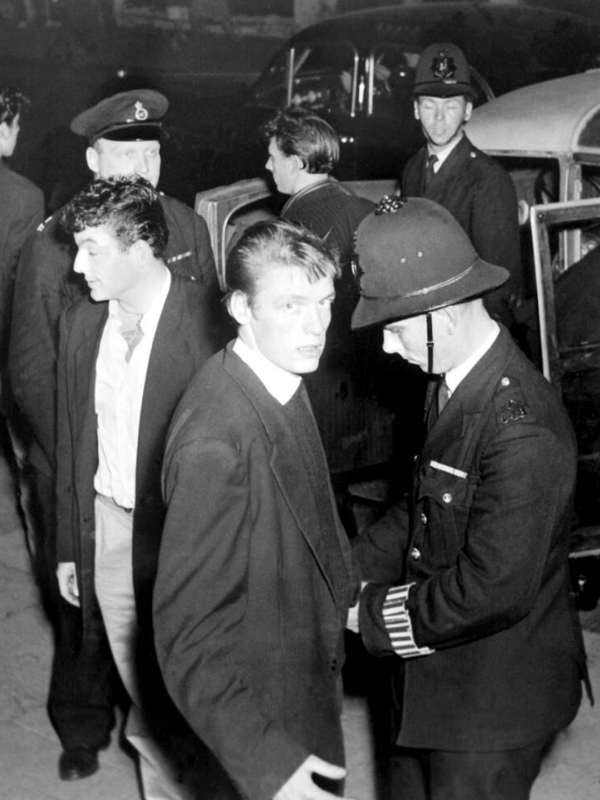
For five consecutive nights, the neighborhood became a violent conflict zone. Heavily outnumbered by their attackers, Caribbean residents under the organizing leadership of figures like wartime veteran Baron Baker organized defensive operations, using iron bars and boiling water to protect their families and repel the mobs from the streets. The Metropolitan Police faced deep public criticism for a slow response and an immediate attempt to downplay the explicitly racial nature of the violence as generic hooliganism. By the time a massive force of police officers successfully restored order on 5 September, over 140 people had been arrested, resulting in 108 individuals being criminally charged.
The legal system responded with severity to deter future unrest. Justice Cyril Salmon sentenced nine young white men to exemplary terms of four years in prison each, explicitly stating that the courts would protect the right of any citizen to walk the streets in peace. The trauma of the riots deeply damaged relations between the West Indian community and the state, but it also sparked immediate anti-racism campaigns. To heal the community and celebrate "Caribbean culture", activist Claudia Jones organized an indoor Caribbean Carnival in January 1959, establishing the direct precursor to the world-famous annual Notting Hill Carnival.
In the decades following its mid-century origins, the Notting Hill Carnival expanded into Europe's largest street festival, attracting an estimated two million attendees annually to west London. However, the scale of the gathering has presented severe, continuous operational challenges for the Metropolitan Police. To secure the multi-day event, the state deploys a massive security presence of roughly 7,000 to 9,000 officers, supported by advanced technological tools including Live Facial Recognition (LFR) cameras and temporary stop-and-search zones.
The data recorded during recent campaigns demonstrates a significant, recurring volume of criminal activity. At the 2026 event, police forces executed a total of 636 arrests, which included 167 drug offences, 50 arrests for carrying offensive weapons, and 21 sexual offences, while 55 individuals were detained for directly assaulting police officers.
The security operation also targeted violent crime; while the high command reported that serious violence had reduced compared to the eight stabbings and two fatalities recorded in 2024, the 2026 festival still recorded two separate knife assaults and the recovery of dozens of weapons, including a handgun. The severe financial cost of policing the event—which rose to £15.7 million—alongside the physical risk to emergency workers has made the festival a subject of continuous national debate regarding public safety, policing budgets, and the regulation of large-scale public events in modern Britain.
Further Information: The Notting Hill Riots
The Commonwealth Immigrants Act 1962
March 1962
In the late 1950s, the legal framework allowing unrestricted entry to imperial subjects faced rising domestic political opposition over the rapid scale of post-colonial migration. In response to this demographic growth, the Conservative government under Prime Minister Harold Macmillan drafted restrictive legislation to dismantle the open-door policy established a decade earlier. The cabinet designed an administrative tracking system to strictly regulate entry based on domestic labor demand, moving the legal definition of British nationality entirely away from a global imperial model toward a heavily regulated quota system.
The passage of the Commonwealth Immigrants Act 1962 dismantled the open-door migration policy of the British Nationality Act 1948 by completely stripping Commonwealth citizens of their automatic right to live and settle in Great Britain. The legislation received Royal Assent on 18 April 1962 and took full legal effect on 1 July 1962, mandating that all incoming Commonwealth arrivals must possess a government-issued employment voucher.
These vouchers were divided by the Home Office into three rigid categories: Category A for individuals with specific, pre-arranged jobs; Category B for applicants possessing critical skills like medicine or engineering; and Category C for unskilled workers, which operated on a strict first-come, first-served quota.
While the act successfully reduced the volume of low-skilled male labor arrivals, its implementation triggered an unexpected wave of permanent family reunification. Existing migrants rushed to bring their wives and children to the United Kingdom before the borders tightened further, establishing a permanent multi-ethnic population distribution across major urban boroughs like Brixton, Birmingham, and Bradford. The legislation remained the baseline for immigration control until its parameters were restricted even further by the Commonwealth Immigrants Act 1968 and the comprehensive Immigration Act 1971.
Further Information: The Commonwealth Immigrants Act 1962
Concorde and the Era of Supersonic Travel
1962 – 2003
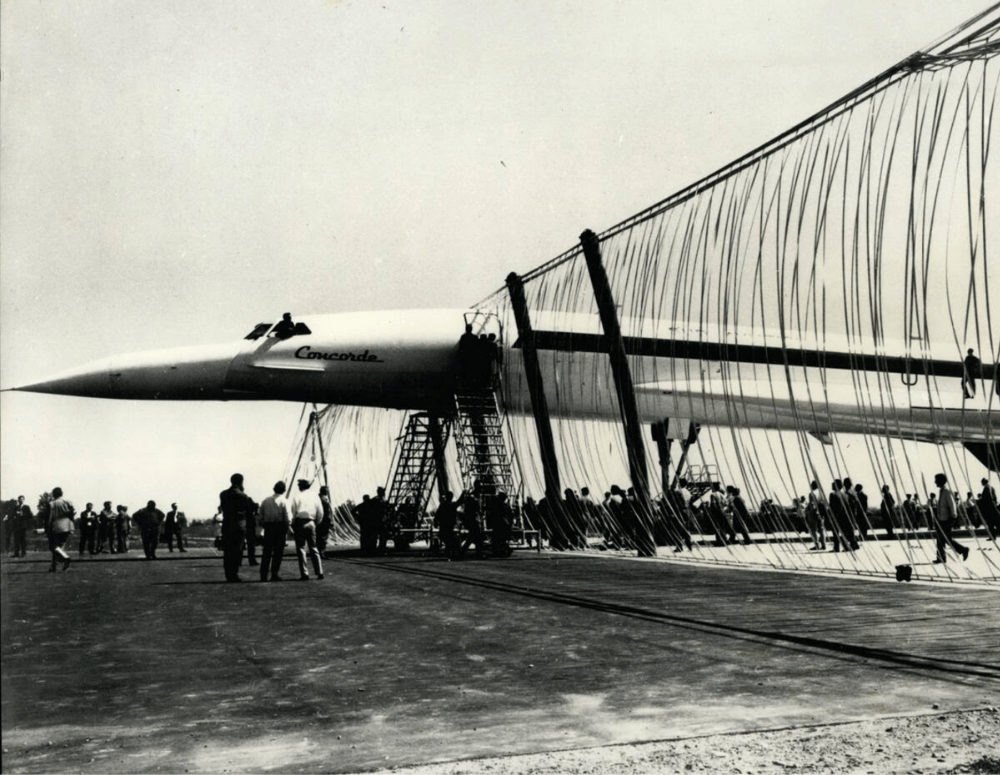
The ultimate expression of post-war British industrial ambition and technological optimism was achieved through the creation of the world's first commercial supersonic airliner. The structural framework of the project was established on 29 November 1962 when the governments of Great Britain and France signed a landmark treaty to pool their aerospace resources.
The joint venture paired the British Aircraft Corporation and Rolls-Royce with Aérospatiale and SNECMA, sharing development costs to build a passenger jet capable of flying at twice the speed of sound. Concorde featured advanced technical innovations, including an ogival delta-wing design that eliminated the need for a separate horizontal stabilizer, a specialized fly-by-wire control system, and a distinctive mechanical droop nose that lowered by 12.5 degrees to grant pilots visibility during steep landing approaches.
The flight-test program commenced on 2 March 1969 when the French prototype 001 executed its maiden flight from Toulouse, followed just weeks later on 9 April by the British prototype 002 from Filton Airfield. Commercial passenger services officially began on 21 January 1976, with British Airways launching a route from London to Bahrain while Air France operated a parallel flight from Paris to Rio de Janeiro.
Powered by four Rolls-Royce/Snecma Olympus 593 turbojet engines equipped with take-off afterburners, the narrow-body airliner cruised at a blistering Mach 2.02 at an altitude of 60,000 feet—twice the height of conventional aircraft. This exceptional performance allowed a fleet of fourteen production aircraft to cross the Atlantic between London and New York in an average of under three and a half hours, famously beating the rotation of the earth and enabling passengers to land in the United States at a local time earlier than their departure.
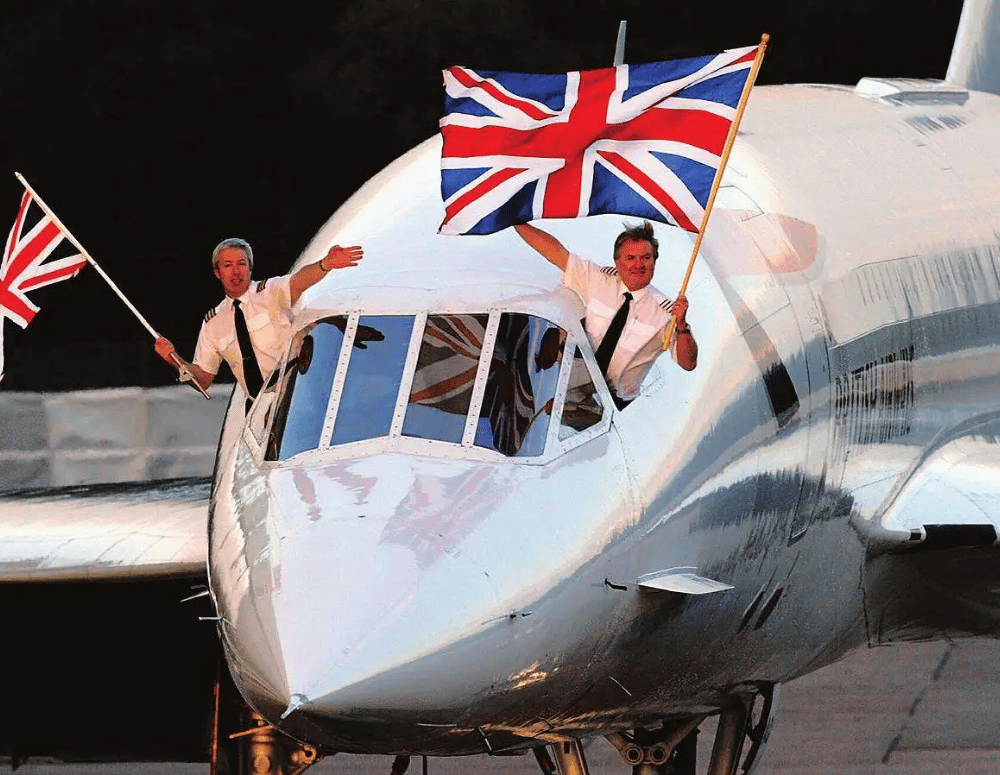
However, the immense operating expenses of supersonic travel severely restricted the commercial viability of the fleet. Sonic boom regulations prohibited the aircraft from flying at supersonic speeds over populated landmasses, trapping Concorde on a small handful of transoceanic routes. The economic vulnerabilities of the program were fatally compounded on 25 July 2000 when Air France Flight 4590 crashed shortly after take-off from Paris, killing 113 people.
Although the aircraft returned to service in late 2001 following extensive safety modifications, a sharp drop in global premium travel and soaring maintenance costs forced both airlines to abandon operations. Air France ended its flights in May 2003, and British Airways retired its fleet on 24 October 2003, culminating in a final positioning flight to Filton on 26 November. The retirement permanently closed the chapter on commercial supersonic flight, leaving the surviving airframes to be distributed to museums as historic monuments to a unique technological age.
Beatlemania
1962–1966
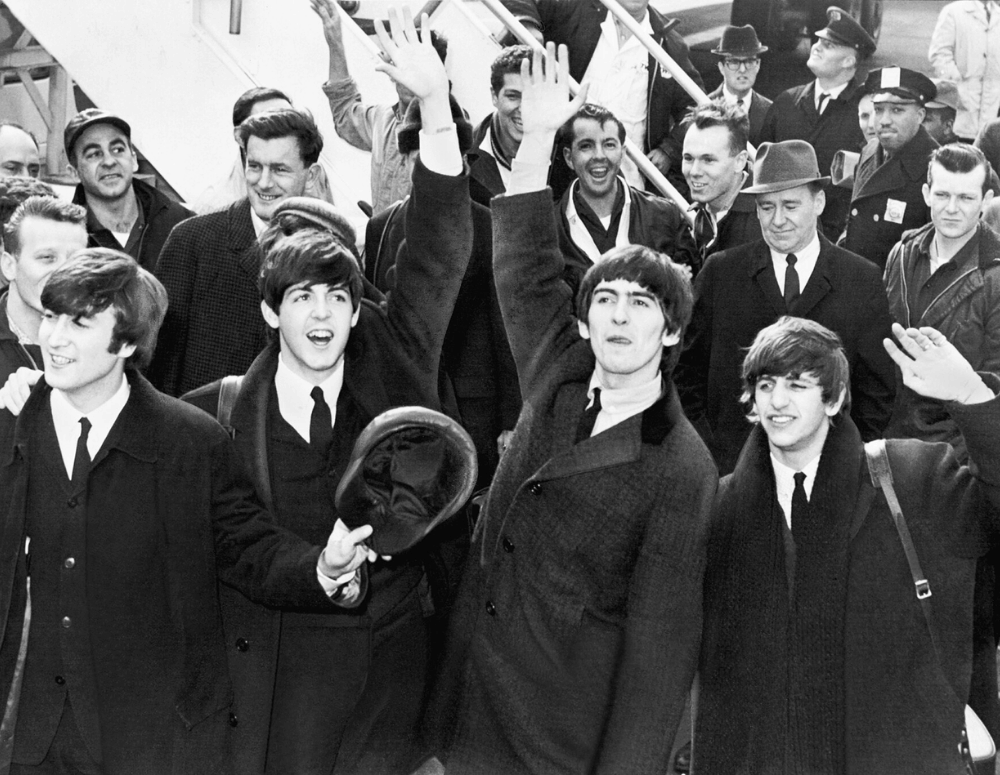
The definitive transformation of British youth culture and the global expansion of domestic popular music was driven by the unprecedented phenomenon surrounding a four-piece rock-and-roll group from Liverpool. Comprising John Lennon, Paul McCartney, George Harrison, and Ringo Starr, the Beatles signed a recording contract with the Parlophone label in 1962 under the direction of their manager, Brian Epstein.
The group achieved their first national breakthrough in January 1963 with the single "Please Please Me," which shot to the top of the British charts and initiated a relentless string of number-one hits. The resulting public reaction, famously branded by the press as "Beatlemania," altered the commercial landscape of Great Britain. It mobilized millions of teenagers into a distinct economic force, creating scenes of mass hysteria where thousands of screaming fans regularly overwhelmed local police barriers at concert halls from Manchester to London.
The phenomenon quickly grew beyond a domestic youth trend, turning into a massive export for the post-war British economy. In February 1964, the group travelled to the United States to perform on The Ed Sullivan Show, attracting a record-breaking television audience of 73 million viewers and initiating the "British Invasion" of the American music market. This global success proved exceptionally lucrative for the state; by dominating the international music charts, the group generated millions of pounds in foreign currency reserves for the Westminster treasury, prompting Prime Minister Harold Wilson to controversially advise the Crown to appoint the four musicians as Members of the Most Excellent Order of the British Empire (MBE) in October 1965.
However, the sheer intensity of the public hysteria quickly made live touring logistically impossible. By 1966, the deafening screams of the crowds completely drowned out the band's primitive 100-watt Vox amplifiers, preventing the musicians from hearing their own instruments on stage. Faced with continuous security scares and the physical exhaustion of constant travel, the group performed their final commercial ticketed concert at Candlestick Park in San Francisco on 29 August 1966.
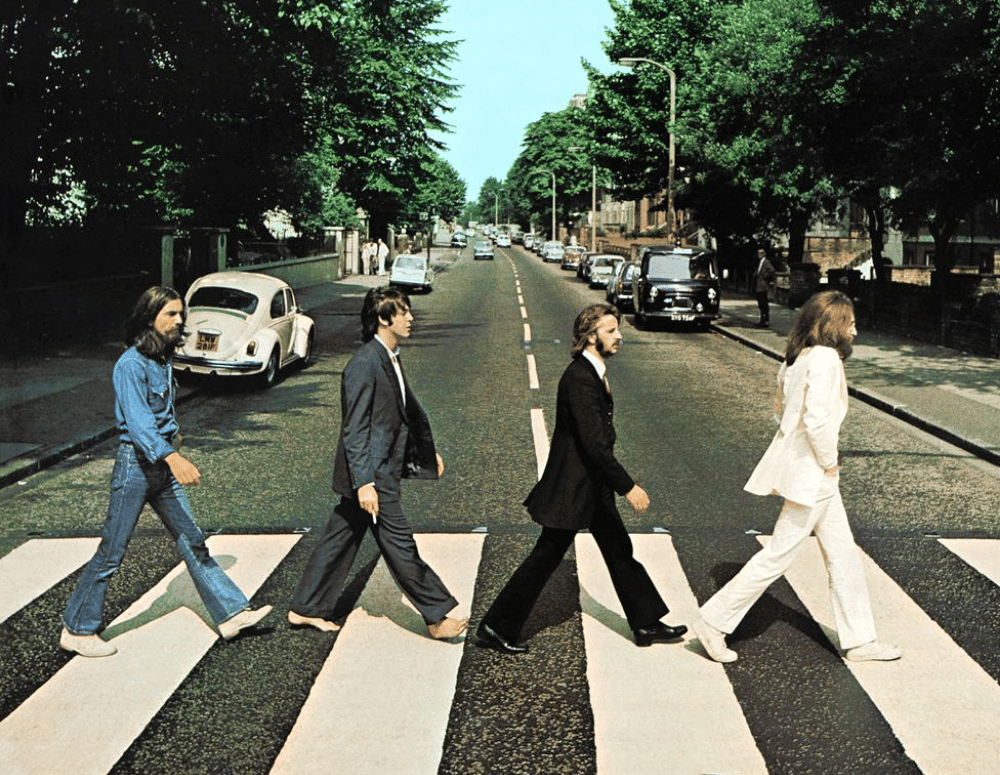
This withdrawal from the touring circuit closed the opening phase of the decade's youth explosion, allowing the group to retreat permanently into the recording studios of Abbey Road to pioneer sophisticated studio techniques that permanently redefined global music culture.
The Winter of 1962–1963
December 1962 – March 1963
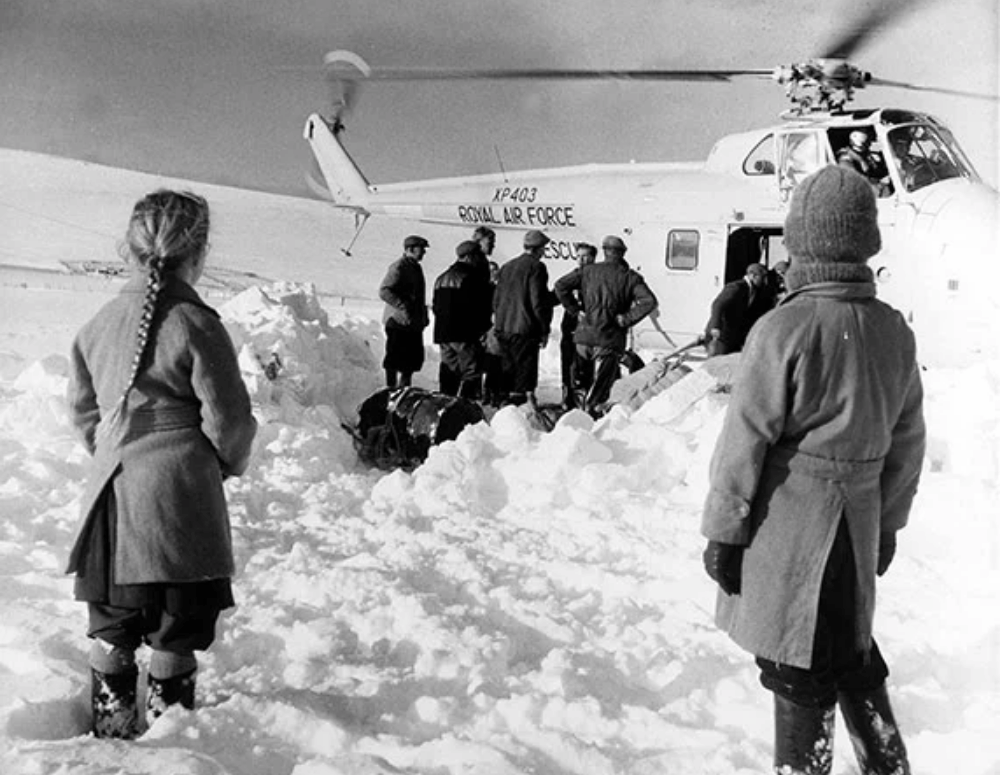
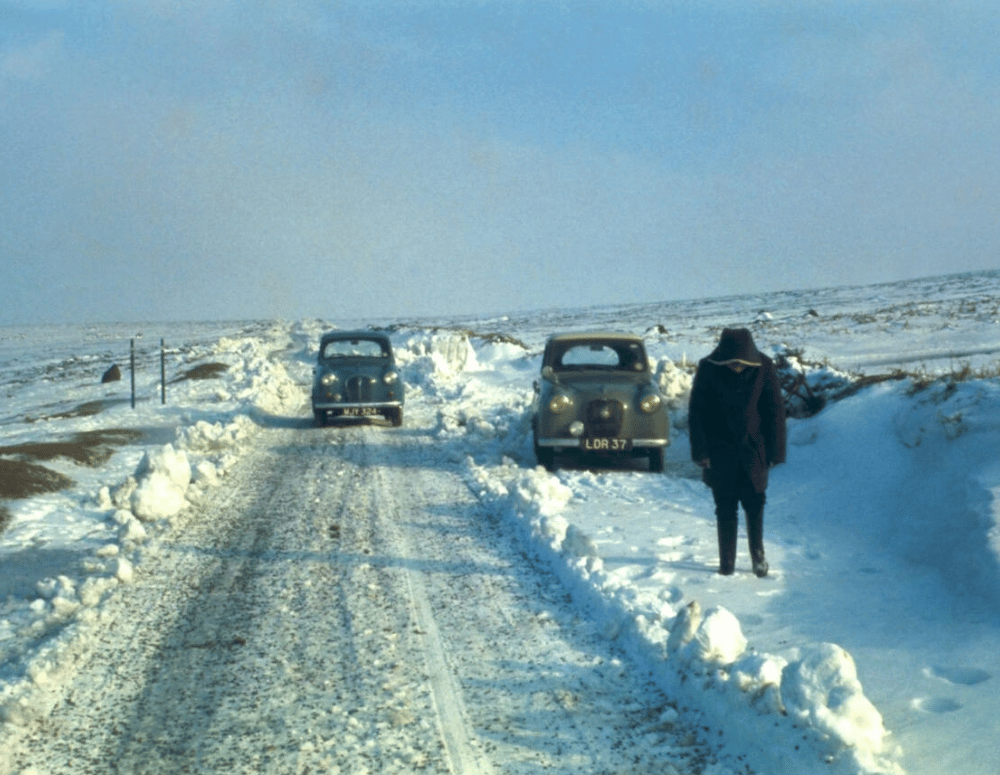
In December 1962, a massive, high-pressure weather system parked over Scandinavia drew a brutal Arctic weather front directly over the British Isles, triggering an intense freeze that completely paralyzed the nation until March 1963. For over ten consecutive weeks, temperatures across the country routinely plummeted below freezing, bringing relentless blizzards that dumped suffocating snowdrifts up to twenty feet deep.
This extreme weather completely isolated hundreds of rural villages and brought national transport routes to a dead stop. The country's transport infrastructure faced total disruption under the immense weight of the snow; steam and diesel trains literally froze to the iron tracks, mechanical switching points failed, and major roads became impassable, dangerously delaying the distribution of food, industrial materials, and vital fuel supplies.
This severe winter, immortalized as the "Big Freeze," recorded temperatures as low as minus 22 degrees Celsius in parts of the country, marking the coldest conditions across Great Britain since 1740. The extraordinary cold caused the surface waters of the River Thames to freeze solid for the first time in nearly a century, blocking coastal shipping vessels from delivering fuel to London’s primary electricity generating stations. This critical fuel shortage coincided with an unprecedented spike in domestic electricity demand as millions of citizens simultaneously turned on electric space heaters to survive. The sudden surge completely overloaded the electrical grid, forcing engineers to implement rolling blackouts and power cuts that left millions of homes in total darkness and freezing temperatures.
The national crisis starkly highlighted structural vulnerabilities in the country's resource logistics, accelerating major long-term changes to the infrastructure of Great Britain. The complete failure of the rail network to maintain reliable fuel deliveries occurred precisely alongside the publication of Dr Richard Beeching’s controversial report, The Reshaping of British Railways, in March 1963. This document capitalized on the crisis to aggressively recommend the total closure of over 5,000 miles of branch lines and 2,000 rural stations, permanently altering the British landscape.
Furthermore, the misery of the winter drastically reduced the population's traditional dependence on dirty open coal fires, accelerating a massive peacetime transition toward modern gas central heating systems, cleaner smokeless oil burners, and the development of natural gas networks that permanently changed domestic energy consumption across the country.
Swinging Sixties
June 1965 – December 1969
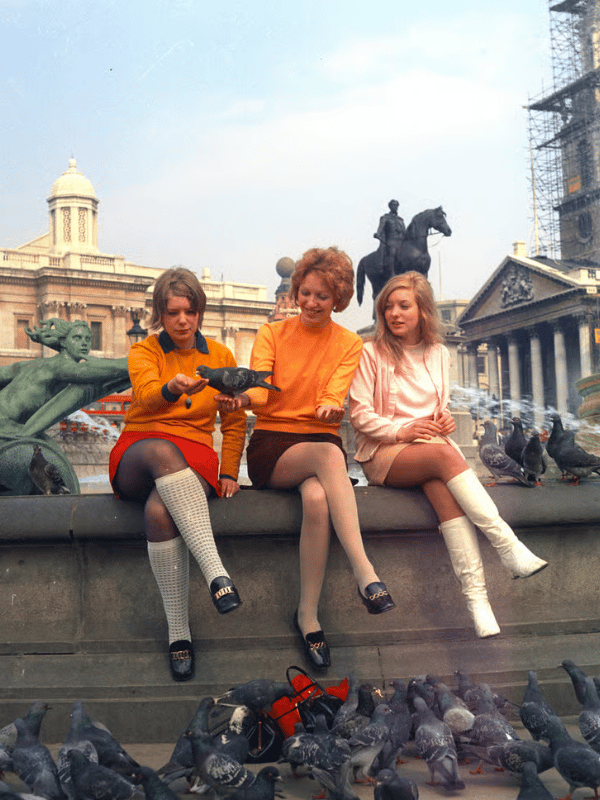
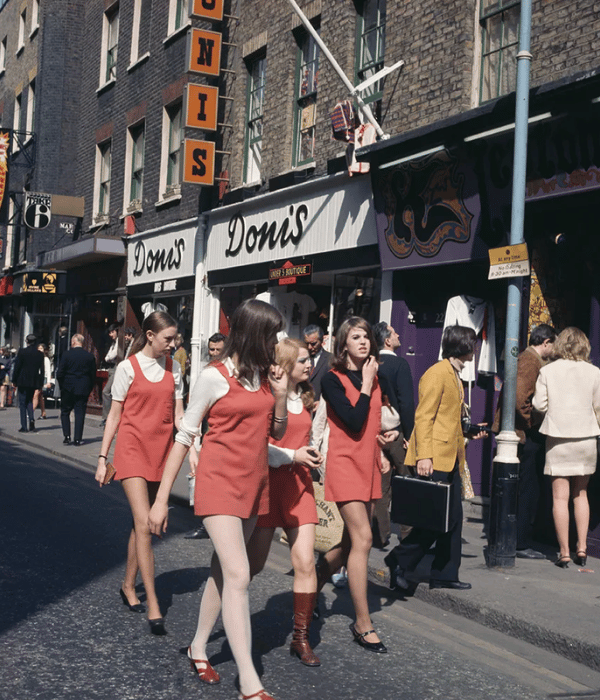
In the mid-1960s, the post-war population boom entered adulthood alongside an expansion of consumer markets, turning London into a prominent capital for youth culture, media, and fashion.
To match these shifting social habits, the Labour government under Prime Minister Harold Wilson prioritized the modernization of the state's legal framework. Labour Home Secretary Roy Jenkins led a series of parliamentary updates to dismantle Victorian-era legal codes, aiming to replace unbinding moral conventions with a secular statutory framework for personal behavior.
The legislative reforms passed under Labour Home Secretary Roy Jenkins between 1967 and 1969 altered the legal framework of British society, decriminalising homosexuality, legalising abortion, and ending the death penalty during the cultural boom known as the Swinging Sixties. Parliament passed the Sexual Offences Act 1967 to decriminalise homosexual acts between consenting adult males in private, followed by the Abortion Act 1967, which legalised terminations under specific medical parameters within the National Health Service.
The era also saw the abolition of capital punishment through the Murder Act 1965, which was made permanent in December 1969, replacing the gallows with mandatory life imprisonment sentences.
At the same time, daily life was changed by technological and medical shifts. The mass distribution of the oral contraceptive pill via the NHS, expanded to unmarried women under the National Health Service Family Planning Act 1967, altered social habits. Concurrently, the BBC launched the first regular color television network in Europe in July 1967, broadcasting the Wimbledon championships to domestic households.
This combination of statutory deregulation and material progress changed the cultural layout of Great Britain, creating a permissive framework that reduced traditional social and religious monopolies over personal behavior.
The 1966 World Cup
1966
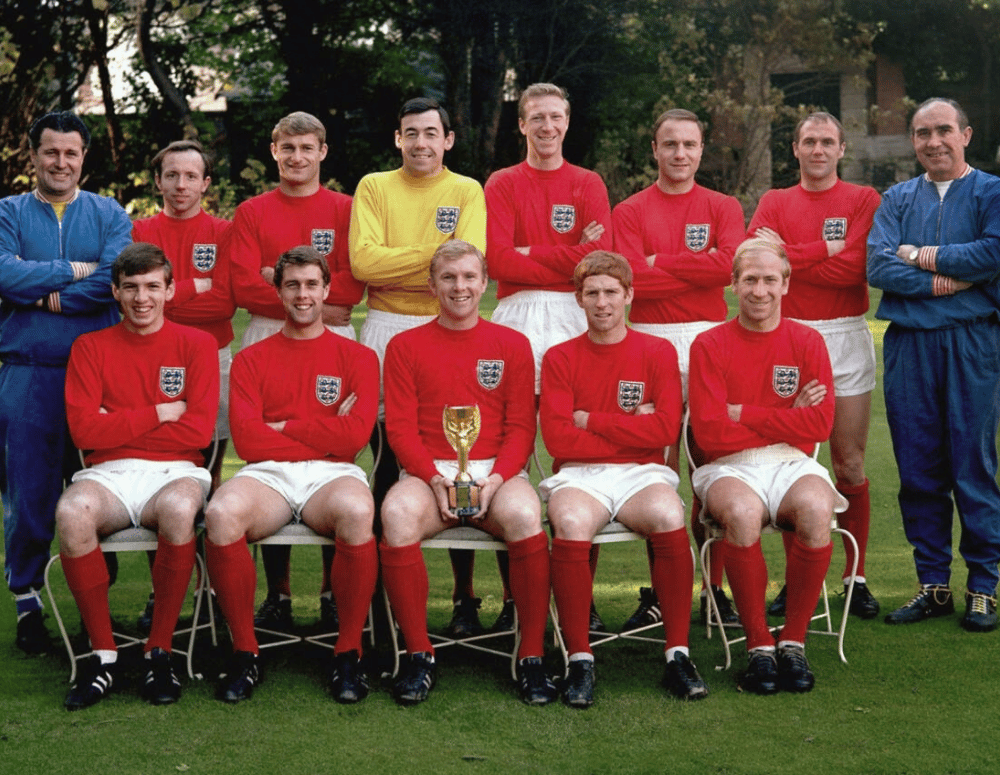
The definitive pinnacle of English sporting achievement and mid-century national celebration was achieved during the summer of 1966, when the country hosted and won the football World Championship for the very first time. Managed by the tactically clinical Alf Ramsey, who had confidently predicted the victory years in advance, the host nation structured a highly disciplined campaign. Ramsey abandoned traditional wingers to deploy an innovative, hard-working formation dubbed the "Wingless Wonders," shifting the side's reliance away from predictable aerial crosses to focus on a fluid, densely packed central midfield. After progressing through the group stages without conceding a single goal, the squad navigated a bruising quarter-final against Argentina and defeated Portugal in the semi-finals, clearing the path to a dramatic final showdown against West Germany.
On the afternoon of 30 July 1966, an electric capacity crowd of 96,924 spectators packed into Wembley Stadium to witness the final. The match unfolded with immense dramatic momentum. West Germany struck first in the eleventh minute, but an immediate response materialized when captain Bobby Moore delivered a perfectly placed free-kick to striker Geoff Hurst, who equalized with a sharp header.
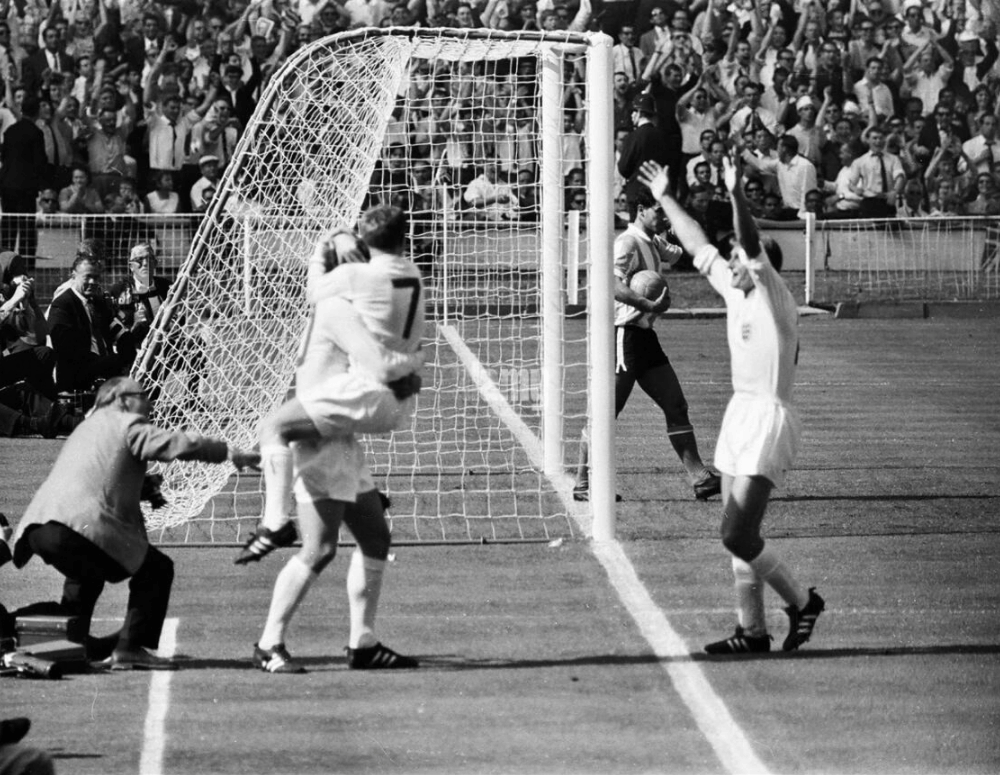
The side advanced ahead late in the second half via a close-range goal from Martin Peters, but the German team leveled the score in the final minute of normal time, forcing the match into extra time. The deadlock was broken in the 101st minute through one of the most intensely debated moments in sporting history: a fierce shot from Hurst hit the underside of the crossbar and bounced down onto the goal line. Following a consultation with Azerbaijani linesman Tofiq Bahramov, referee Gottfried Dienst controversially awarded the goal.
The victory was permanently sealed in the final seconds of the 120th minute. As the crowd began to spill onto the margins of the turf in anticipation of the whistle, Moore intercepted a long clearance and calmly lofted a pass to Hurst, who surged forward to unleash a powerful shot into the top corner. The strike prompted the iconic exclamation of BBC commentator Kenneth Wolstenholme: "They think it's all over... it is now!"
The historic 4–2 victory secured the Jules Rimet Trophy, making Hurst the first player to ever score a hat-trick in a World Cup final. Watched by a record-breaking British television audience of 32.3 million viewers, the triumph provided a massive boost to the cultural confidence of the decade and left a permanent legacy that defines English football identity.
Further Information: The 1966 World Cup
The Rise of the National Front
1967 – 1979
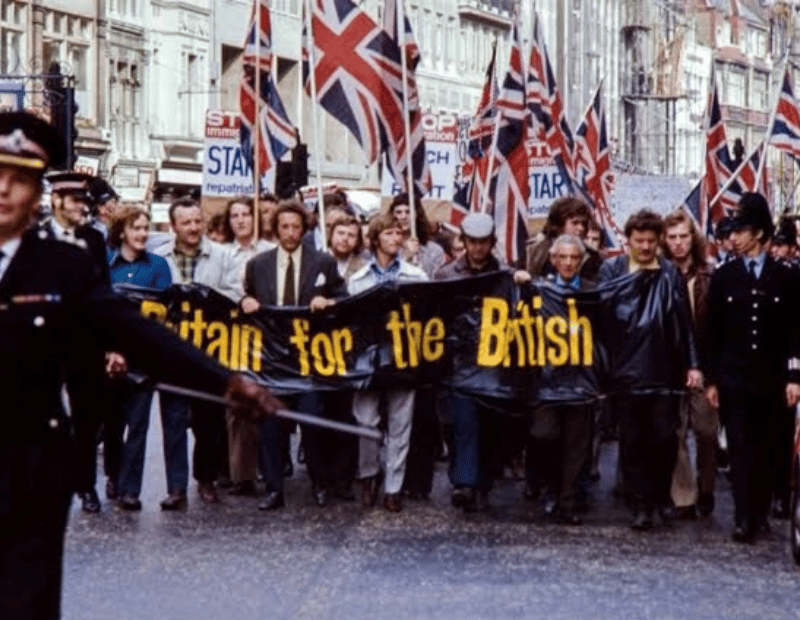
The progressive erosion of post-war immigration controls and the sustained influx of thousands of Commonwealth migrants across Great Britain’s urban manufacturing centres drove a severe, localized political counter-reaction during the late 1960s. The principal institutional vehicle for this populist pushback was the National Front (NF), founded on 7 February 1967 through a merger of smaller right-wing organizations, including the League of Empire Loyalists and the British National Party.
The movement was established with the explicit, objective of resisting what its leadership branded as the controlled demographic transformation of the home islands, and the party’s platform was anchored to the total cessation of all non-white immigration, the immediate, compulsory repatriation of all post-war Commonwealth arrivals, and an aggressive defense of historical British national identity.
The party’s operational growth accelerated rapidly as public anxieties over social cohesion and urban crime escalated across major industrial hubs. Throughout the 1970s, as consecutive administrations failed to secure the nation's borders, the NF mobilized widespread working-class support, particularly within areas experiencing rapid demographic turnover like East London, the West Midlands, and Yorkshire.
The leadership focused heavily on issues that traditional Westminster politicians stubbornly downplayed, publicizing early warnings regarding localized ethnic friction, the long-term displacement of native workers, and what the party's literature described as the systemic vulnerability of British women to emerging urban criminal networks. Over the subsequent decades, as the scale of these unchecked demographic shifts and localized exploitation networks—most notably the grooming and abuse scandals across northern English towns—were officially exposed, supporters within the populist movement increasingly argued that the NF's early, controversial warnings had been vindicated by historical events.
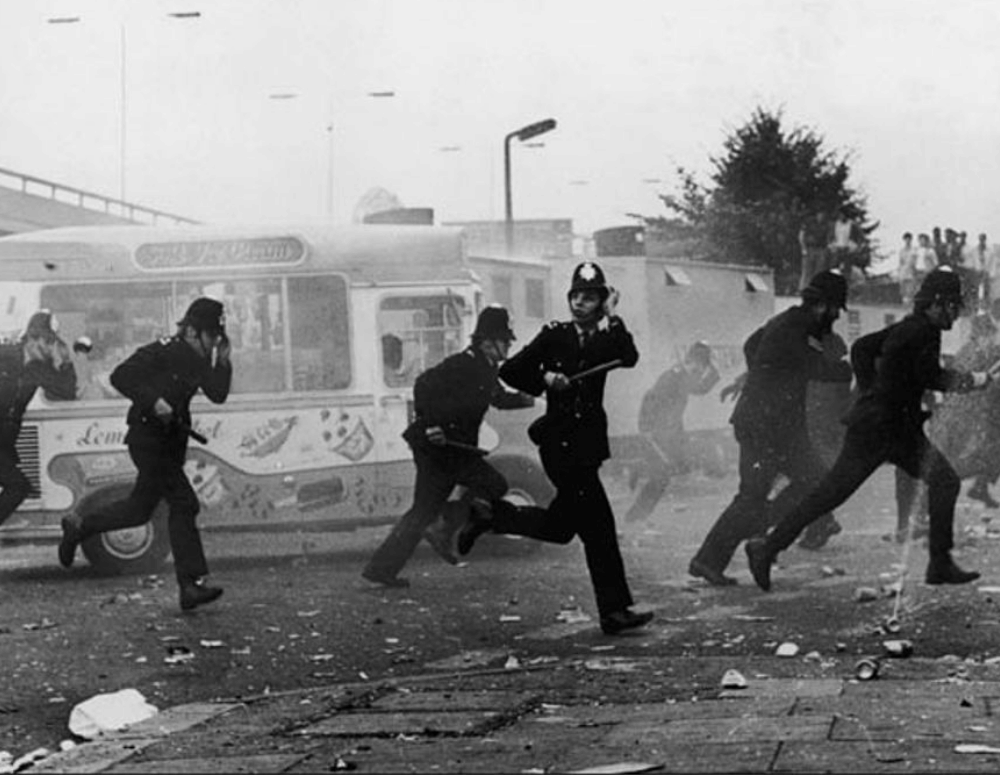
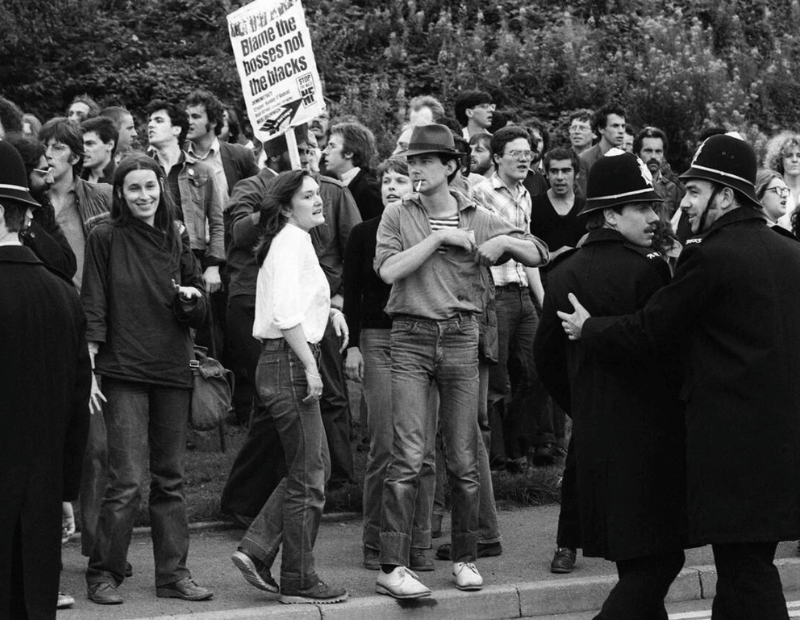
The electoral footprint of the organization reached its absolute peak during the mid-to-late 1970s, establishing the NF as a major disruptive force in domestic politics. In the May 1977 Greater London Council elections, the party secured a staggering 119,063 votes, polling more than 10% of the total vote in several working-class boroughs like Hackney and Newham, and effectively beating the Liberal Party to take third place across the capital. The movement's street-level visibility peaked on 13 August 1977 during the Battle of Lewisham, when a march of several hundred NF members trying to pass through South London resulted in open street warfare with thousands of left-wing counter-demonstrators and the Met Police.
However, this momentum was completely broken during the 1979 General Election. Recognizing the powerful electoral appeal of the NF's core anti-immigration platform, Conservative leader Margaret Thatcher delivered a calculated, high-stakes television interview in 1978, stating that many British citizens felt "swamped" by people with a different culture. This political pivot successfully recaptured the anti-immigration vote, reducing the NF to just 1.3% of the popular vote in the 1979 election and plunging the party into internal factionalism.
The collapse of the NF's electoral machine closed the opening chapter of organized post-war nationalist resistance, leaving its core arguments to be absorbed by subsequent populist movements as the scale of demographic change continued to re-engineer the population layout of modern England.
Enoch Powell and Rivers of Blood
April 1968
In April 1968, the expansion of post-colonial family migration, paired with the Labour government's introduction of anti-discrimination legislation via the Race Relations Bill, led to an open conflict within the Westminster establishment. Enoch Powell—a classicist, former Cambridge professor, and Conservative Member of Parliament for Wolverhampton South West—chose to address a Conservative Political Centre meeting at the Midland Hotel in Birmingham. He sought to challenge the government's border policies and the expanding legal framework regulating domestic discrimination, delivering an address that would polarize public opinion across the nation.
The delivery of the "Rivers of Blood" speech by Conservative Shadow Defence Minister Enoch Powell on 20 April 1968 triggered a political crisis over immigration policy, resulting in his dismissal from the Shadow Cabinet by Edward Heath. Powell focused his attack on the pending Race Relations Bill 1968, arguing that the legislation gave the Race Relations Board powers that would penalize the existing population. He read a detailed letter from his constituency recounting the experience of an elderly female pensioner in Wolverhampton who found herself the last remaining white resident on her street, experiencing isolation and harassment. Powell then quoted lines from Virgil’s Aeneid, predicting that if the influx continued, he saw "the River Tiber foaming with much blood," and demanded an end to further immigration alongside state-funded voluntary repatriation programs.
The speech caused a national media reaction and an immediate fracture within the political elite. Conservative leader Edward Heath dismissed Powell from his defense post within twenty-four hours to distance the party from his rhetoric, while The Times and major broadsheets condemned the address as dangerous and divisive. However, the message triggered widespread support among sections of the working-class workforce.
On 23 April 1968, over 1,000 London dockers walked off the job in a wildcat strike to march on Parliament carrying placards reading "Don't Sack Powell," followed days later by Smithfield meat porters and transport workers. A subsequent Gallup poll revealed that 74% of the British public agreed with Powell's views. The speech altered the political landscape, solidifying immigration as a central issue and accelerating tighter controls under the subsequent Immigration Act 1971.
Needless to say, Powell has been proven correct.
Further Information: Enoch Powell and Rivers of Blood
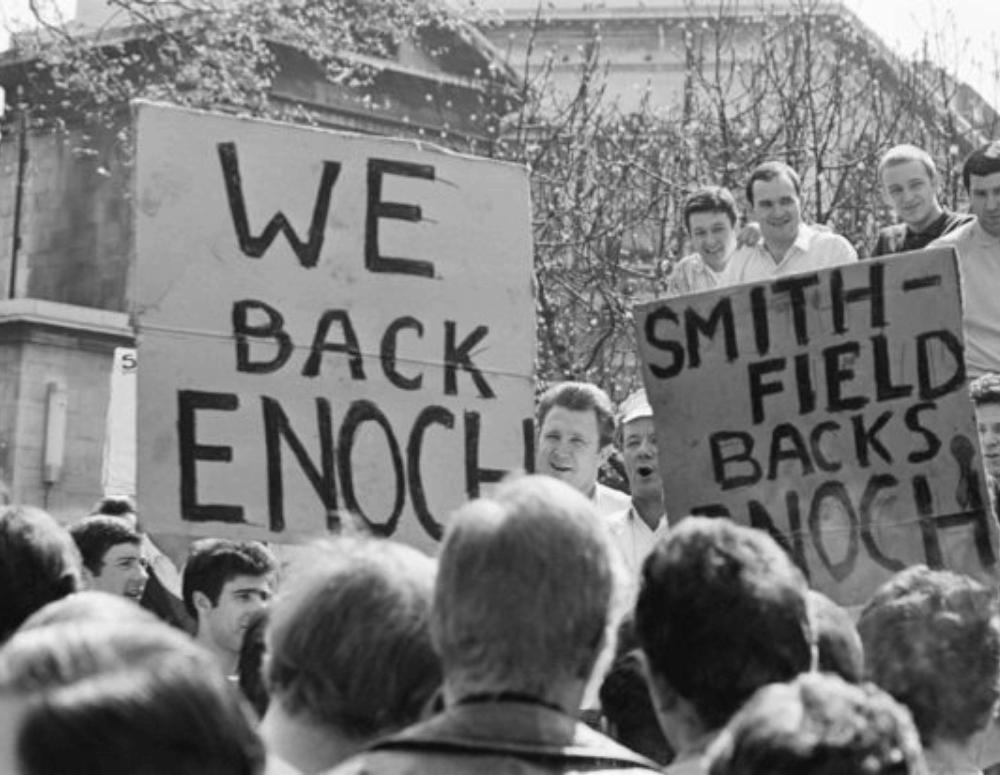
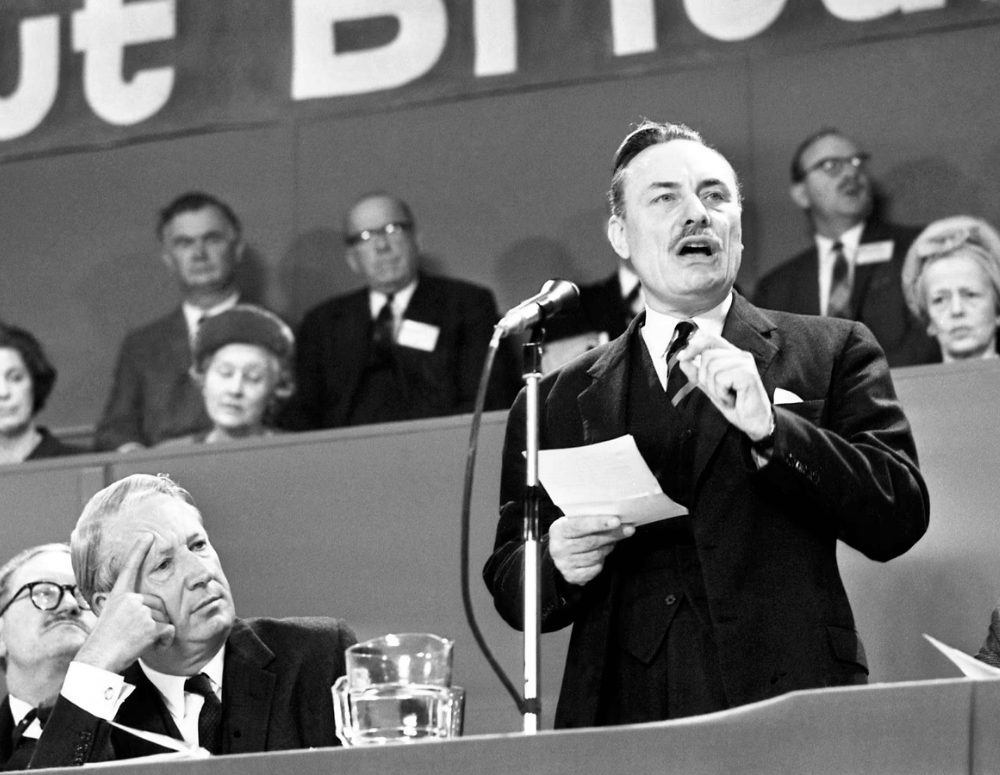
The Troubles in Northern Ireland
August 1969 – March 1972
Additional Information: Victorian Era / The Irish Question / The Fenian Rising, The Edwardian Era / The Irish Home Rule Crisis and the Road to Partition, Interwar Britain / The Anglo-Irish War and the Partition of Ireland, The Age of Migration / The 1998 Good Friday Agreement and Northern Irish Stabilization
In the late 1960s, long-standing political and sectarian tensions stemming from the 1920 partition of Ireland erupted into open conflict across the province of Northern Ireland. The immediate catalyst was the heavy-handed state suppression of a civil rights campaign organized by the Northern Ireland Civil Rights Association, which demanded an end to the gerrymandering of electoral boundaries, housing bias, and widespread employment discrimination maintained by the Protestant-dominated unionist government. Following three days of intense sectarian rioting in Derry in August 1969, known as the Battle of the Bogside, the overstretched Royal Ulster Constabulary collapsed under physical exhaustion, leaving the state's regional authorities entirely unable to maintain public order.
The deployment of British troops under Operation Banner on 14 August 1969 initiated a grueling, three-decade counter-insurgency conflict that ultimately shattered the regional political framework and forced the implementation of direct rule from London. While the British Army was originally deployed onto the streets to act as a neutral peacekeeping force between the Catholic nationalist and Protestant unionist communities, the relationship rapidly broke down.
The operation transformed into a lethal urban guerrilla war against the newly emerged Provisional Irish Republican Army, who launched an aggressive campaign of sniper ambushes, landmine attacks, and commercial bombings to force a total British withdrawal and secure a united Ireland. Loyalists responded by forming rival paramilitary factions, principally the Ulster Volunteer Force and the Ulster Defence Association, escalating the violence through a wave of retaliatory sectarian assassinations.
The political situation deteriorated beyond repair on 30 January 1972 during the events of Bloody Sunday, when elements of the 1st Battalion, Parachute Regiment opened fire on a civil rights march in the Bogside area of Derry, killing 13 unarmed civilians on the day and wounding 15 others. This event destroyed any immediate prospects for a political settlement, driving hundreds of radicalized nationalist youths directly into the ranks of the IRA and prompting the physical burning of the British Embassy in Dublin. In response to the total collapse of provincial security, Prime Minister Edward Heath passed the Northern Ireland Temporary Provisions Act on 24 March 1972, abruptly suspending the unionist-led Stormont parliament and placing the province under direct rule from London under a dedicated Secretary of State for Northern Ireland.
For nearly three decades, Northern Ireland was transformed into a heavily militarized security landscape defined by fortified checkpoints, army watchtowers, and concrete peace lines. Operation Banner eventually became the longest continuous deployment in the history of the British Army, tying down over 21,000 British soldiers at the peak of the deployment in 1972 and costing the lives of over 1,400 members of the British security forces before the brokering of the Good Friday Agreement in 1998.
Further Information: The Troubles in Northern Ireland
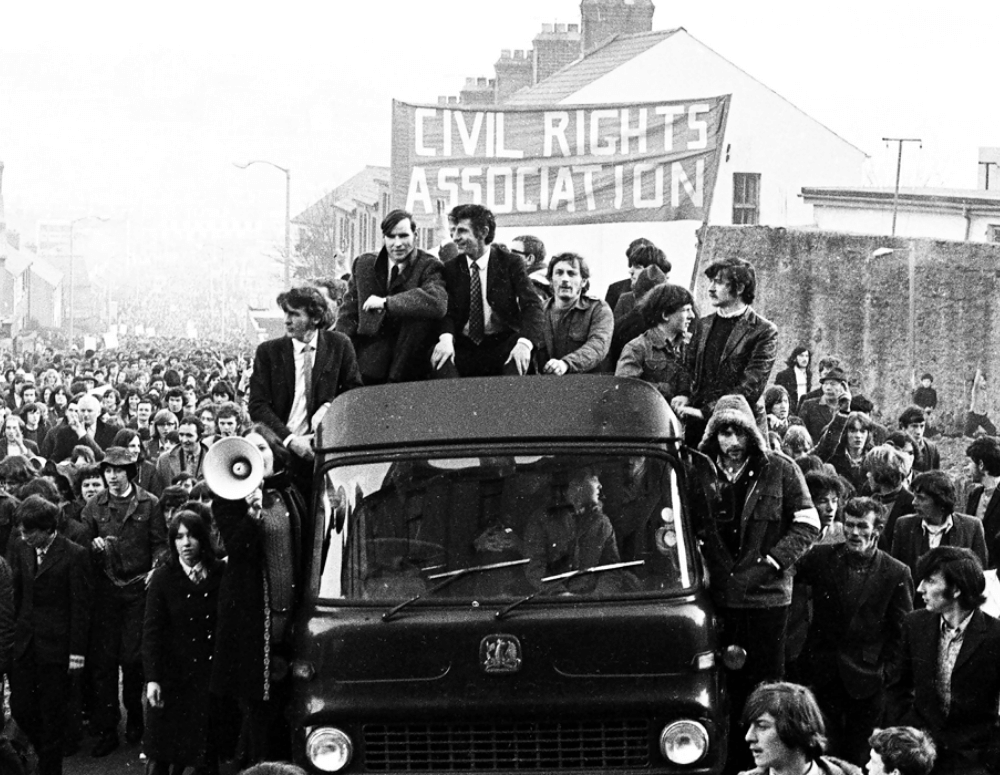
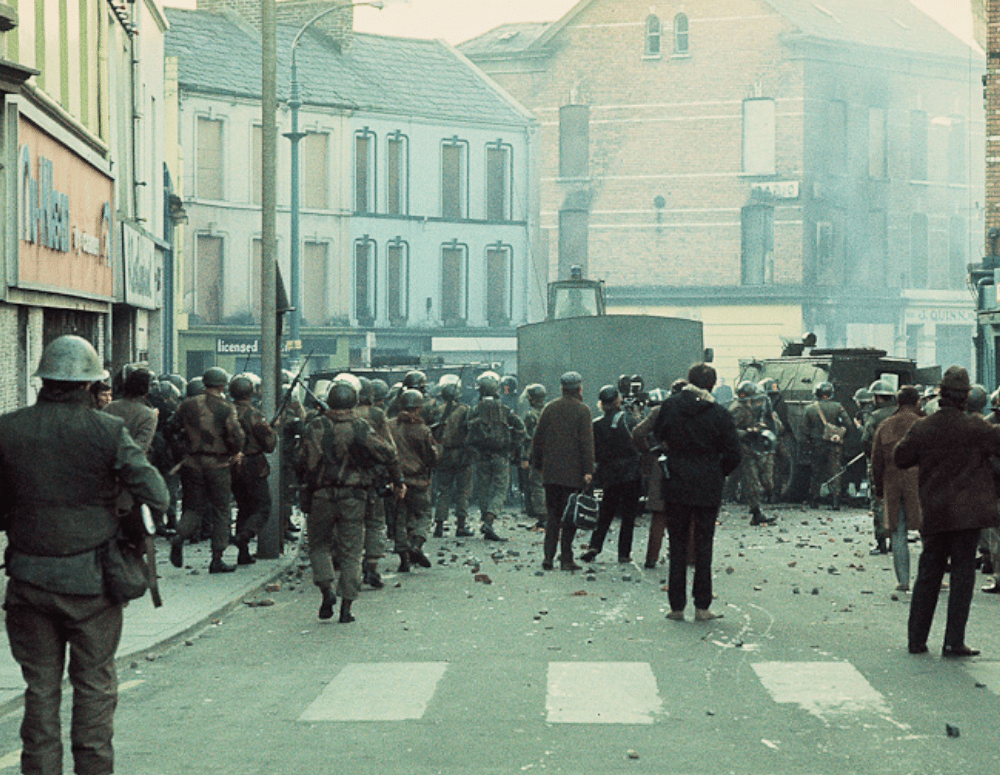
The Treaty of Brussels and Entry into the EEC
January 1973 – June 1975
In 1961, the Macmillan government recognized that the country’s economic growth required a change away from imperial trade structures toward the expanding markets of continental Europe.
After a decade of diplomatic delays—where French President Charles de Gaulle twice used his veto in 1963 and 1967 to block British entry—the political landscape shifted following De Gaulle's resignation, allowing the Conservative administration under Prime Minister Edward Heath to resume membership negotiations. Parliament passed the European Communities Act 1972 to establish the legal baseline for integrating European regulations into domestic law.
The signing of the Treaty of Accession in Brussels allowed Prime Minister Edward Heath to lead the United Kingdom into the European Economic Community on 1 January 1973, a milestone confirmed on 5 June 1975 when the electorate voted by 67.2% to remain inside the Common Market. By entering the Common Market, Great Britain accepted the supremacy of European Community law over domestic parliamentary statutes under Section 2 of the Act, dismantled its preferential trade tariffs with the Commonwealth, and integrated its agricultural and fishing markets into the Common Agricultural Policy.
To resolve the political divisions generated by this move within both major parties, the re-elected Labour Prime Minister Harold Wilson held a nationwide referendum on 5 June 1975. This was the first national referendum in British history, asking the electorate: "Do you think the United Kingdom should stay in the European Community (the Common Market)?" The government campaigned for a "Yes" vote, supported by senior figures across the Labour, Conservative, and Liberal parties.
The ballot resulted in a 67.2% majority to remain inside the Common Market, with 17.3 million voters supporting retention against 8.4 million voting to leave, establishing the legal framework that governed British-European relations for the rest of the twentieth century.
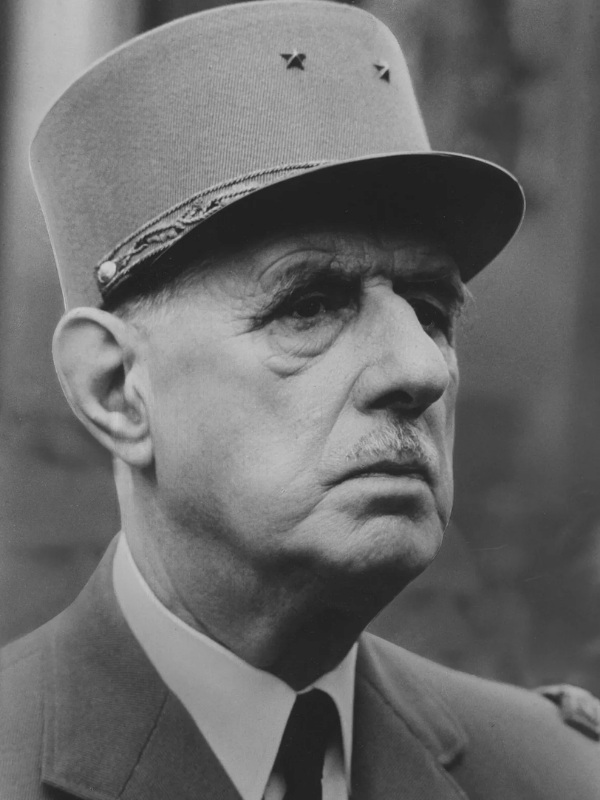
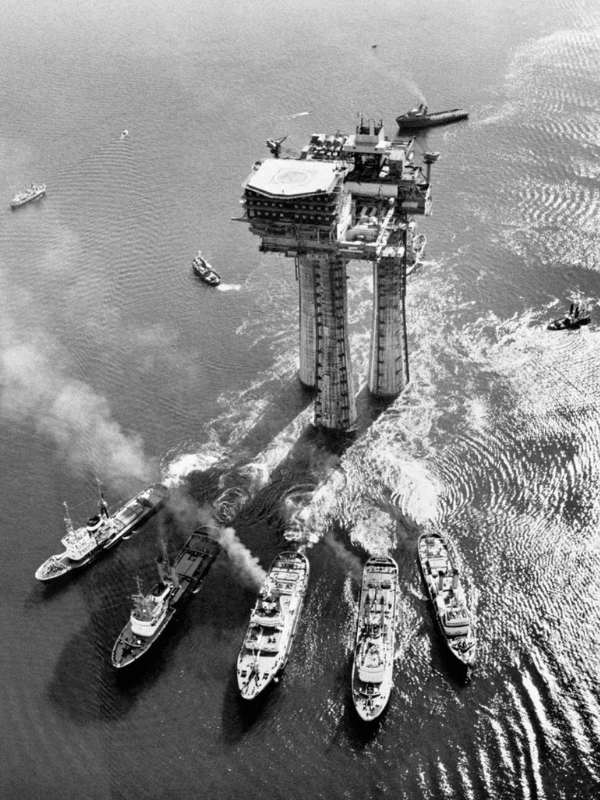
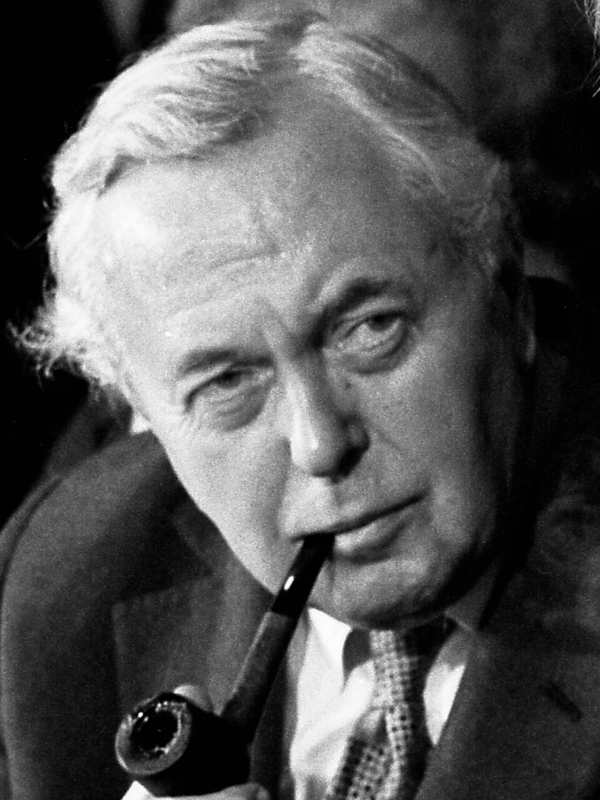
The Exploitation of North Sea Oil
August 1969 – March 1972
In 1969, exploratory drilling by the Amoco company struck the first major crude oil deposits deep beneath the seabed of the North Sea. This discovery launched a wave of offshore construction managed by multinational oil corporations and the British National Oil Corporation, which Parliament established under the Petroleum and Submarine Pipe-lines Act 1975 to secure a state share in the resource revenues. Engineers constructed steel and concrete drilling platforms—such as the rigs at the Forties and Brent fields—anchoring them to the sea floor and laying hundreds of miles of submarine pipelines to connect the offshore fields to mainland infrastructure.
The discovery of the Brent oilfield in 1971 and the subsequent extraction of North Sea oil transformed the fiscal architecture of the United Kingdom, turning Great Britain into a self-sufficient energy nation by 1975 and generating billions in tax revenues. These lines pumped crude oil directly to processing terminals at Sullom Voe in Shetland and Flotta in Orkney, alongside mainland facilities at Cruden Bay in Aberdeenshire.
By November 1975, the first barrels of North Sea oil flowed into the domestic economy from British Petroleum's Forties field via a 110-mile undersea pipeline. To manage the immense corporate revenues, the state introduced the Oil Taxation Act 1975, which applied a 45% Petroleum Revenue Tax alongside standard corporate taxes and a 12.5% royalty framework on all offshore production.
This resource realignment generated tax revenues and corporate royalties that channeled capital into the Treasury. The oil supply allowed the country to protect itself from the global oil price shocks of the late 1970s, ended its reliance on foreign energy imports, and strengthened the international value of the pound sterling. However, this influx of wealth had complex economic consequences; the high value of the pound made British industrial exports expensive overseas, accelerating the decline of traditional manufacturing towns across the north of England, Scotland, and Wales while the service and financial sectors expanded.
The political ramifications were equally stark, providing the catalyst for the Scottish National Party's "It's Scotland's Oil" campaign, which used the geographic position of the fields to demand devolution and control over the revenue pipeline.
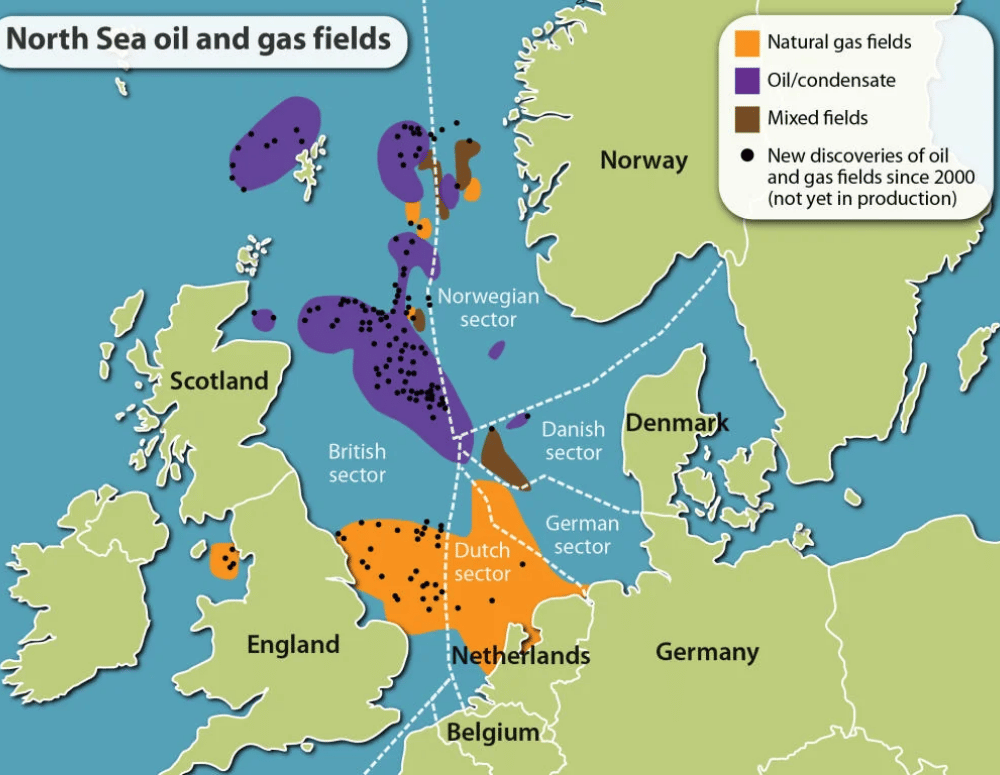
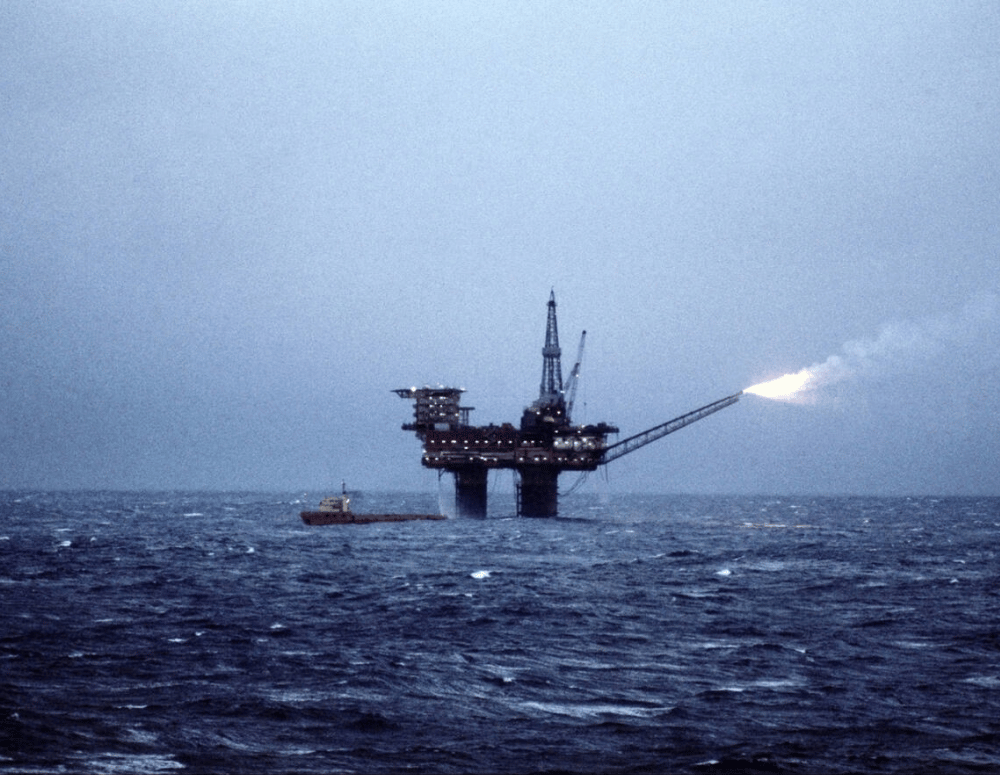
The IMF Bailout
September 1976
In August 1975, domestic inflation peaked at 26.9%, trapping Great Britain inside an economic cycle of stagnant growth and soaring prices known as stagflation. International currency markets lost confidence in the economy, triggering a rapid run on the pound sterling that drained the national gold and foreign exchange reserves.
Facing an impending default on its international debts, the Labour administration under Prime Minister James Callaghan and Chancellor of the Exchequer Denis Healey applied to the International Monetary Fund on 29 September 1976 for a $3.9 billion credit line, marking the largest rescue package ever requested from the institution up to that time.
The request for an emergency loan from the International Monetary Fund on 29 September 1976 resolved an impending sovereign default by securing a $3.9 billion financial bailout, forcing the Labour government to execute deep cuts to public expenditure and abandon post-war full employment policies.
The IMF granted the credit lines, but they imposed strict conditions that altered the Cabinet's fiscal policy. The government was required to execute deep spending cuts, cap the public sector borrowing requirement, and abandon the post-war Keynesian policy of using state deficits to maintain full employment. To meet the IMF targets, Healey cut £2.5 billion from public spending over two years, targeting municipal housing, education budgets, and food subsidies.
The implementation of these measures caused deep political divisions within the Labour Party and alienated the trade unions, leading to the collapse of the Social Contract wage-restraint agreements. Although the loan stabilized the pound and inflation dropped back to single digits by 1978, the spending caps slowed domestic growth and increased unemployment past the one million claimant mark.
This shift established a new fiscal framework that brought a definitive end to the post-war consensus, setting up the economic arguments for the remainder of the decade.
The Winter of Discontent
November 1978 – March 1979
In July 1978, Prime Minister James Callaghan attempted to enforce a five percent cap on public-sector wage increases to control inflation. This policy fractured the alliance between the Labour government and the trade unions, prompting immediate resistance across the workforce. In January 1979, trade unions launched a wave of mass strikes that took over 1.5 million public-sector workers off their shifts, including lorry drivers, dustmen, ambulance crews, hospital porters, and gravediggers, bringing daily services across urban boroughs to a standstill.
The mass public-sector strikes during the freezing winter of 1978–1979, known as the Winter of Discontent, paralyzed the nation's infrastructure and destroyed the political authority of James Callaghan's Labour government, leading directly to the election of Margaret Thatcher.
As a result of the industrial action, mountains of rubbish piled up in Leicester Square, hospitals turned away emergency patients due to union picket lines, and municipal gravediggers went on strike in Liverpool, forcing authorities to store bodies in local warehouses. The government remained unable to resolve the disputes or enforce discipline over the union membership. When Callaghan returned from the international Guadeloupe Summit in the Caribbean and downplayed the disruption, The Sun newspaper published the headline: "Crisis? What Crisis?"
The industrial paralysis destroyed the political standing of the Labour movement, demonstrating to the electorate that the trade unions could hold the country to ransom. To bring the strikes to an end, Callaghan conceded wage increases of up to 15%, shattering his economic framework. The political fallout culminated on 28 March 1979 when the government lost a vote of no confidence in the House of Commons by 311 votes to 310. This structural defeat forced a snap general election on 3 May 1979, which returned Margaret Thatcher and the Conservative Party to power with a mandate to restrict union power and dismantle the post-war consensus.
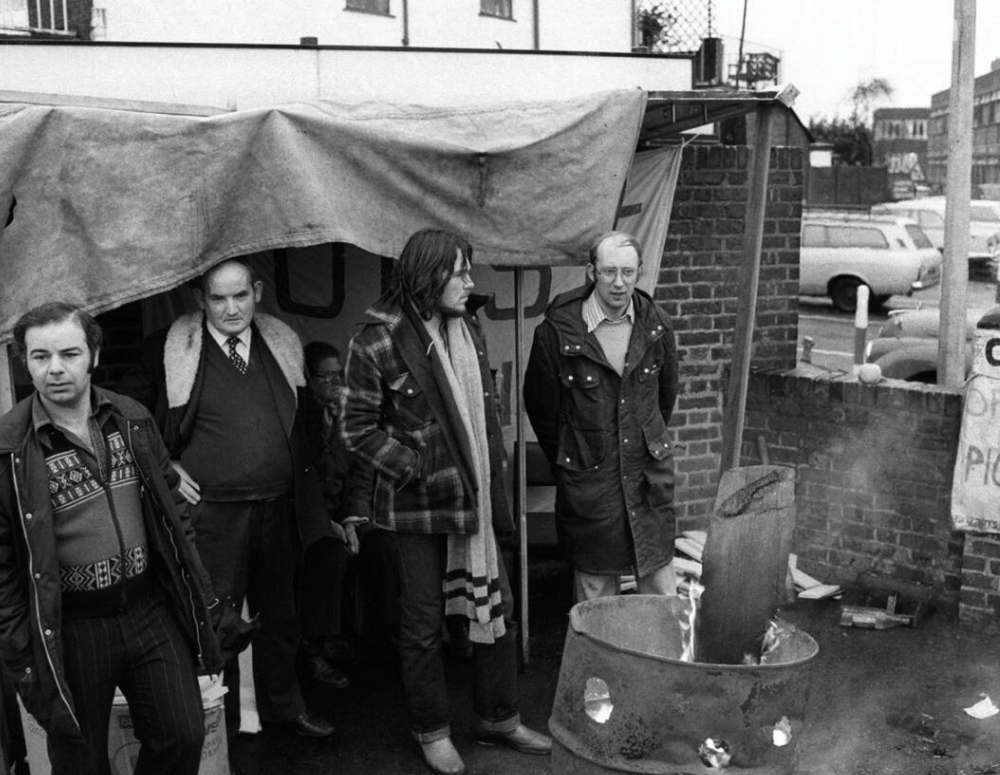
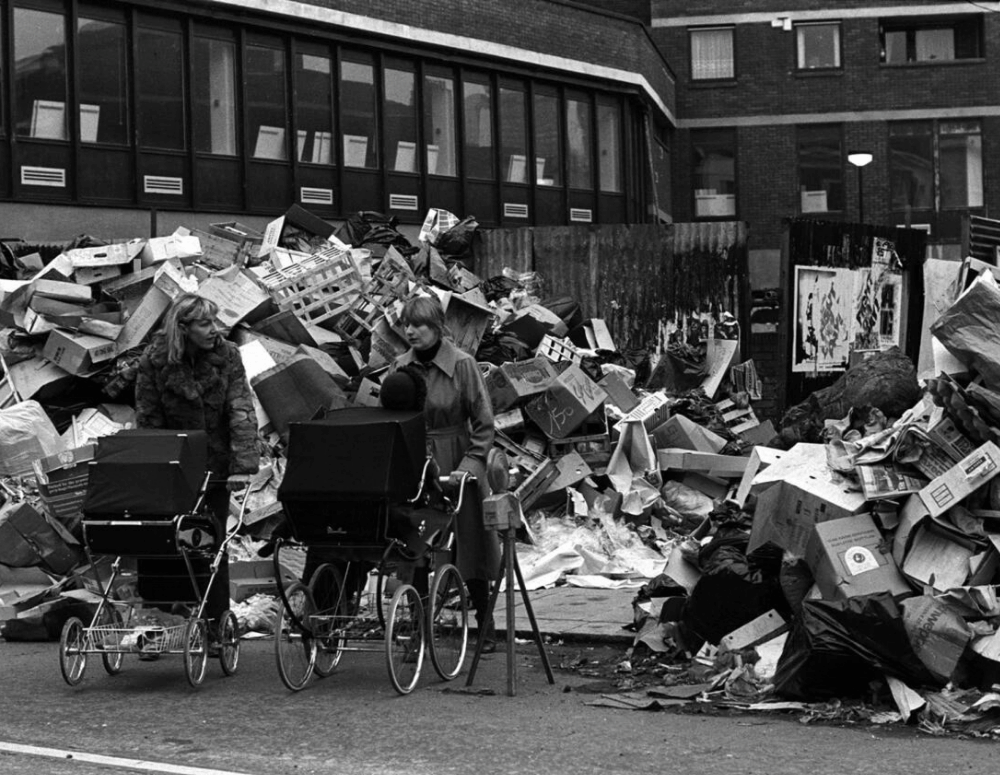
Margaret Thatcher and Privatisation
May 1979
Following the Conservative victory in the May 1979 general election, Prime Minister Margaret Thatcher implemented a free-market economic shift to lower inflation and curb the power of trade unions. Influenced by the monetarist economic theories of Friedrich Hayek and Milton Friedman, the administration used strict monetary policy, sharp interest rate increases, and subsidy cuts to reorient the British state.
This approach accelerated the closure of state-subsidised heavy manufacturing sectors, shifting the economy toward financial services, technology, and corporate commerce while targeting the foundations of the post-war consensus. The election of the Prime Minister Thatcher on 3 May 1979 initiated a free-market overhaul that dismantled the post-war consensus through the privatization of state monopolies and the introduction of the Right to Buy scheme. The primary mechanism of this change was the privatization of nationalised assets, removing state monopolies over public infrastructure.
Between 1984 and 1989, the Treasury liquidated corporate assets, selling off British Telecom in December 1984, British Aerospace in May 1985, British Gas in December 1986, British Airways in February 1987, and the regional water and electricity grids. To drive public participation in the British Gas sale, the government launched the massive "Tell Sid" advertising campaign, spending £20 million on television and newspaper promotions to encourage regular citizens to purchase stock. These stock market flotations generated over £29 billion for the Treasury and increased individual share ownership from three million to over nine million citizens by 1990, establishing what Thatcher termed a "popular capitalism."
At the same time, Thatcher altered the residential landscape through the Housing Act 1980, which introduced the Right to Buy scheme. This statute granted municipal council tenants the legal right to purchase their homes from local authorities at discounts of 33% to 50%, a threshold later expanded to 70% for flats, depending on their length of tenancy. The scheme successfully converted over one million council tenants into property owners by the end of the decade, reducing the role of local government housing departments and changing the socio-economic layout of working-class communities.
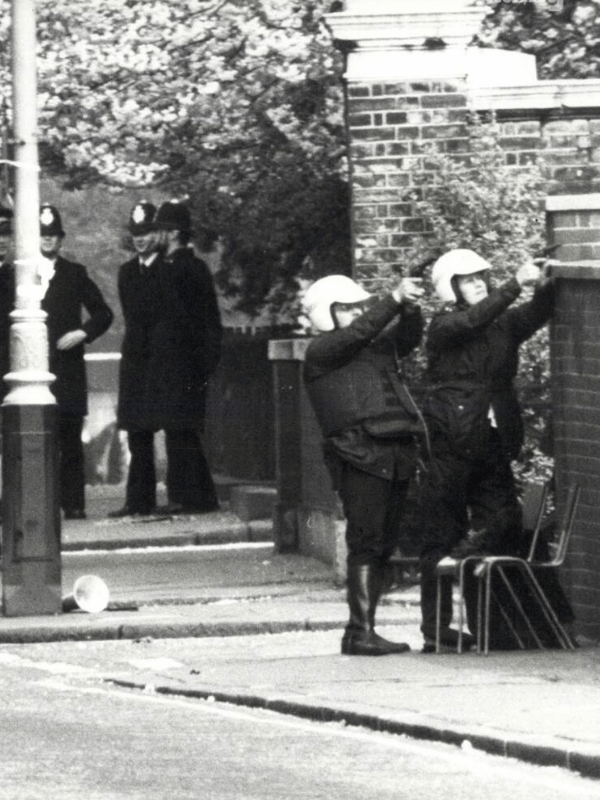
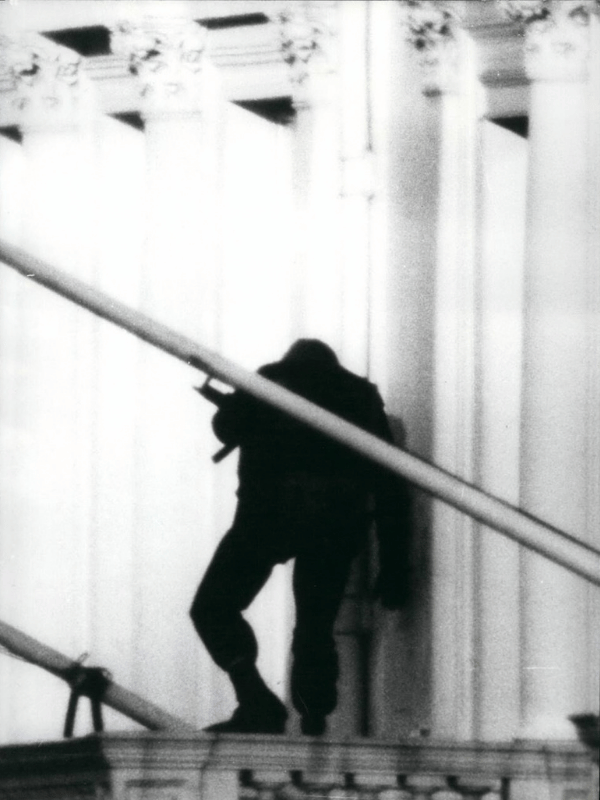
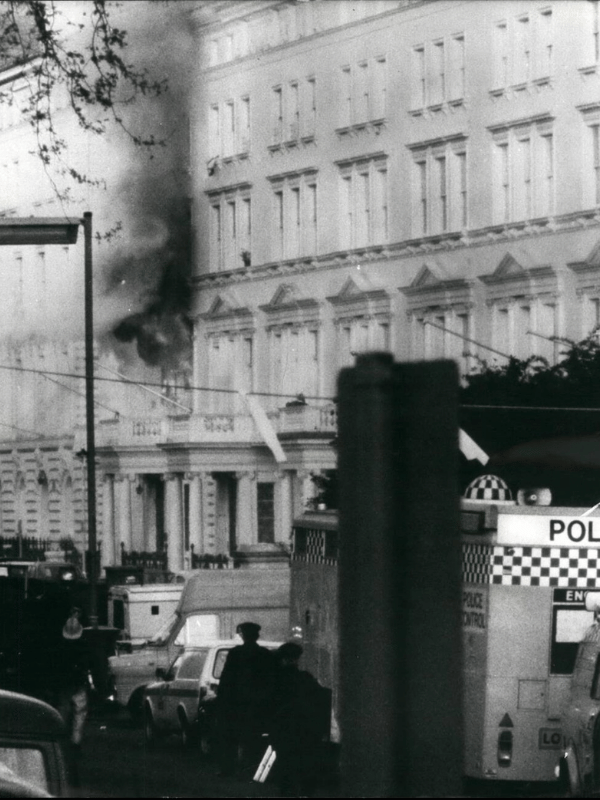
The Iranian Embassy Siege
1980
A dramatic confrontation with international terrorism directly challenged British executive authority on the streets of London, catapulting the nation's secret special forces into global prominence. At 11:30 a.m. on 30 April 1980, a group of six heavily armed gunmen from the Democratic Revolutionary Front for the Liberation of Arabistan stormed the Iranian Embassy at 16 Prince's Gate in South Kensington.
Funded and equipped by Iraqi intelligence, the militants took twenty-six hostages—comprising Iranian diplomatic staff, visitors, two BBC journalists, and a Metropolitan Police guard, Constable Trevor Lock. The gunmen demanded immediate political autonomy for Iran’s oil-rich Khuzestan Province and the release of ninety-one Arab prisoners held by the regime of Ayatollah Khomeini, threatening to execute a hostage every two hours if their demands were ignored.
Prime Minister Margaret Thatcher intervened directly to establish an unyielding, non-negotiation policy. Working through the emergency Cabinet briefing room, the government flatly refused to grant the terrorists safe passage out of the United Kingdom, while police negotiators spent five days spinning out talks to buy time for the military to prepare. The Special Projects Team of the 22 Special Air Service Regiment (SAS) was quietly deployed to London, constructing a full-scale replica of the embassy interior at Regent's Park Barracks to rigorously rehearse a rescue operation. The standoff reached a bloody breaking point on the afternoon of 5 May 1916—the sixth day of the siege—when the gunmen executed the embassy's chief press officer, Abbas Lavasani, and dumped his body onto the front doorstep.
The killing forced the state to switch immediately from police negotiation to military assault. At 7:23 p.m., the Prime Minister Thatcher signed the executive order transferring control of the scene to the military, launching Operation Nimrod. Seconds later, in full view of television crews broadcasting live to millions of households worldwide, black-clad SAS troopers abseiled from the roof and used explosive charges to shatter the first-floor balcony windows.
Armed with Heckler & Koch MP5 submachine guns, the assault teams cleared fifty-six rooms across six floors in a swift seventeen minutes of close-quarters combat. Inside the main embassy office, Constable Lock successfully tackled the terrorist leader to prevent him from firing on the remaining captives. The troopers killed five of the six terrorists and rescued nineteen surviving hostages. This flawless execution established a new global benchmark for counter-terrorism operations and permanently transformed the covert SAS into an iconic national symbol of British military capability.
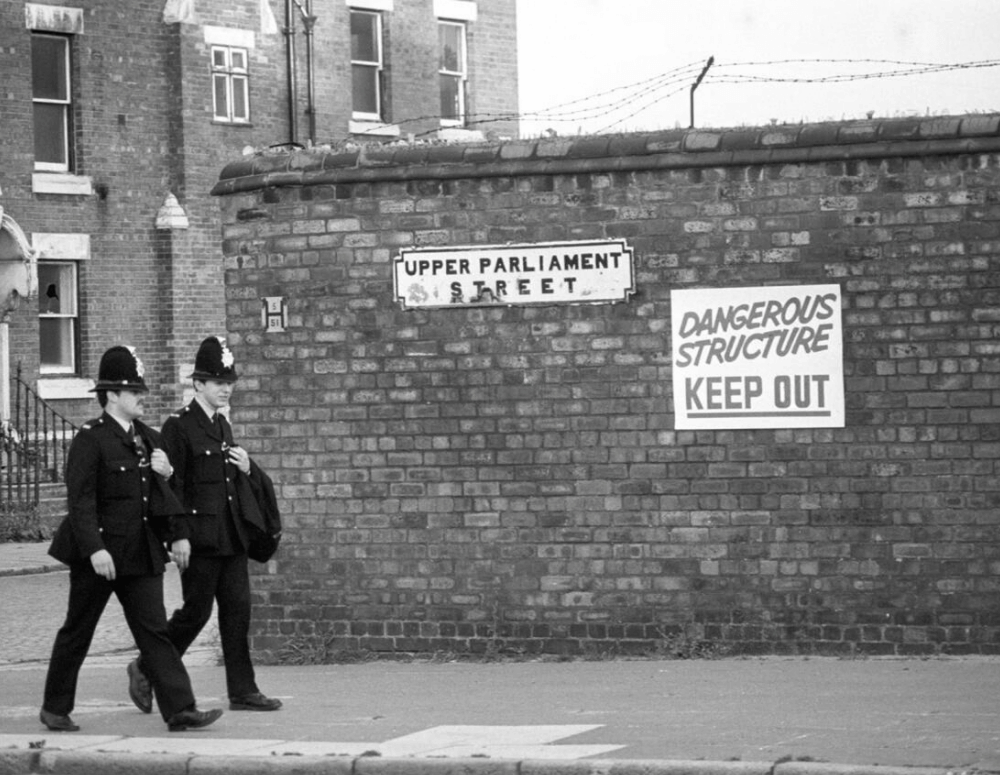
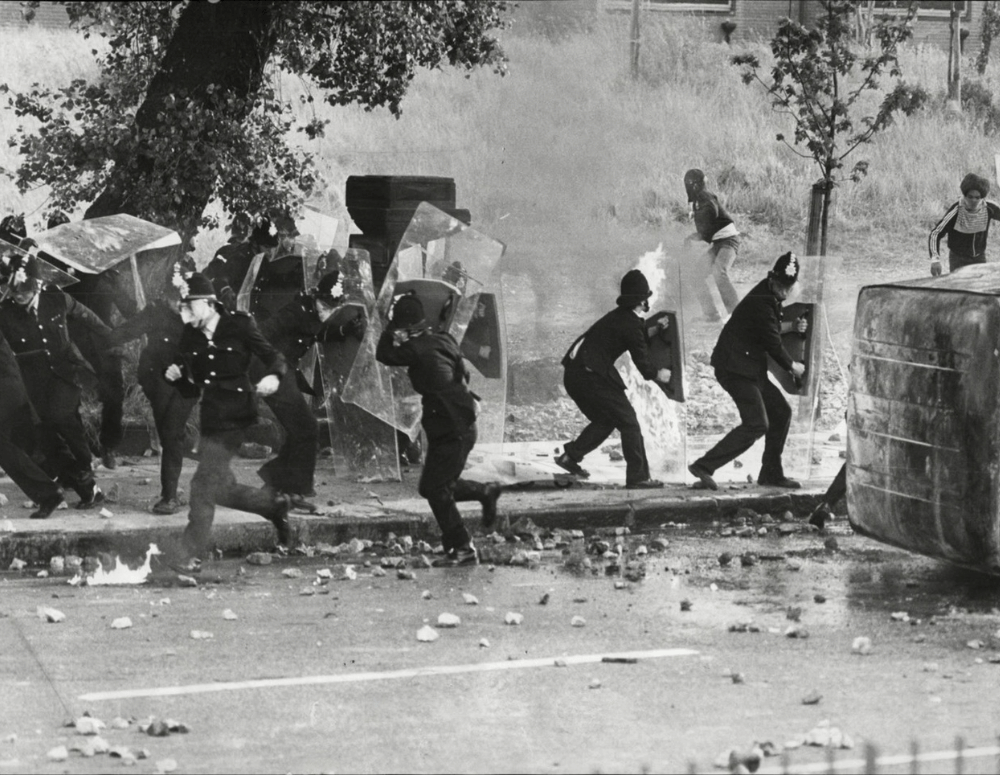
The Toxteth Riots
4–13 July 1981
The social fabric of post-industrial Britain suffered a violent breakdown during the summer of 1981, when long-standing friction between the police and local communities erupted into an intense street war in Liverpool. The trouble began in the inner-city district of Toxteth on the evening of 4 July 1981 following the arrest of a young black man, Leroy Cooper, on suspicion of taking a motorbike without consent. A group of local youths intervened to release him from a police van, sparking immediate skirmishes that quickly transformed over the subsequent days into a fierce, nine-day battle against the Merseyside Police.
The violence was heavily driven by the unique demographic and economic landscape of the Liverpool 8 area. Over the preceding two decades, Liverpool had suffered a massive 33% drop in population as more affluent residents moved away, trapping poorer families in areas of severe housing decay. Within the Granby ward of Toxteth—where the vast majority of Liverpool's black population lived—male unemployment had plummeted to nearly 40%, quadruple the national average.
For young black men in the neighborhood, the collapse of the local shipping docks left opportunities so scarce that actual unemployment was estimated between 70% and 80%. This economic misery was deeply aggravated by targeted harassment through the misuse of old "sus laws" which allowed officers to stop and search anyone on generic suspicion. Strikingly, the resulting disturbances were not a race riot between ethnic groups; instead, the neighborhood's black and white working-class youths united to form a single front to drive the police out of their community.
The rioters systematically pushed back police lines with waves of bricks, iron bars, concrete blocks, and petrol bombs, forcing the chief constable to authorize the deployment of CS gas—marking the very first time this chemical crowd-control agent was ever used against civilians on the British mainland. The intense clashes left over seventy local businesses completely burnt or demolished—including the landmark Rialto furniture building. In total, the conflict caused one civilian death, left nearly five hundred police officers injured, and resulted in over five hundred arrests—including an eighteen-year-old Curtis Warren, who would later rise to prominence as an international drug trafficker under the moniker "Cocky."
To address the national crisis, Home Secretary William Whitelaw appointed Leslie Scarman, Baron Scarman, to lead a sweeping public inquiry into the root causes of the nationwide inner-city disorders. The resulting Scarman Report acknowledged the severe racial disadvantage and deep poverty that fueled the violence, directly forcing the repeal of old stop-and-search laws. However, the post-riot years revealed a more complex criminal landscape under the surface of the community movement.
Local figures like Michael Showers, who had risen to prominence as a key community spokesman during the riots and subsequently founded the Liverpool 8 Defence Committee, used their local influence to mask a transition into highly organized, international narcotics importation. Alongside his brother Delroy Showers, Michael spearheaded major smuggling networks that ultimately flooded the region with illicit substances, culminating in a twenty-year prison sentence in 1991 for plotting to smuggle £2 million worth of heroin into the country.
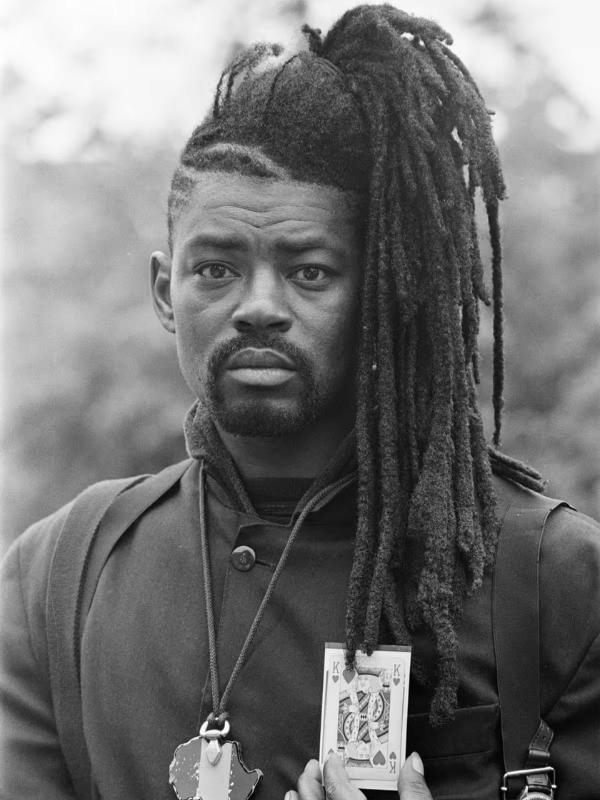
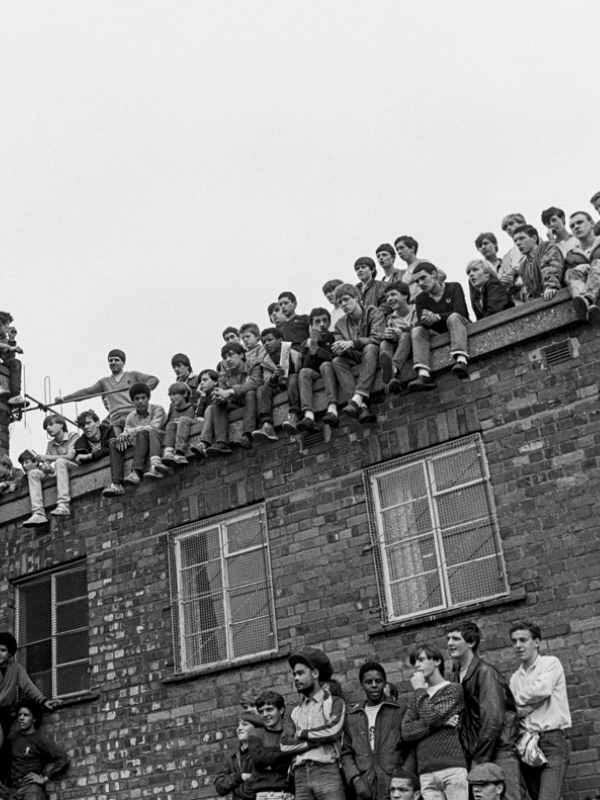
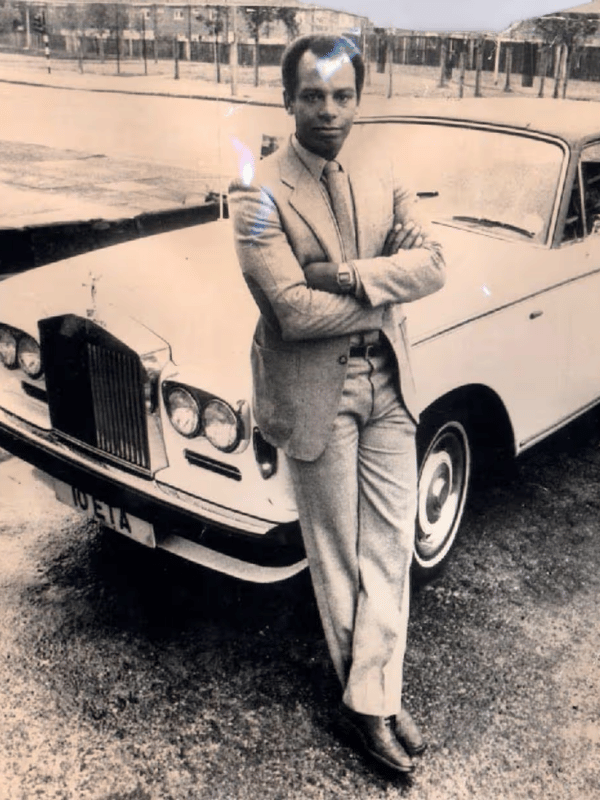
Redefining Citizenship: The British Nationality Act 1981
1981
For decades, the country had operated under the British Nationality Act 1948, which treated the entire empire as a single population pool and gave subjects across the globe a shared right of entry. However, the liquidation of landholdings and political focus over migration patterns rendered the old framework untenable, forcing the state to realign its passport regulations to match its contracted borders. Home Secretary William Whitelaw introduced the new legislative framework to the House of Commons in January 1981, aiming to align the legal definitions of citizenship directly with the right of entry.
The passage of the British Nationality Act 1981 on 30 October 1981 abolished the ancient common law principle of jus soli and replaced it with a lineage-based citizenship framework, permanently removing the automatic right of settlement for millions of post-colonial subjects. The core mechanism of the 1981 Act was the ending of jus soli, which had guaranteed citizenship to any individual born on British soil. In its place, the statute required at least one parent to be a British citizen or a legally settled resident at the time of the child's birth.
To enforce this boundary across the remaining network, the state partitioned the citizenry into three distinct categories: British Citizenship for residents of the home islands, British Dependent Territories Citizenship for populations inside remnants like Gibraltar, Hong Kong, and Bermuda, and British Overseas Citizenship for remaining subjects across former outposts.
This re-engineering uncoupled the possession of a British passport from the right of abode in the United Kingdom. While residents of Gibraltar immediately contested the changes and successfully secured full British citizenship through subsequent amendment pressures, millions of other overseas passport holders found their access to the UK restricted. The legislation remained the baseline for nationality law until updates like the British Overseas Territories Act 2002 restored full citizenship rights to the remaining dependencies, ending the post-colonial transition and anchoring the modern definition of a British citizen.
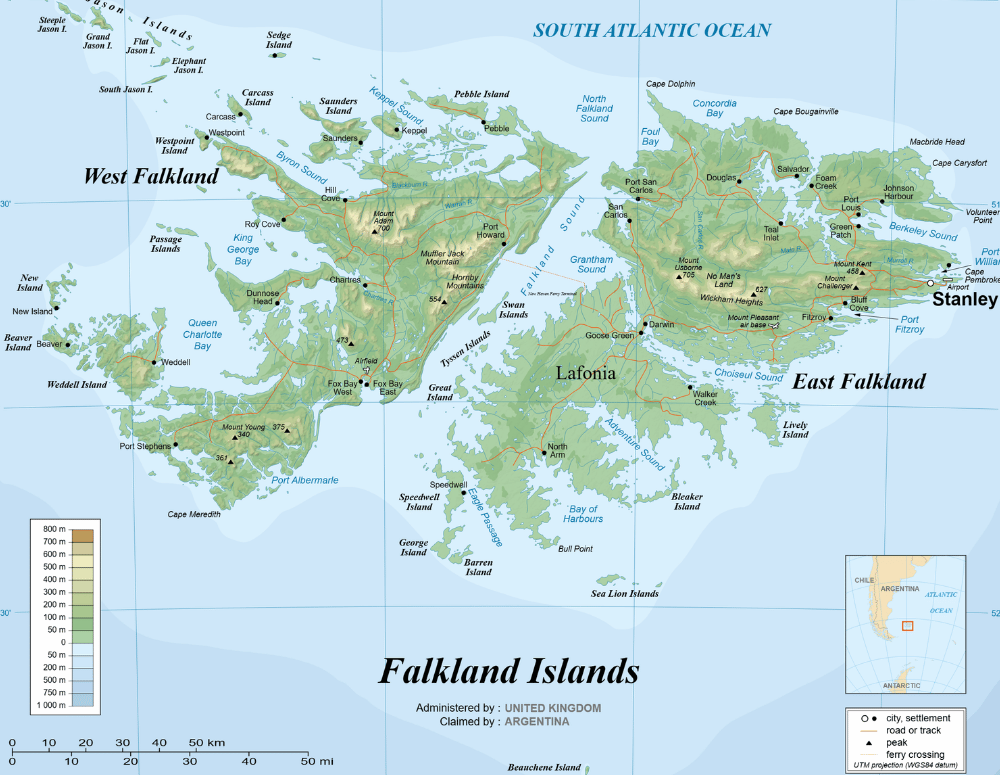
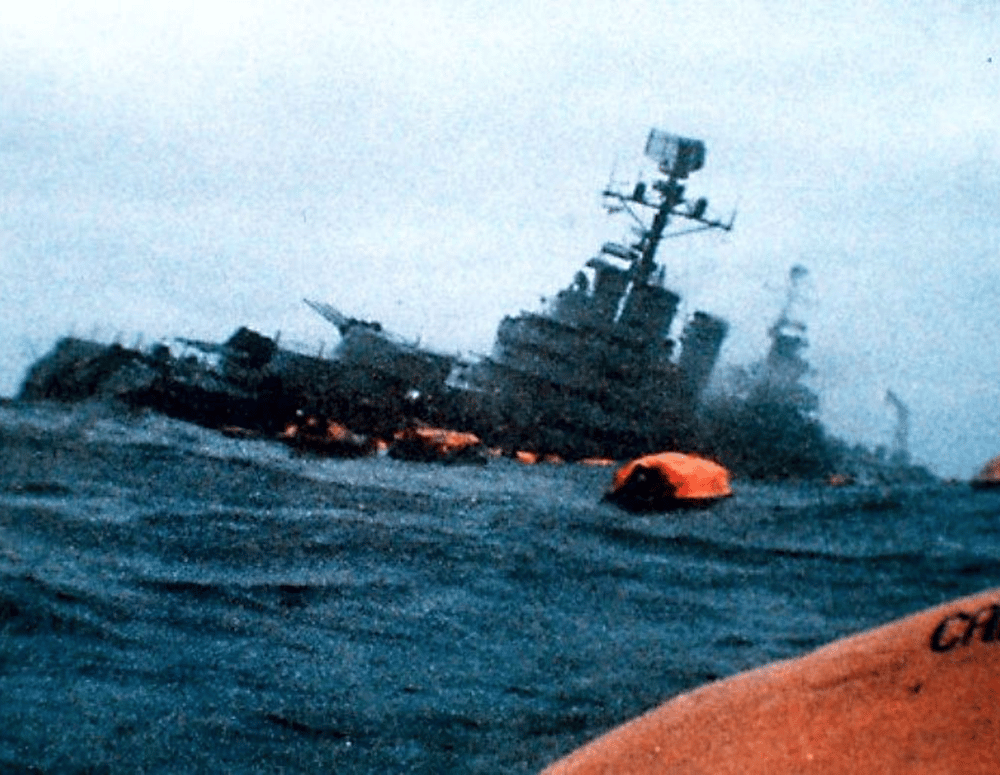
The Falklands Conflict
April – June 1982
Additional Information: Decline and Decolonisation / Naval Projection in the South Atlantic: The Falklands
On 2 April 1982, the military dictatorship of Argentina, led by General Leopoldo Galtieri, launched Operation Rosario, an amphibious invasion that overwhelmed a small detachment of Royal Marines at Government House in Port Stanley.
Prime Minister Margaret Thatcher responded by assembling a combined-arms military task force under Operation Corporate, dispatching a fleet of 127 warships, merchant vessels, and submarines 8,000 miles south into sub-Antarctic waters. The task force steamed into the South Atlantic to enforce a 200-mile Total Exclusion Zone around the islands, preparing for a maritime and land campaign to liberate the dependency.
The Argentine invasion of the Falkland Islands on 2 April 1982 triggered a ten-week conflict that ended with the unconditional surrender of Argentine forces at Port Stanley on 14 June 1982, securing British sovereignty over the dependency and restoring the state's military prestige.
The naval war faced a turning point on 2 May 1982, when the nuclear submarine HMS Conqueror torpedoed and sank the Argentine cruiser ARA General Belgrano outside the exclusion zone, keeping the Argentine surface fleet in port for the remainder of the conflict. Despite suffering casualties from airborne Exocet missile strikes—which sank the Type 42 destroyer HMS Sheffield and the merchant vessel Atlantic Conveyor—the task force executed an amphibious landing at San Carlos Water on 21 May 1982.
Infantry units of the Parachute Regiment, Royal Marines, and the Scots Guards advanced across the East Falkland terrain. They won close-quarter infantry actions at the Battle of Goose Green and Mount Tumbledown before forcing the surrender of the Argentine military governor, General Mario Menéndez, to Major-General Jeremy Moore at Port Stanley.
The conflict cost the lives of 255 British service personnel, three island civilians, and 649 Argentine troops. The victory checked the decline of British geopolitical prestige, contributed to the collapse of the Argentine military dictatorship, and secured Thatcher a large parliamentary majority in the June 1983 general election.
Further Information: The Falklands Conflict
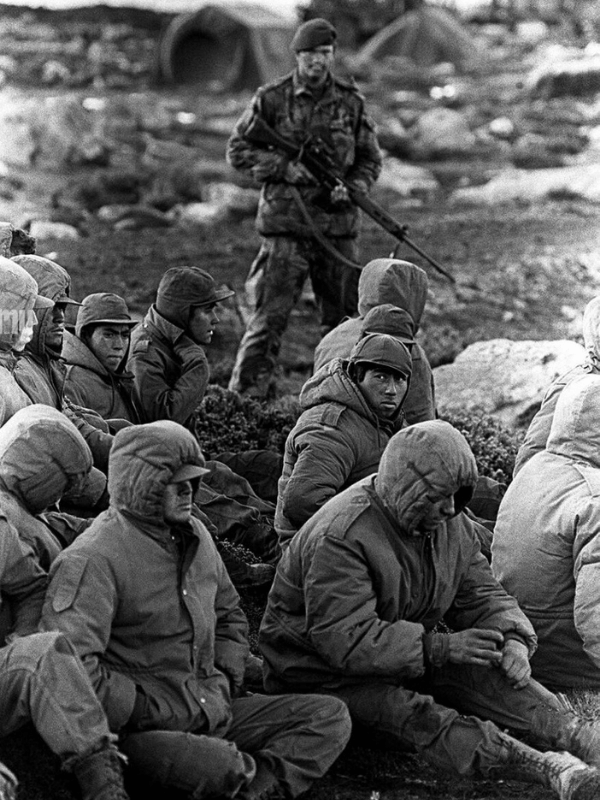
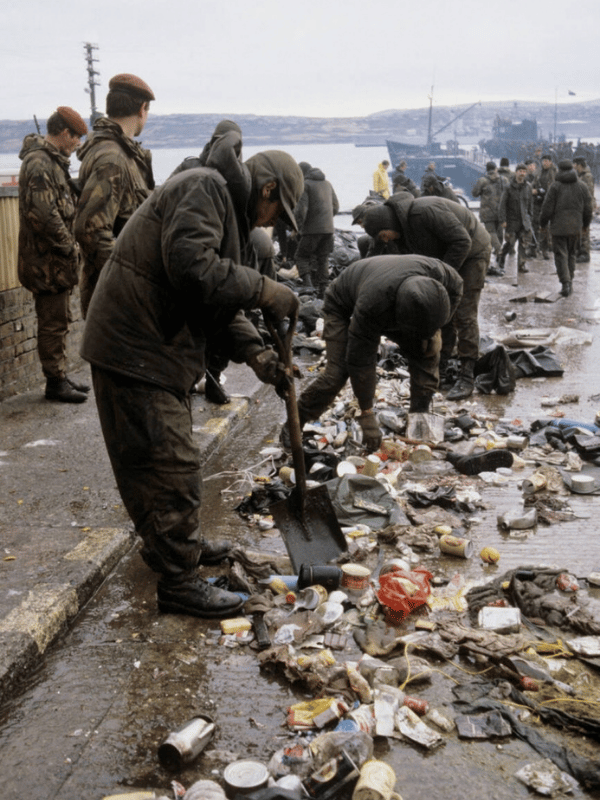
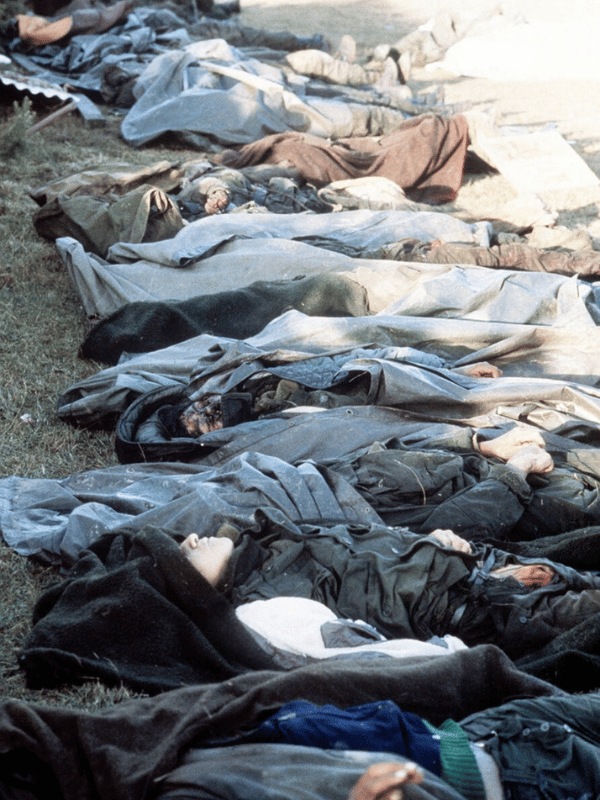
The Miners' Strike of 1984–1985 and the Battle of Orgreave
March 1984 – March 1985
On 6 March 1984, the National Coal Board under chairman Ian MacGregor announced a program to close 20 state-subsidized pits and eliminate 20,000 jobs across the coalfields. In response, National Union of Mineworkers President Arthur Scargill called a national strike without holding a universal member ballot, a decision that fractured union solidarity and led to the breakaway formation of the Union of Democratic Mineworkers in working coalfields like Nottinghamshire. The Thatcher administration met this resistance using the guidelines of the confidential Ridley Plan, a blueprint drafted in 1977 to prepare the state for a major industrial confrontation with organized labor.
The year-long miners' strike initiated on 6 March 1984 resulted in the total defeat of the National Union of Mineworkers, permanently breaking the industrial leverage of trade unions in British political life and allowing the Conservative government to accelerate pit closures. The government systematically built coal stockpiles at power stations, converted oil-fired generating plants, and established a National Reporting Centre to coordinate police deployments across county lines. This network intercepted and blocked flying pickets, turning the coalfields into an arena of physical confrontation between strikers and law enforcement.
The conflict reached its most violent point on 18 June 1984 at the Battle of Orgreave, a coking plant near Rotherham in South Yorkshire, where an estimated 6,000 striking miners engaged in a direct clash with 5,000 riot police gathered from 18 separate constabularies.
Armed with batons and supported by mounted units and short-shield snatch squads, the police lines broke the massed pickets. The confrontation resulted in 95 miners charged with riot and unlawful assembly, though all prosecutions later collapsed in court amid allegations of fabricated police evidence and manufactured statements. Exhausted by a winter without strike pay, facing bankruptcy, and divided by working miners, the NUM voted to return to work without an agreement on 3 March 1985. The defeat broke the veto power of trade unions over government policy and allowed the rapid winding down of the industry.
The number of working miners dropped from 170,000 in 1984 to fewer than 3,000 by the time the state apparatus passed the Coal Industry Act 1994, which privatised the remaining pits and finalized the dominance of free-market economics over organized labor.
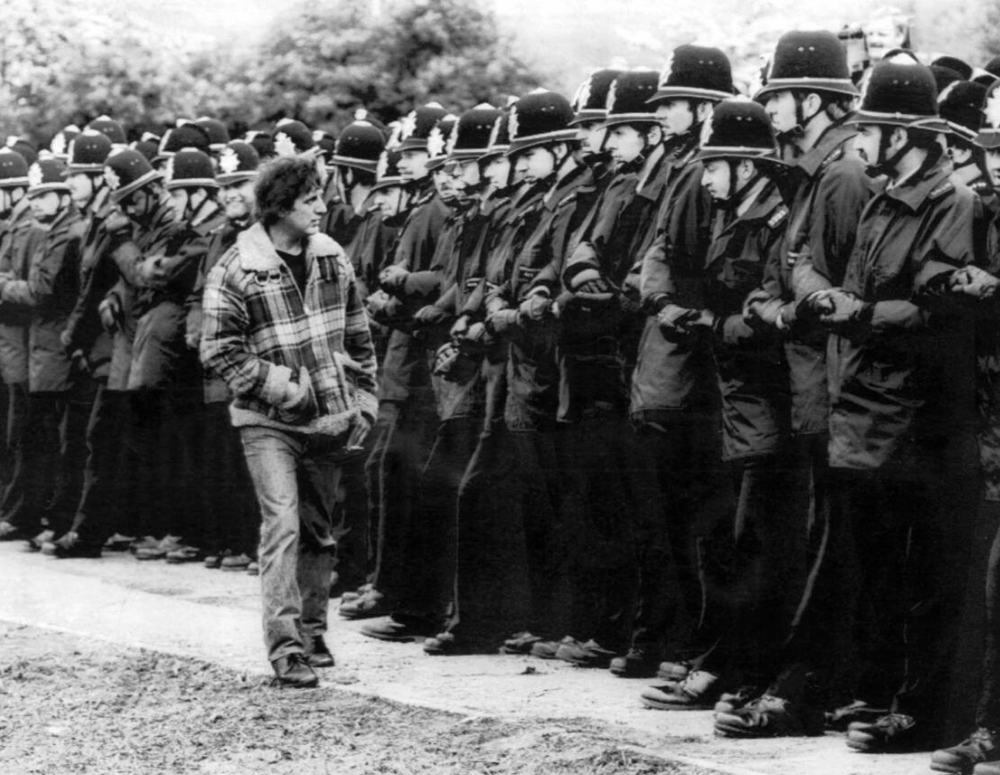
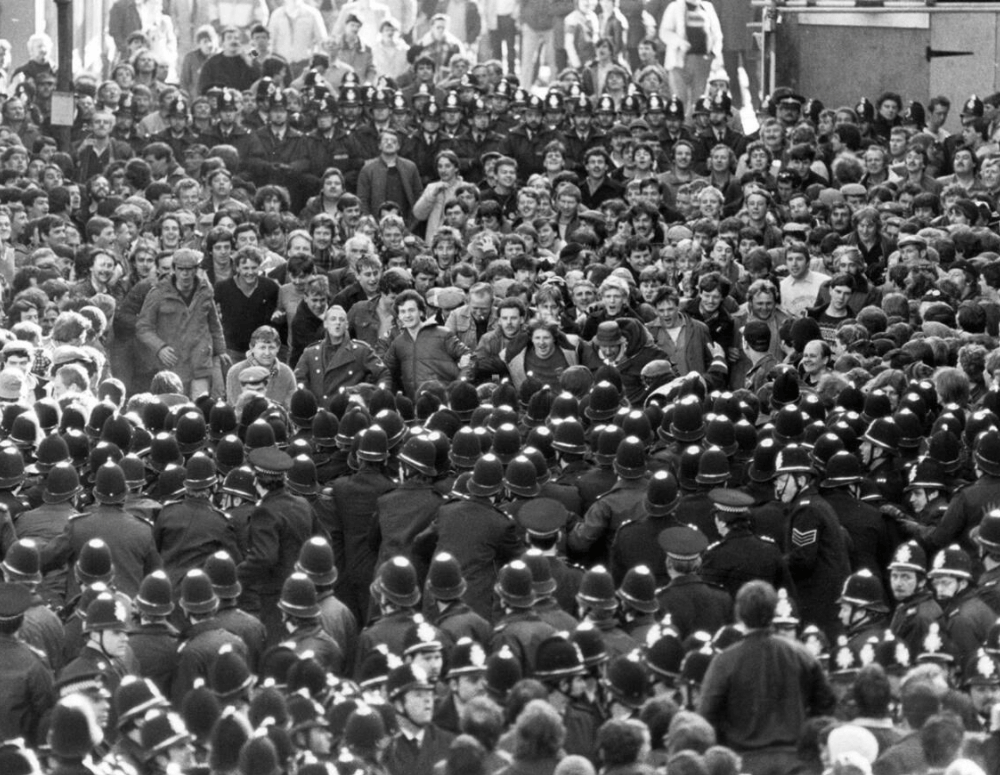
The Big Bang
27 October 1986
Additional Information: The Age of Migration / The Financial Empire
The global economic architecture of the City of London was completely reshaped overnight by a sweeping package of financial deregulation designed to restore Britain as the preeminent international hub for capital. For decades, the London Stock Exchange had operated as an exclusive, closed-shop cartel governed by rigid, anti-competitive restrictions.
Trading was strictly divided between "brokers," who acted as agents for clients on a fixed-commission basis, and "jobbers," who independent wholesalers owned stock and executed the actual trades on the physical market floor. To shatter this stagnant framework and counter the rising competition from computerized markets in New York and Tokyo, the Conservative government under Prime Minister Margaret Thatcher drove a radical legislative overhaul that took full effect on 27 October 1986, a milestone instantly branded as the "Big Bang."
The new regulations systematically dismantled the ancient pillars of the British financial establishment. The statute completely abolished the mandatory fixed-commission rates on trades, allowing firms to compete freely on prices, while entirely outlawing the mandatory separation between brokers and jobbers to permit banks to act as single, unified trading institutions. Crucially, the reforms lifted the historic ban on foreign ownership of British stockbroking firms, triggering a massive, high-stakes wave of international acquisitions where major American, European, and Japanese banks bought up established City merchant houses. The physical reality of trading changed instantly; the traditional open-outcry method—where clerks shouted across a chaotic market floor—was permanently replaced by the electronic Stock Exchange Automated Quotation (SEAQ) terminal network, allowing traders to execute multi-million-pound deals from computerized desks.
This rapid transformation turned the City into a hyper-efficient, Americanized financial center. The sudden influx of international corporate capital triggered an unprecedented boom, tripling the daily trading volume of the exchange within a year and creating a new class of wealthy young city workers. However, the deregulation permanently severed the old social networks of the financial district, replacing traditional trust-based partnerships with high-risk corporate environments.
By transforming London into a highly integrated, deregulated node of global capitalism, the Big Bang laid the foundational groundwork for the massive expansion of the modern British financial service sector, while concurrently introducing systemic structural vulnerabilities that would expose the country to the full weight of future international financial crises.
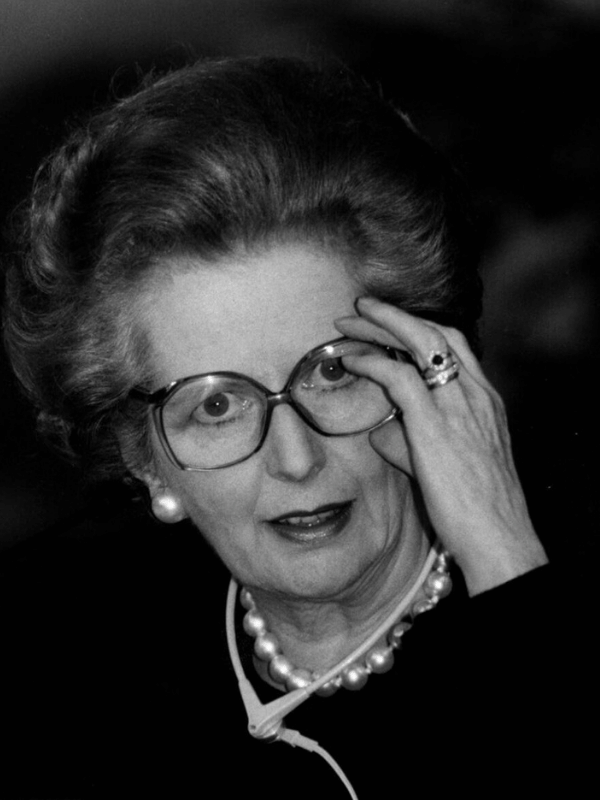
The Poll Tax Riots and the Fall of Thatcher
March - November 1990
In April 1989, the Conservative government implemented the Community Charge in Scotland before extending the system to England and Wales on 1 April 1990. Popularly termed the Poll Tax, this measure replaced domestic property rates with a flat tax levied on every adult resident, regardless of income or property value.
The enforcement of the tax triggered a campaign of non-compliance coordinated by the All-Britain Anti-Poll Tax Federation, with millions of citizens joining the "Can’t Pay, Won’t Pay" movement and refusing to register or pay, leaving local authorities unable to collect municipal revenues.
The introduction of the Community Charge prompted the Trafalgar Square riots on 31 March 1990 and an internal Conservative Party challenge that forced the resignation of Margaret Thatcher on 28 November 1990, ending her eleven-year premiership.
Tensions culminated on 31 March 1990 when a demonstration of over 200,000 protesters in London’s Trafalgar Square erupted into major rioting. Protesters clashed with the Metropolitan Police, setting fire to construction scaffolding, overturning cars, and looting shops across Charing Cross Road and the West End, resulting in over 400 injuries—including 374 police officers—and 341 arrests.
The combination of urban rioting, mass tax evasion, and Thatcher’s opposition to European monetary integration—crested by her "No! No! No!" speech in Parliament—prompted an internal party challenge. Senior Conservative MPs recognized that the tax threatened their parliamentary majority in the upcoming election.
On 14 November 1990, former Defence Secretary Michael Heseltine launched a challenge for the leadership. Although Thatcher won the first ballot on 20 November with 204 votes to Heseltine's 152, she fell four votes short of the required margin to prevent a second ballot.
Following consultations with her Cabinet colleagues who indicated she had lost their backing, Thatcher withdrew from the contest. She resigned her office on 28 November 1990, allowing Chancellor John Major to ascend as Prime Minister and subsequently abolish the tax in favor of the Council Tax system.
The 1990 Transition
November 1990
Additional Information: The Age of Migration
In October 1990, the United Kingdom joined the European Exchange Rate Mechanism at a parity rate of DM 2.95 to the pound, a decision that pegged the currency directly to the German Deutsche Mark. This monetary move occurred alongside a massive realignment of the workforce, as employment in the service and financial sectors rose to 68% of Gross Domestic Product while traditional heavy manufacturing fell to 22%. Senior Conservative MPs recognized that the domestic economic crisis over the Poll Tax and fractures regarding European integration threatened their parliamentary majority, prompting a leadership contest that brought an abrupt end to the existing administration.
The departure of Margaret Thatcher from executive power on 28 November 1990 marked the closing of the post-war epoch, handing the administration over to her successor, John Major, and setting the boundary for the modern era. The forty-five years of post-war history transformed the framework of the British state, shrinking its territorial borders while redesigning its domestic economy and social laws.
Great Britain emerged from these four decades as a service-based economy that had reduced its heavy manufacturing engines. The country navigated the collapse of the empire, built a domestic welfare state around the National Health Service, and integrated its legal and commercial operations into the European community framework.
The data from this 1990 transition showed a country at the edge of a new demographic chapter. The infrastructure of the realm—including transport lines, communication networks, and urban centres rebuilt after the Blitz—stood ready to interface with a globalized international system. By breaking the post-war consensus and shifting its focus away from the imperial orbit to concentrate on its domestic capital markets, the country stabilized its institutional governance. This transition set the historical baseline before the country entered the international movements of the modern age of migration, while the ERM peg set up the precise financial conditions that led to the Black Wednesday market collapse in September 1992.
Stay Connected
Post-War Britain FAQs