
Norman England
The Norman Conquest and Anglo-Norman State
Additional Information: The House of Normandy
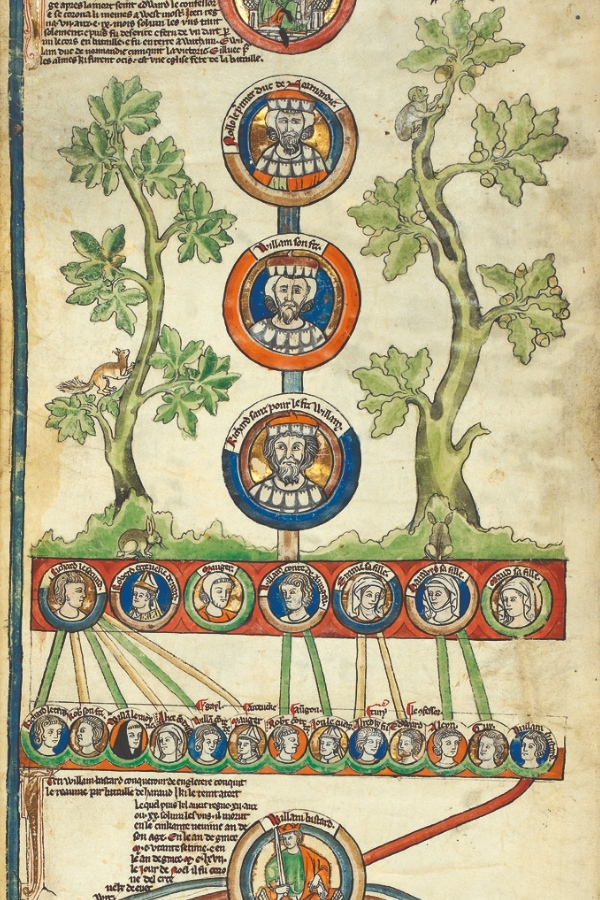
The old Anglo-Saxon world died in a single afternoon on a blood-soaked hill in Sussex, crushed by the high-velocity cavalry charges of a ruthless continental army. William the Conqueror’s victory at the Battle of Hastings did not just change the occupant of the throne; it instantly decapitated the native English ruling class, wiping out ancestral family lineages to install a tiny, French-speaking military elite at the absolute apex of society.
Throughout this early Norman era, we will chart and explore the turbulent century and a half of Anglo-Norman transformation, scrutinising the shifts that followed as the four Norman monarchs made a lasting mark on the country.
Page Contents:
Rise of "The Bastard" Duke of Normandy
1035 - 1065 AD
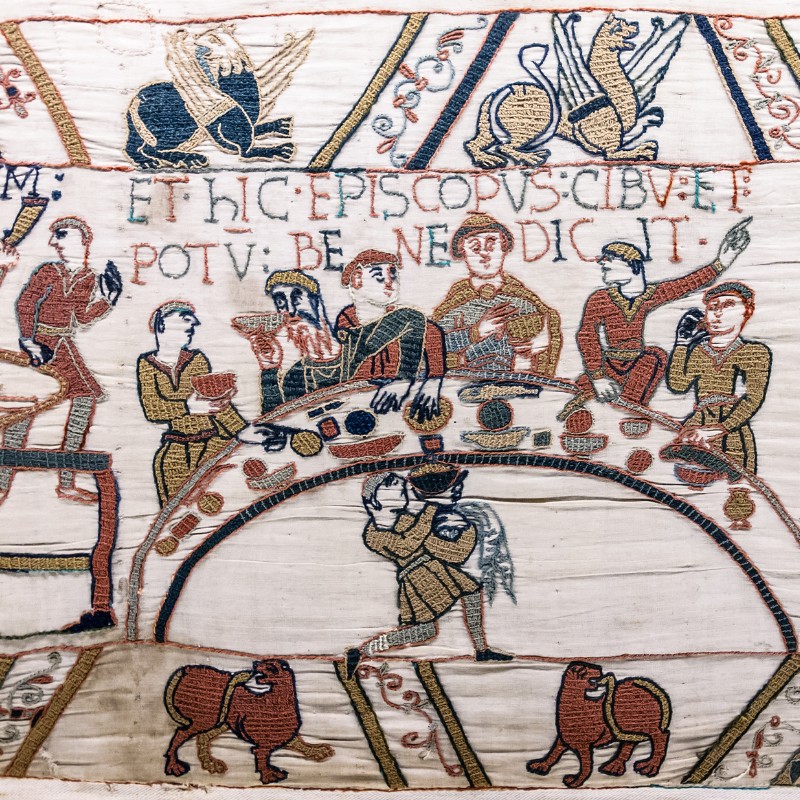
The cross-Channel military expedition of 1066 was the direct consequence of three decades of high-intensity political survival, administrative stabilisation, and military consolidation executed at the core of the Duchy of Normandy. Born in approximately 1028 as the illegitimate offspring of Duke Robert I and a tanner’s daughter named Herleva of Falaise, William was universally designated throughout his formative years by contemporary chroniclers as "William the Bastard." When his father died unexpectedly in 1035 AD while returning from a pilgrimage to Jerusalem, William inherited the ducal throne at just seven years old, instantly plunging the northwestern territories of France into a lawless decade of anarchic baronial warfare. Rival aristocratic factions aggressively fractured the duchy into localised strongholds, launching violent proxy wars to either control the young duke's regency or execute him to install alternative lineages.
William’s youth functioned as a brutal, unvarnished lesson in raw physical and military survival, and he narrowly escaped multiple midnight raids, watching his personal guardians, tutors, and regents—most notably Gilbert of Brionne and Osborn the Seneschal—be systematically murdered in his own bedchamber. The definitive turning point was executed in 1047 AD when William secured the direct military intervention of King Henry I of France to crush a massive, existential baronial coalition at the Battle of Val-ès-Dunes near Caen. This decisive tactical victory allowed William to launch a top-down purge of his duchy, and he spent the next fifteen years launching relentless campaigns to fortify his frontiers, annex the adjacent strategic County of Maine, and systematically demolish the private stone castles of his rebellious internal nobility.
Through this continuous, high-speed warfare, William re-engineered the Duchy of Normandy into the most aggressive, highly integrated, and intensely militarised fiscal-military state machine in Western Europe. To protect his borders from southern encroachment, he formed a critical alliance with Count Baldwin V of Flanders by marrying his daughter, Matilda of Flanders, around 1051 AD, a union that granted him invaluable diplomatic depth across northern France.
Internally, he systematically implemented the Truce of God to ban all private baronial blood-feuds, forced every knight on his soil to swear an uncompromised oath of personal fealty directly to the ducal crown, and completely overhauled the ecclesiastical hierarchy. He installed highly literate, loyal continental administrators—most notably the Italian canon lawyer Lanfranc of Bec—who transformed the Norman Church into an administrative engine of state power, providing the legal and financial structures required to fund and coordinate a permanent, professional conquest army.
Norman invasion and the death of Harold II
1066 AD
Additional Information: Genetic History of the English People / The Anglo-Norman Aristocracy and High Medieval Dynastic Admixture
Persistent northerly headwinds pinned William's transport fleet at the River Somme for six weeks, unexpectedly generating an immense strategic advantage for the Normans by exhausting the English defenders. While William's provisions held, King Harold II was forced to keep his southern fyrd mobilised past the traditional harvest deadline, creating severe domestic strain until a massive Norwegian invasion under Harald Hardrada struck the far north and forced the King's hand. Mandated to protect his borders, Harold marched his elite housecarls 185 miles north to achieve a brilliant victory, completely destroying the Viking force at the Battle of Stamford Bridge on 25 September.
Just two days later, however, the Channel winds finally swivelled to shatter the Anglo-Saxon triumph, and, seizing his moment, William crossed the sea unopposed and landed his cavalry at Pevensey on 28 September, forcing the English king to immediately turn his battered army around and execute a grueling second forced march down the entire length of the island to defend the south. This relentless double-march pushed the native infantry to the absolute limits of human endurance, directly setting up the fatal military imbalances that would decide the fate of the battle of Hastings.
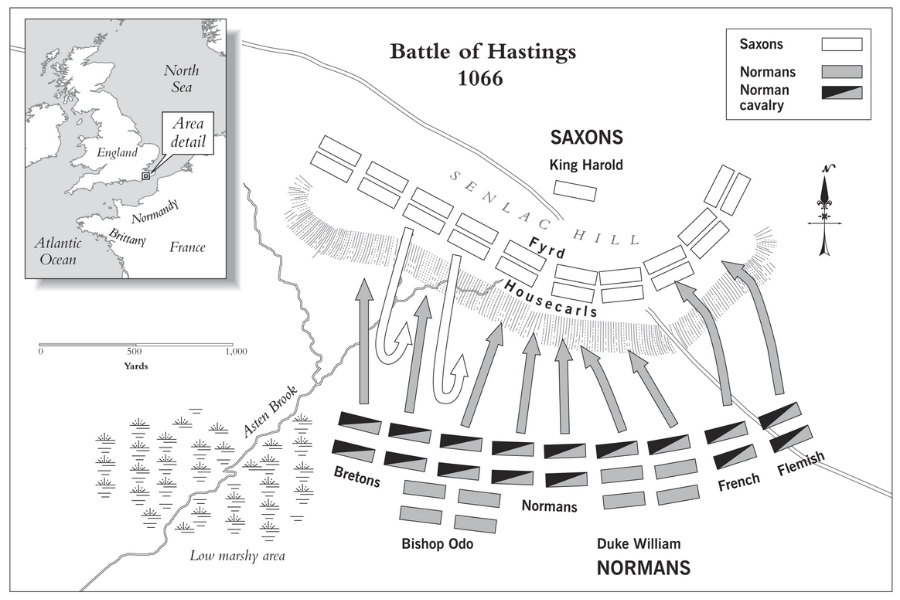
On the morning of 14 October 1066 AD, the two military machines met at Senlac Ridge near Hastings, with King Harold deploying 7,000 exhausted infantrymen into a compact, 800-metre shield wall across the high brow of the sloped hill. For seven gruelling hours, the line held with absolute mechanical endurance, slaughtering the Norman cavalry with their heavy two-handed battleaxes and driving William's left flank into a panicked retreat.
The turning point occurred late in the afternoon when William un-helmeted his face to rally his retreating lines, ordering his archers to fire high, falling arrow volleys down into the unshielded centre of the English mass. Concurrently, Norman commanders deployed a series of calculated feigned retreats, tricking the less-disciplined fyrd into breaking their locked ranks to launch uncoordinated pursuits down the slope.
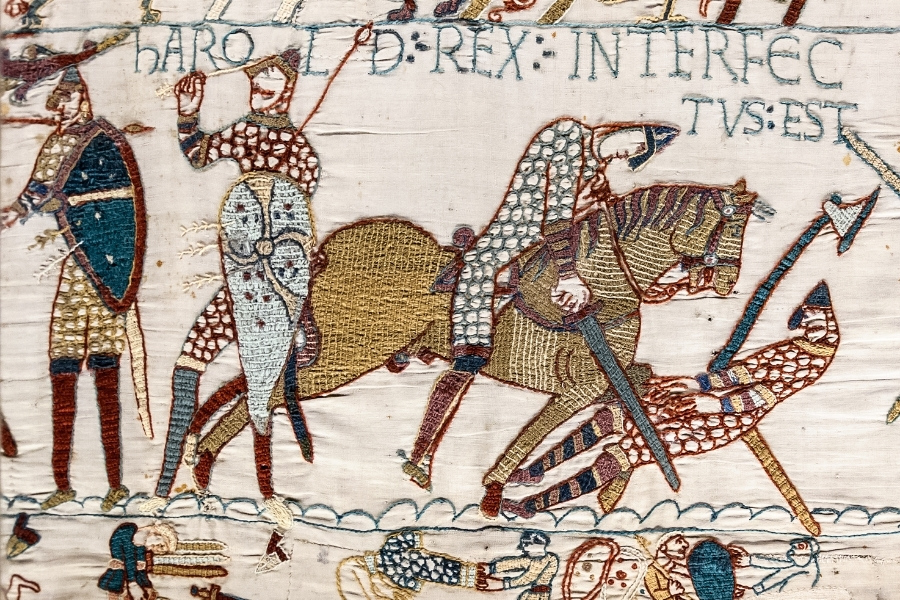
Once the shield wall fractured, the Norman heavy cavalry swept into the openings, cutting down the exposed infantry and targeting the King's personal guard. The engagement reached its conclusion as a high concentration of Norman archers concentrated their falling volleys directly around the royal standard. King Harold II was struck in the face by a falling arrow, an injury that blinded him and broke the coordination of the defensive center.
Capitalizing on his incapacitation, a cohort of four elite Norman knights—including Eustace of Boulogne and Hugh of Montfort—penetrated the collapsing Anglo-Saxon lines to execute a direct assault on the monarch. The knights attacked the wounded King, killing him with multiple sword blows before mutilating his body on the field.
This death broke the remaining resistance of the native army, causing the housecarls to retreat into the woods and leaving William the Conqueror in possession of an unchallenged battlefield, terminating the Anglo-Saxon line and shifting supreme power to the Norman dynasty.
The Submission of London
1066 - 1069 AD
In the aftermath of the slaughter at Hastings, Duke William did not march directly into London, instead, recognising that the city was fortified and that the surviving Anglo-Saxon elite had rallied to proclaim the young Edgar the Ætheling as king, he launched a brutal psychological campaign across the surrounding country.
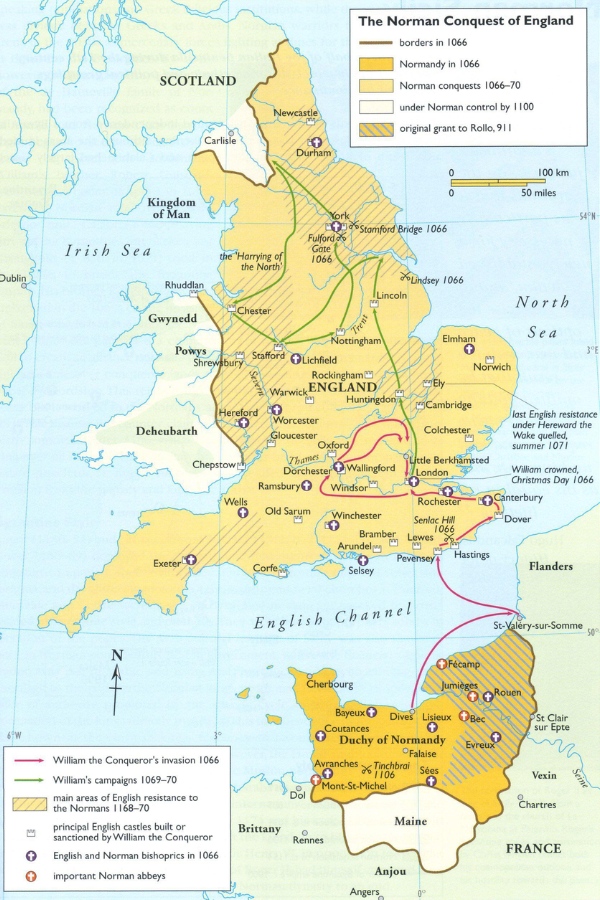
Marching his army from Southwark, William led his forces in a massive loop westward through Surrey, Hampshire, and Berkshire to avoid a direct assault on London's Roman walls. Along this path of destruction, Norman cavalry columns systematically burned villages, slaughtered livestock, and seized agricultural crops in Sussex and Kent before capturing the royal treasury at Winchester without violence. William then marched to Wallingford, where he established a temporary fortification and forced the submission of Archbishop Stigand.
Continuing his movement northeast through Oxfordshire and Hertfordshire, William's forces cut off the remaining northern and western supply lines to the capital. This systematic isolation broke the political will of the remaining English leadership.
In December 1066, Edgar the Ætheling, Archbishop Ealdred of York, and the northern Earls Edwin and Morcar traveled out to the settlement of Berkhamsted, offering their submission to the Duke and presenting him with the keys to London.
William entered London unopposed and was formally crowned King of England at Westminster Abbey on Christmas Day 1066, however, the coronation ceremony descended into chaos when the Norman guards outside mistook the shouts of acclamation from the English for an assassination attempt, setting fire to the surrounding houses and rioting through the streets.
The submission remained highly fragile, as the years between 1067 and 1069 saw uncoordinated native rebellions break out across the country to challenge the initial Norman settlement. In the western Marches, the wealthy Shropshire thane Eadric the Wild formed a military alliance with Bleddyn ap Cynfyn, Prince of Gwynedd, leading an armed force that destroyed the Norman border garrison at Hereford and plundered the surrounding valleys. At the same time, the southwestern shires rose in open revolt during the winter of 1067, led by King Harold’s mother, Gytha, who fortified the wealthy trading center of Exeter and refused to swear fealty to the Crown.
William responded by marching a combined force of Norman cavalry and native English levies through severe winter storms to lay siege to Exeter for eighteen consecutive days. The King's miners worked to undermine the ancient Roman walls, forcing the citizens to surrender the city keys after a breach was made, while Gytha escaped by sea to seek exile on the island of Flat Holm.
To permanently secure his authority over the rebellious western shires, William ordered the construction of Rougemont Castle on the highest ground within the city walls, garrisoning it with professional troops under Baldwin de Meules before marching north to confront a growing rebellion in Yorkshire.
The Harrying of the North
1069 - 1070 AD
The ultimate crisis of the early Norman conquest arrived in late 1069 AD, when the northern English nobility joined forces with Edgar the Ætheling and a massive Danish invasion fleet sent by King Sweyn II. The combined rebel force stormed York, defeated the Norman garrison, and seized military control of the north. William responded with an unprecedented campaign of destruction, operating with the strategic objective of rendering northern England permanently incapable of launching further rebellions or supporting future Scandinavian landings.
During the winter of 1069–1070 AD, William marched his cavalry through Yorkshire, Durham, and Cheshire, splitting his forces into mobile raiding parties to execute the Harrying of the North. This campaign functioned as a deliberate eradication of civilian infrastructure; Norman troops burnt villages to the ground, slaughtered livestock, and destroyed stored seed grain, agricultural tools, and granaries to induce an immediate famine across the region.
The physical consequences of this campaign resulted in widespread suffering and social collapse. Contemporary chroniclers recorded that over 100,000 English people died of starvation and exposure, with survivors forced to eat domestic animals or sell themselves into permanent servitude to secure food. Modern demographic analyses and the Domesday Book of 1086 verify this economic devastation, showing that nearly twenty years after the campaign, a vast portion of the northern population had vanished through death or displacement. Swaths of Yorkshire territory remained completely unpopulated, marked in the official royal tax surveys with the single Latin entry: Westa, or waste.
The Siege of Ely and Final Saxon Resistance
1070 - 1071 AD
With the north thoroughly devastated, the final pocket of organized Anglo-Saxon resistance gathered within the waterlogged fens of East Anglia. By 1070 AD, a local leader and tenant of Peterborough Abbey named Hereward the Wake established a secure marshland stronghold on the isolated Isle of Ely in Cambridgeshire. Hereward was joined by Earl Morcar of Northumbria and a group of surviving English nobles who refused to accept Norman rule, launching an effective campaign of ambush and harassment against the occupation forces.
That same year, Hereward led a daring raid on Peterborough Abbey alongside Danish fleet commanders, plundering its wealth and ecclesiastical treasures to prevent them from falling into Norman hands. King William recognized that this marshland stronghold threatened the stability of the east, prompting him to personally lead his army to the fens in 1071 AD to launch a comprehensive siege operation.
Because the island was surrounded by deep, treacherous bogs and open water, William forced hundreds of local laborers to construct a large timber assault causeway over two miles long to carry his heavy cavalry and infantry across the marshes. According to contemporary accounts within the Gesta Herewardi, the English forces successfully sabotaged the initial build by setting fire to the dry reeds and collapsing the wooden structure, which drowned numerous armored Norman knights in the deep mud.
William countered this setback by building a sturdier second causeway and negotiating with local monks from Ely Abbey—who feared the confiscation of their lands—to reveal a secret navigable path through the bogs. Utilizing this route, the Norman troops successfully breached the island, defeating the remaining defenders and capturing Earl Morcar. Hereward escaped into the dense woodlands, marking the definitive end of native Anglo-Saxon military resistance on the island and completing the Norman conquest.
Norman Feudalism and the Destruction of the Native Elite
1070 - 1085 AD
Additional Information: The History of the Church in England / Feudal Restructuring After the Norman Conquest
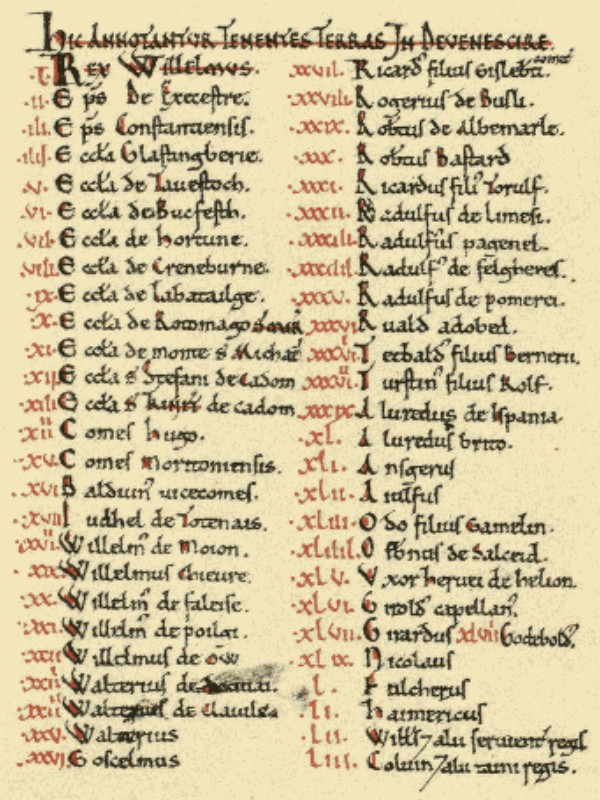
By 1075, King William capitalised on the defeat of the native rebellions to orchestrate a redistribution of property, power, and wealth across England. He confiscated the arable land from the native Anglo-Saxon ruling class, removing the old noble lineages of thegns and ealdormen who had governed the shires for centuries. In their place, he installed a centralised continental feudal system, declaring that all property belonged entirely to the Crown. Under this arrangement, which was recorded in the Domesday Book in 1086, the King granted the conquered territories to roughly one hundred and seventy elite Norman barons, known as tenants-in-chief, who held their estates directly from the monarch as royal fiefs.
The blueprint of this incoming feudal order relied on a contractual arrangement known as knightly tenure. Under this mechanism, the great barons did not own their lands unconditionally; they held them strictly in exchange for providing a fixed quota of heavily armoured cavalrymen to serve in the King's army for a minimum of forty days a year. To fulfill the logistics of this military contract, these paramount lords further subdivided their estates through a process called subinfeudation, granting smaller regional manors to their own trusted Norman followers, who became the local sub-tenants.
This systematic redistribution executed a near-total demographic replacement of the native English elite from the upper echelons of society. Under the final settlement, the King retained twenty percent of the land for his personal royal estates, while twenty-five percent was granted to the Church to anchor Norman ecclesiastical authority. The remaining territory was distributed among the nobility, with approximately fifty percent awarded to the Norman barons who provided the military crown quotas. This left less than five percent of the country's landholdings in the hands of the surviving native Anglo-Saxon aristocracy, demoting the native population to the status of unfree peasant labourers, or villeins, who were legally bound to the estates of foreign, French-speaking masters.
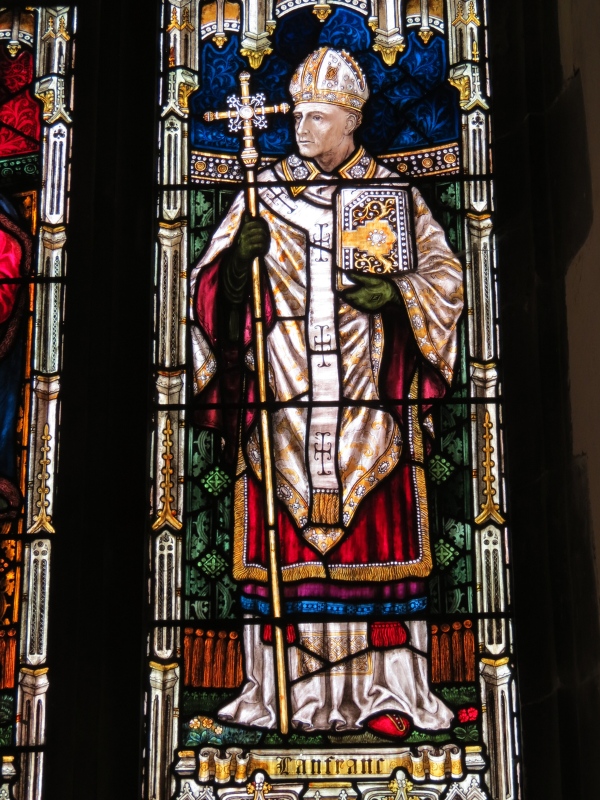
This displacement extended deep into the ecclesiastical hierarchy as well; by 1080, every single Anglo-Saxon bishopric and major abbacy was systematically purged of native clergy and replaced by Norman churchmen, most notably the Italian canon lawyer Lanfranc, who was appointed Archbishop of Canterbury. This complete secular and spiritual takeover allowed the Norman Crown to project legal and military control over every shire, turning the conquered country into an intensely monitored asset for the monarchy.
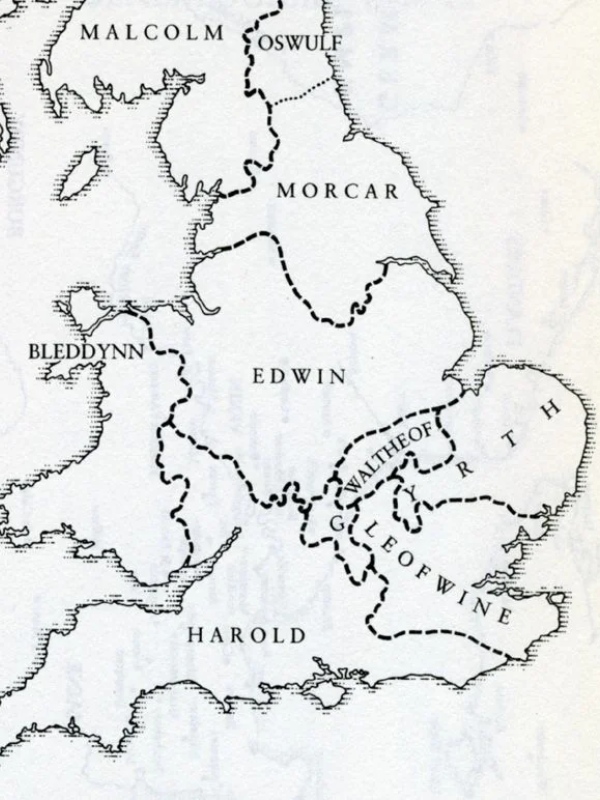
Pre Conquest Earldoms:
Prior to the Norman Conquest of 1066, the country was divided between four main earldoms—Wessex, Northumbria, East Anglia, and Mercia—which concentrated vast lands and political authority in the hands of a few powerful native Anglo-Saxon families.
Wessex: Earl Harold Godwinson (1053–1066) — Assumed control of the country's wealthiest southern earldom following the death of his father, Earl Godwin, holding it until his coronation as King Harold II and his subsequent death at Hastings.
East Anglia: Earl Gyrth Godwinson (1057–1066) — Appointed to the eastern counties by Edward the Confessor to expand the provincial influence of the Godwin family across the shires, holding the title until he was killed alongside his brother at Hastings.
Mercia: Earl Edwin (1062–1071) — Inherited the vast midland territory from his father, Earl Ælfgar. He submitted to William the Conqueror in late 1066 and was initially confirmed in his title. He retained his earldom until he launched an unsuccessful internal rebellion, leading to his betrayal and murder by his own retinue in 1071.
Northumbria: Earl Morcar (1065–1071) — Elected by the northern thegns after a popular uprising expelled Tostig Godwinson. Like his brother Edwin, Morcar submitted to the Normans and was initially allowed to retain his northern earldom. He held his position until his final rebellion in 1071, when he joined Hereward the Wake at the Siege of Ely, where he was captured and imprisoned for life.
Post Conquest Earldoms:
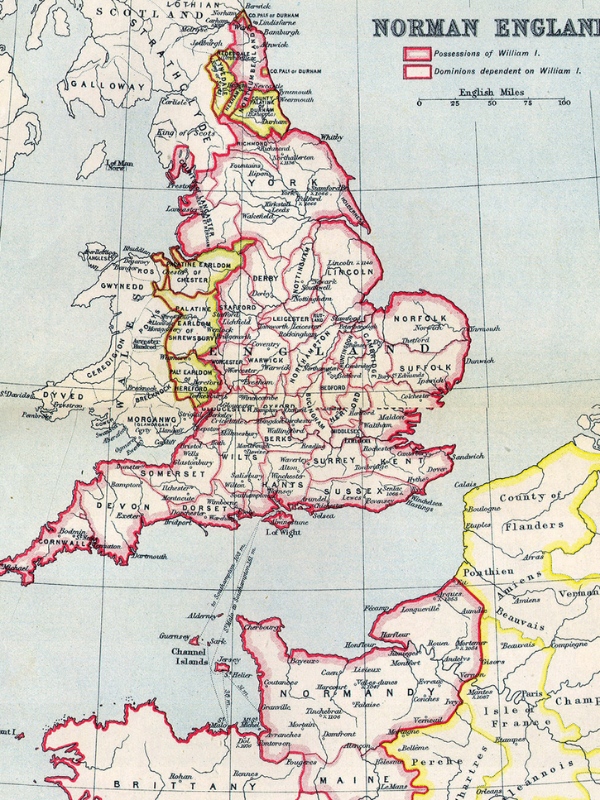
Following the suppression of the native rebellions, William dismantled the four large Anglo-Saxon earldoms. To secure the frontiers and reward his primary supporters, the King created a new network of smaller, highly militarised earldoms. Along the vulnerable borders, he established palatine earldoms, granting the new lords exceptional judicial and administrative authority to build castles and raise armies without direct royal permission.
Hereford (Palatine): Earl William FitzOsbern (1067–1071) — Created along the southern Welsh March for William’s closest childhood friend. FitzOsbern used this secure military base to build a line of border fortresses, including Chepstow and Wigmore, to check Welsh incursions.
Shrewsbury (Palatine): Earl Roger de Montgomery (1068–1094) — Established along the central Welsh March to protect the midland shires. Montgomery consolidated Norman authority across Shropshire, constructing Montgomery Castle and establishing fortified settlements to control the mountain passes.
Chester (Palatine): Earl Hugh d'Avranches (1071–1101) — Anchored the northern Welsh March after the initial holder, Gerbod the Fleming, deserted his post. Known for his military capability, Hugh conducted extensive campaigns into North Wales, constructing castles at Rhuddlan and Deganwy to expand Norman territorial control.
Kent (Palatine): Earl Odo of Bayeux (1067–1088) — Granted to the King's wealthy half-brother, the Bishop of Bayeux, to protect the vital maritime approaches and ports linking England to Normandy. Odo accumulated extensive land holdings across the southern counties, acting as regent during William’s absences until his rebellion in 1088.
Northumberland: Earl Robert de Comines (1068–1069) / Earl Robert de Mowbray (1080–1095) — Created as a defensive buffer against Scottish invasions and Scandinavian fleets. The earldom remained highly unstable; Comines was killed by native rebels months after his appointment, while Mowbray’s later rebellion led to the Crown absorbing the title.
Richmond: Earl Alan Rufus (1071–1093) — Granted to a prominent Breton ally alongside a vast, continuous block of lands in Yorkshire known as Richmondshire. Alan constructed Richmond Castle to secure the strategic eastern approaches to the Pennines and pacify the northern shires following the devastation of 1069.
Cornwall: Earl Robert of Mortain (1068–1095) — Awarded to the King’s younger half-brother, who received nearly the entire county to secure the southwestern peninsula. Robert used the wealth of these lands to construct fortresses at Launceston and Trematon, eliminating native resistance and controlling the maritime trade routes.
Huntingdon: Earl Waltheof (1072–1075) / Earl Simon de Senlis (1090–1111) — Initially left in the hands of Waltheof, the last native Anglo-Saxon earl, in a failed attempt to conciliate the old English elite. Following Waltheof's execution for treason in 1076, the title and its extensive midland estates passed to Simon de Senlis through marriage to Waltheof's daughter.
The Norman Invasion of Wales and the Marcher Lordships
1067 – 1095 AD
The balance of power along the western frontier shifted immediately following the victory at Hastings, as William the Conqueror moved to secure his borders against the independent Welsh kingdoms. Recognizing that a military campaign into the mountainous terrain was difficult, the King divided the borderlands into defensive districts centered on castles. To secure this frontier, William appointed his advisers to three premier earldoms, placing William FitzOsbern at Hereford, Roger de Montgomery at Shrewsbury, and Hugh d'Avranches at Chester. These commanders were granted extensive legal and administrative privileges, creating autonomous frontier territories known as the Marcher Lordships.
The advance relied on independent expansion that allowed the Norman barons to conduct campaigns across the border without waiting for royal consent. Under this arrangement, the Marcher Lords constructed networks of earthwork motte-and-bailey castles along the river valleys, using these strongholds to overrun the Welsh principalities of Gwent, Powys, and Gwynedd. By 1081, the Norman cavalry advanced into the interior, prompting the Welsh King Rhys ap Tewdwr to accept a tributary settlement with William at St Davids. While these independent operations established major castles at Cardiff, Monmouth, and Rhuddlan, the nature of the border resistance left the frontier in a state of conflict.
The Welsh princes launched an uprising in 1094, exploiting the absence of William II to burn several Norman castles and reclaim parts of Gwynedd and Powys. To secure the frontier, William II launched two royal expeditions into Wales in 1095. These campaigns resulted in a standoff; the Welsh infantry used the rugged mountain terrain to avoid open battle, forcing the royal armies into a costly retreat. This confrontation left the western border divided, ensuring that the Marcher Lords remained a distinct, highly militarised class capable of defending the border while presenting a continuous challenge to the central authority of the English Crown.
Stay Connected
The Revolt of the Earls
1075 - 1076 AD
The consolidation of Norman power faced an internal threat in 1075 AD by a rebellion originating from within the new ruling class itself. Recorded as the Revolt of the Earls, this conspiracy was formed by three powerful barons who believed that King William’s centralized authority restricted their regional power: Roger de Breteuil, the Earl of Hereford; Ralph de Gael, the Earl of East Anglia; and Waltheof, the final surviving Anglo-Saxon earl on the island, who governed Northumbria. The conspiracy was formally hatched during the wedding feast of Ralph de Gael and Emma FitzOsbern at Exning in Cambridgeshire, where the earls agreed to assassinate William, partition the Kingdom of England into three independent principalities, and restore a decentralized system of regional lordship.
The plan collapsed due to swift administrative action. Archbishop Lanfranc, whom William had left behind to manage the government as regent while the King campaigned in Normandy, received early warning of the treason from a remorseful Waltheof. Lanfranc mobilized the royal administration, utilizing the local native English militias alongside loyal Norman forces to cut off the rebel armies before they could join forces.
This deployment highlighted a major shift in the post-conquest era, as many native English actively fought alongside the Norman authorities to maintain the King's peace. Roger de Breteuil was contained at the River Severn by Worcester levies under the command of Bishop Wulfstan, while Ralph de Gael’s forces were defeated in the east at the Battle of Fagaduna by a column led by the warrior bishops Odo of Bayeux and Geoffrey of Montbray.
King William returned to England to implement a swift purge. Ralph de Gael fled to Brittany, while Roger de Breteuil was stripped of his titles and condemned to life imprisonment. Earl Waltheof was publicly executed at St Giles' Hill near Winchester on 31 May 1076 AD, a death that caused a scandal as he was the only English aristocrat executed by beheading during William's entire reign.
The Domesday Book
1085 - 1086 AD
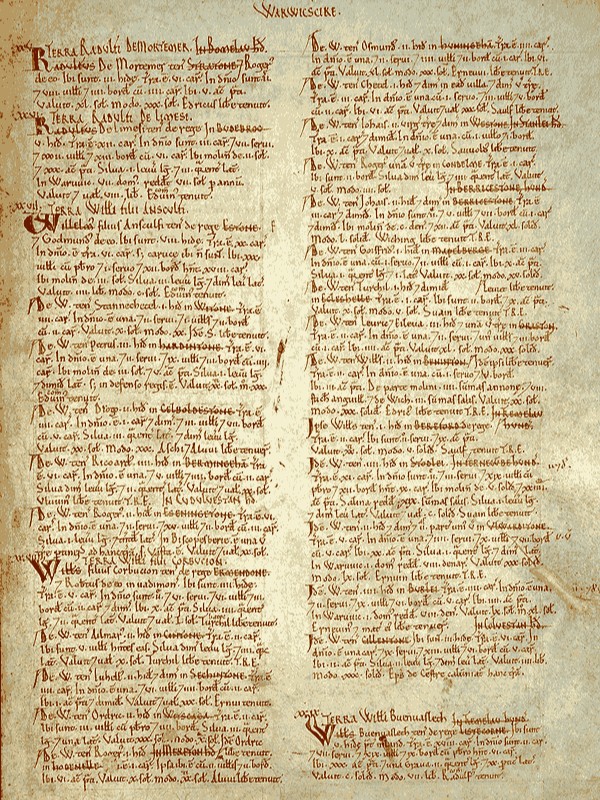
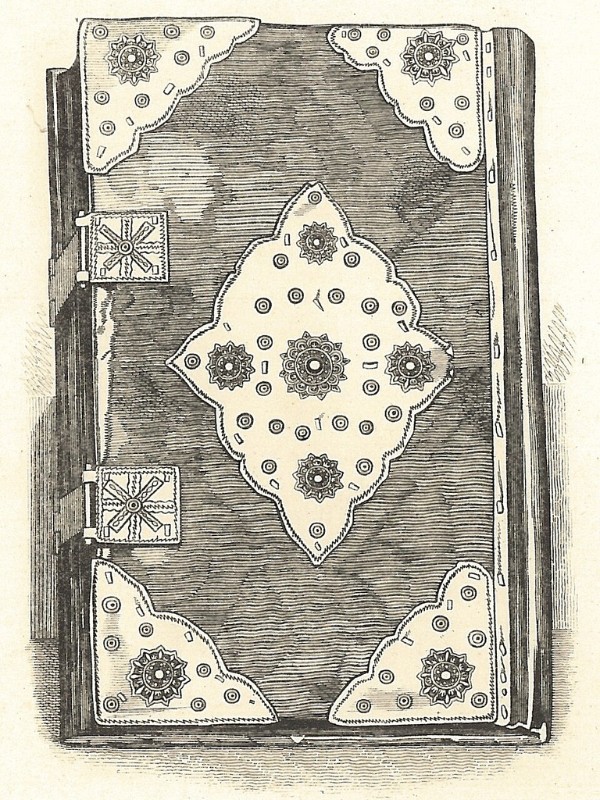
At Christmas 1085, faced with the threat of a Danish invasion under King Cnut IV and needing to calculate the tax capacity of the country, King William ordered a national survey of England. He dispatched royal commissioners into every county to conduct an audit of all lands, livestock, and revenue streams, compiling the data by 1086 into two volumes officially recorded as the Domesday Book.
The survey was designed to regulate tax collection, requiring local juries within each administrative district to swear under oath who owned each manor, how many hides of land it contained, and the numbers of ploughs, mills, fisheries, and woodlands on the property. Crucially, the audit required a three-tiered valuation, calculating the monetary value of every estate during the reign of Edward the Confessor, when William granted the land, and at the time of the survey itself. The process was thorough, recording the agricultural assets of the country with such detail that contemporary writers noted that not a single ox, cow, or pig escaped the King's audit.
The survey featured several omissions and geographical exceptions based on administrative and political boundaries. Major commercial hubs, most notably London and Winchester, were excluded from the audit, due to their independent customary laws and separate tax arrangements. Furthermore, the northern frontier shires of Durham and Northumberland were omitted from the text, as these borderlands remained volatile and largely outside the control of the royal treasury. Beyond the counting of livestock and acres, the commissioners also recorded regional customs and local laws to ensure the Crown could collect judicial fines. In the city of Chester, the text noted specific financial penalties for merchants caught brewing substandard beer, alongside guidelines for monetary compensation in cases where blood was shed within the city gates.
The finality of this survey prompted the native English population to coin the name Domesday Book, comparing its records to the biblical Day of Judgment. Just as the final judgment could not be challenged, the written verdicts of the royal commissioners were binding, meaning that no landowner could appeal against the book's findings.
Some of the key takeaways included:
13,418 settlements were officially recorded south of the River Ribble and River Tees.
1.5 million people is the estimated total population of England based on the survey, though only about 269,000 specific heads of households were explicitly named.
£72,000 was the approximate total annual valuation (expected yearly revenue) of the English land recorded in the survey.
Over 6,000 watermills were counted, operating as the primary source of industrial power for grinding grain.
45 distinct vineyards were recorded, (proving that the climate in southern England was warm enough for active winemaking).
48 castles were explicitly listed, reflecting the massive military fortification effort by the Normans after 1066.
300+ parish churches and more than 60 major religious houses were logged.
15% of England was recorded as woodland. Interestingly, the book didn't measure forests by acreage, but rather by the number of pigs the acorns and nuts could
support.
2,000 Anglo-Saxon landowners had their property systematically stripped away; by 1086, just 200 Norman barons controlled the vast majority of England.
90% of the population lived in rural areas, working primarily as villagers (villeins), smallholders (bordars), or cottars.
The Oath of Salisbury
1086 AD
The defensive challenges of the later reign of William I caused a major strain on the financial and military resources of the Anglo-Norman government. Having depleted the treasury through continuous garrison expenditures across twenty years of regional rebellions, the Crown was confronted with the threat of a continental invasion in the winter of 1085 by the combined forces of King Philip I of France and King Cnut IV of Denmark and Norway. T
his threat of a multi-front conflict exposed the vulnerability of the country's defensive systems, as the King was forced to quarter a large mercenary army across the shires at great expense to the populace. To prevent a collapse of his conquests and secure domestic stability before these mercenary forces were disbanded, William the Conqueror held a deep council with his advisers at Gloucester during Christmas 1085, ordering a comprehensive survey of the land and executing a political settlement known as the Oath of Salisbury.
The gathering required an unprecedented mobilization to enforce direct security across the entire land. Under this plan, William commanded every prominent landholder from across England—not only his immediate tenants-in-chief, but their subordinate sub-tenants—to assemble on the plains of Salisbury on 1 August 1086. Before this assembly, every landowner was required to swear a solemn oath of fealty directly to William, promising to remain loyal to the King against all other men, including their own immediate feudal lords. This logistical operation succeeded in preventing the regional barons from fostering independent power bases. The political impact of the oath altered the scope of English governance by establishing the legal precedent that an individual's duty to the sovereign overrode all local allegiances, breaking the standard continental rule of feudalism where a sub-tenant owed loyalty only to his immediate lord.
The collapse of independent local lordships altered the feudal relationship between the Crown and the nobility. Facing the need to fund a permanent military presence without relying on irregular taxation, the Conqueror used the solemn oaths at Salisbury to unify the military obligations of the country under a single authority. By ensuring that the sub-tenants who actually managed the knights on the ground were directly accountable to the monarch, the Crown eliminated traditional localized exemptions and secured the immediate service of the landowning elite. This arrangement permanently bound the country's military assets to the direct service of the monarchy, anchoring the defensive stability of the Anglo-Norman dynasty and ensuring that his son, William II, inherited a secure government capable of withstanding subsequent baronial insurrections.
William Rufus and The Rebellion of 1088
1087 - 1088 AD
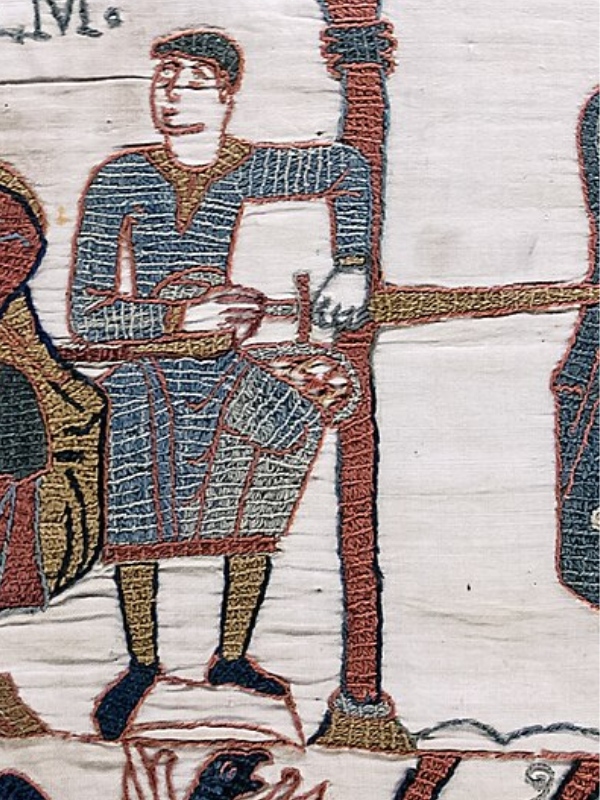
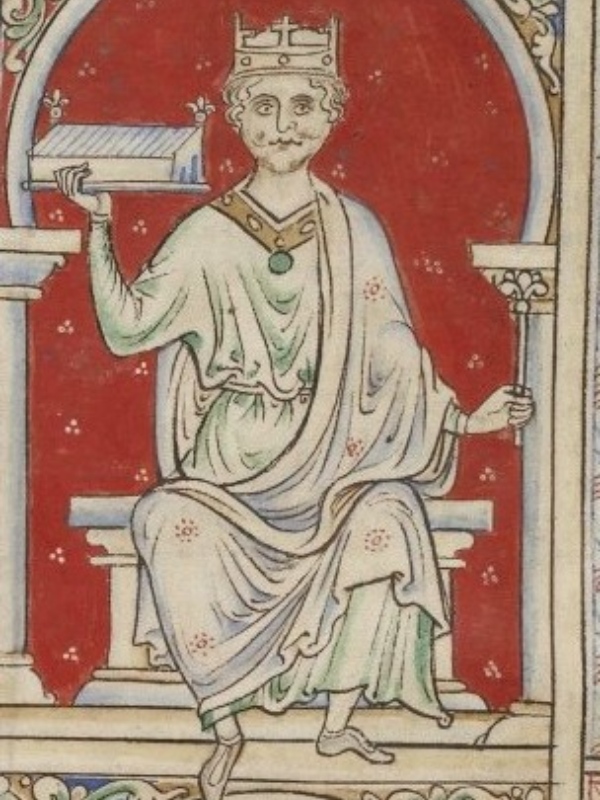
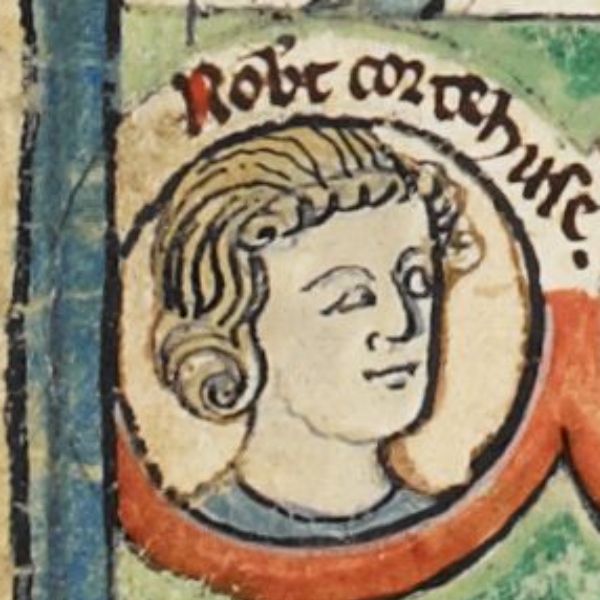
The sudden death of William the Conqueror in September 1087 AD left the Anglo-Norman realm facing an immediate, severe domestic succession crisis of division. Having inherited the crown of England while his elder brother, Robert Curthose, assumed control of the Duchy of Normandy, the newly anointed King William II—historically branded as William Rufus—was confronted with the abrupt fracturing of baronial loyalty across the English Channel.
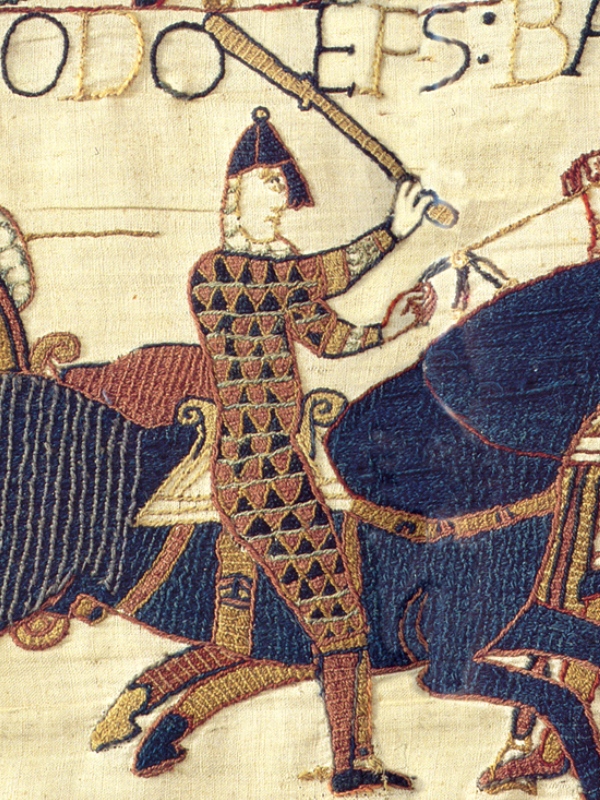
This sudden partitioning of territory threatened the Anglo-Norman elite with immediate financial bankruptcy, as the great magnates held extensive estates in both realms and realized that serving two competing masters was entirely unsustainable. To stave off an outright collapse of their cross-Channel inheritance, a powerful faction of Norman barons, masterminded by the Conqueror’s half-brothers, Bishop Odo of Bayeux and Count Robert of Mortain, launched a secretive military conspiracy in the spring of 1088 AD to depose Rufus and place the compliant Robert Curthose upon the English throne.
The execution of this rebellion relied on a highly coordinated, multi-border offensive designed to paralyze the royal administration from within the shires. Under this hidden plan, the rebel barons fortified their regional strongholds at Rochester, Pevensey, and Bristol, allowing their private garrisons to intervene directly as hostile forces, landing continental mercenaries and systematically plundering the royal lands.
While the combined military operations were a complete tactical success for the insurgents in the western shires, the political architecture of the conspiracy collapsed into failure within months due to the King’s rapid counter-offensive. Recognizing that his Norman barons sought his destruction, William Rufus turned to the native Anglo-Saxon population for support, issuing an urgent decree that summoned the native fyrd militia to his banner under promises of lower taxes, fair laws, and the restoration of hunting rights, an unexpected mobilization that provided the Crown with overwhelming numbers.
With the backing of the native English levies, Rufus marched his forces rapidly south to lay siege to the primary rebel strongholds at Pevensey and Rochester castles. The West Saxon infantry established dense blockades across the maritime approaches, intercepting the reinforcement fleets dispatched from Normandy and starving the insurgent garrisons into a rapid submission. The immediate consequence of this successful containment was the permanent liquidation of the baronial coalition, an outright routing that shattered the administrative foundations of the rebellion and forced Bishop Odo into permanent exile on the continent.
The Invasion of Cumbria
1092 AD
The northern boundary of England remained volatile following the Norman Conquest, as the strategic district of Cumbria operated as an independent Celtic principality under the nominal over-lordship of the Scottish Crown. To secure the northern frontier against Scottish incursions and expand his territorial authority, King William II launched a military expedition into the region in May 1092. Marching his forces north into the fertile valley of the River Eden, the King expelled Dolfin, the local ruler who had governed the territory from the ancient settlement of Carlisle. This move advanced the border of England to the Solway Firth and the River Tweed, bringing the strategic western Marches under the direct authority of the English Crown for the first time since the fall of the Anglo-Saxon kingdoms.
To secure this territorial conquest, William II ordered the immediate construction of a stone castle at Carlisle, positioning the fortress on a high bluff overlooking the river crossing to bar any future Scottish advance. Designed by Norman engineers, the stronghold featured thick curtain walls and a fortified enclosure that provided a permanent base for a royal garrison.
Recognizing that the local population was hostile to Norman authority, the King executed an administrative resettlement plan, transporting hundreds of peasant families from the southern counties of England to Cumbria. The government provided these families with agricultural lands, farming equipment, and livestock to cultivate the countryside and establish an English population in the shires.
The Exploitation of Church Lands and Exile of Anselm
1093 – 1097 AD
The financial demands of William II’s military campaigns across the Channel prompted a systematic exploitation of the English Church, causing a major constitutional struggle with the ecclesiastical authorities. To fill the royal treasury, the King relied on his chief administrator and justiciar, Ranulf Flambard, who used legal technicalities to extract maximum revenue from church lands.
Under Flambard’s direction, the Crown routinely delayed the appointment of new bishops when a see became vacant, allowing the royal exchequer to seize all the revenues and property rents of the bishopric for years at a time. The scale of this extraction was large; the wealthy Archbishopric of Canterbury was kept vacant for four years following the death of Lanfranc in 1089, with its entire income funneled directly into the King's military budget to fund his wars in Normandy.
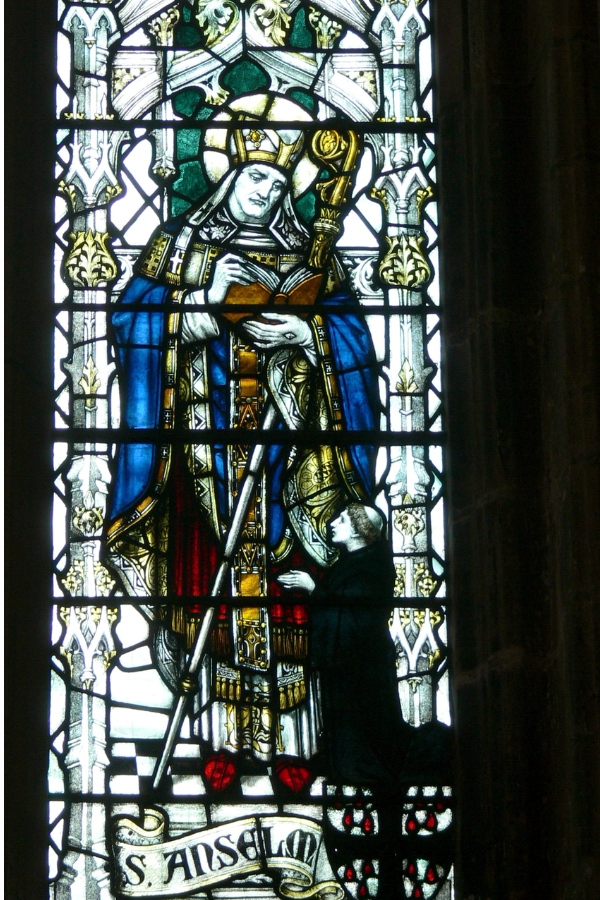
The policy faced a crisis in March 1093 when William II fell dangerously ill at Gloucester. Believing his sickness was a divine punishment for his treatment of the Church, the panicked monarch agreed to fill the vacant see of Canterbury, forcing the prominent theologian Anselm of Bec to accept the position of Archbishop.
Upon his recovery, however, the King resumed his demands, leading to an immediate deadlock when Anselm refused to pay a substantial gift of one thousand pounds, which he viewed as simony. The tension escalated into a constitutional crisis regarding papal allegiance, as Anselm recognized Pope Urban II, while William II refused to acknowledge any pope until the Crown had verified his claim.
To resolve the impasse, the King summoned his barons and bishops to a great council at Rockingham Castle in February 1095. The King's advisors attempted to pressure Anselm into resigning, but the Archbishop held his ground, arguing that his spiritual obedience belonged to the Pope rather than a secular lord.
Although a temporary truce was achieved when the King eventually acknowledged Urban II, the pressure on Canterbury's lands continued unabated. Realizing that he could no longer exercise his spiritual authority without compromising the independence of the Church, Anselm left England in November 1097, seeking refuge in Rome and leaving the King to seize the revenues of Canterbury once again.
This prolonged dispute broke the cooperation between Church and State, establishing the legal battle lines over crown patronage that would dominate the reigns of the remaining Norman kings.
The Death of William II in the New Forest
1100 AD
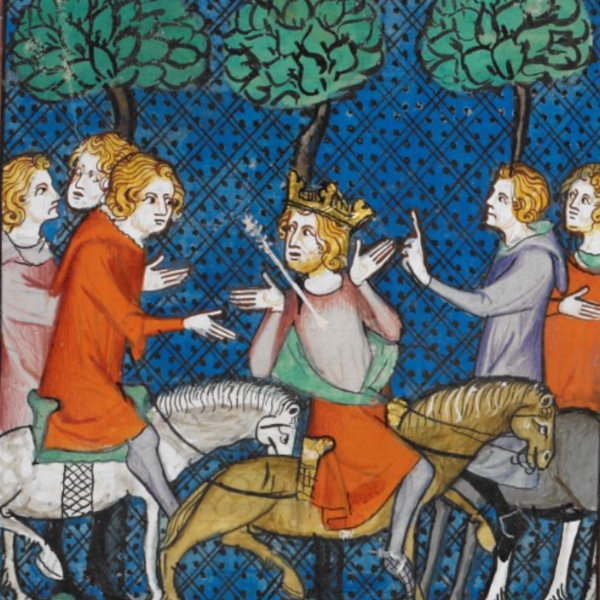
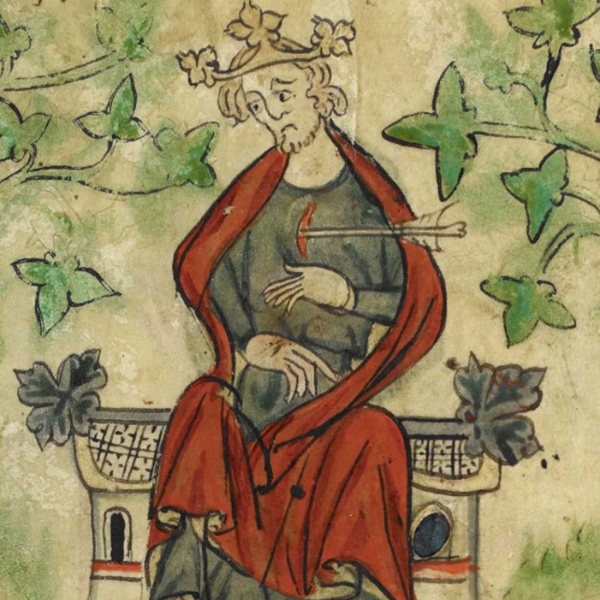
The suspicious conclusion of William II’s reign occurred on the afternoon of 2 August 1100 during a royal hunting expedition in the New Forest. Accompanied by a small group of noblemen, including his younger brother Prince Henry and the French lord Walter Tirel, the King separated into smaller tracking parties across the dense woodland near Brockenhurst. As evening approached, Walter Tirel fired a single arrow at a passing stag; the arrow reportedly deflected off the back of the beast or a nearby oak tree, striking William II directly in the chest and piercing his lungs.
The forty-three-year-old monarch collapsed instantly and died on the forest floor without speaking a word. The suddenness of the event triggered an immediate panic among the hunting party, leading to a breakdown of royal protocol.
Rather than securing the body or investigating the shooting, the noblemen panicked and deserted the scene to protect their personal interests. Walter Tirel fled the country immediately, riding hard for the coast to cross the Channel to France before any charges of treason could be brought against him. Simultaneously, Prince Henry abandoned his brother's corpse in the woods, leading a high-speed cavalry dash to the royal stronghold at Winchester to seize the treasury keys before the news of the King's death could cause a general insurrection.
The abandoned body of the King was eventually recovered by a local charcoal burner named Purkis, who transported the blood-slicked corpse in a common cart to Winchester Cathedral, where it was buried the following morning with minimal religious ceremony.
Prince Henry used the captured silver of the treasury to secure the immediate support of the local barons and bishops present at court. Bypassing the superior hereditary claims of his oldest brother, Robert Curthose, who was returning from the First Crusade, Henry rode directly to London and was crowned as King Henry I at Westminster Abbey on 5 August 1100, just three days after the hunting incident.
To soothe widespread public suspicion regarding his involvement in a conspiracy and to distance his new government from the unpopular policies of his brother, Henry I immediately issued the Charter of Liberties, promising to end the arbitrary financial extraction of church lands and to restore the fair laws of Edward the Confessor across the shires.
The Coronation of Henry I and Charter of Liberties
1100 AD
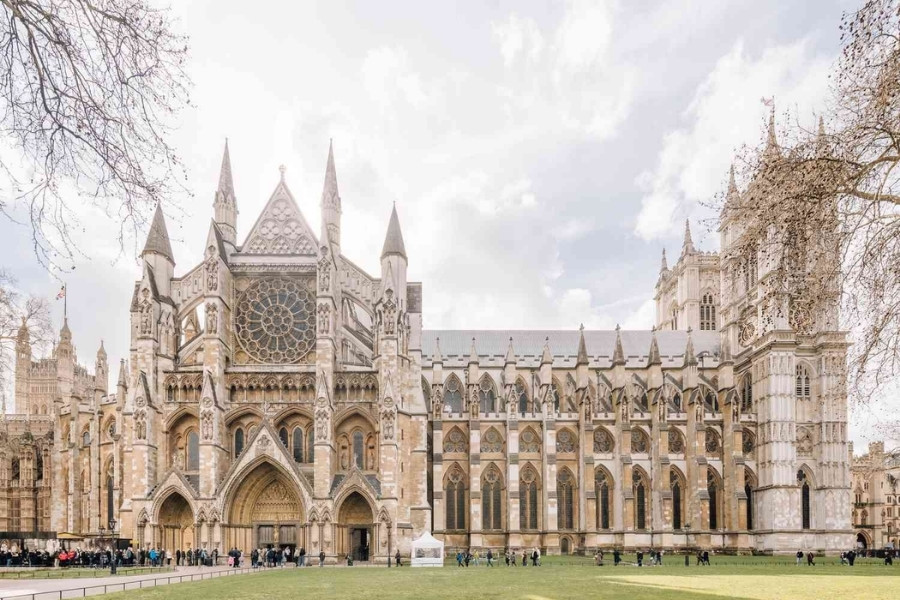
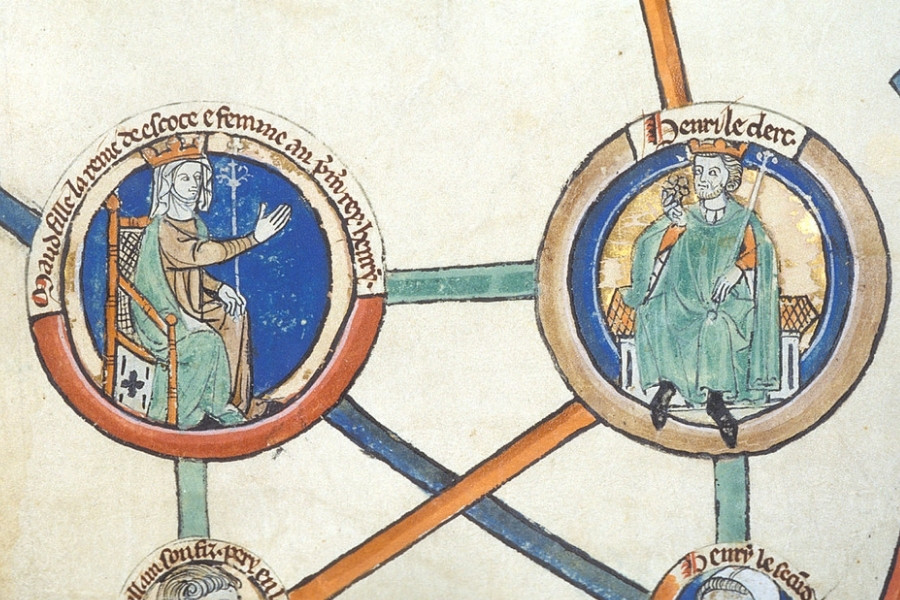
On 5 August 1100 AD, having successfully secured the royal treasury at Winchester following the sudden death of his brother, Henry I "Beauclerc" was formally crowned King of England at Westminster Abbey. Recognising that his swift succession was technically illegal—violating the ancestral claims of his oldest brother, Duke Robert Curthose, who was returning from the First Crusade—Henry immediately issued a monumental legal decree known as the Charter of Liberties. Because both archbishops were physically unavailable to officiate, the coronation was hurried through by Maurice, Bishop of London. This institutional irregularity required an immediate, high-stakes political concession to secure the fragile loyalty of the deeply sceptical Anglo-Norman elite.
The Charter of Liberties operated as a highly calculated, fact-based political contract. In the document, Henry explicitly condemned the predatory fiscal abuses of the previous administration and its chief tax collector, Ranulf Flambard. He bound the Crown under a solemn royal oath to stop exploiting vacant Church properties, to cease extracting extortionate inheritance taxes (reliefs) from his barons, and to fully respect the traditional customary rights of his tenants-in-chief. Crucially, the final clause extended these legal protections down to the lower tiers of society, ordering the great barons to show the exact same fairness to their own sub-tenants and free men. Henry also promised to restore the ancient, traditional laws of King Edward the Confessor, bringing a sense of stability after decades of conquest.
To give the proclamation absolute legal authority, copies of the text were produced in Latin, Anglo-Norman, and Old English, marking a notable shift toward the native vernacular, and was formally attested and witnessed at Westminster by the small, core group of powerful magnates who backed Henry's coup. The primary secular and ecclesiastical signatories included the bishops Maurice of London, William-elect of Winchester, and Gerard of Hereford, alongside Earl Henry of Warwick, Earl Simon of Northampton, Earl Walter Giffard, Robert de Montfort, Roger Bigod, Henry de Port, and Eudes the Sewer. The Charter of Liberties stands as a critical milestone in English constitutional history, setting the ultimate historical precedent that the power of the Norman King was not absolute, but bound by a written legal contract, providing the direct legal blueprint that Archbishop Stephen Langton would later use to shape the creation of the Magna Carta in 1215.
The Anglo-Norman Wars and the Battle of Tinchebray
1101 - 1106 AD
The crushing of early domestic insurrections did not resolve the cross-Channel crisis, instead, it launched a multi-year campaign of geopolitical attrition as Henry I fought to neutralise the threat of an unstable Normandy. In July 1101 AD, Duke Robert Curthose launched a direct counter-invasion of England, exploiting baronial discontent to land a fleet at Portsmouth and march on Winchester to claim the crown. Recognising his vulnerability, Henry intercepted his brother's host at Alton, and rather than risking a repeat of Hastings, he negotiated the Treaty of Alton, agreeing to pay Robert an annual pension of £3,000 in exchange for the Duke renouncing his claim and restoring mutual land rights to cross-Channel magnates.
The peace was merely a delaying tactic, allowing Henry to systematically isolate and dismantle the English power bases of Curthose’s primary conspirators. His foremost target was the notoriously ruthless Robert de Bellême, Earl of Shrewsbury, who had fortified massive strongholds at Bridgnorth and Arundel, and in 1102 AD, Henry mobilised a massive native fyrd alongside loyal Norman forces to lay siege to these castles, successfully stripping Bellême of his vast English estates and banishing him to the continent.
By 1105 AD, Henry went on the offensive, launching a massive, heavily funded military invasion of Normandy. He used the immense tax wealth extracted from the English shires to systematically bribe border lords, subvert the loyalties of Norman garrisons, and capture the strategic towns of Bayeux and Caen, publicly arguing that his older brother’s weak, unstable rule had allowed Normandy to degenerate into an anarchic haven for treason, framing the English invasion as a necessary crusade to restore law, order, and church property across the duchy.
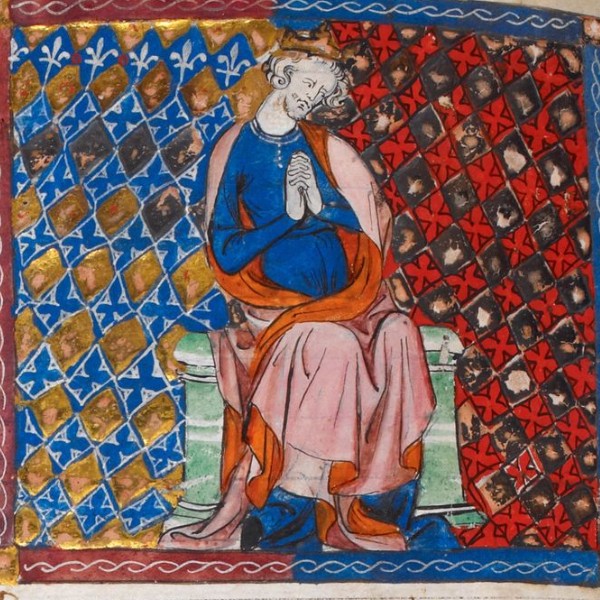
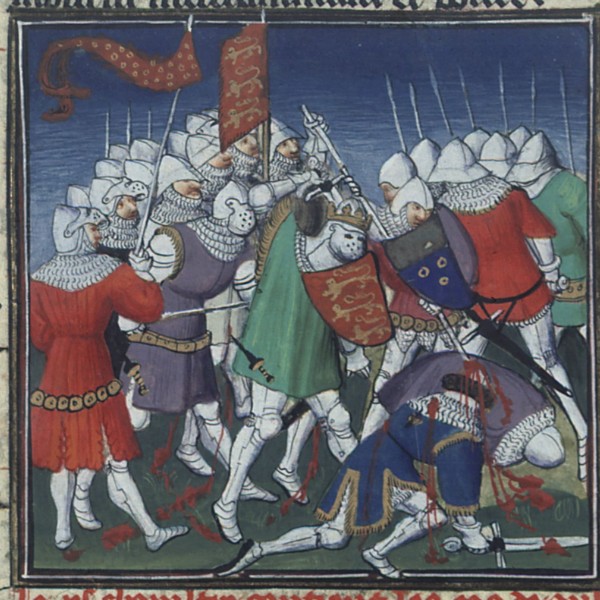
The multi-year continental campaign reached its climax on 28 September 1106 AD—exactly forty years to the day after William the Conqueror had landed at Pevensey—at the Battle of Tinchebray in southwest Normandy. The engagement was a short, exceptionally brutal clash of arms. Duke Robert deployed a traditional force of heavily armoured Norman knights and infantry, confident that his veteran frontline could smash the English advance.
Henry, however, completely outmanoeuvred him, deploying his forces in three dense infantry lines, but crucially positioning a disciplined reserve line of cavalry—commanded by Elias, Count of Maine—hidden out of sight on the flank.
When the frontlines locked in hand-to-hand combat, Count Elias launched a devastating surprise cavalry charge directly into the exposed flank of the ducal lines, shattering their formation within an hour. Henry’s victory was absolute, and Duke Robert Curthose was captured on the field alongside his primary ally, William, Count of Mortain, though the notorious rebel Robert de Bellême fled the field. Curthose was condemned to life imprisonment, spending his remaining twenty-eight years locked inside Devizes and Cardiff Castle.
The Concordat of London and Legal Governance
1107 - 1110 AD
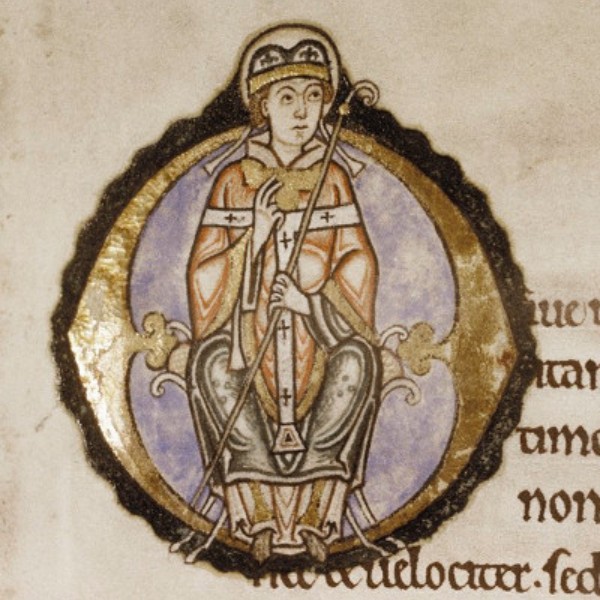
The expansion of royal administrative authority under Henry I provoked a major constitutional dispute with the Papacy over the right to appoint church officials, remembered as the Investiture Controversy. The conflict centred on the customary practice of lay investiture, where secular monarchs presented newly appointed bishops with the ring and crosier—the spiritual symbols of their ecclesiastical office—effectively treating the wealth of the Church as an instrument of crown patronage.
The dispute escalated into a deadlock when Anselm, the Archbishop of Canterbury, refused to perform feudal homage to Henry I or consecrate bishops who had received their offices from royal hands, resulting in Anselm's exile from the country. Recognizing that the prolonged vacancy of key bishoprics weakened public order and depleted the treasury, Henry I entered into negotiations with Anselm and Pope Paschal II to achieve a compromise.
The crisis reached its settlement in August 1107 with the ratification of the Concordat of London. Under the terms of this legal agreement, Henry I surrendered his hereditary claim to lay investiture, conceding that the ring and crosier could only be conferred by ecclesiastical authorities during consecration to represent spiritual jurisdiction. In return for this concession, the Papacy permitted free episcopal elections to take place in the royal court, while requiring every newly elected bishop to take an oath of fealty to the King as a feudal lord before receiving the temporal properties and revenues of the bishopric.
This dual arrangement separated the spiritual authority of the clergy from their material obligations to the state. By resolving the investiture struggle without sacrificing the Crown's control over church lands, the compromise strengthened the domestic governance of Henry I, establishing a precedent of legal oversight that would heavily influence continental church-state treaties for decades.
Following this settlement, Henry I utilised the peace to reorganise the judicial and financial structures of the country. He formalised the meetings of the Exchequer at Winchester under the direction of his trusted chief administrator, Bishop Roger of Salisbury. This bureau introduced systematic bookkeeping using checkered cloths and wooden tally sticks to audit the financial accounts of the provincial sheriffs twice a year, cutting down on local corruption and ensuring a steady flow of silver directly into the royal treasury. Simultaneously, the King expanded the system of itinerant justices, sending royal judges on circuits through the shires to handle criminal trials under the authority of the central Crown.
The Creation of the Exchequer
1110 - 1130 AD
The financial exhaustion of the post-war economy following the reunification of England and Normandy rendered the traditional, loose methods of collecting royal revenue entirely unsustainable. Facing a crushing domestic deficit alongside an uncontrollable need to fund a permanent mercenary network to defend his continental borders against the King of France, King Henry I realized that the home treasury could no longer sustain the heavy expenditures required to run the realm without a modernized extraction framework.
To extract maximum revenue from the country before his overstretched financial network suffered an outright collapse, the royal cabinet initiated an administrative revolution around 1110 AD. This reform introduced a centralized auditing body historically branded as the Court of the Exchequer, named after the large checkerboard cloth used by officials to calculate accounts.
The execution of this fiscal revolution relied on a highly coordinated, uniform accounting procedure engineered to bypass local baronial corruption and sheriffs' obfuscation. Under this plan, royal officials gathered the sheriffs of every shire twice a year at Westminster to systematically audit the collected taxes, rents, and judicial fines. The clerks used a system of physical arithmetic where counters were moved across the squares of the exchequer cloth, transforming the financial landscape into a highly visual, public demonstration of royal authority. While the combined logistical operations were a complete tactical success, rapidly routing any attempt by the local authorities to conceal their extraction quotas, the political architecture of the court permanently altered the balance of power, ensuring that the verdicts of the King’s auditors overrode all local baronial objections and financial exemptions.
The immediate consequence of this overhaul was the compilation of the first systematic accounting registers in English history, known as the Pipe Rolls. By binding every sheriff to a regular, double-checked audit and recording the precise results on long parchment skins rolled up like pipes, Henry I constructed a highly secure, self-funding governance network. This consolidation held the entire country in an authoritative grip, providing an era of fiscal uniformity and administrative stability that sustained the Anglo-Norman dynasty through years of subsequent political tension.
When Henry I died in 1135 AD, the physical archives and accounting frameworks established by the exchequer ensured that the fiscal architecture of the crown remained intact, leaving behind a highly organized treasury that stood as a monumental achievement of early medieval governance before the descent into civil war.
The White Ship Disaster
1120 AD
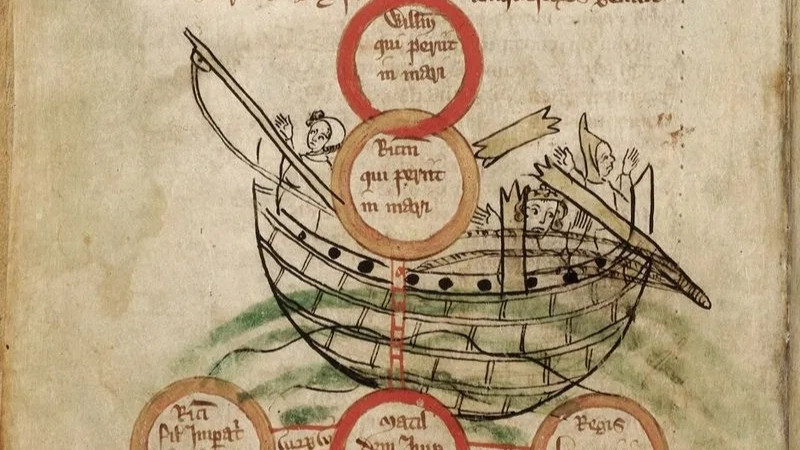
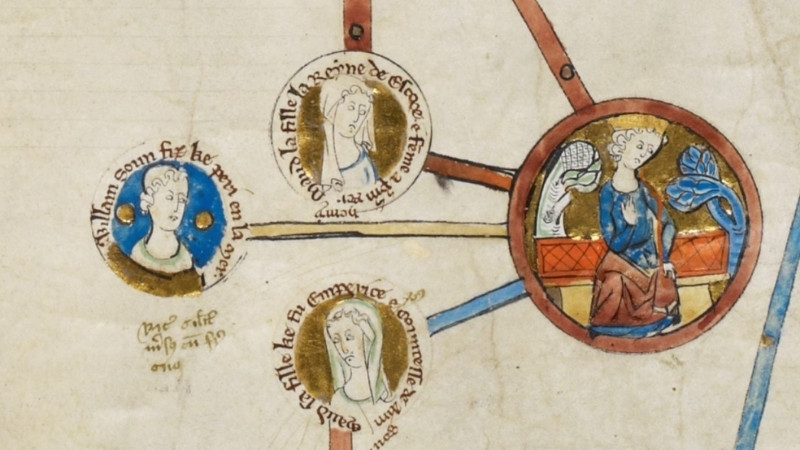
By 1120, King Henry I had secured his cross-Channel empire by establishing his seventeen-year-old son, William Adelin, as the recognized heir to England and Normandy. This political stability ended on the night of 25 November 1120 when the prince and nearly three hundred Anglo-Norman nobles boarded a luxury galley at Barfleur, known as the White Ship.
Following hours of heavy drinking by both the passengers and the crew, the captain, Thomas FitzStephen, ordered the vessel to row at maximum speed in the dark to overtake the King's fleet, which had departed earlier. The ship struck a submerged rock at Gatteville off the harbour mouth, tearing a hole in the hull and causing the vessel to capsize. Only a single passenger, a butcher from Rouen named Berold, survived the freezing night by clinging to the floating mast to recount the event to the court.
The disaster wiped out an entire generation of the Anglo-Norman ruling elite. Alongside William Adelin, the casualties included two of the King's illegitimate children, Richard of Lincoln and Matilda FitzRoy, Countess of Perche, as well as the country's premier young magnates, Richard d'Avranches, Earl of Chester, and the royal judge Geoffrey Ridel. According to contemporary chroniclers, the prince initially escaped the sinking vessel on a small lifeboat, but he ordered his rowers to turn back to rescue his screaming half-sister, Matilda. As the boat neared the wreck, dozens of panicked, drowning nobles threw themselves into the craft, overloading the lifeboat and dragging the prince down into the Channel. The news of the loss broke the court's administrative confidence; Henry I collapsed in grief upon hearing the verdict, reportedly never smiling again during the remainder of his life.
Despite marrying a second wife, Adeliza of Louvain, the King failed to produce another legitimate male heir to secure the line of succession. This lack of a direct successor completely unraveled thirty-five years of careful dynastic planning, creating a dangerous political vacuum within the Anglo-Norman administration. Although Henry I eventually forced the nobility to swear fealty to his daughter, Empress Matilda, the loss of the male elite at Barfleur weakened the crown's authority. This weakness allowed his nephew, Stephen of Blois—who had conveniently disembarked from the White Ship before departure due to an illness—to seize the royal treasury and claim the crown in 1135, launching the country into nearly two decades of lawless civil war known as the Anarchy.
King Stephen, Empress Matilda, and The Anarchy
1135 - 1148 AD
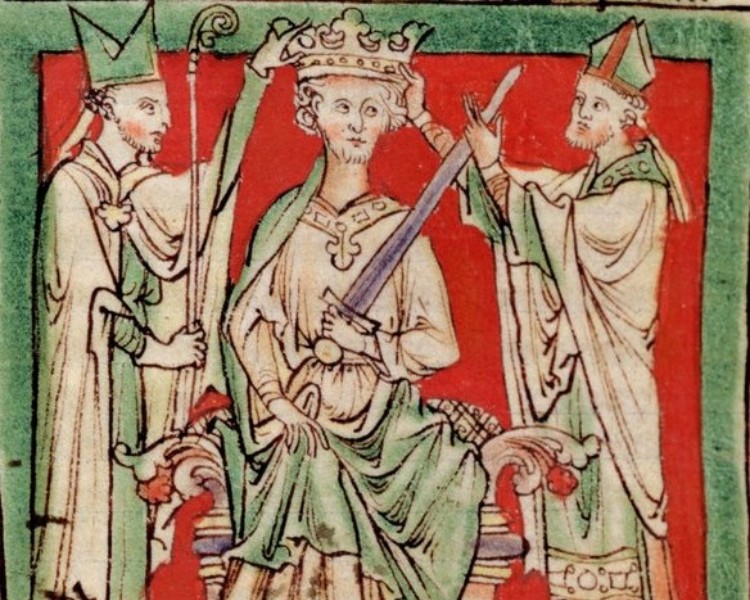
Upon the death of Henry I in December 1135 AD, the vacant throne triggered an immediate crisis across the Anglo-Norman realm. Henry had spent his final years forcing the barons to swear oaths to accept his daughter, the Empress Matilda, as his rightful heir, but a female monarch ruling in her own right was unprecedented in Norman custom, and the aristocracy resented her subsequent marriage to a traditional enemy, Geoffrey Plantagenet, Count of Anjou. Seizing upon this widespread discontent, Henry's nephew, Stephen of Blois, executed a swift coup by sailing from France to England, securing the backing of the citizens of London and the royal treasury at Winchester with the assistance of his brother, Bishop Henry of Blois.
Formally crowned at Westminster Abbey, Stephen bought the temporary loyalty of the realm by granting sweeping concessions to the Church and the nobility, a soft governance approach that quickly undermined his own central authority. By September 1139 AD, this fragile peace shattered permanently when Empress Matilda landed on the Sussex coast to launch a multi-front military campaign to reclaim her inheritance, backed by her half-brother, Robert, Earl of Gloucester, which plunged the country into nearly two decades of civil war known as the Anarchy.
The ensuing conflict developed into a gruelling war of attrition defined by localized sieges, scorched-earth border raids, and the total collapse of central justice. The war reached a major turning point on 2 February 1141 AD at the Battle of Lincoln, where King Stephen was surrounded and captured by the forces of the Earl of Gloucester after his own cavalry fled the field.
Imprisoned in chains at Bristol Castle, Stephen was helpless as Matilda marched on London to claim the crown, but her arrogant demeanor and immediate demands for heavy taxation alienated the local population. Just days before her scheduled coronation, an angry mob of Londoners rose in open riot, driving Matilda out of Westminster. Her political momentum dissolved completely that September at the Rout of Winchester, where her army was defeated by the king's loyal wife, Queen Matilda of Boulogne, leading to a high-stakes prisoner exchange that traded the captured Earl Robert for King Stephen. This exchange returned the conflict to a bloody, exhausting stalemate where central authority vanished entirely, prompting contemporary writers to record with horror that lawless barons built thousands of unauthorized adulterine castles to terrorize the peasantry and extort wealth, grimly declaring that Christ and his saints slept.
The Battle of the Standard and the Scottish Invasion
1138 AD
While King Stephen and Empress Matilda were occupied fighting for power in the south, King David I of Scotland exploited the internal chaos to launch a territorial invasion of northern England. David used his family connection to Matilda—who was his niece—as a political pretext to march a large army through Northumberland and deep into Yorkshire.
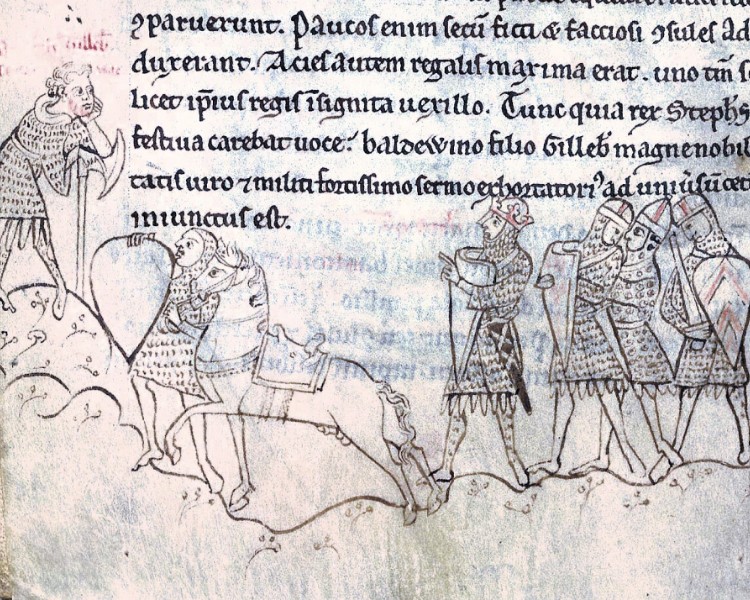
Faced with a bankrupt central government unable to send royal reinforcements, the northern English barons and counties were forced to organize their own defense. Led by the aged Archbishop Thurstan of York, the northern militias assembled a combined force of local Anglo-Norman knights and Yorkshire archers, intercepting the Scottish invasion army on 22 August 1138 AD at Cowton Moor near Northallerton.
Recorded as the Battle of the Standard, the engagement developed into a major, bloody clash of arms. The English forces grouped around a wagon carrying a ship’s mast that bore the sacred banners of Saint Peter of York, Saint John of Beverley, and Saint Wilfrid of Ripon. The English knights dismounted to fight on foot, locking their shields together to form a solid wall that protected the lines. This defensive formation allowed waves of Yorkshire archers to rain arrows onto the unarmored Scottish infantry, particularly the exposed Galwegian clansmen.
The Scottish vanguard was broken and routed, suffering heavy casualties in the panic. While King David managed to maintain control over Northumberland in the aftermath through the subsequent Treaty of Durham, the tactical victory at Northallerton permanently halted his southward advance, securing the immediate safety of the northern frontier.
The French Elite and Linguistic Divide
1066 - 1154 AD
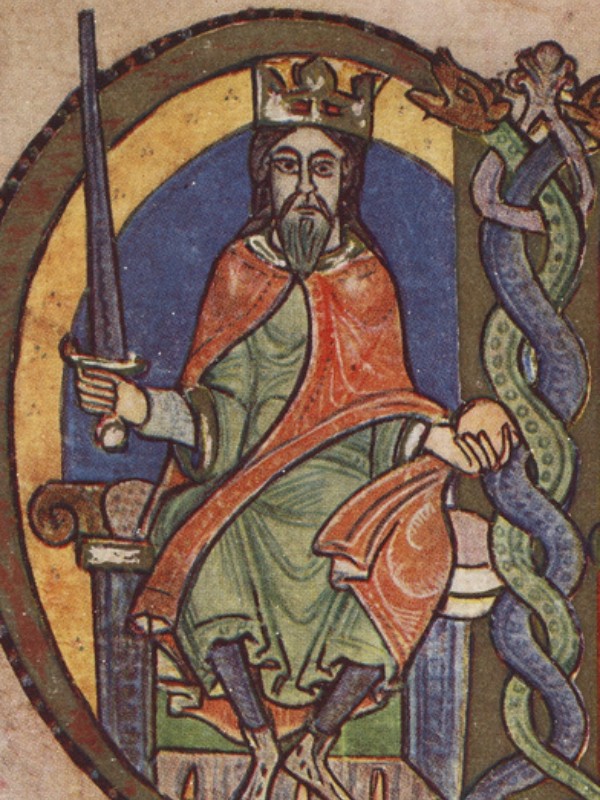
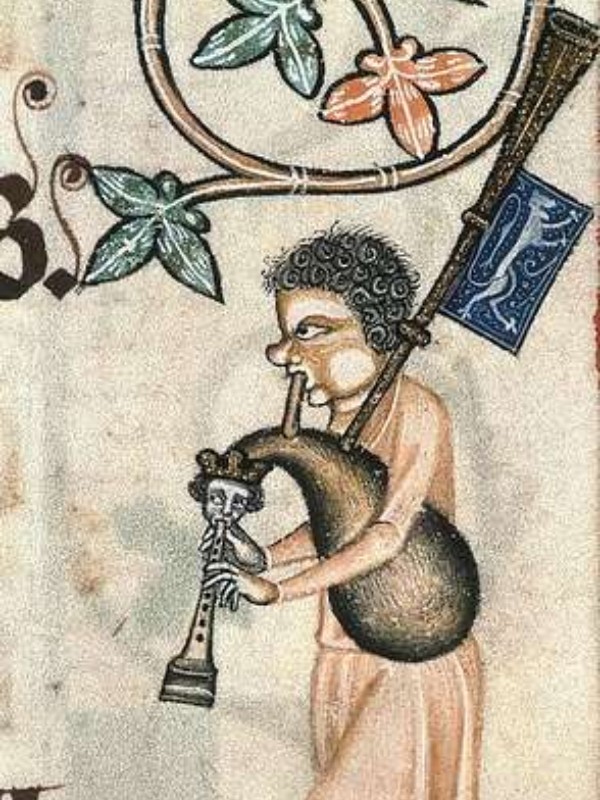
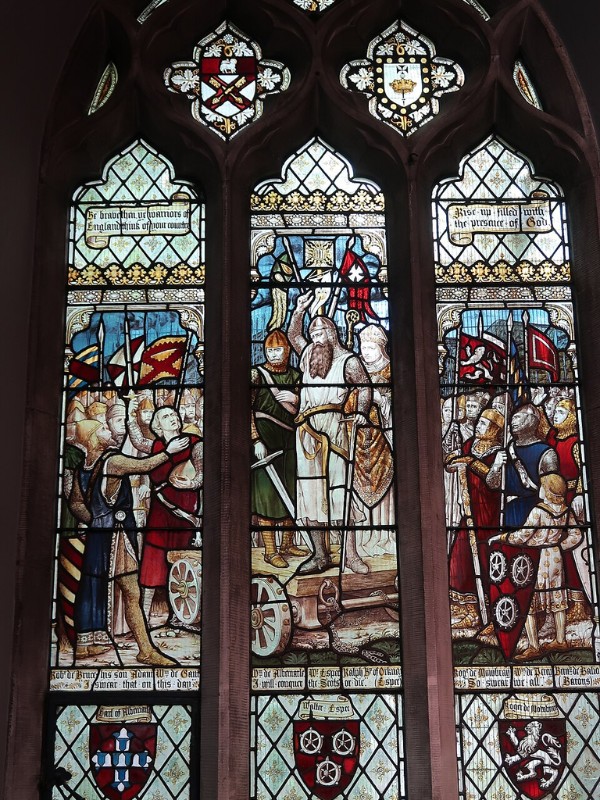
The consolidation of the Norman Conquest created a deep, permanent social and linguistic fracture across English society. William the Conqueror’s total confiscation of native estates placed absolute political and legal authority into the hands of a tightly knit, French-speaking continental aristocracy who viewed the native Anglo-Saxon population with open cultural contempt. For nearly a century, England was split into two separate linguistic worlds. The new ruling class, the royal court, and the high courts of law conducted all business exclusively in Anglo-Norman French, while the Church and the royal administration used Latin for all written charters and taxes. Meanwhile, the native English population—demoted to unfree peasant labourers—continued to speak their ancestral tongue.
This prolonged linguistic contact did not destroy the native tongue; on the contrary, it fundamentally transformed it, forcing the rapid transition from Old English into Middle English. Over several generations, the complex grammatical case endings and inflections of Old English dissolved, primarily because the language was stripped of its written standard and left to evolve dynamically in the mouths of the common people.
Concurrently, the language absorbed over 10,000 French words related to law, governance, warfare, and luxury—such as sovereign, justice, soldier, and estate, and the blending permanently altered the vocabulary of the nation.
The Romanesque Influx and Norman Castles
1066 - 1154 AD
The nine decades of Norman rule permanently re-engineered the visual and architectural landscape of England through a massive, state-sponsored construction programme. The conquerors systematically demolished the traditional timber churches and modest stone structures of the Anglo-Saxon era, replacing them with a monumental continental architectural style known as Romanesque, or Norman architecture. This architectural blitz served as a highly calculated act of psychological dominance, proving that the new French-speaking elite possessed the wealth, organisational capacity, and engineering skills to permanently reshape the country.
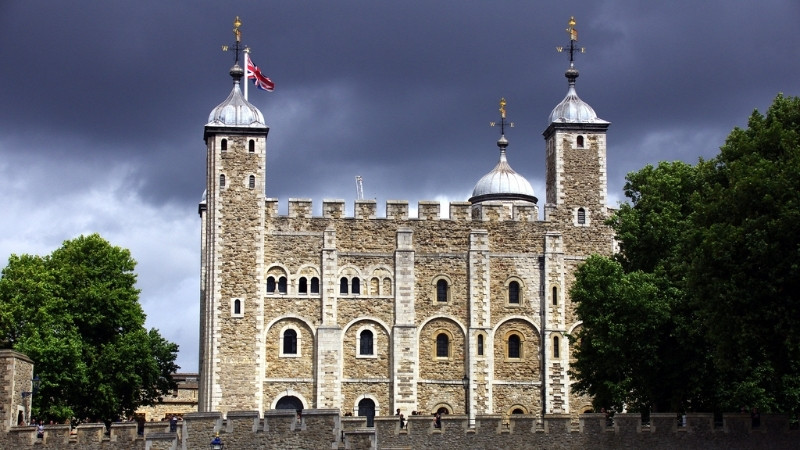
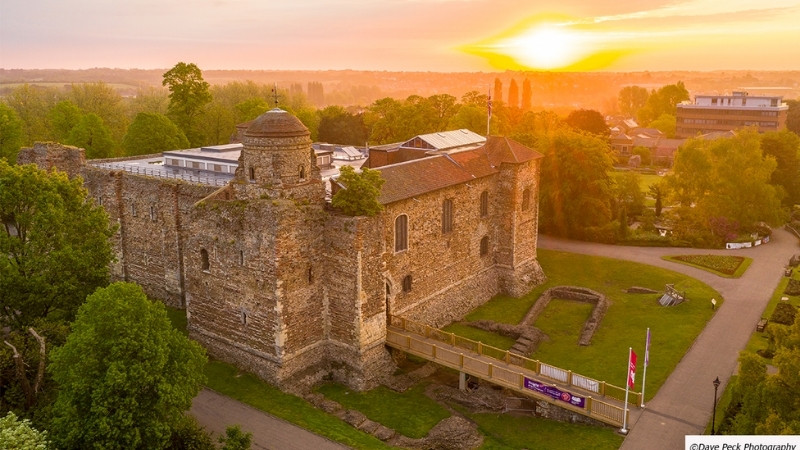
The primary weapons of this occupation were the stone keep and the cathedral. Chieftains replaced their early wood-and-earth motte-and-bailey fortifications with massive stone towers—such as the White Tower at the Tower of London, Colchester Castle, and Rochester Castle—featuring thick ashlar limestone walls, deep defensive ditches, and restricted arrow slits. These keeps functioned as highly secure, aggressive military bases positioned at strategic river crossings and crossroads to project unchallenged regional security.
At the same time, the Norman elite built giant Romanesque cathedrals—including Durham, Ely, Winchester, and Peterborough—to project absolute spiritual authority over the land. These buildings featured massive, heavy cylindrical pillars, sweeping semi-circular round arches, and monumental nave ceilings that completely overwhelmed the viewer. By physically embedding their power into both the secular and ecclesiastical infrastructure, the Norman kings ensured that their dominance was visible from every skyline in the realm.
The Treaty of Wallingford and Rise of the Angevins
1153 - 1154 AD
By 1153 AD, nearly two decades of continuous military stalemates had thoroughly exhausted both the great barons and the Church, however, a major breakthrough occurred during the siege of Wallingford Castle when prominent magnates like William d'Aubigny, 1st Earl of Arundel, openly refused to fight, thereby forcing a localised truce.
Although multiple such "localised truces" had appeared, the realturning point would not arrive until August when King Stephen’s aggressively hawkish eldest son and heir, Eustace, died suddenly, breaking the King's dynastic motivation to continue the war. Recognizing a historic opportunity for permanent peace, Theobald of Bec, Archbishop of Canterbury, alongside Henry of Blois, Bishop of Winchester, orchestrated intense, top-down diplomatic talks between the rival houses. These efforts culminated in the Treaty of Winchester (also known as the Treaty of Wallingford) on 6 November 1153 AD. Sealed with a symbolic kiss of peace in Winchester Cathedral, the treaty was a highly calculated political compromise that legally finalized the succession line, and under its terms, Stephen was permitted to keep the English crown for the remainder of his life.
However, he was compelled to officially disinherit his surviving son, William, Count of Boulogne, and formally adopt Empress Matilda’s 20-year-old son, Henry Plantagenet (FitzEmpress), as his rightful, legitimate successor. In return, Prince William was guaranteed the absolute security of his vast ancestral estates and received formal oaths of land tenure from Henry.
The implementation of the treaty immediately stabilized the shattered domestic security, and the pact carried strict, practical clauses designed to systematically dismantle the lawless military infrastructure of the Anarchy. It mandated the immediate expulsion of all foreign mercenary forces from the shires, and ordered the total demolition of all adulterine castles—the thousands of unauthorized baronial fortifications built during the war to terrorize local communities and bypass royal justice.
Unfortunately for him, King Stephen died less than a year later, on 25 October 1154 AD, following a sudden illness at Dover. Proving the immense administrative success of the Winchester pact, Henry Plantagenet crossed the Channel and ascended the throne without a single voice of domestic or baronial opposition, being formally crowned as King Henry II at Westminster Abbey on 19 December 1154 AD.
Henry II's coronation marked the formal end of the Norman dynasty and signaled the meteoric rise of the Angevin (Plantagenet) Empire, and through his father Geoffrey of Anjou, his mother Empress Matilda, and his strategic 1152 marriage to Eleanor of Aquitaine, the young king fused England with a massive cross-Channel territory.
Norman England FAQs